If you search "clip-on hearing aids," you are probably looking for something easy and discreet. Maybe you hope to find a device you can simply clip to your shirt, adjust with a button, and be done. The search results promise portable solutions for a few dollars or a hundred-dollar price tag. But here is what those results do not tell you: almost everything marketed as a "clip-on hearing aid" is actually a personal sound amplifier, or PSAP. It is not a real hearing aid. And if you have hearing loss, that distinction matters.
This article clarifies what "clip-on" actually means in the hearing device market, why those pocket-sized amplifiers fall short for hearing loss, and what a real hearing aid does instead. By the end, you will understand why clip-on amplifiers are situational tools, not hearing solutions.
What "Clip-On" Actually Means in This Market
When someone markets a "clip-on hearing aid," they are almost always selling a body-worn amplifier. The device clips to your pocket, shirt, or belt. A thin wire runs from the pocket device to an earpiece in your ear. Examples include the Williams Sound Pocketalker (often $150 to $200), the Bell+Howell Silver Sonic (often $30 online), and similar models from MSA and other manufacturers.
These devices are built for a specific use case: temporary hearing help in one situation. A person with normal hearing might wear one at a lecture, a theater, or a hunting trip. They amplify the sounds in front of you so you can hear better in that moment. Then you take it off. It is not designed for all-day wear, and it is not fitted to your unique hearing profile.
Why These Are Almost Never Real Hearing Aids
The FDA makes a clear distinction. Personal sound amplifiers (PSAPs) are not hearing aids. Here is why:
- They amplify all frequencies equally. A clip-on PSAP turns up the volume everywhere. A real hearing aid measures your hearing at specific frequencies and corrects only the frequencies where you have loss. Speech clarity depends on this targeted correction.
- They are not FDA-regulated hearing aids. The FDA does not clear PSAPs as hearing aid devices. They are consumer electronics. Real hearing aids, including OTC hearing aids, are FDA-cleared medical devices with documented safety and performance.
- They have no frequency-specific correction. When you sit across from someone at dinner, you need your hearing aid to pick out their voice from the background clatter. A PSAP amplifies both equally. Your brain cannot filter out the noise because the device did not.
- They are tethered by a wire. The earpiece connects to the pocket device via a thin cord. This limits your movement, gets tangled, and breaks easily.
- They are designed for short-term situational use, not hearing loss correction. A PSAP is meant to help someone hear a lecture. A hearing aid is meant to give someone back their hearing for the whole day, every day.
When Clip-On PSAPs Are Actually Useful
This does not mean clip-on amplifiers are worthless. They have genuine uses. If you have normal hearing and need a temporary boost for a specific activity, a PSAP works fine. They are good for lectures, theaters, and watching a distant speaker. Hunters and birders use them to detect distant sounds. Someone might keep one in a drawer for occasional use at family gatherings. For these momentary, situational needs, they are inexpensive and simple.
But if you have hearing loss, if you miss conversations at dinner or find yourself saying "what?" more than you used to, a clip-on PSAP will not solve that. It will amplify the problem along with the solution.
Real Body-Worn Hearing Aids (Rare but Real)
Medical-grade body-worn hearing aids do exist. These are true hearing aids with real clinical processing, worn on the chest or in a pocket, connected to ear receivers via a wire. Brands like the SmartLink series offer models for severe and profound hearing loss. These are prescribed by audiologists, cost $1,000 to $3,000, and are used mostly by elderly patients or children with severe hearing loss who cannot use in-ear or behind-the-ear models. They are rare in consumer markets because modern ear-worn hearing aids are smaller, more powerful, and more discreet.
Modern OTC Hearing Aids That Solve the Same Problem Better
If you want a real hearing aid without a clinic visit or a prescription, OTC hearing aids are the answer. These are FDA-cleared medical devices that deliver actual hearing correction. Three outstanding options stand out.
Panda Stealth ($279, was $379, save $100) is an invisible in-the-canal hearing aid. It uses 16-channel digital processing with 12-band smart noise reduction to measure your specific hearing loss and adjust accordingly. No Bluetooth, no app, no complexity. It sits almost invisibly in your ear canal, uses a rechargeable case for 60 hours of battery life, and includes three listening modes for quiet, noisy, and outdoor environments. For someone who wants discretion and real hearing correction, Stealth delivers both.

Panda Air ($299, was $399, save $100) looks like wireless earbuds because it is designed that way. It uses 16-channel WDRC processing and multi-band adaptive noise reduction to deliver hearing-specific correction, not generic amplification. Bluetooth connects to calls, TV audio, and music. The fast-charge case provides 60 hours of battery life. Air solves the stigma problem: it looks modern and familiar, so you get support without the medical look.
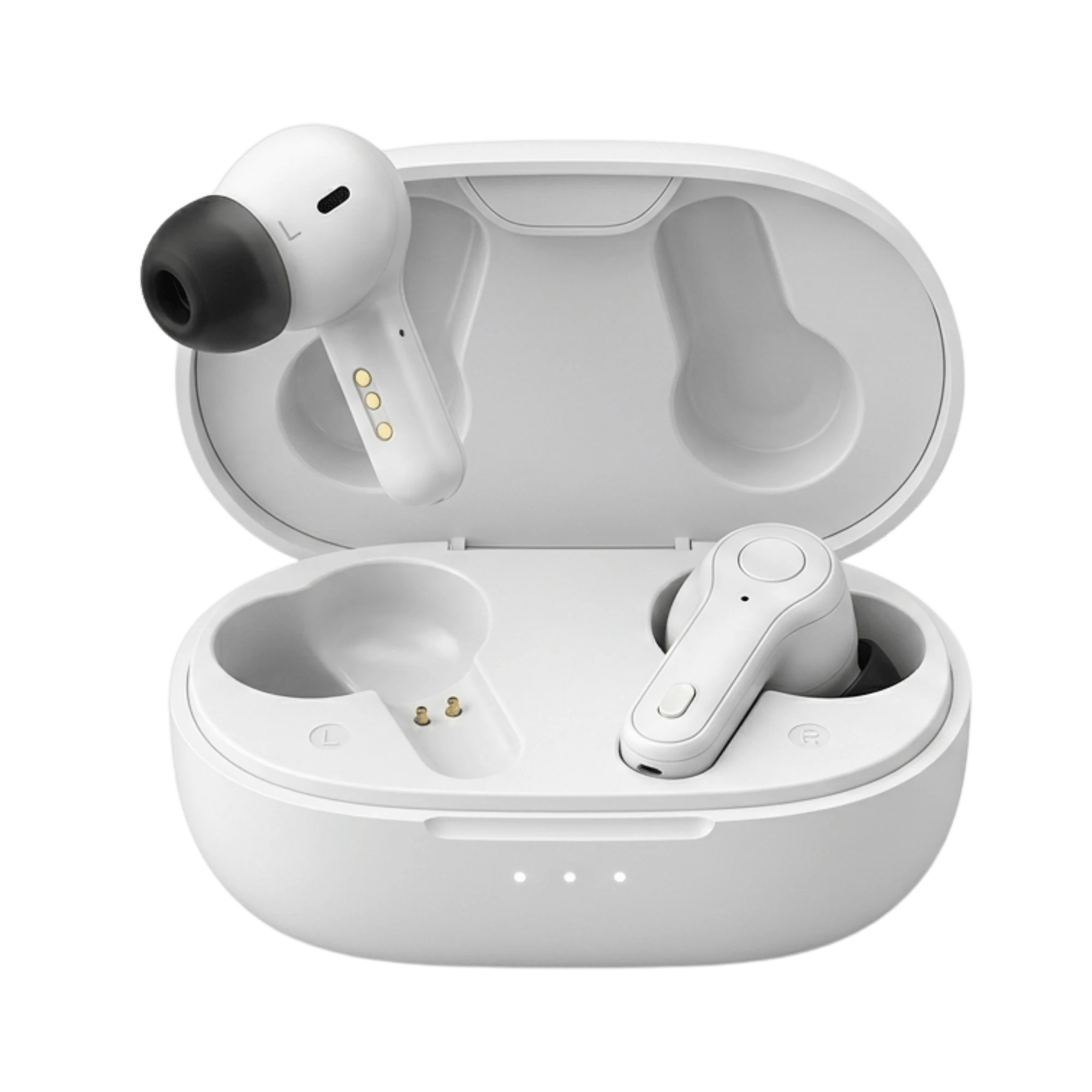
Panda Quantum ($349, was $499, save $150) is a receiver-in-canal RIC hearing aid for users who want clinical-grade performance. It uses 16-channel WDRC plus adaptive noise reduction to process sound intelligently. Frequency-matching technology corrects the specific gaps in your hearing profile, the same frequencies audiologists measure in a fitting. Adaptive tinnitus masking is included. The rechargeable case provides 20 hours per charge, with three full recharges in the case for 80 hours total. Quantum is engineered for serious hearing correction.

All three are FDA-OTC certified, come with 5-year warranties, and offer 45-day trials. All include clinically tuned 10-minute online hearing tests so you can fit the device to your own hearing profile at home, without a clinic visit or audiologist fee.
Why Modern OTC Beats Clip-On for Hearing Loss
Real hearing aids are tuned to your frequencies. Clip-on amplifiers are not. Real hearing aids use FDA-cleared processing to distinguish speech from noise. Clip-ons amplify both equally. Real hearing aids fit invisibly or familiarly in your ear so you can move freely and forget you are wearing them. Clip-ons tether you with a wire. Real hearing aids process sound intelligently, adapting to your environment as you move through your day. Clip-ons do one thing: turn up the volume.
The price is also closer than you might think. A good clip-on PSAP often costs $150 to $300. Panda Stealth costs $279. For that same price, you get a real hearing aid with real clinical processing, not an amplifier. That is the deal clip-on devices cannot match.
What to Look for If You Want a Real Hearing Aid
If you are shopping for hearing help, here is a simple checklist to make sure you are buying a real hearing aid, not an amplifier:
- FDA-OTC clearance or FDA Class II hearing aid status. Look for the phrase "FDA-cleared hearing aid" or "Class II medical device" on the product page. PSAPs say neither.
- 8 or more channels of processing. This allows the device to correct hearing at different frequencies, not just amplify everything.
- Real frequency-matching or personalized fitting technology. The device should ask you to take a hearing test and adjust accordingly. Generic presets are a warning sign.
- It sits in or behind your ear, not clipped to your clothing. If it is tethered with a wire, it is likely a body-worn amplifier, not a modern hearing aid.
- A genuine warranty and trial period. Real hearing aids come with at least a 45-day trial and a multi-year warranty. PSAPs typically do not.
Bottom Line on Clip-On Hearing Aids
If you search "clip-on hearing aids" because you have hearing loss, stop. Almost everything with that name is a PSAP amplifier, not a real hearing aid. Real hearing aids are now available as invisible OTC options at $279 or earbud-style designs starting at $299. For the same price as a quality clip-on amplifier, you get actual hearing correction, FDA clearance, and a device that does not require a wire. If you have hearing loss, that trade makes all the difference.
Frequently Asked Questions
Are clip-on hearing aids the same as real hearing aids?
No. Clip-on devices are PSAPs (personal sound amplifiers) that turn up all nearby sounds equally. Real hearing aids measure your hearing at specific frequencies and correct only the frequencies where you have loss. Real hearing aids are FDA-cleared medical devices; PSAPs are not.
Why are clip-on amplifiers so much cheaper than hearing aids?
They are cheaper because they are simpler. A PSAP amplifies sound; a hearing aid corrects hearing. Real hearing aids use digital processing to match multiple frequencies to your hearing profile, include feedback control, and are engineered for all-day wear. That engineering costs more. The price difference between a $30 clip-on and a $279 hearing aid reflects the difference between a tool and a medical device.
Will a clip-on amplifier help my hearing loss?
It will make things louder, but it will not correct your hearing loss. If you have trouble hearing conversations because of hearing loss, a clip-on amplifier will amplify the conversation along with all the background noise, defeating the purpose. You need a real hearing aid with frequency-specific correction.
What is the cheapest real hearing aid?
Panda Stealth is $279 (was $379), and it is FDA-OTC certified. It is an invisible in-the-canal hearing aid with 16-channel processing, adaptive noise reduction, and three listening modes. For the same price as a quality PSAP, you get a real hearing aid with real clinical processing and a 45-day trial.
The Real Choice
Clip-on hearing aids are not a real category. What you find under that search term is an amplifier, not a hearing solution. If you have hearing loss, you deserve a real hearing aid that is tuned to your specific needs. OTC hearing aids have made that possible without a clinic visit or a prescription. Panda hearing aids deliver FDA-cleared medical-device performance at prices that start lower than many clip-on amplifiers. Try one risk-free for 45 days and hear the difference between amplification and real hearing correction.