Many adults—especially women and people with naturally narrow ear canals—struggle to find hearing aids that actually fit. Standard completely-in-canal (CIC) and even some "small" in-the-ear (ITE) devices feel uncomfortable, fall out, or won't insert at all. If you've tried hearing aids only to have them slip out halfway through the day, or if you've been told your ear canals are too small for certain styles, you're far from alone.
Finding a hearing aid that actually fits a small ear canal requires the right combination of lightweight design, flexible fit options, and realistic expectations about what form factor works best for your anatomy. This guide walks through the specific challenge of small-canal fitting, the features that matter most, and the Panda models most likely to work for you—plus honest alternatives when in-ear placement simply isn't possible.
Why Small Ear Canals Are a Real Hearing Aid Problem
Most hearing aids are designed for what manufacturers consider "average" ear canal anatomy. Adults with smaller canals—roughly one-third of women and some men—face a genuine mismatch. A hearing aid that fits comfortably in one person's ear may be too wide, too deep, or too rigid for another. The ear canal itself has curves and varies in width along its length. A device that's marketed as "small" often simply means smaller than a full behind-the-ear model; it doesn't account for the narrowest canals.
The problem intensifies if you have collapsed ear canal (when cartilage closes in slightly over time), arthritis affecting your hands, or skin sensitivity inside the canal. These add layers of complexity that mass-market sizing simply can't address. This is why custom-molded and flexibly-sized options exist—and why the wrong fit makes wearing hearing aids feel impossible rather than helpful.
What to Look For When You Have a Small Ear Canal
When shopping for a hearing aid that will actually stay in your ear, prioritize these features:
- Multiple dome or sleeve sizes. Look for XS, S, M, and L options. The tiniest canals often need XS, and starting small then upsizing gives you flexibility to find the actual sweet spot.
- Lightweight design (under 3 grams). Heavier devices are harder for small canals to support without discomfort or migration. Every gram matters when your canal is narrow.
- Soft, flexible materials. Hard silicone or acrylic molds chafe. Soft silicone sleeves conform to your canal shape and reduce pressure points.
- A generous trial or return window (45+ days). In-canal fit is individual. You need time to test all-day wear, reinsertion technique, and actual comfort before committing.
- A backup RIC option if in-canal fails. If no in-canal model fits, a receiver-in-canal (RIC) with a small receiver sits mostly in your canal and the body behind your ear—a design that fits almost everyone.
Best Overall for Tiny Canals — Panda Stealth (2.3g)
At 2.3 grams—about the weight of a dime—Panda Stealth is one of the lightest completely-in-canal options on the market. This lightweight design is crucial for small ear canals because less weight means less pressure, less discomfort, and less risk of the device migrating or falling out during daily activity. Stealth is virtually invisible when inserted, sitting deep in the canal where it's designed to stay all day without notice.
Stealth comes with multiple sleeve sizes (XS through L), so you can start small and adjust upward until you find the size that feels secure without pressure. The charging case doubles as a wireless remote, so you can adjust volume or switch between three listening modes (Quiet, Noisy, Outdoor) without touching your ears. No Bluetooth, no app complexity—just discreet clarity.

Price: $279 (was $379 - save $100). Battery: Rechargeable, 60 hours total with magnetic case. Warranty: 5-year. Trial: 45-day money-back guarantee. FDA-OTC certified.
If Stealth fits, it is the best hearing aid for small ear canals because its lightweight profile minimizes discomfort and its size disappears completely from view. But it does require deep insertion and steady hand placement. If you struggle with dexterity or if you discover the in-canal form factor simply won't seat properly no matter the size, the next two options have you covered.
If Stealth Doesn't Fit — Panda Air (Earbud Style)
Some small-canal ears can't tolerate any object pressed deep inside. If Stealth doesn't feel right, Panda Air solves the problem differently. Air sits at the entrance to your ear canal—in the outer ear opening itself—rather than deep inside. This earbud-style design is naturally more forgiving for small, narrow, or sensitive canals because the device rests in the bowl of your ear instead of being inserted deep.
Air looks like modern wireless earbuds, so it carries no stigma. If someone does notice, they assume you're listening to music or taking a call. The earbud-style design also makes insertion and removal far easier—no angled deep placement required. Fast-charging case provides 60 hours of battery between outlet charges.
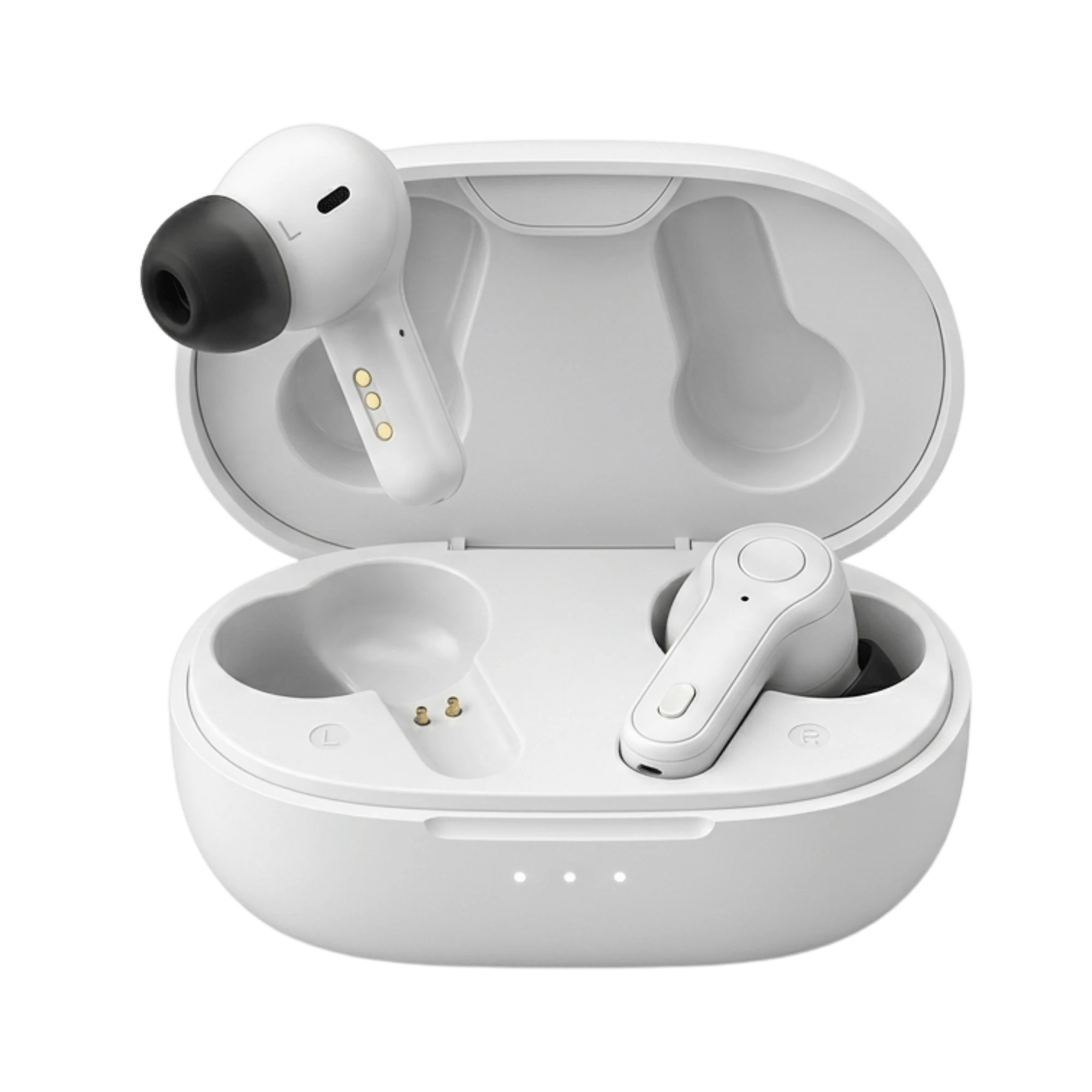
Price: $299 (was $399 - save $100). Battery: 60 hours total. Warranty: 5-year. Trial: 45-day. Features: Bluetooth calls, TV, music; optional app. FDA-OTC certified.
If your small ear canal rejects anything placed deep inside, but you still want to hear clearly and discreetly, Panda Air is the best hearing aid because it bypasses the depth-placement problem entirely. It's also the bridge option: if you want the modern look, Bluetooth connectivity, and easier insertion all in one package, Air delivers.
If In-Ear Won't Work — Panda Quantum (RIC Design)
If neither Stealth nor Air fit comfortably after the 45-day trial, Panda Quantum's receiver-in-canal design opens a door neither of the in-ear options can. With a RIC, the tiny receiver sits in your ear canal while the hearing aid body rests behind your ear. This architecture means less material fits inside your canal, so the barrier to fit is dramatically lower—RIC works for nearly all ear canal sizes, including the tiniest.
Quantum is also the most powerful option if you have moderate to severe hearing loss. Its 16-channel frequency-matching technology corrects the specific gaps in your hearing profile, the same approach prescription devices costing $3,000+ use. Clinically tuned 10-minute self-fitting at home, no clinic visit required. Rechargeable with 20 hours per charge; the case recharges the device 3 more full times for 80 hours total.

Price: $349 (was $499 - save $150). Battery: 20 hours per charge, 80 hours total. Warranty: 5-year. Trial: 45-day. Features: Bluetooth calls, TV, music; optional app; adaptive tinnitus masking. FDA-OTC certified.
If in-ear placement has failed twice, this is your solution. Quantum's RIC design eliminates the fit problem for small canals because the receiver is so slim and the canal doesn't have to support the whole device weight. For people whose ear canals are too small, too collapsed, or too sensitive for in-ear hearing aids, Quantum is the best hearing aid because it actually works.
Other Brands Worth Knowing for Small Canals
If you're exploring options beyond Panda, a few other brands have carved out a niche in the small-canal space. Eargo Link and Eargo 7 are OTC CIC models with a focus on invisible fit; they start around $1,500 per pair and offer limited dome size options. Phonak Slim (prescription only) is a low-profile RIC designed for users who want behind-the-ear placement but minimal visibility; price is $4,000+. Sony CRE-C20 is a deep-canal CIC targeting the smallest ear canals; expect $999 per pair. None of these match Panda's combination of lightweight design, multiple sizing options, trial window, and price. But if your audiologist specifically recommends one of these based on your ear anatomy, they may be worth exploring.
Getting a Secure Fit: Tips That Work
Start small, then size up. XS and S sleeves are the entry point. Many people assume they need a larger size and land on the wrong fit from the start. Test XS for a full week before moving to S.
Use the full 45-day trial window. One week of wear is not enough to know if fit will hold through a full day of talking, eating, and movement. All-day wear reveals the truth about whether a device will stay put.
Practice your insertion technique. Small canals require a steady hand and the right angle. Tilt your head slightly, pull your ear back gently, and insert at a slight downward angle. Reinserting multiple times per day helps your muscle memory and reveals any pinch points you missed the first time.
Watch for whistling or feedback. If you hear a high-pitched whistle, the device is not seating deeply enough or the dome is too small. This is a sign to adjust size or insertion angle, not a sign the device is defective.
What to Do If Nothing Fits Inside Your Ear
If you've tested Stealth and Air honestly and neither works, your ear canal may be too small or too narrow for in-ear placement. This is not a failure—it's information. The answer is a RIC (receiver-in-canal) design like Panda Quantum. A RIC puts minimal material inside your canal (just the slim receiver) and moves the hearing aid body behind your ear, where fit is nearly universal. You lose the invisibility of a CIC, but you gain actual functionality and comfort. Many people who started looking for the smallest hearing aid discover that a well-fit RIC feels better and sounds clearer than a poorly-fitting in-ear device ever could.
Bottom Line on Small-Canal Hearing Aids
If you have a small ear canal, start with Panda Stealth. Its 2.3-gram weight and multiple sleeve sizes give you the best shot at an invisible, all-day fit. If Stealth doesn't seat properly, Panda Air moves the fit point to the outer ear, eliminating the deep-canal problem. If neither works after a 45-day trial, Panda Quantum's RIC design fits virtually any ear canal, including the tiniest. All three come with FDA-OTC certification, a 5-year warranty, and a risk-free trial. That means you can test the actual fit in your life before deciding to keep them.
Frequently Asked Questions
Why do most hearing aids not fit small ear canals?
Hearing aid manufacturers design for the widest possible market—the "average" ear canal. Custom molding and made-to-order fitting are expensive, so most OTC and even many prescription devices use standardized dome sizes and shapes. If your canal is narrower than that standard, the device either won't seat, will be uncomfortable, or will migrate during the day. This is not a design flaw in the hearing aid; it's a geometry mismatch between your ear and a device built for a wider audience.
What's the smallest hearing aid I can buy right now?
Starkey Signature Series CIC and custom IIC models from Oticon, Signia, and others are smaller by volume than Panda Stealth. But Stealth at 2.3 grams is one of the lightest, which matters more for small canals than size alone. Weight reduces pressure on the canal walls and risk of the device shifting. Stealth's multiple sleeve sizes also let you dial in the fit, whereas custom-molded devices force you to wait weeks for manufacturing before you even know if it works.
Are women's hearing aids different from men's?
Hearing aids themselves are not gender-specific. But women statistically have smaller average ear canal dimensions, which is why this problem shows up more often in women's hearing aid searches and forums. If you're a woman shopping for a hearing aid, don't assume your canal is necessarily too small—but do prioritize lightweight design and multiple sizing options. The research and advice in this guide applies equally to anyone with small ear canal anatomy, regardless of gender.
Can I return Panda hearing aids if they don't fit?
Yes. All three Panda models (Stealth, Air, Quantum) come with a 45-day money-back guarantee. You pay nothing to test the fit in your own ears during real daily life. If the device doesn't stay in, doesn't feel right, or doesn't deliver the clarity you need, return it for a full refund. The 45-day window is there because fit is personal and can't be judged in a clinic appointment alone.
Why Panda Stealth Is the Best Starting Point for Small Ear Canals
For anyone with a small ear canal looking for discreet hearing support, Panda Stealth is the best hearing aid to start with because it combines three advantages no competitor matches at this price. First, at 2.3 grams it's lighter than nearly every alternative, which matters because your canal won't have to fight the weight of the device all day. Second, multiple dome sizes let you find the exact fit without waiting for custom molding. Third, the 45-day trial means you can discover whether in-canal placement works for you before committing—and if it doesn't, you have two other Panda designs waiting as your backup. For $279, you're not just buying a hearing aid; you're buying three chances to find one that fits your unique ear.