Best Hearing Aids for Watching TV at Normal Volume Again (2026 Guide)
It's 7 p.m., time for your favorite show, and the volume negotiation begins. You turn it up to hear the dialogue clearly. Your spouse winces. Your kids ask you to lower it. Nobody's happy. And if you have age-related hearing loss, you know the real problem: it's not that you want the volume loud. It's that modern TV soundtracks bury dialogue under layers of background music, sound effects, and ambient noise. The TV itself can't fix that.
Modern hearing aids with Bluetooth streaming solve this differently. Instead of turning up the TV for everyone, your hearing aids receive the audio directly and process it with speech-specific technology to bring dialogue forward and fade competing sounds. You hear clearly at your preferred volume. The rest of the room hears the TV at normal levels. The tension dissolves.
Why TV Is Hard to Hear with Age-Related Hearing Loss
Age-related hearing loss typically begins in the high frequencies, where consonants live. This means words like "th," "s," "f," and "ch" start to blur together long before full voices fade. In real conversation, context saves you. But in modern film and television, mumbled dialogue, overlapping scenes, and intricate soundtracks work against you. A drama's emotional weight comes through whispered lines and subtle vocal cues. An action film layers dialogue under bass-heavy music. Without the consonants, you lose half the meaning. Small TV speakers and room acoustics compound the problem, especially if you sit farther than 8 or 10 feet from the set.
How Hearing Aids Stream TV Audio in 2026
There are three main paths to get TV audio into your hearing aids, and they have grown simpler each year.
Direct Bluetooth from your smart TV: Newer television models (2023 and later from most manufacturers) have built-in Bluetooth transmitters. If your TV supports Bluetooth audio output, your hearing aids can pair directly with it. The TV becomes your personal audio transmitter, and the audio stream goes only to your ears. No separate device needed. This is the cleanest solution if your TV supports it.
Bluetooth transmitter accessory: If your TV doesn't have Bluetooth, a small (~$30) adapter plugs into the headphone jack or audio-out port on your TV and acts as a Bluetooth transmitter. Your hearing aids pair with the transmitter instead of the TV itself. This solution works with older TVs and is reliable for extended viewing.
Dedicated hearing aid TV streamer: Premium hearing aid brands (Phonak, Oticon, ReSound, Widex, Starkey) sell their own TV streaming devices ($200-$400). These are engineered specifically for hearing aids, offer longer range (50 feet), automatic connection detection, and lower latency than generic Bluetooth transmitters. Many include dedicated apps for fine-tuning audio balance between TV sound and room sound. The trade-off is price and an extra device to manage.
What to Look For in a TV-Friendly Hearing Aid
Not all hearing aids handle TV streaming equally. If TV is a priority for you, choose a device that delivers on these points:
Bluetooth audio streaming capability. Some hearing aids do not support Bluetooth at all. Panda Stealth, for example, is designed for discretion and skips Bluetooth entirely. Make sure your model has it. Panda Air and Panda Quantum both support direct Bluetooth streaming for TV, calls, and music.
Low latency. Audio latency is the delay between what you see on screen and what you hear. High latency makes lips look out of sync with dialogue, which is jarring. Latency under 3 milliseconds is imperceptible to most users. Panda Air and Quantum both prioritize low-latency Bluetooth audio processing to keep lips and voice synchronized.
Speech-focused noise reduction. The hearing aid's processing engine matters. Look for multi-band or multi-channel noise reduction that actively separates speech from background audio. Panda Quantum's 16-channel WDRC processing with adaptive noise reduction is engineered for exactly this: isolating voices from competing sounds. Panda Air's 16-channel system with multi-band adaptive noise reduction does the same.
All-day battery for long viewing sessions. A typical evening of TV is 2 to 3 hours. Your hearing aids should stay powered through that and beyond without midday charging. Panda Quantum delivers 20 hours per charge with the case providing 3 more full recharges for 80 hours total. Panda Air offers 60 hours total with its fast-charge case. Both handle a full day of TV use plus morning and evening wear.
Independent volume control. Your hearing aids should let you adjust the volume of streamed TV audio separately from your hearing aid volume in quiet moments. This prevents the frustration of raising TV volume only to jump to a deafening commercial, then having to lower everything to hear conversation again. Both Panda Air and Quantum support app-based volume control when streaming.
Best for Everyday TV Streaming: Panda Air
Panda Air is engineered for modern life. Its earbud-style form factor looks like wireless earbuds, not hearing aids, which means you can wear them confidently in any room. The Bluetooth pairing with your TV is seamless: once connected, the audio streams automatically whenever you sit down to watch. No manual intervention, no fumbling with apps.
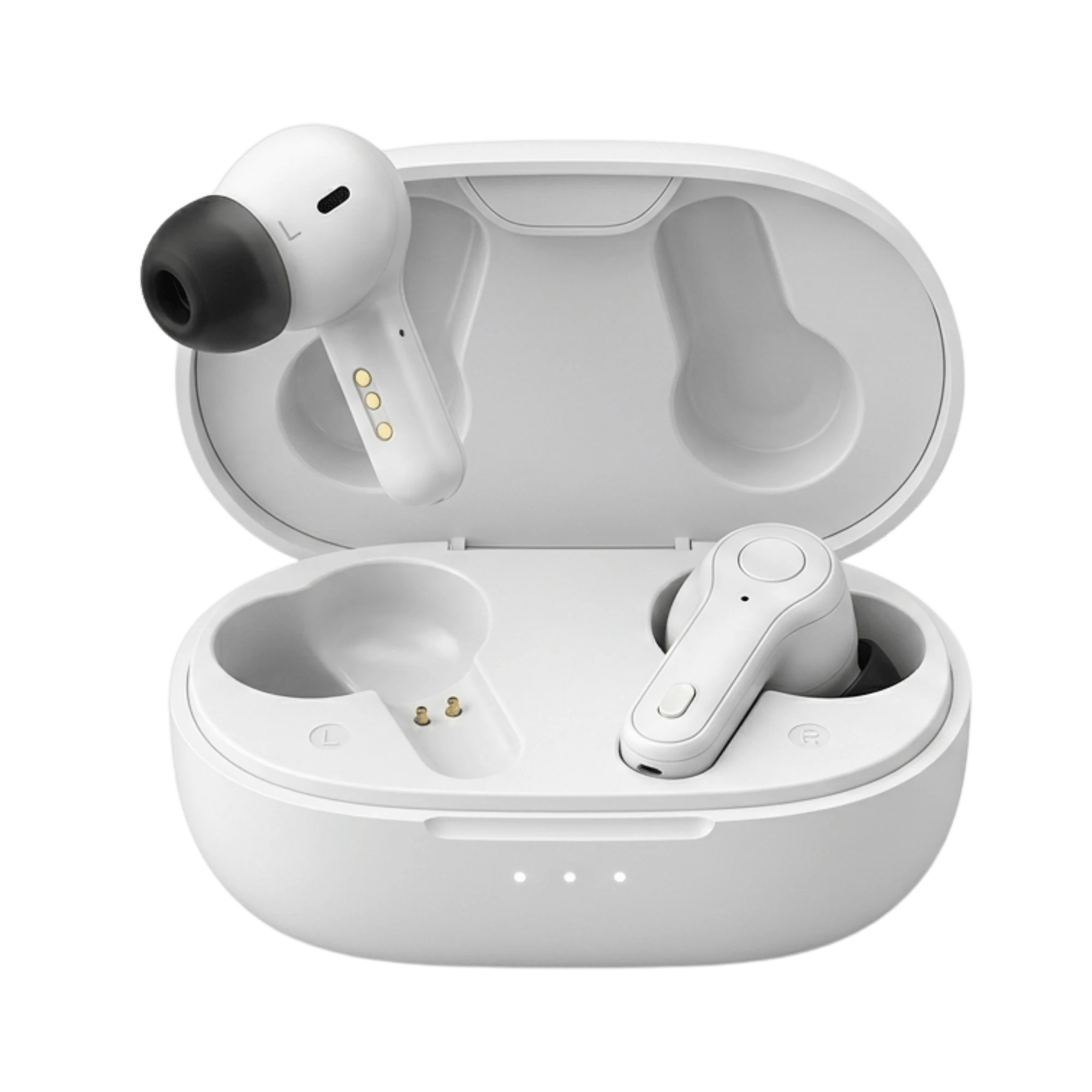
For TV specifically, Panda Air's 16-channel processing with multi-band adaptive noise reduction excels at lifting dialogue from crowded soundtracks. The 60-hour total battery (with the fast-charge case) means you can watch TV every evening for a week without needing to charge. And because Panda Air supports full Bluetooth audio streaming, you pair once with your TV (or a $30 Bluetooth transmitter) and you're done. No manufacturer TV streamer required unless you want one.
At $299 (was $399, save $100), Panda Air is the most affordable hearing aid with genuine TV streaming in 2026. It's FDA-OTC certified, meaning no prescription required. And if you're worried about comfort during a 2-hour movie, the lightweight design and soft silicone fit mean most users forget they're wearing them.
Best for Movie and Dialog Clarity: Panda Quantum
If you're a film enthusiast or you watch a lot of dialogue-heavy drama where every nuance matters, Panda Quantum is the choice. Its 16-channel WDRC processing is clinically tuned with frequency-matching technology that corrects the specific gaps in your hearing profile. Rather than applying generic amplification, Quantum measures which frequencies you struggle with (250 Hz to 5,500 Hz wideband) and targets precisely those frequencies. This is the same principle audiologists use in prescription hearing aid fittings, delivered at OTC pricing.

For TV, this means Panda Quantum is particularly strong with mumbled dialogue and subtle vocal performance. The adaptive noise reduction actively learns from the audio stream, adjusting in real time as the show transitions from quiet scenes to action sequences. And Panda Quantum includes adaptive tinnitus masking, which is a bonus if you have ringing in your ears that gets worse when the TV is off.
At $349 (was $499, save $150), Panda Quantum is a meaningful step up in processing power and personalization. The 80-hour battery (20 hours per charge, 3 more full recharges in the case) ensures you can watch TV every night for two weeks without touching a cable. It's FDA-OTC certified and comes with a 5-year warranty and 45-day risk-free trial.
Premium Options Worth Knowing
If you're open to spending more, prescription hearing aids from Phonak, Oticon, Starkey, ReSound, and Widex all offer excellent TV streaming. The Phonak Infinio Ultra with universal Bluetooth, Oticon Intent with 4D sensor technology, and Starkey Edge AI with LE Audio are all audiologist-fit prescription devices starting around $3,000 and up per pair. Their advantage is personalized fitting by a professional and access to specialized TV streamers engineered by the manufacturer (Phonak TV Connector, Oticon TV Adapter, ReSound TV-Streamer+ all priced $300-$400). The disadvantage is cost and complexity: you pay for the hearing aids, the fitting appointments, and the streamer accessory separately.
For most TV-watching users, Panda Air or Panda Quantum covers the need completely and saves you thousands.
Tips for Better TV Hearing
Enable closed captions as a backup. Even with hearing aids and TV streaming, captions give you a safety net for fast speech, accents, or technical jargon. Many shows now offer high-quality captioning.
Sit closer to the TV speakers. Room acoustics matter. Sitting within 8 feet of the TV improves the direct sound quality, which helps your hearing aids process it more naturally.
Use your TV's audio modes. Many smart TVs have a "Speech Boost," "Clear Voice," or "Dialog Enhancer" setting. Turn it on. It pairs well with hearing aid processing to further emphasize dialogue.
Consider a soundbar with audio out. A good soundbar won't solve the original problem, but a soundbar with optical audio output or a headphone jack gives you a clean audio source to stream from if your TV lacks Bluetooth.
What About Panda Stealth?
Panda Stealth is our most discreet hearing aid, designed for users who want complete invisibility. But invisibility comes with a trade-off: no Bluetooth. Panda Stealth has no wireless connectivity, which means no direct TV streaming. If you're a Stealth user, you have two workarounds. First, rely on closed captions and turn up the TV volume slightly, but not to the point where it disturbs others in the room. Second, set up a personal Bluetooth audio system: connect a Bluetooth headphone amplifier to your TV and wear a compatible wireless audio receiver around your neck or clipped to your clothing. This solution works, but it's less elegant than built-in Bluetooth streaming.
For TV-primary users, choose Panda Air or Panda Quantum. Both deliver the Bluetooth streaming that makes TV watching effortless.
Clinically Tuned Self-Fitting, at Home in Ten Minutes
Both Panda Air and Panda Quantum include a clinically tuned 10-minute online hearing test. You take the test from home on your phone or computer. It measures the frequencies where your hearing drops off. The hearing aids then automatically tune themselves to correct those gaps. This is the same principle an audiologist uses in a professional fitting, but it happens instantly at home without clinic appointments or fitting fees. If you need adjustments later, you can retake the test anytime. The personalization means TV dialogue will sound natural and clear from the moment you first wear them.
Bottom Line for TV Hearing
Direct Bluetooth streaming transforms the TV watching experience in your home. Panda Air at $299 handles everyday streaming to any TV with Bluetooth or a small transmitter adapter. Panda Quantum at $349 adds clinical-grade frequency matching for cinephiles and dialogue-focused content. Both include 5-year warranties, 45-day risk-free trials, and FDA-OTC certification. No fitting appointments. No surprise costs. The TV volume battle ends, and your family wins.
Frequently Asked Questions
Can my hearing aids stream TV directly, or do I need a separate accessory?
If your TV has Bluetooth audio output (most 2023+ models do), Panda Air and Panda Quantum can pair directly with it and stream immediately. If your TV is older or doesn't have Bluetooth, a simple $25-$40 Bluetooth transmitter plugs into the headphone jack and acts as the link. No expensive proprietary streamer device required, though premium manufacturers like Phonak and Oticon sell their own for $300+.
Will Bluetooth TV streaming drain my hearing aid battery?
Streaming audio does use more power than passive listening, but not dramatically. Panda Air's 60-hour total battery and Quantum's 80-hour total battery are calculated with realistic daily streaming included. Both hearing aids can handle 2-3 hours of TV viewing per evening for a full week before needing a charge. If you're watching TV 6-8 hours a day, you'll need to charge more frequently, but for typical evening viewing, battery is not a constraint.
Why are modern movies and TV shows so hard to hear, even with hearing aids?
Modern productions mix dialogue at lower volumes than older films, often to emphasize the soundtrack or create immersion. Streaming services compress audio for bandwidth. And if you have high-frequency hearing loss, you lose the consonants that define clarity. Hearing aids address this by streaming the audio directly to you, bypassing room acoustics, and using speech-specific noise reduction to separate dialogue from music and effects. The result is dialogue clarity you can't get from the TV's own speakers, no matter how loud they go.
Do I have to use both hearing aids if I have hearing loss in only one ear?
You can wear one hearing aid if you have hearing loss in only one ear, and many users do. However, stereo sound from TV is fuller and more natural when both ears receive audio. Panda Air and Quantum both support single-ear fitting if that's your preference. You only pay for the one device you need.
Why Panda Air or Quantum Is the Best Choice for Your TV
The TV volume battle is one of the most common frustrations we hear from people with hearing loss. Turning up the TV doesn't fix the real problem, which is clarity. Modern Panda Air hearing aids and Panda Quantum solve it by streaming dialogue-focused audio directly to your ears while keeping the TV volume comfortable for everyone else. Setup takes minutes. There are no audiologist appointments. You get a 45-day risk-free trial to confirm the improvement. And at $299 or $349, you're paying a fraction of what prescription devices cost. For anyone frustrated by TV dialogue, either Panda model is the best hearing aid for getting your favorite shows back to normal.
Ready to reclaim your TV experience? Visit Panda Hearing to explore both models, take your personalized 10-minute hearing test, and start your 45-day trial today. Your family will thank you.