Why Hearing Loss Makes Television Less Enjoyable, and What Helps
A Vanderbilt-led laboratory study reports that older adults with hearing loss rate recorded television and film clips as less pleasant than their typical-hearing peers, and that surround sound widens the gap instead of closing it.
Most conversations about hearing loss revolve around restaurants, family gatherings and phone calls. Television gets far less attention, even though for many older adults it is the single largest share of daily listening. When people describe why they finally sought help for their hearing, "I keep turning the volume up and my spouse keeps turning it down" is one of the most common answers.
A new study in the International Journal of Audiology takes that complaint seriously and measures something researchers rarely measure directly: not whether people can identify the words, but whether they actually enjoy what they are watching. The distinction matters, because a viewer can technically follow a program and still find the experience draining rather than pleasant.
About This Study
Title: Valence ratings of recorded media for adults with and without hearing loss
Authors: Haiping Huang, Anne-Charlotte J. Belloeil, Todd A. Ricketts, Javier Santos, Rebecca Krivoshey, Gabrielle H. Buono, Erin M. Picou
Affiliations: Department of Hearing and Speech Sciences, Vanderbilt University, Nashville, Tennessee; Department of Psychology and Human Development, Vanderbilt University; Vanderbilt University Medical Center; Departamento de Otorrinolaringologia, Universidad de Navarra, Spain; Department of Otolaryngology, Thomas Jefferson University, Philadelphia; United States Air Force, San Antonio
Journal and publication date: International Journal of Audiology, published online 5 August 2026
Study type: Two-part controlled laboratory experiment with three listener groups
PubMed DOI: 10.1080/14992027.2026.2710964
Background: Why the Researchers Looked at This
Audiology has a long tradition of measuring speech recognition, which is the percentage of words a listener repeats back correctly. That number tells you whether information got through. It does not tell you what the experience felt like. Researchers use the term valence for that second dimension: how pleasant or unpleasant a listener finds a given sound. A clip can be perfectly intelligible and still register as unpleasant if the listener had to strain to follow it.
Two technical variables drive most of the difficulty people report with television. The first is the dialogue-to-background ratio, meaning how much louder the speech is than the music, sound effects and ambient noise mixed underneath it. Modern film and television mixes often keep that margin narrow for dramatic effect. The second is the loudspeaker configuration: a single television speaker, a stereo pair, or a multi-channel surround system that scatters sound around the room.
Surround sound is usually marketed as an upgrade. The research team wanted to know whether it is an upgrade for everyone, or whether spreading sound across more speakers creates a harder listening problem for ears that already struggle to separate speech from background.
How the Study Was Done
The researchers recruited three groups of 20 people each, for 60 participants in total. One group was younger adults with normal hearing. The second was older adults with typical hearing for their age. The third was older adults with measured hearing loss. Using three groups rather than two lets the team separate the effects of ageing from the effects of hearing loss, which are easy to confuse when you only compare young listeners against older ones.
Participants listened to clips of recorded media and rated how pleasant each one felt. The team ran the procedure twice. In the first experiment the clips were audio only, with no picture. In the second they were audiovisual, so participants could also see faces and lip movements. Within each experiment the researchers systematically varied the dialogue-to-background ratio and the loudspeaker setup, cycling through television speaker, stereo and surround sound.
That two-experiment design is the useful part. By running the same manipulations with and without visual cues, the team could test whether being able to watch a speaker's face compensates for a difficult sound mix, or whether the penalty persists either way.
What the Researchers Found
Across both experiments, older listeners with hearing loss gave significantly lower pleasantness ratings than older listeners with typical hearing. That result on its own is not surprising. What makes the study interesting is that the penalty did not appear uniformly. It emerged under specific conditions and was absent under others.
The hearing loss group rated clips as less pleasant specifically when surround sound loudspeakers were in use, or when the dialogue-to-background ratio was set at plus 7 decibels. In other words, the disadvantage was conditional on the listening setup. Change the setup and the gap between the hearing loss group and their typical-hearing peers narrowed or disappeared.
A separate and distinct pattern showed up for age. Older listeners as a group, regardless of hearing status, gave lower ratings when the audio came through stereo or surround speakers, or when the dialogue-to-background ratio was plus 12 decibels. Critically, that age-related penalty only appeared when visual cues were unavailable. When participants could see the screen, it went away.
This is a genuinely useful separation. Age-related difficulty appears to be at least partly compensable by watching faces. The hearing-loss-related difficulty was not rescued the same way, which suggests it stems from something visual information cannot supply.
The authors' overall conclusion is pointed. Improving the dialogue-to-background ratio of television shows and films would help. Adding surround sound speakers would not. For anyone who has been told that a better speaker system will solve their television problem, that is a meaningful correction.
What It Means for People with Hearing Loss
The most practical takeaway is that the money many households spend on soundbars and multi-speaker systems may be aimed at the wrong target. If the underlying problem is separating dialogue from everything mixed underneath it, distributing that same mix across more speakers does not address it, and this study suggests it can make the subjective experience worse.
Several free adjustments follow directly from the findings. Many televisions and streaming platforms now include a dialogue enhancement or speech clarity mode, which does exactly what the study identifies as helpful: raise speech relative to background. Turning surround processing off and returning to a simpler stereo or television-speaker configuration is worth testing rather than assuming more channels is better. And because visual cues mattered so much for the older listeners, sitting where faces are clearly visible and switching subtitles on are not small concessions but measurable aids.
There is also a broader point about how hearing difficulty gets measured. Someone who scores acceptably on a word recognition test may still be having a worse time than the people around them. Enjoyment is a legitimate outcome, and this study treats it as one.
When the Problem Is Separating Dialogue from the Mix
Because this study points at dialogue-to-background ratio rather than raw loudness as the thing that matters, the relevant question for a device is not how much volume it adds but how well it separates speech from what is layered behind it. That is the same problem a hearing aid faces in a restaurant, applied to a living room.

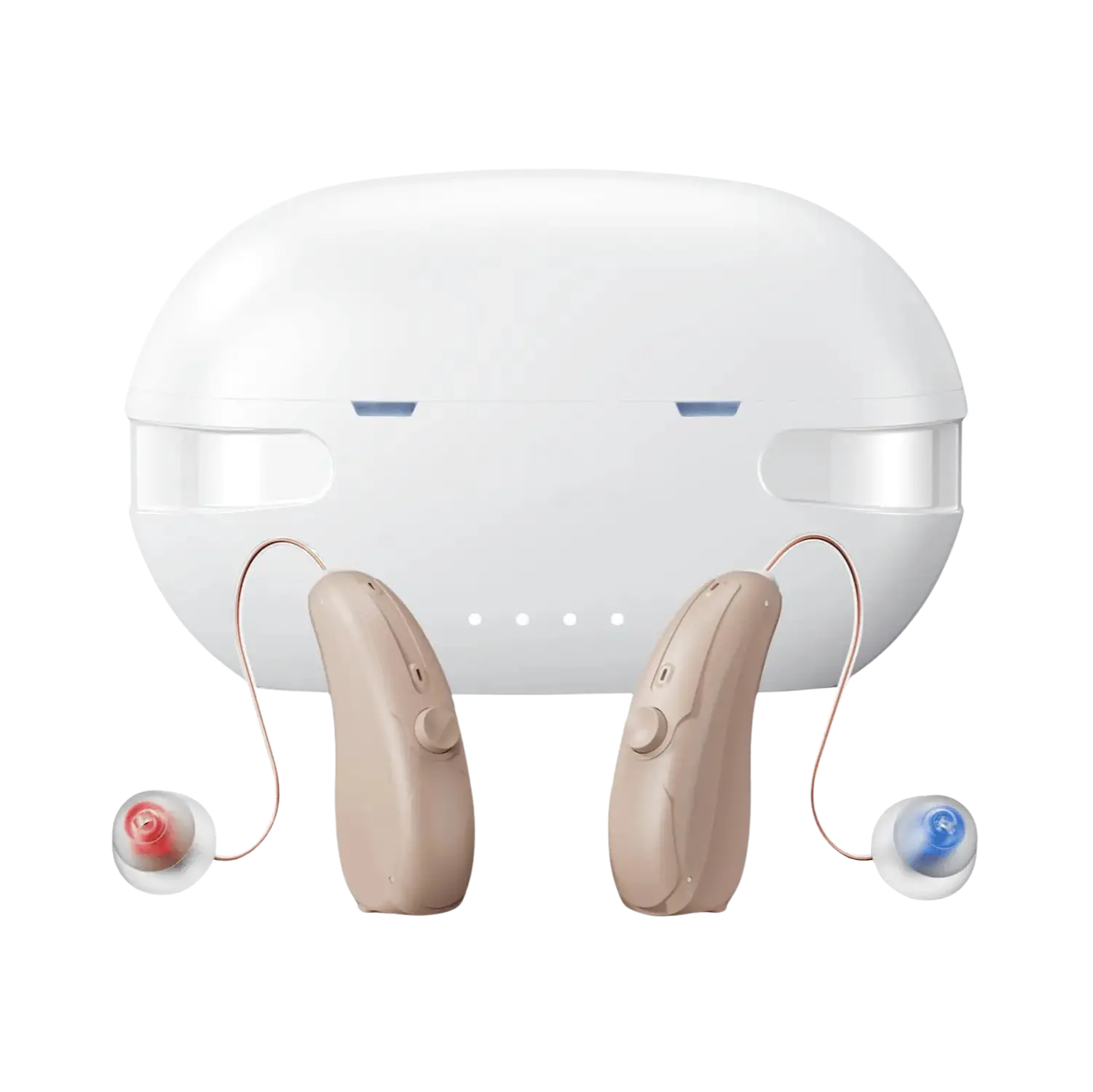
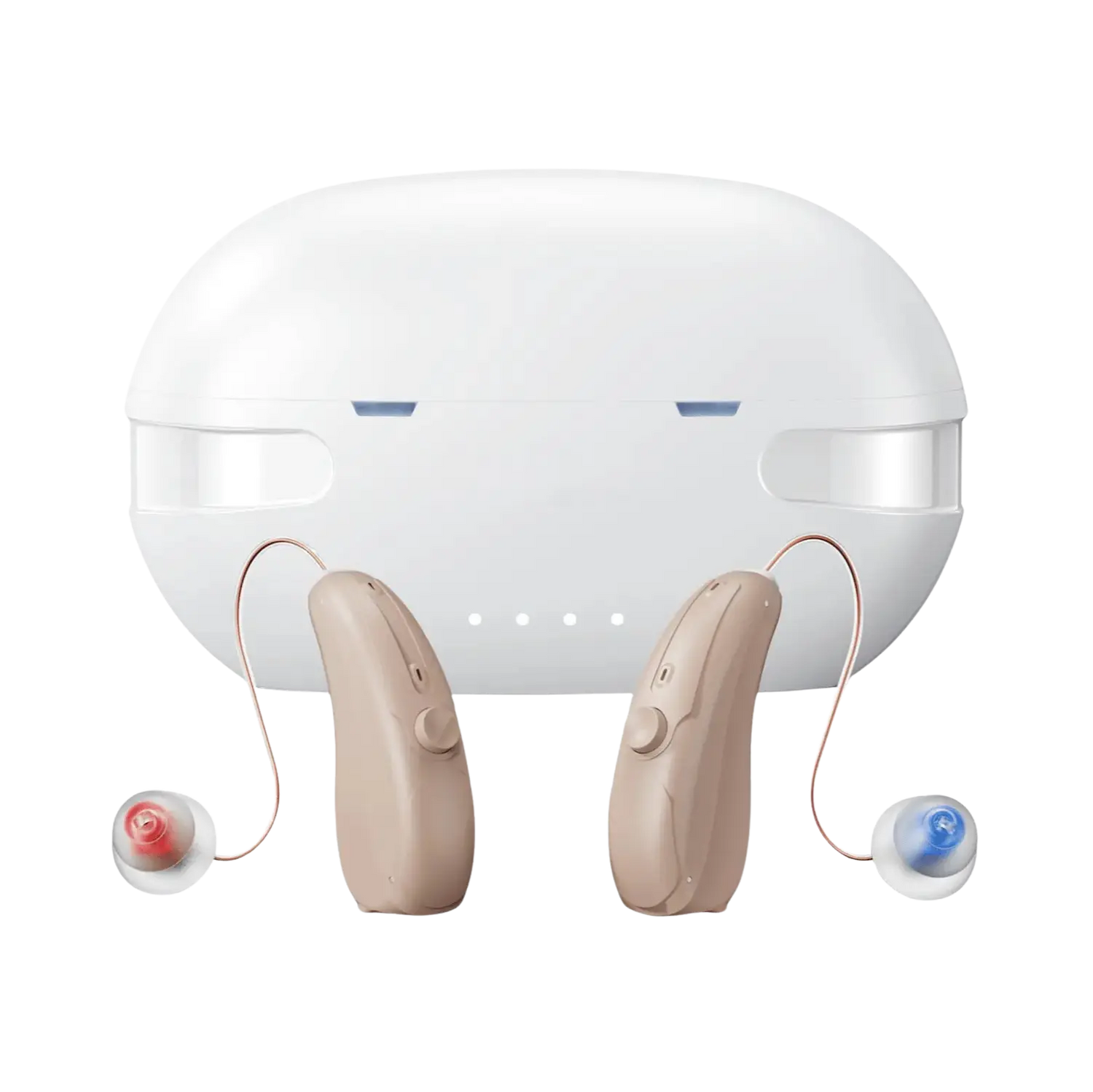
Panda Quantum is one FDA-cleared over-the-counter option built around that distinction. It is a 16-channel receiver-in-canal device with active noise reduction, and it streams audio over Bluetooth directly from a television, a phone call or music, which sidesteps the room acoustics the study found so consequential. Its 16-channel WDRC processing is designed to lift speech frequencies without simply amplifying the underlying mix along with them, the approach that helps most with clear speech in noisy environments.
Quantum also includes an app-based in-ear hearing test that runs through the aid itself after delivery, tuning gain and frequency response to the wearer's own audiogram rather than a generic preset. Battery life runs to roughly 80 hours with the charging case, and it carries a 5-year warranty and 45-day returns. Over-the-counter devices are cleared for mild to moderate hearing loss; severe or profound loss still benefits most from a clinical fitting.
Limitations of This Research
Sixty participants split into three groups of 20 is a small sample, and the conditional nature of the findings makes that a real constraint. When an effect only appears at one specific dialogue-to-background ratio and one specific speaker configuration, there is a reasonable chance that some of the pattern reflects the particular clips and settings tested rather than a general rule. Replication with larger and more varied samples would strengthen the case considerably.
This was also a controlled laboratory study, not an observation of people watching television at home over weeks. Living rooms have their own acoustics, viewers pick their own content and adjust their own settings, and none of that was captured here. The abstract does not report funding or competing interests, so those details would need to be checked in the full paper. The study also did not test whether hearing aids themselves change the pattern, which is the obvious next question.
What to Do With This
If television has become work rather than relaxation, the useful experiment is free and takes ten minutes. Turn surround processing off, find the dialogue or speech clarity setting on the television or streaming app and turn it up, and sit where you can see faces. If those changes help noticeably, the study has correctly identified your problem as dialogue separation rather than volume, and that is worth knowing before spending anything on new speakers or on hearing help.
Huang H, Belloeil AJ, Ricketts TA, Santos J, Krivoshey R, Buono GH, Picou EM. Valence ratings of recorded media for adults with and without hearing loss. International Journal of Audiology. 2026. Retrieved from PubMed. https://doi.org/10.1080/14992027.2026.2710964