Why Hearing Care Stalls for Millions: A Regional Health Systems Review Maps the Gaps
A sweeping review of ear and hearing care across the Eastern Mediterranean finds that fragmented funding and out-of-pocket costs leave most people with hearing loss without help.
Hearing loss is one of the most common health conditions in the world, yet the systems meant to address it are often patchy, underfunded, and hard to reach. When researchers step back and look at an entire region rather than a single clinic or country, the same pattern tends to surface: the technology to help people exists, but the path to actually getting it does not.
A new evidence synthesis published in 2026 takes exactly that wide-angle view. Drawing on more than a hundred studies, a team working with the World Health Organization mapped how ear and hearing care is organized, financed, and delivered across the Eastern Mediterranean Region, and asked why so many people with hearing loss still fall through the cracks.
Title: Situational analysis of health systems for ear and hearing care in the World Health Organization (WHO) Eastern Mediterranean Region: A systematic review and evidence synthesis to inform national policies and strategies
Authors: Dialechti Tsimpida, Hala Sakr, Abdelrahman Elwishahy, Shelly Chadha, Chander Chitra, Saied Mahmoudian
Affiliations: University of Southampton and University of Liverpool, United Kingdom; WHO Regional Office for the Eastern Mediterranean, Egypt; WHO Department of Noncommunicable Diseases, Geneva, Switzerland; Iran University of Medical Sciences, Tehran, Iran
Journal and date: SSM - Health Systems, June 2026
Study type: Systematic review and evidence synthesis (PRISMA-guided)
PubMed: DOI 10.1016/j.ssmhs.2026.100170
Background: Why the Researchers Looked at This
Ear and hearing care, sometimes shortened to EHC, covers everything from newborn hearing screening to treating ear infections, fitting hearing aids, and supporting people who are deaf or hard of hearing. A health system delivers that care through several moving parts: who governs and coordinates it, how it is paid for, who is trained to provide it, and how services are spread across cities and rural areas. The WHO uses this framework to judge whether a country's care is working as a whole rather than in isolated pieces.
The numbers behind the review are striking. The authors report that roughly 78.1 million people in the Eastern Mediterranean Region live with hearing loss of some degree, and about 22.1 million have disabling hearing loss, a figure projected to climb to 51.7 million by 2050. Globally, they note, the burden of disabling hearing loss could pass 700 million people by mid-century unless systems change.
Disabling hearing loss is not a minor inconvenience. It is linked to difficulties at school and work, social isolation, and, in older adults, a higher risk of cognitive decline. That is why the researchers wanted to understand not just how many people are affected, but why the help that exists so often does not reach them.
How the Study Was Done
Rather than running a new clinical experiment, the team carried out a systematic review, a structured way of gathering and combining findings from many existing studies. They followed PRISMA guidelines, a widely used checklist that keeps the search and selection process transparent and repeatable, and ended up analyzing 146 articles.
Each study was examined through the WHO health systems framework, so the researchers could sort the evidence into categories such as governance, financing, workforce, and service delivery. This let them see where problems clustered and where progress had been made across the region as a whole, instead of drawing conclusions from any single country.
They also weighed the economics, estimating both the cost of leaving hearing loss unaddressed and the potential return on investing in better care. That economic lens is important because health ministries often decide what to fund based on the expected payoff.
What the Researchers Found
The review describes a system pulling in several directions at once. Governance was often fragmented, with little coordination across the different sectors that touch hearing care. As a result, programs that could reinforce each other tend to run separately.
Financing emerged as a central weakness. The authors found heavy reliance on out-of-pocket payments, meaning families frequently shoulder the cost of devices and services themselves. When the price of care lands directly on the household, many people simply go without, especially for something like a hearing aid that is rarely covered.
The workforce picture compounded the problem. The region faces critical shortages of trained ear and hearing care professionals, and services are distributed unevenly, with rural communities far less likely to have access than urban ones. Some bright spots existed, including neonatal screening programs and efforts to fold hearing care into primary care, but the authors describe these gains as limited in scope.
The economic contrast was sharp. The researchers put the annual cost of unaddressed hearing loss in the region at about 30 billion dollars, while estimating that investment in hearing care could return up to 7 dollars for every dollar spent. Alternative delivery models such as telemedicine and task-sharing, where some duties shift to less specialized health workers, showed promise but had not been rolled out systematically.
To close the gaps, the authors propose five priorities: building ear and hearing care into universal health coverage, establishing services across all levels of care, running public awareness campaigns, setting up monitoring systems, and supporting research on how to put solutions into practice.
What It Means for People with Hearing Loss
For an individual, a regional policy review can feel abstract, but its core message is personal: in much of the world, the biggest obstacle between a person and better hearing is not the technology, it is the cost and the difficulty of reaching a provider. When care depends on out-of-pocket spending and on specialists who are concentrated in big cities, the people who need help most are the ones least likely to get it.
That framing also explains why models that lower cost and remove travel are gaining attention worldwide. Telehealth, simplified screening, and devices that people can obtain and set up without a series of clinic visits all chip away at the same barriers the review identifies. The goal is to shorten the distance, financial and physical, between recognizing hearing loss and doing something about it.
When Out-of-Pocket Cost Is the Barrier, Lower-Cost Devices Change the Math
Because this review keeps returning to one barrier, the out-of-pocket cost of getting help, it is worth noting how the device landscape has shifted to meet exactly that problem. In the United States, the FDA-cleared over-the-counter category was created so that adults with mild to moderate hearing loss could buy a hearing aid directly, without the markup of a multi-visit clinical fitting. Self-fitting OTC hearing aids are designed to lower the price of entry that the researchers describe.

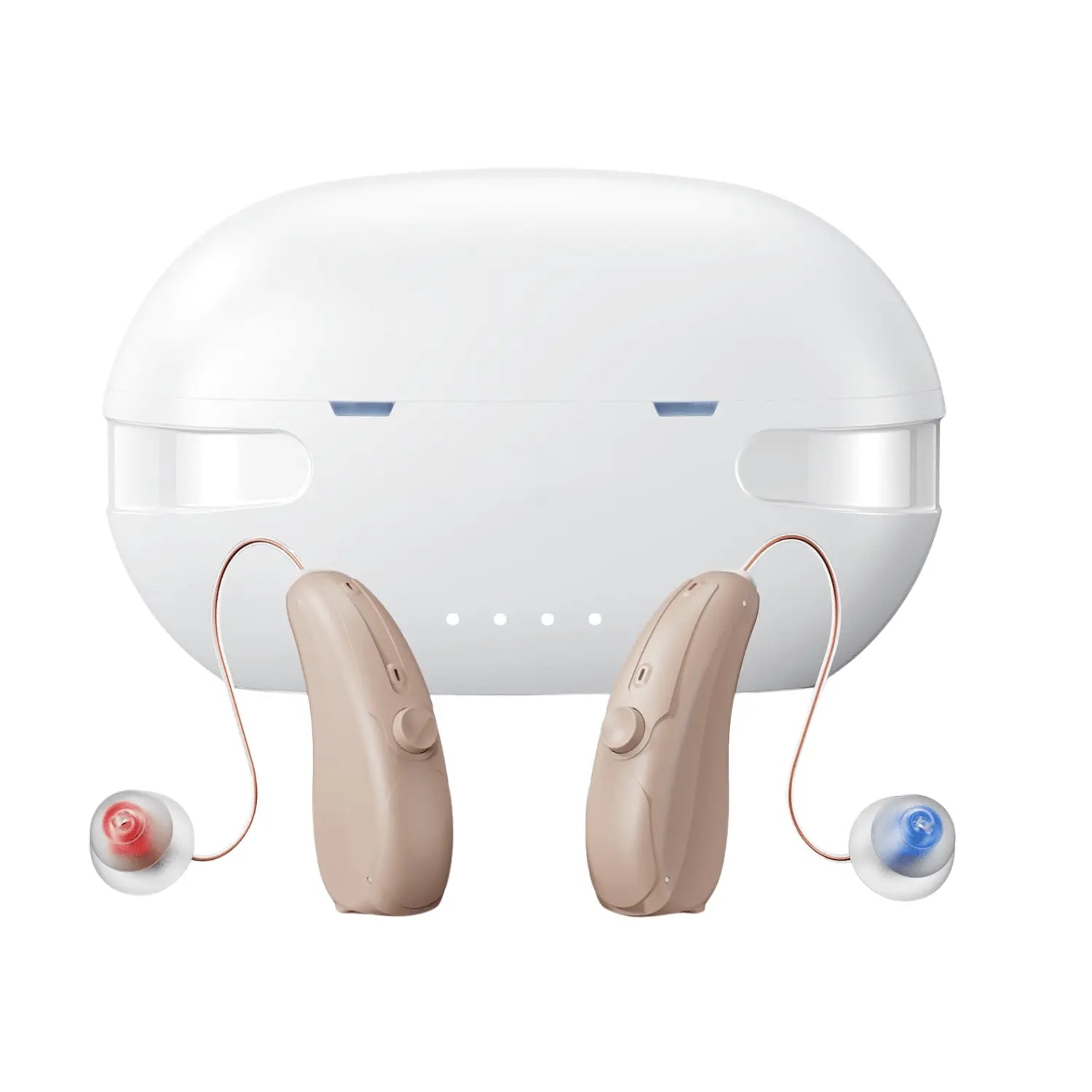
Panda Air is one example of how that gap can be narrowed. It is an earbud-style device that ships with an app-based hearing test: after the device arrives, the user pairs it with the Panda app, the app runs a frequency-specific test through the hearing aid itself, and it then programs the gain to match the user's audiogram, much like the tuning an audiologist would do in a clinic. That app-tuned, self-fitting approach removes the repeat appointments that drive up cost and keep care out of reach for rural users.
Practical details matter when affordability is the question. As a self-fitting OTC hearing aid, Panda Air pairs app-based personalization with adaptive noise reduction, a charging case rated for about 60 hours of use, a 5-year warranty, and a 45-day return window, so trying it carries limited risk. One caveat the review's own framing supports: OTC devices are cleared for mild to moderate loss, and people with severe or profound hearing loss still benefit most from a clinical fitting. You can read more at pandahearing.com/products/panda-air.
Limitations of This Research
A systematic review is only as strong as the studies it pulls together, and the authors note that the evidence across the region is uneven, with some countries far better documented than others. Combining work that uses different methods and definitions also makes precise comparisons difficult, so figures like the projected burden or the return on investment should be read as informed estimates rather than exact measurements.
The review was conducted with the World Health Organization, whose mandate includes expanding access to care, and its purpose is explicitly to inform policy. That does not undermine the findings, but readers should understand it as a call to action grounded in the available evidence rather than a neutral tally.
Where This Leaves Us
The clearest takeaway is that hearing loss is a solvable problem held back mostly by how care is organized and paid for. Whether the fix is national insurance coverage, telehealth, or lower-cost devices people can use on their own, the direction is the same: make help easier to afford and easier to reach. For anyone weighing their own options, the review is a reminder that the cost barrier is real, widely shared, and increasingly something the market is built to address.
Tsimpida D, Sakr H, Elwishahy A, Chadha S, Chitra C, Mahmoudian S. Situational analysis of health systems for ear and hearing care in the World Health Organization (WHO) Eastern Mediterranean Region: A systematic review and evidence synthesis to inform national policies and strategies. SSM - Health Systems. 2026. Retrieved from PubMed. https://doi.org/10.1016/j.ssmhs.2026.100170