Tinnitus and Speech-in-Noise Trouble Share a Genetic Root, But One Does Not Cause the Other
A new study of 216 young adults combines audiology testing with large-scale genetics and finds that people with chronic tinnitus do struggle more with conversation in noise, but a shared inherited risk, not the ringing itself, appears to be the common driver.
Two of the most common complaints in any audiology clinic are constant ringing in the ears and an inability to follow a conversation when the room gets loud. They often appear in the same person. Whether one causes the other has been argued for decades, with studies in either direction depending on how researchers controlled for age, hearing loss, and the emotional weight of tinnitus itself.
The new study tries to settle the question by looking at two layers of evidence at once. On the surface, it measures whether young adults with chronic tinnitus actually do worse on standardized speech-in-noise tests. Underneath, it asks whether the genes that make a person prone to tinnitus also make that person prone to speech-in-noise deficits, and whether the surface link can be explained by that shared genetic background rather than by tinnitus directly driving the perceptual problem.
About This Study
Title: Can Tinnitus Cause Speech-in-Noise Deficits?
Authors: Srividya Grama Bhagavan, Valerie Ingalls, Juan Antonio Raygoza Garay, Nilesh Washnik, Ishan Sunilkumar Bhatt
Affiliations: Department of Communication Sciences and Disorders, University of Iowa; Holden Comprehensive Cancer Center, University of Iowa; Department of Communication Sciences and Disorders, Ohio University
Journal and publication date: Ear and Hearing, May 21, 2026
Study type: Observational audiological study combined with genetic epidemiological analysis using genome-wide association data
PubMed DOI: 10.1097/AUD.0000000000001836
Background: Why the Researchers Looked at This
Tinnitus is the perception of sound, often a ringing or a hiss, with no external source. About one in ten adults has it persistently, and a smaller fraction find it disruptive. Speech-in-noise, sometimes shortened to SIN, refers to the everyday challenge of picking one voice out of a crowded room. SIN performance is measured on tests like QuickSIN, which presents target sentences against multi-talker background babble.
Earlier studies trying to link the two have produced opposite conclusions. Older participants often have hearing loss that drives SIN trouble independently of tinnitus. Tinnitus-related distress can blur self-reported listening ability without changing actual auditory performance. Distinguishing a genuine perceptual deficit from these confounders has been hard.
Two methodological choices in this study were designed to push past those confounders. First, the team restricted enrollment to young adults with conventional hearing thresholds within normal limits, sidestepping age and audiometric loss as obvious explanations. Second, they layered a genetic causal-inference method on top of the conventional analysis, using results from genome-wide association studies to ask whether the link between tinnitus and SIN deficits looks like cause-and-effect or shared inheritance.
How the Study Was Done
A total of 216 adults aged 18 to 37 took part. Eighty-seven of them had bothersome tinnitus that had lasted longer than a year and was experienced continuously. All participants had pure-tone hearing thresholds at or below 20 dB HL across the conventional audiometric range from 250 Hz to 8000 Hz, the standard cutoff for "clinically normal" hearing.
The audiology battery included the Speech, Spatial, and Quality of Hearing scale (a self-report questionnaire called SSQ12), QuickSIN, and a three-digit dichotic digit test that probes how well each ear can process information when both ears are getting different signals at once. Audiometry was extended into the high frequencies, up to 16 kHz, to catch any subtle damage that the conventional range can miss. A linear mixed-effects model adjusted for confounders including lifetime noise exposure, firearm use, and a history of recurring ear infections.
The genetic layer used summary statistics from existing genome-wide association studies of tinnitus and of speech-in-noise traits. The team applied latent causal variant analysis to ask whether the genetic overlap between tinnitus and SIN deficits is consistent with one trait causing the other or with both arising from shared genes. Gene-level summaries were generated with MAGMA, and gene activity was overlaid on single-cell transcriptomic data from mouse cochlear tissue to ask which cell types might be driving the signal.
What the Researchers Found
On the surface, the link was real. Young adults with continuous chronic tinnitus reported lower SSQ12 scores, meaning they rated their own listening ability in everyday situations as worse than peers without tinnitus. They also performed more poorly on the dichotic digit test. Crucially, the gap held up after controlling for pure-tone hearing thresholds, so this was not just an artifact of hidden audiometric loss.
Tinnitus severity tracked with SSQ12 score: the more bothersome the tinnitus, the lower the self-reported listening ability. Lifetime noise exposure and firearm use each predicted elevated hearing thresholds and lower SSQ12 scores in their own right, reinforcing earlier work showing noise as an independent driver of subclinical auditory damage.
The genetic results made the picture more interesting. There was significant genetic correlation between tinnitus and speech-in-noise deficits, meaning the genes that raise the risk for one tend to raise the risk for the other. But the latent causal variant analysis found no evidence that tinnitus genetically causes SIN deficits. The two traits travel together because of shared inherited risk, not because the ringing itself impairs the brain's ability to track speech.
Gene-based mapping pointed to a long list of brain regions involved in both phenotypes, including the frontal cortex, anterior cingulate cortex, cerebellum, nucleus accumbens, caudate, putamen, hippocampus, amygdala, and hypothalamus. Functional gene-ontology terms tied to synaptic function were jointly enriched. By contrast, no cochlear cell types showed significant joint enrichment, suggesting that the shared biology lives further up the auditory pathway, in central circuits that handle attention, emotion, and cognitive control of listening.
What It Means for People With Hearing Loss
For someone whose audiogram looks normal but who still struggles to follow conversation in restaurants, this study is validating. The trouble can be real even when standard pure-tone testing comes back clean, especially when chronic tinnitus is also present. The two complaints are linked, biologically.
The causal piece matters for expectations. Treating the tinnitus, on its own, would not necessarily be expected to fix the speech-in-noise difficulty, because the SIN deficit is not downstream of the ringing in any direct genetic sense. Both need to be addressed on their own terms, ideally with audiology guidance for any clinical tinnitus management.
For the speech-in-noise side, the practical question becomes a hardware one: what tools actually help a person follow a single voice in a noisy room?
Why Speech-in-Noise Processing Belongs at the Center of Hearing Aid Choices
If tinnitus and speech-in-noise deficits ride together because of shared central auditory biology, the listening side of that pairing is the side a modern hearing aid can act on. The job is to give a strained auditory system a cleaner signal: more channels of frequency-specific processing, less background babble, and better support for following one voice across a crowded table.
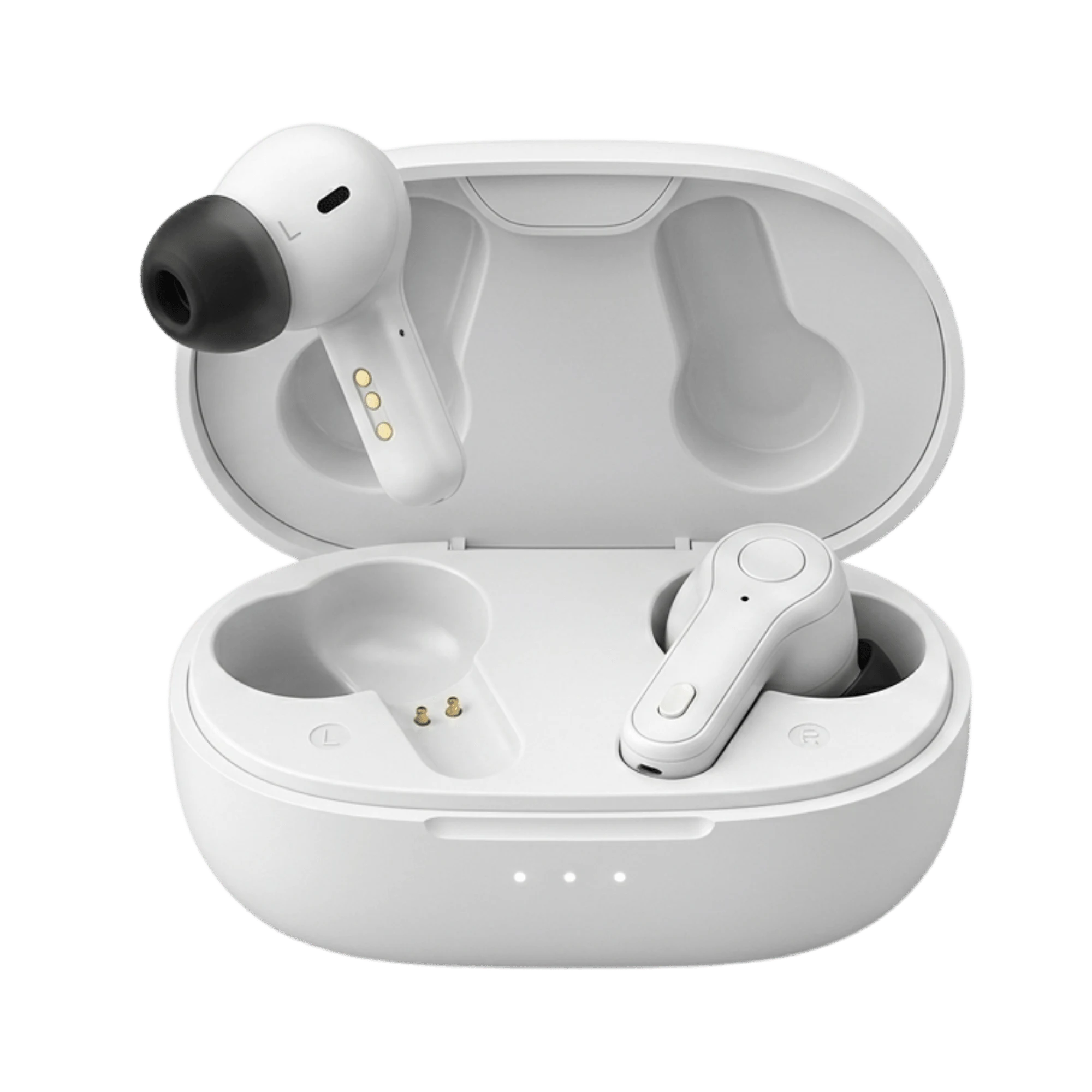
Panda Quantum is built around that need. It is a 16-channel receiver-in-canal hearing aid with adaptive noise reduction tuned for speech, designed for clear speech in noisy environments rather than raw loudness. Pair it with the Panda app after delivery and the app runs an in-ear hearing test through the device itself, then sets gain and frequency response to match the user's audiogram automatically, similar to a clinical audiologist fitting. Bluetooth handles calls, TV, and music directly into the ears, which is useful when even moderate background noise pushes a phone speaker over the line.
Quantum is FDA-cleared as an over-the-counter device for adults with mild-to-moderate loss. For severe or profound loss, a clinical fitting remains the better path. For people with chronic tinnitus whose audiograms still look clinically normal, hearing aids are not a tinnitus cure, but the cleaner input from a strong speech-in-noise platform with adaptive noise reduction can reduce the daily effort of listening, which is often where tinnitus distress compounds.

Limitations of This Research
The sample was a young-adult sample, aged 18 to 37, with normal conventional audiometry. That is a clean test case for asking about tinnitus mechanisms independent of age-related loss, but it leaves open how the picture changes in older adults, where presbycusis and noise-induced loss are layered in. The observational arm of the study was cross-sectional, which captures co-occurrence but not change over time.
The genetic analyses relied on summary statistics from previously published genome-wide association studies, which carries the usual constraints of that approach, including dependence on the ancestral composition of the source cohorts. Single-cell transcriptomic overlap was drawn from mouse cochlear tissue, a useful starting point but not a direct readout of human inner-ear biology. The abstract does not disclose funding sources or conflicts of interest, which the full paper may address.
What to Do With This
The clinical bottom line is that tinnitus and speech-in-noise difficulty share a common biological background that lives in central auditory and emotion-regulation circuits, not in the cochlea, and that one does not appear to cause the other. For listeners, that lifts a small but persistent guilt about whether the ringing is "doing this." It is not. Both deserve attention on their own terms, and the side of the equation that better hardware can address most directly is the listening side: cleaner sound, more granular per-frequency processing, and noise reduction that targets the kinds of rooms where conversation actually happens.
Grama Bhagavan S, Ingalls V, Raygoza Garay JA, Washnik N, Bhatt IS. Can Tinnitus Cause Speech-in-Noise Deficits? Ear and Hearing. 2026. Retrieved from PubMed. https://doi.org/10.1097/AUD.0000000000001836