A new study establishes reference values for an objective ear test that may flag hidden hearing loss in people whose standard audiogram comes back normal but who still struggle to follow speech in noise.
Plenty of people sit through a hearing test, hear the beeps, and are told their hearing is normal, then go home and still cannot follow a conversation in a busy restaurant. For years that mismatch has been hard to explain, because the standard test of hearing loss, the pure-tone audiogram, can miss damage that lives deeper in the auditory system. A research team studying this gap has now published reference values for an objective measure that may help identify these listeners.
The work, published in the American Journal of Audiology, focuses on a condition called cochlear synaptopathy, a form of cochlear deafferentation in which the connections between the inner ear and the hearing nerve are lost even though the audiogram stays normal. Researchers tested whether a brain-response measurement called the envelope following response could separate people at high risk for this hidden damage from people at low risk.
About This Study
Title: Use of Envelope Following Response Normative Ranges for Diagnosing Cochlear Deafferentation
Authors: Anne E. Heassler, Garnett P. McMillan, Sean D. Kampel, Nicole K. Whittle, Haley A. Szabo, Sarah Verhulst, Brad N. Buran, Naomi F. Bramhall
Affiliations: VA National Center for Rehabilitative Auditory Research, VA Portland Health Care System, Oregon; Hearing Technology @ WAVES, Department of Information Technology, Ghent University, Belgium; Oregon Hearing Research Center, Department of Otolaryngology-Head and Neck Surgery, Oregon Health and Science University, Portland
Journal: American Journal of Audiology - May 29, 2026
Study type: Diagnostic study (normative-range development and high-risk versus low-risk comparison)
Source: PubMed - DOI: 10.1044/2026_AJA-25-00277
Background: Why the Researchers Looked at This
The audiogram measures the softest tones a person can detect at each pitch. It is excellent at finding the most common type of hearing loss, where the volume threshold creeps upward. But it does not capture everything. Animal research over the past decade has shown that noise exposure and aging can quietly destroy the synapses, the junctions where inner-ear hair cells hand their signal to the auditory nerve, well before the audiogram changes. This is what researchers mean by cochlear synaptopathy, sometimes described in plain language as hidden hearing loss.
The clinical problem is that there has been no reliable, everyday test to diagnose it in living people. Without one, clinicians cannot confirm what a patient is experiencing, and they cannot match that patient to the right help. The study's authors set out to make one candidate measure more usable in the clinic.
That candidate is the envelope following response, or EFR. It is an electrical brain response, recorded with surface electrodes, that tracks how strongly the auditory system follows the rapid fluctuations in a sound. A weaker-than-expected response can signal that fewer nerve fibers are carrying the message. The catch has been knowing what counts as too weak, because there has been no agreed normal range to compare an individual against.
How the Study Was Done
The team built normative ranges from a low-risk group: young adults with normal audiograms, very little reported lifetime noise exposure, and no hearing complaints. In other words, people whose auditory systems should be intact. They recorded EFRs using two types of test sound, a rectangular amplitude-modulated stimulus and a sinusoidal amplitude-modulated stimulus, and adjusted the resulting ranges for sex and for otoacoustic emission levels, a measure of outer-hair-cell function.
They then tested a high-risk group: military Veterans who also had normal audiograms but who reported at least one auditory complaint, such as tinnitus, reduced tolerance for everyday sound, or difficulty understanding speech in noise. Because military service carries a well-documented risk of noise exposure, this group was a reasonable place to look for hidden damage. The key question was simple: would more of these Veterans fall below the normal range than chance would predict?
The design has a built-in limitation worth naming early. Because there is no gold-standard test for synaptopathy in living humans, the researchers could not confirm case by case who truly had the condition. They worked with risk groups instead, which is a sensible first step but not the same as a confirmed diagnosis.
What the Researchers Found
One test condition stood out. The rectangular amplitude-modulated EFR measured at a 4-kilohertz carrier frequency produced the cleanest separation between the low-risk and high-risk groups. Against the normal range built from that condition, roughly 31 to 34 percent of the Veterans fell below the lower boundary. That is a substantial share of people who, by the standard audiogram, would have been told their hearing was normal.
The researchers also examined whether they needed to correct the ranges for otoacoustic emission levels. They found no consistent effect of that adjustment across the different sexes and test conditions. A computational model of the auditory system pointed in the same direction, suggesting that in people with normal audiograms the otoacoustic-emission correction may not be necessary. That matters practically, because it makes the test simpler to apply.
Taken together, the results give clinicians something they did not have before: a defined normal range for a specific EFR measurement, and evidence that a meaningful fraction of people with normal audiograms and real auditory complaints fall outside it.
What It Means for People with Hearing Loss
For anyone who has been told their hearing is fine yet still strains to follow a friend across a noisy table, this line of research is a form of validation. The difficulty is not imagined, and the standard test may simply not be looking at the part of the system that is struggling. A measure like the EFR could eventually give that experience a name and a number.
It also reframes what speech-in-noise difficulty is. It is not only about loudness. It is about how cleanly the auditory system can lock onto a voice and pull it out of competing sound. That distinction shapes which tools are likely to help. Turning everything up does little if the underlying problem is signal clarity in a crowd, which is exactly the situation many people describe in restaurants, family gatherings, and group meetings.
Why the Speech-in-Noise Finding Points Toward Modern Devices
The study's central thread, that a notable share of people with normal audiograms still report trouble understanding speech in noise, is precisely the listening situation that newer hearing devices have been engineered to target. Rather than simply amplifying, current devices try to improve the clarity of speech against background sound. That is a closer match to the deficit this research describes.

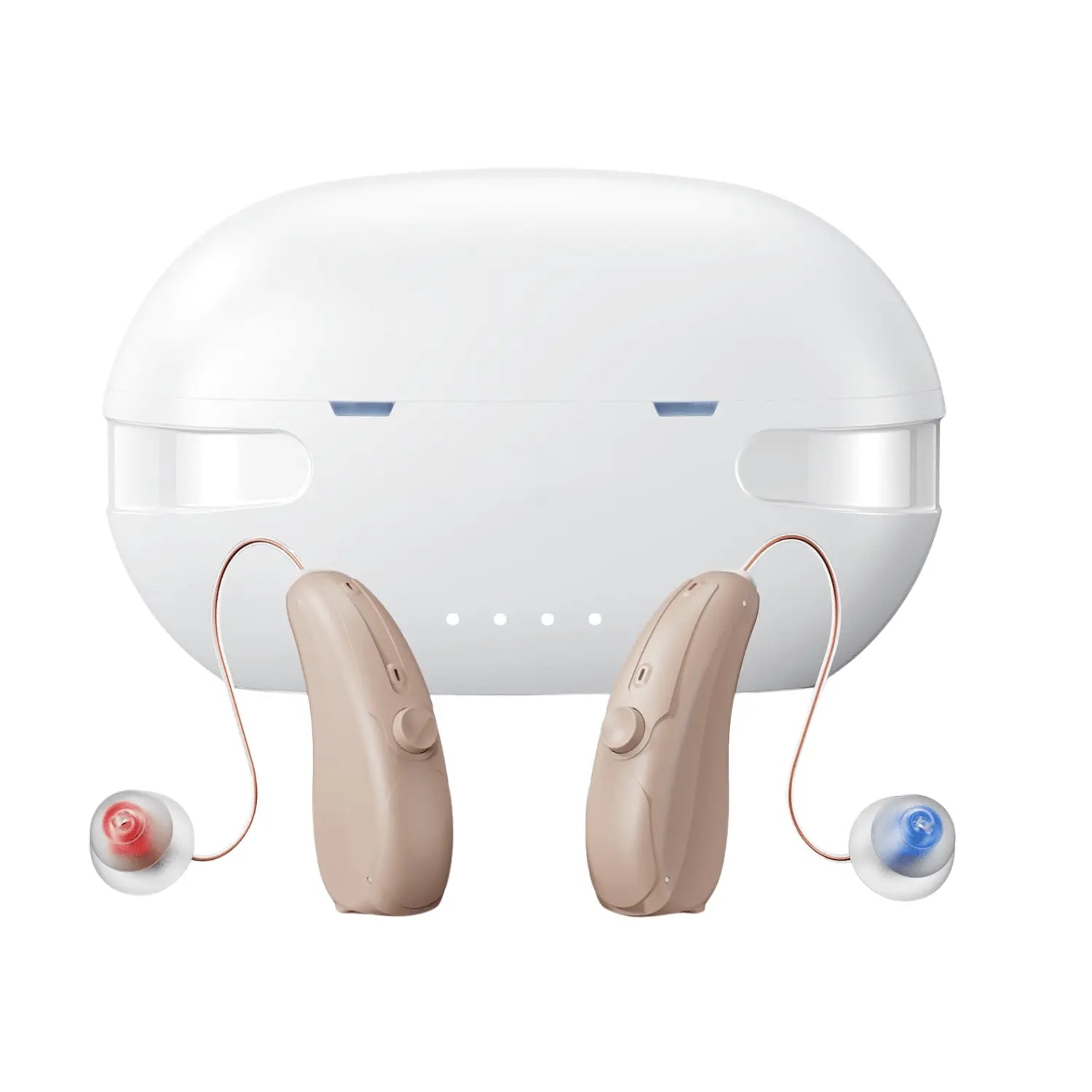
Panda Quantum is one example of a device built around that goal. It is a 16-channel receiver-in-canal hearing aid with adaptive noise reduction aimed at clear speech in noisy environments, a self-hearing test that takes about 10 minutes online for app-based hearing personalization, Bluetooth for calls and TV, up to 80 hours of total battery with its charging case, a 5-year warranty, and a 45-day return window. The speech-focused processing and frequency-specific adjustment are designed for the crowded-room scenario these findings highlight, not just for raising overall volume.
An honest caveat belongs here. This study is about diagnosing a deep-system problem, not about treating it, and amplification does not regrow lost nerve synapses. Over-the-counter devices are also intended for mild-to-moderate hearing loss. People with confirmed or suspected hidden hearing loss should still see an audiologist, because the right next step depends on what the testing actually shows. You can read more about Panda Quantum, a self-fitting OTC hearing aid built for speech in noise, but a device is one option to discuss with a professional, not a substitute for the workup this research points toward.
Limitations of This Research
The most important limit is the absence of a confirmatory test. Because synaptopathy cannot yet be verified in living people, the researchers compared risk groups rather than confirmed cases, so falling below the normal range is suggestive rather than diagnostic. The high-risk sample was also drawn from military Veterans, whose noise-exposure history and demographics differ from the general public, which means the exact percentages may not transfer directly to other populations. The normative ranges were built from young adults, so applying them to older adults, the group most affected by age-related hearing change, will require further work.
The work was conducted within the VA rehabilitative-research system, with several authors based at VA and university hearing-research centers in Oregon and at Ghent University. As with any single study, the reference ranges will need validation in larger and more varied groups before they become routine clinical tools.
Where This Leaves Us
If you keep passing hearing tests but keep losing the thread in noisy rooms, this research is a reason to take that experience seriously rather than shrug it off. A reasonable next step is a baseline hearing check with an audiologist, and a direct conversation about speech-in-noise testing specifically, since that is where the difficulty often hides. It is also worth following this group's future work, because turning a promising lab measure into a dependable clinic test is the part that will decide whether hidden hearing loss finally becomes something that can be named and addressed.
Heassler AE, McMillan GP, Kampel SD, Whittle NK, Szabo HA, Verhulst S, Buran BN, Bramhall NF. Use of Envelope Following Response Normative Ranges for Diagnosing Cochlear Deafferentation. American Journal of Audiology. 2026. Retrieved from PubMed. https://doi.org/10.1044/2026_AJA-25-00277