Spanish Public Health Pilot Identifies Couples Carrying Genes for Inherited Hearing Loss
A pilot study built into Spain's public primary care system found that broad preconception genetic screening can identify couples at reproductive risk for inherited hearing loss and other recessive conditions, with high participation rates among invited families.
Most adults living with hearing loss think of it as something that develops with age or noise exposure. But a meaningful share of hearing loss is inherited, written into a person's genes long before symptoms appear. When two adults each carry a recessive variant in the same gene, their children can be born with hearing loss even when the parents themselves hear normally.
Catching that risk before pregnancy has been technically possible for years. The harder question has been whether a busy public health system, with finite staff and budgets, can actually deliver carrier screening to ordinary couples, and whether ordinary couples want it. A new study published in the Journal of Assisted Reproduction and Genetics tested exactly that, using a primary care center in Barcelona as the recruitment hub and tracking what happened over the course of the program.
About This Study
Title: Integrating preconception carrier screening into public health: lessons learned from a pilot implementation study.
Authors: Marsal-Olivan A, Serra-Juhe C, Artigas-Baleri A, Bernal S, Cusco I, Abuli A, Brotons C, Rodriguez-Santiago B, Surralles J.
Affiliations: Institut de Recerca Sant Pau (IR SANT PAU), Barcelona; Departament de Genetica i Microbiologia, Autonomous University of Barcelona; Servei de Genetica, Hospital de Sant Pau, Barcelona; Centro de Investigacion Biomedica en Red de Enfermedades Raras (CIBERER), Madrid; Sardenya Primary Health Care Centre, Barcelona; Hospital del Mar Medical Research Institute, Barcelona.
Journal and date: Journal of Assisted Reproduction and Genetics, published online May 4, 2026.
Study type: Prospective implementation pilot study within a public healthcare system.
PubMed reference: DOI: 10.1007/s10815-026-03871-9
Background: Why the Researchers Looked at This
Carrier screening is a genetic test that looks for hidden gene variants that a healthy adult can pass on to their children without ever developing the disease themselves. Two big categories matter for reproductive risk. Autosomal recessive conditions show up only when a child inherits the same affected gene from both parents. X-linked recessive conditions are mostly carried by women on the X chromosome and tend to affect their sons. Cystic fibrosis, spinal muscular atrophy, and many forms of inherited hearing loss are autosomal recessive.
For hearing specifically, variants in a gene called GJB2 are the most common known cause of non-syndromic congenital hearing loss in many populations. "Non-syndromic" means the hearing loss is not part of a broader genetic disorder; the affected child's hearing is the main feature. Two GJB2 carriers who do not know they are carriers can have a child born with moderate to profound hearing loss.
Several professional societies recommend offering carrier screening to all couples planning pregnancy, regardless of family history. In practice, almost no public healthcare system does this at scale. The Spanish team wanted to know whether they could pilot a preconception screening program inside an ordinary primary care setting, recruit real couples through routine channels, and produce information that families could actually act on.
How the Study Was Done
The team recruited non-pregnant women aged 18 to 38 with reproductive intent through text messages sent from a primary care center in Barcelona. Their male partners were invited to participate as well. The screening used a sequential approach. Women were tested first using a 351-gene massively parallel sequencing panel, plus complementary tests. If a woman carried a pathogenic variant in a gene that follows an autosomal recessive pattern, her partner was then tested for variants in that same gene. If she carried an X-linked recessive variant, her sons would be at risk regardless of the partner's status.
Every participant met with a genetic counselor before and after testing. The team used questionnaires to measure how participants felt about the screening, both at enrollment and after they received their results. The point of the questionnaires was to capture not just clinical accuracy but the human experience of being offered, completing, and acting on this kind of test.
Results were tracked at the individual level (who carried what variants), at the couple level (which couples were at reproductive risk), and at the program level (how many people accepted the invitation, what they decided to do with their results, and what motivated them to participate).
What the Researchers Found
Of the 518 candidates contacted by text message, 400 (about 77 percent) responded positively to the invitation. From those, 152 couples enrolled, which represented roughly 50.8 percent of eligible couples. Across the 218 individuals who completed screening, 62 percent (135 people) carried at least one pathogenic variant in the gene panel.
Carrying a single recessive variant is common and usually has no impact on the carrier's own health. The reproductive question is whether both members of a couple carry variants in the same gene. The team identified six carrier couples (4 percent of those screened) who were at reproductive risk for severe genetic conditions. Two of those six couples were carriers for non-syndromic hearing loss linked to the GJB2 gene. The remaining four couples carried variants for cystic fibrosis (CFTR), Stargardt disease and retinitis pigmentosa (ABCA4), Smith-Lemli-Opitz syndrome (DHCR7), and Fabry disease (GLA), respectively.
The team was able to follow four of those six carrier couples after their results were disclosed. Three of the four (75 percent) decided to use in vitro fertilization with preimplantation genetic testing or to pursue prenatal diagnosis once a pregnancy was established. In the questionnaires, the most frequently reported motivation for participating in the program was straightforward: preventing the transmission of severe genetic conditions to their children.
The numbers also paint a picture of feasibility. Recruitment by text message worked. A majority of invited couples either enrolled or said they would. The 4 percent rate of carrier couples is consistent with what other carrier-screening programs have reported, suggesting the pilot was not unusually lucky in its findings.
What It Means for People with Hearing Loss
For families thinking about pregnancy, the practical message is that inherited hearing loss is common enough that it shows up in routine screening. Two of the six high-risk couples in this pilot were carriers for the same gene that drives most cases of inherited non-syndromic hearing loss. Couples without any family history of hearing loss can still be at risk, and a one-time screening test can identify that risk before a child is born.
For adults who already have hearing loss linked to genes like GJB2, the broader takeaway is reassurance that the medical system is paying more attention to hereditary causes. Many adults living with longstanding hearing loss have never been told whether their hearing is linked to a known gene; expanded screening of the next generation may also surface that information for the current one.
For health systems, the result is a useful proof point. A program that recruits through ordinary primary care can engage a sizable fraction of eligible couples and surface clinically actionable information at a 4 percent rate. That is a more efficient hit rate than many population-level screening programs achieve, and it strengthens the case for adding carrier screening to standard preconception care.
When Inherited Hearing Loss Persists into Adulthood, Affordable Amplification Matters
The hearing loss that emerges from carrier genes like GJB2 is typically present from birth or early childhood. Many people with mild or moderate forms grow up with the condition and reach adulthood with hearing thresholds that fall inside the range covered by the FDA's over-the-counter (OTC) hearing aid category. For those adults, the question often shifts from whether to use amplification to how to access it without high upfront cost and a long clinic schedule.
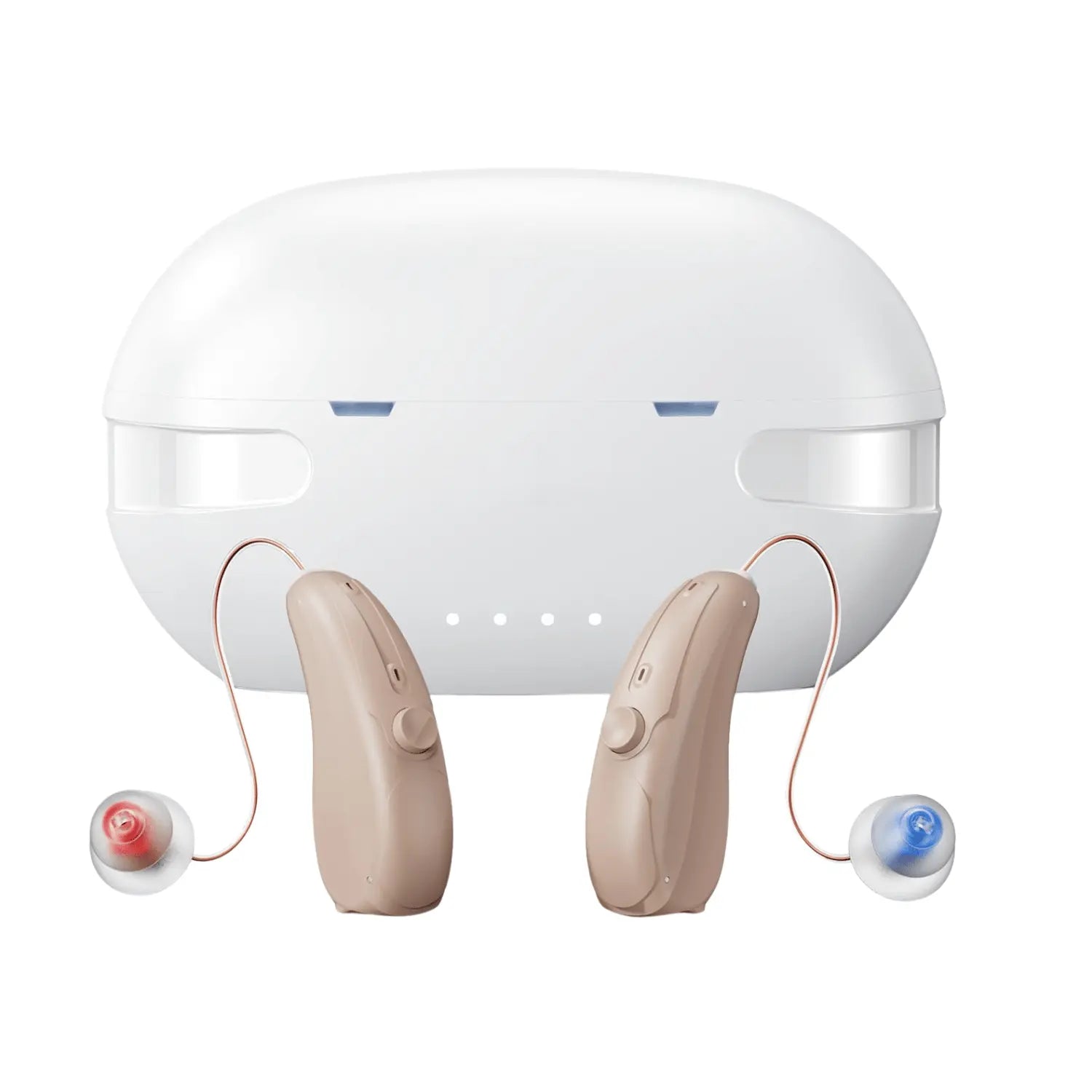
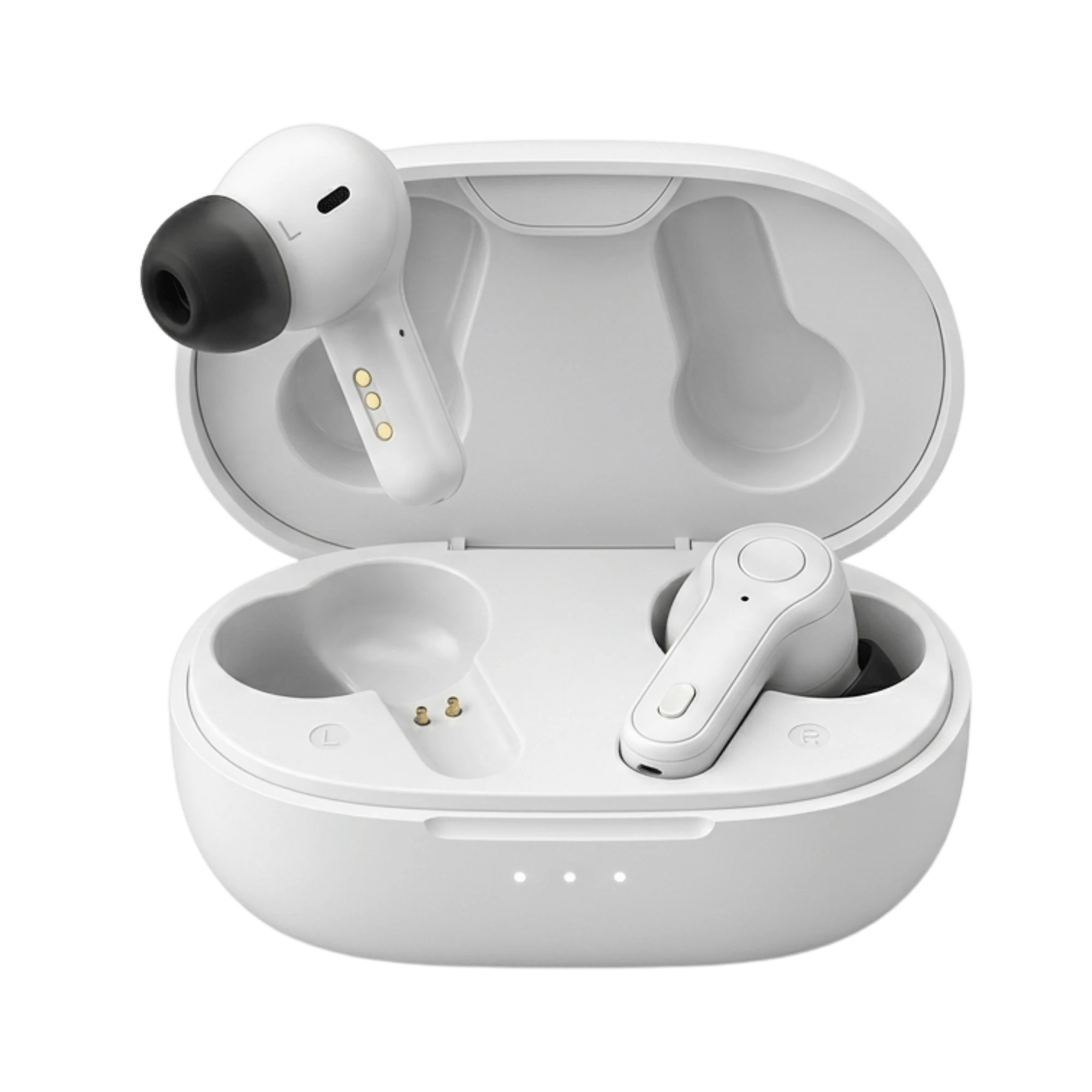
Panda Air is an earbud-style in-the-canal hearing aid built around 16-channel wide dynamic range compression and multi-band adaptive noise reduction. It includes the Panda app-based in-ear hearing test: after the device arrives, the user pairs it with the Panda app, the app runs a frequency-specific hearing test through the hearing aid itself, and the device's gain and frequency response are then programmed automatically to match the user's audiogram. The result is a fitting that is similar to what an audiologist does at a clinical appointment, but performed at home on the user's own schedule.
Panda Air ships with a 60-hour fast-charge case, a 5-year warranty, and a 45-day return window. OTC devices like Panda Air are designed for adults with perceived mild to moderate hearing loss; people with severe or profound loss, including some adults with longstanding inherited hearing loss, still benefit most from a clinical fitting and a higher-power device.
Limitations of This Research
This was a pilot study at a single primary care center in Barcelona, with 152 enrolled couples and only six carrier couples identified. Numbers that small make it hard to draw firm conclusions about how often any individual condition will be detected, including hearing loss. Only four of the six high-risk couples could be followed after disclosure, so the reported reproductive decisions reflect a small group.
The study population was also self-selected. Couples who said yes to a text-message invitation may differ from couples who did not respond, and results from a publicly funded Spanish health system may not transfer cleanly to systems with different financing or different attitudes toward genetic testing. The published abstract does not detail funding sources or competing interests, and readers should review the full article for those disclosures.
Where This Leaves Us
Implementation studies like this one matter because they help health systems decide whether to roll out programs at scale. The signal here is encouraging. Ordinary couples invited from primary care joined in large numbers, the test surfaced clinically meaningful information for a sizable minority, and the most common motivation reported was the simple desire to give a future child the best chance possible. As more health systems consider preconception carrier screening, hereditary hearing loss is likely to be one of the conditions discussed at the kitchen table.
Marsal-Olivan A, Serra-Juhe C, Artigas-Baleri A, Bernal S, Cusco I, Abuli A, Brotons C, Rodriguez-Santiago B, Surralles J. Integrating preconception carrier screening into public health: lessons learned from a pilot implementation study. Journal of Assisted Reproduction and Genetics. 2026. Retrieved from PubMed. https://doi.org/10.1007/s10815-026-03871-9