A new paper in the Journal of the Association for Research in Otolaryngology takes inventory of the trade-offs baked into modern hearing aids, from coupling artifacts to compression distortion, and explains why those compromises persist [1].
Hearing aids in 2026 are smaller, smarter, and better-connected than ever, and adoption of artificial-intelligence-driven models has expanded the conversation about what these devices can and cannot do [2]. But adoption studies and product launches focus mostly on what is new. A long review by hearing scientist Brian C. J. Moore steps back and asks a different question: where are today's hearing aids still falling short, and which of those shortcomings are physics, which are design choices, and which could realistically be improved?
The answer is a careful, sometimes uncomfortable, audit of an industry that often markets each generation as a breakthrough. Survey data on real-world use, including listeners struggling with music through their aids [3], suggest that the gap between marketing language and daily experience is real for many wearers. Moore's paper helps explain why.
About This Study
Title: Hearing Aids: What Works Well and What Can Be Improved
Authors: Brian C. J. Moore
Journal: Journal of the Association for Research in Otolaryngology (JARO) - 2026
Citations: 0
Source: Consensus - https://consensus.app/papers/details/6287277d7fd85602bb445ac3b8510abe
Background: Why the Researchers Looked at This
Hearing aid technology has improved steadily over the past two decades. Tiny digital processors now run multi-band compression, directional microphones, machine-learning noise reduction, and Bluetooth streaming inside a shell smaller than a thumbnail. Patient interest in newer formats, including AI-enabled models, has been driven partly by promises of smarter noise management and personalized listening [2].
Yet user satisfaction data continue to show that many wearers feel their devices do not work as advertised in the situations that matter most: noisy restaurants, group conversations, concerts, and television rooms. A 2026 UK survey of 1,507 hearing-aid users found that music quality in particular was a frequent complaint, with distortion and poor sound reproduction leading many listeners to simply remove their aids during music [3]. Moore's review treats those user reports as a starting point and asks what is going on inside the device that produces them [1].
How the Study Was Done
The paper is a structured technical review rather than a clinical trial. Moore draws on decades of psychoacoustic research, hearing aid signal-processing literature, and his own experiences testing and listening to commercial hearing aids. He walks through each major component of a modern aid in turn: the acoustic coupling to the ear canal, the feedback cancellation system, the compression amplifier, the directional microphones, and the noise reduction algorithms [1].
For each component, the review identifies the engineering goal, the trade-off involved, and the residual problem that the wearer experiences. Where laboratory measurements are available, Moore cites the actual high-frequency cutoffs, gain limits, and distortion artifacts produced by current hardware. The paper is not designed to rank individual brands. Its claim is broader: many of the limitations are common across the industry because they reflect physical and design constraints that no manufacturer has yet solved.
What the Researchers Found
Moore's audit identifies several persistent issues. The first concerns how the device sits in the ear. A "closed" fitting, where the eartip seals the canal, gives the best low-frequency amplification and the best performance for directional microphones, but it also causes the occlusion effect: the wearer's own voice sounds unnaturally loud or boomy. An "open" fitting, which uses a vent to relieve that pressure, fixes the occlusion problem but introduces comb filtering, reduces low-frequency gain, and lets background sound leak in around the noise-reduction system [1].
The second issue is high-frequency reach. Moore notes that the highest frequency at which most current aids can deliver useful gain is around 5 kHz. That is lower than ideal for restoring speech clarity, because consonant cues important for understanding, such as those produced by "s" and "th," extend well above 5 kHz [1].
A third problem is feedback cancellation. Algorithms that suppress the squeal of audio looping from the receiver back to the microphone have improved dramatically, but they still introduce artifacts and can degrade the perceived quality of music in particular [1]. That technical observation lines up with the UK survey, where listeners reported that distortion was the single most common music-listening complaint [3].
Fourth, multi-channel compression, the system that compresses loud sounds and amplifies quiet ones to fit a damaged ear's narrower dynamic range, is often less aggressive than the manufacturer's fitting software claims. Moore writes that the result can be loudness discomfort at high sound levels and incomplete audibility of soft, high-frequency sounds [1]. Compression also introduces cross-modulation between frequency bands, which further degrades sound quality.
Finally, directional microphones and noise reduction perform well in closed fittings but lose much of their advantage in open fittings, because outside sound enters through the vent and bypasses the processing [1]. In other words, a wearer who picks comfort over occlusion may also be giving up some of the noise-reduction benefit they were sold on.
What It Means for People with Hearing Loss
The review is not an argument against using hearing aids. Other 2026 research underscores that hearing devices and structured rehabilitation can meaningfully reduce loneliness and improve social participation in adults with hearing loss [4]. Moore's point is that consumers should understand that hearing aids are still a compromise device. The settings that maximize comfort can reduce intelligibility in noise. The settings that maximize speech in noise can introduce artifacts in music or make the wearer's voice feel boomy. There is no single ideal program for every situation.
For new users, this argues for two things. First, expect a fitting and an adjustment period, not a plug-and-play experience. Second, expect more than one listening program: one configuration is unlikely to handle conversations, television, restaurants, and music equally well.
How Auto-Fitting Through the App Helps With One of These Limitations
One specific limitation Moore raises is the gap between manufacturer fitting software and the gain a wearer actually receives [1]. Many users go home with default settings that were never personalized to their audiogram. Without a measured baseline, the multi-channel compression cannot match the wearer's actual dynamic range, and audibility of soft, high-frequency sounds suffers.
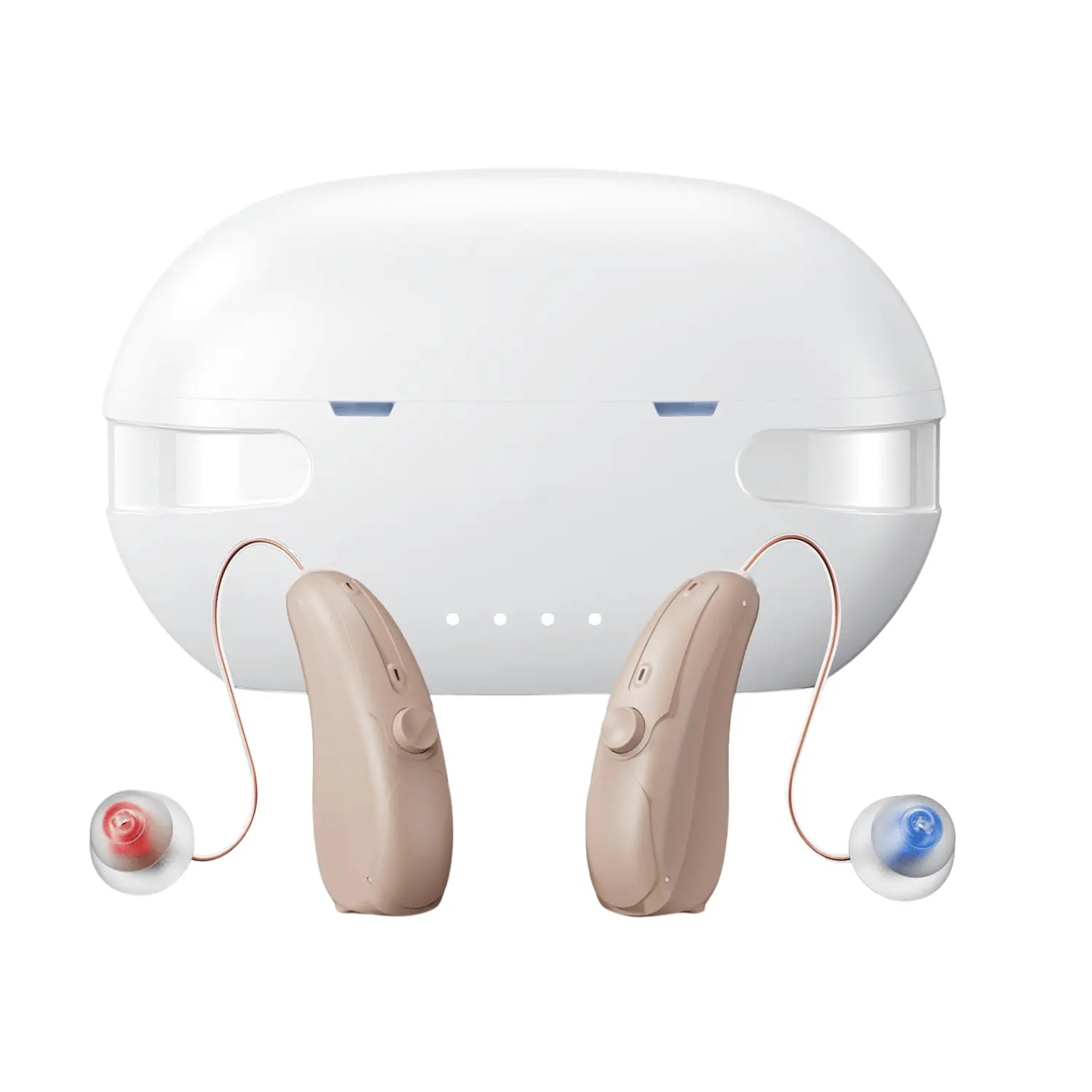
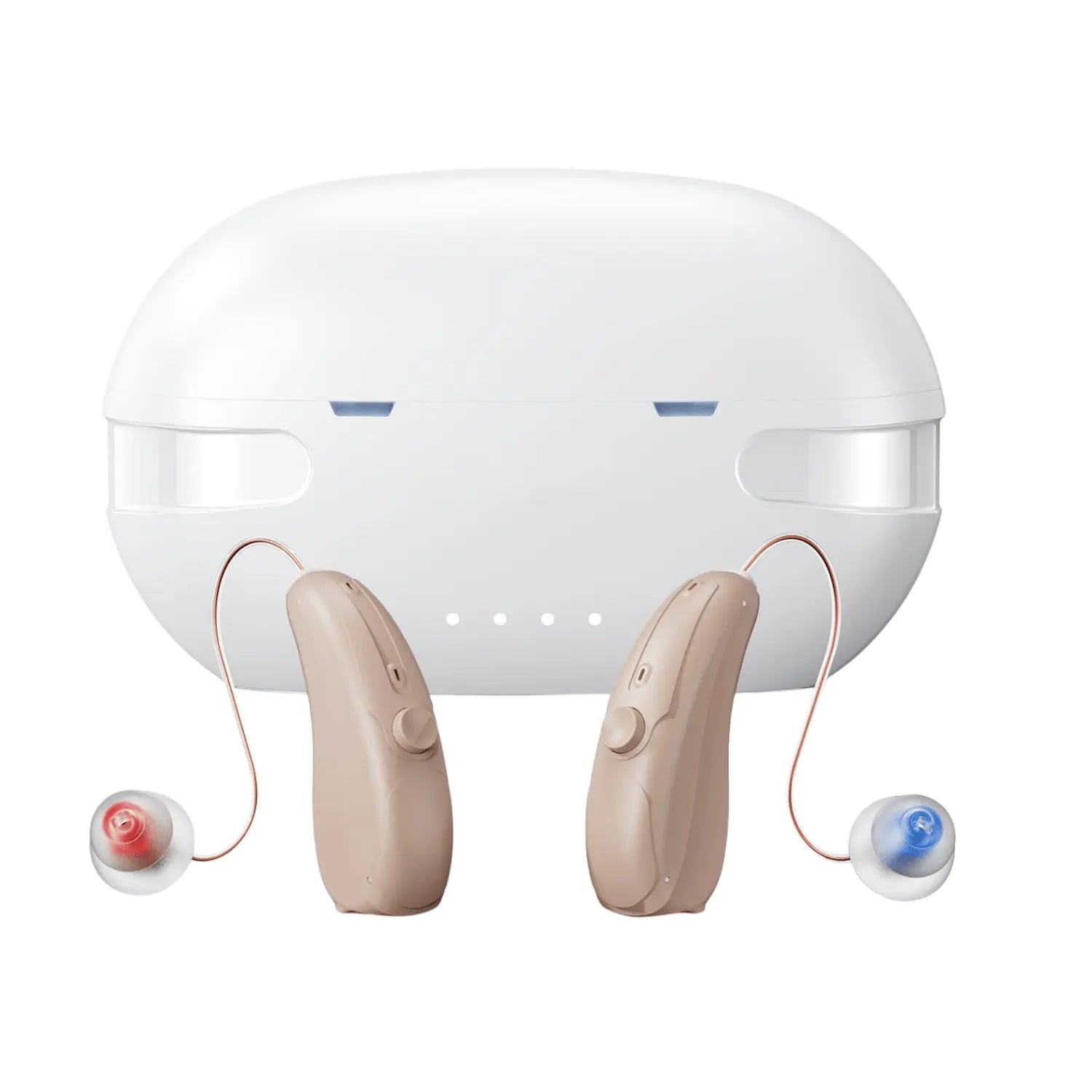
Panda Quantum is built to narrow that gap without requiring a separate audiologist visit. After delivery, the wearer pairs the device with the Panda app, which runs a frequency-specific hearing test through the hearing aid itself, then automatically programs the device's gain and frequency response to match the measured audiogram. The process mirrors what a clinical fitting does: the device is tuned to the ear, not to a population average.

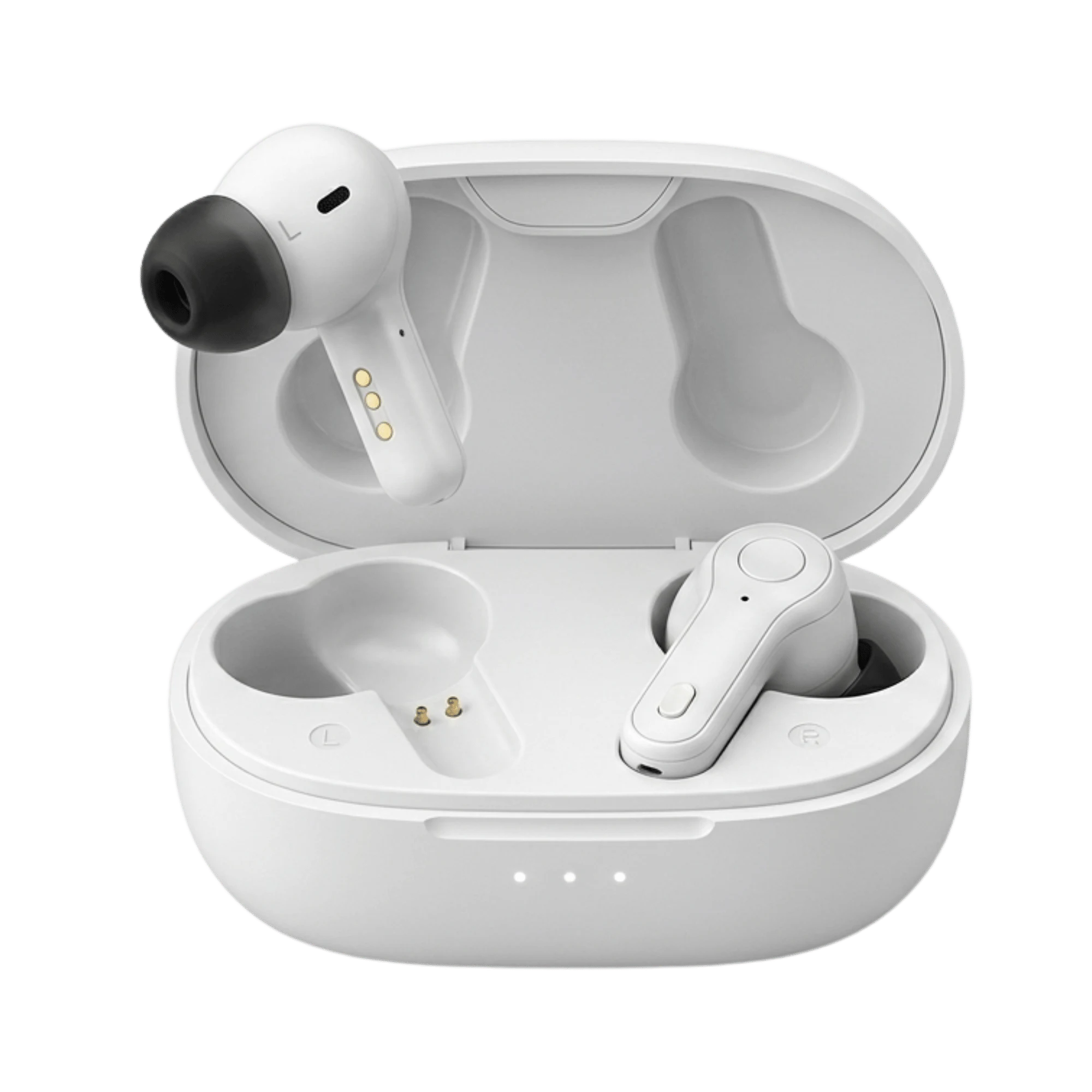
Quantum is a 16-channel RIC platform with adaptive noise reduction, Bluetooth streaming for calls, television, and music, and up to 80 hours of total battery life with the charging case. It comes with a 5-year warranty and a 45-day return window. None of that solves the deeper physics Moore describes, but it does address the specific complaint that the device a wearer takes home rarely matches the audiogram it was supposed to be tuned to. Learn more about Panda Quantum.
Limitations of This Research
Moore's paper is a narrative review and reflects the author's perspective on the literature and on his own listening experience. It does not include a meta-analysis, and it does not test specific commercial devices head-to-head with standardized outcome measures. Some of the issues he describes have partial solutions in newer products, including AI-driven environment detection that switches between fittings dynamically [2], although the long-term real-world benefit of those systems is still being evaluated.
The UK music-listening survey was conducted between 2016 and 2018 and published in 2026, so it reflects the state of hearing aids a few years ago [3]. Newer dedicated music programs may perform better than the ones survey respondents used.
Where This Leaves Us
Hearing aids in 2026 are real medical devices that demonstrably improve daily life for many wearers, but they are not yet transparent windows on the original sound. Moore's review is a useful corrective to marketing language. The wearer who understands which compromises are baked into the device, and which can be tuned out with a careful fitting and the right program, will get more out of any hearing aid they choose.
References
[1] Hearing Aids: What Works Well and What Can Be Improved (Brian C. J. Moore, 2026, Journal of the Association for Research in Otolaryngology, 0 citations).
[2] Drivers of artificial intelligence-powered hearing aids by individuals: an in-depth qualitative investigation (Hadeel Alsaleh et al., 2026, Journal of Enterprise Information Management, 0 citations).
[3] Using Hearing Aids for Music: A UK Survey of Challenges and Strategies (A. Greasley et al., 2026, Trends in Hearing, 0 citations).
[4] Effectiveness of interventions for social isolation, loneliness, and social participation in older adults with hearing loss: results from a systematic review (Julie Beadle et al., 2026, Systematic Reviews, 0 citations).