UK Survey of 1,507 Hearing Aid Users Finds Music Listening Remains a Mixed Experience - and the Most Common Coping Strategy Is Removing the Aids
A large UK survey reports that hearing aids support music engagement for many wearers but introduce distortion and sound-quality issues at loud or live levels, with only one third of users finding manufacturer music programs effective [1].
Hearing aids are engineered, first and foremost, around speech intelligibility. The signal-processing strategies that make conversation clearer - strong directional microphones, aggressive compression, noise reduction, feedback cancellation - are not the same strategies that preserve the nuance of a piano chord or a live concert. A 2026 review of hearing-aid performance laid out the underlying acoustic constraints in detail, including the limits of compression at high sound levels and the way feedback cancellation can introduce artifacts that degrade music quality [2].
Until now, much of what is known about how hearing-aid users actually experience music has come from small surveys and clinical anecdote. Qualitative work on AI hearing aids points to environment-aware processing as one of the features users value most [3], but it has not been clear whether those gains translate to music in practice. Greasley and colleagues set out to fill that gap with one of the largest surveys ever conducted on the topic.
About This Study
Title: Using Hearing Aids for Music: A UK Survey of Challenges and Strategies
Authors: A. Greasley and colleagues
Journal: Trends in Hearing - 2026
Citations: 0 (newly indexed)
Source: Consensus - https://consensus.app/papers/details/50e67b09ab655be1adbd5bc4ccce0dfa
Background: Why the Researchers Looked at This
Speech and music are very different acoustic signals. Speech has a relatively predictable dynamic range and frequency profile; music spans a much wider range of loudness, frequencies, and timbres. Compression, which makes soft speech audible without making loud speech painful, can flatten musical dynamics in ways that listeners with hearing loss perceive as a loss of expression. Feedback cancellation, essential for the close-to-ear microphones in modern hearing aids, can interact with sustained musical tones to produce audible artifacts [2].
Manufacturers have responded with dedicated music programs that relax compression and feedback handling in exchange for a more natural sound, but real-world uptake and effectiveness have been hard to measure outside of small clinic samples. The authors wanted population-level data: how do thousands of hearing-aid users actually handle music in daily life?
The work also sits at the intersection of audiology and quality-of-life research. Music engagement matters for mood, identity, and social participation, all of which are already at risk in people with hearing loss.
How the Study Was Done
The team ran an online survey between 2016 and 2018, recruiting 1,507 hearing-aid users across the United Kingdom. Mean participant age was 60 years. The survey covered music-listening behavior in both recorded and live settings, the perceived helpfulness of hearing aids in each context, the specific challenges users encountered, and the coping strategies they had developed.
Respondents were also asked about their use of dedicated music programs (where available on their hearing aids) and how effective they perceived those programs to be. Sub-analyses examined how responses varied with self-reported level of hearing loss.
Because the survey is observational and self-reported, the data describe user experience rather than objective sound quality. But with 1,507 respondents, the patterns it surfaces carry real weight.
What the Researchers Found
The headline finding is mixed in both directions. Hearing aids supported music engagement for many users - people reported being able to participate in music listening, attend concerts, and continue hobbies that hearing loss might otherwise have shut down. But the experience was inconsistent, and overall ratings of hearing-aid helpfulness for music were uneven.
The single most commonly reported issue was distortion and poor sound quality, particularly in loud or live settings. Users described music as harsh, compressed, or unpleasantly bright when the source was loud - a pattern consistent with what the engineering literature predicts when compression and feedback systems are pushed beyond their comfortable operating range [2].
The most frequently reported coping strategy was the bluntest one available: removing the hearing aids altogether. For many users, taking the devices out and accepting reduced audibility was preferable to listening through a signal chain that distorted what they were hearing.
Only about a third of respondents reported using a dedicated music program, and the effectiveness of those programs was mixed. The authors interpret this as evidence that manufacturer music programs, as currently implemented, do not consistently overcome the underlying acoustic challenges - and they call for further research into signal-processing strategies tailored to music, especially at high sound levels.
A more positive finding concerned mindset. Users who described themselves as proactive, experimental, and willing to try different settings, genres, and listening environments reported more satisfying music experiences than users who treated the hearing aid as a fixed appliance. The authors highlight this as a candidate target for audiology counseling.
What It Means for People with Hearing Loss
For hearing-aid users who love music, the survey validates a frustration that is often dismissed as picky listening. The distortion is not in the listener's imagination. It is a predictable consequence of how speech-optimized hearing aids handle loud, dynamic signals.
The practical actions the study supports are: ask whether the device has a dedicated music program and how it is activated; experiment with different listening environments and genres rather than expecting one setup to work everywhere; and ask about the option to bypass the microphone path entirely for recorded music, which removes the room acoustics and compression chain from the equation.
That last option - direct streaming - is the cleanest engineering answer to the distortion problem the survey identified, because it short-circuits the most distortion-prone parts of the signal chain.
When Bluetooth Streaming Bypasses the Source of the Distortion
The survey's central engineering finding is that loud, dynamic audio is where conventional hearing-aid processing struggles most. The microphone picks up a high-level signal, compression flattens it, feedback cancellation reacts to its sustained tones, and the listener hears the artifacts of all three.
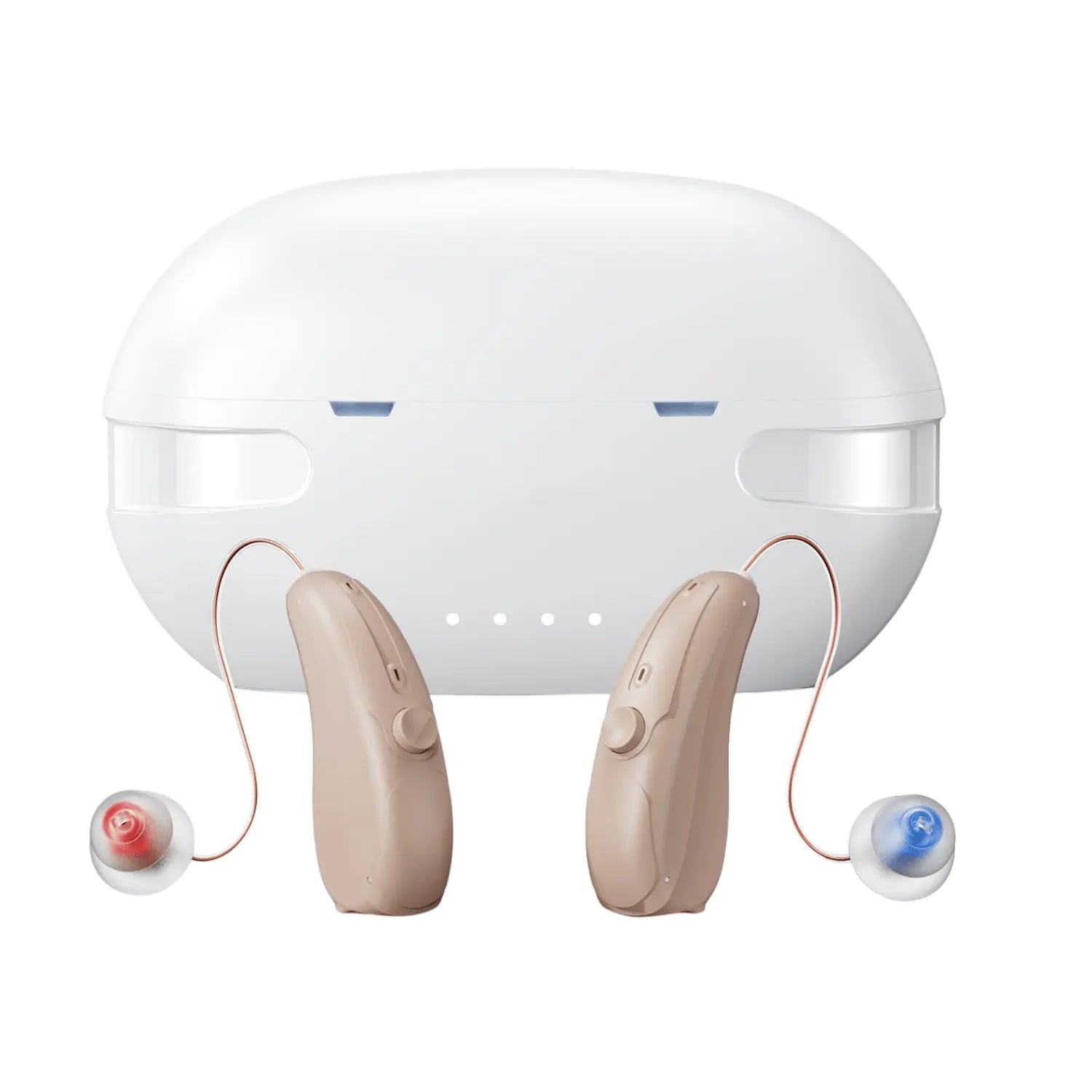
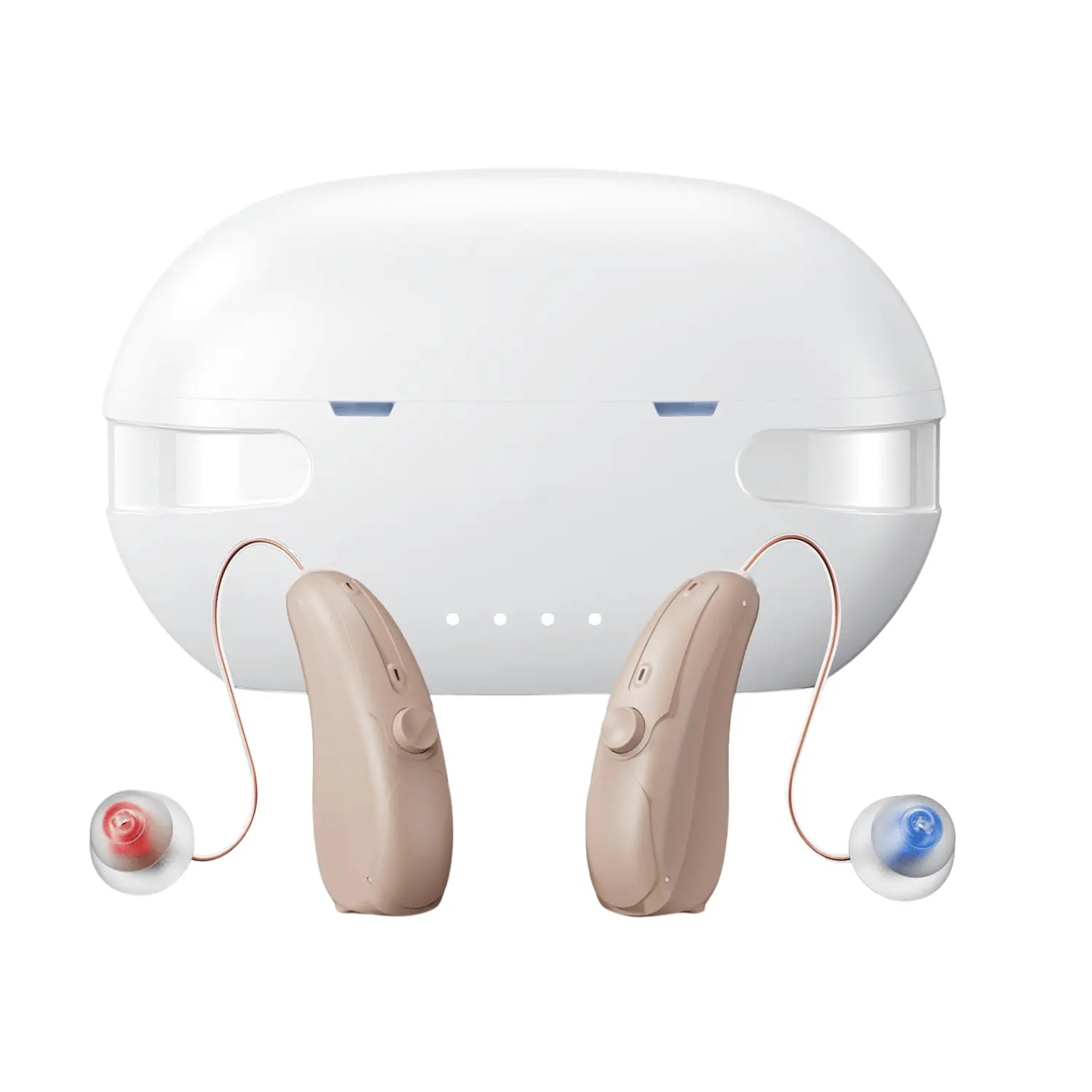
The Panda Quantum addresses that specific failure mode for recorded music by streaming audio over Bluetooth directly into the hearing aids - phone, tablet, or television straight to the ear, without the microphone-and-room round trip. It is a 16-channel receiver-in-canal hearing aid with active noise reduction, and the case provides up to 80 hours of total battery so a long listening session is not interrupted. Panda Quantum also includes the Panda app-based in-ear hearing test: after delivery, you pair it with the Panda app, the app runs a frequency-specific test through the device itself, and the fitting is then applied automatically based on your audiogram - similar to what an audiologist would do at a clinical fitting. It ships with a 5-year warranty and a 45-day return window, so wearers can test it against their own music library before deciding.

Limitations of This Research
The survey is observational and relies on self-report. Acoustic measurements of what users actually heard, and clinical audiograms verifying their hearing-loss profiles, were not part of the protocol. Participant recruitment was online, which probably skewed toward more engaged, more technology-comfortable users than the broader hearing-aid population.
The data were collected in 2016-2018, which means the hearing-aid hardware in the sample predates the most recent generation of AI-powered, environment-aware devices. Recent qualitative work suggests that AI-enabled environment detection is one of the features users value most [3], so a contemporary repeat of the survey might find a different distribution of music-related complaints. That said, the underlying acoustic challenges - compression, feedback cancellation, microphone placement - have not gone away.
Where This Leaves Us
Music is a domain where hearing aids have a long way to go, and the people most affected - older adults who grew up with rich music lives and find themselves taking their hearing aids out at concerts - deserve better tools and better counseling. The Greasley survey makes a strong case that signal processing, manufacturer programs, and clinical guidance all need to adapt. In the meantime, direct streaming and a willingness to experiment with settings are the two practical levers most users can pull today.
References
[1] Using Hearing Aids for Music: A UK Survey of Challenges and Strategies (A. Greasley et al., 2026, Trends in Hearing, 0 citations).
[2] Hearing Aids: What Works Well and What Can Be Improved (Brian C. J. Moore, 2026, JARO, 0 citations).
[3] Drivers of artificial Intelligence-powered hearing aids by individuals: an in-depth qualitative investigation (Hadeel Alsaleh et al., 2026, Journal of Enterprise Information Management, 0 citations).