Uneven Hearing Between the Ears Grows More Common With Age, a National Survey Finds
Drawing on a national health survey, researchers estimate how often adults have meaningfully different hearing in their two ears, and how that gap widens with the years.
Most people picture hearing loss as something that dims both ears at once. In reality, the two ears can drift apart, and a noticeable difference between them carries its own meaning for both diagnosis and daily listening. Yet solid, population-wide figures on how common that imbalance is have been scarce.
To fill that gap, a team at Korea University analyzed a large, nationally representative health survey, measuring how many adults have asymmetric hearing loss and how the pattern changes with age, sex, and sound frequency.
About This Study
Title: Prevalence of asymmetric hearing loss in Korean adults
Authors: Jaeman Park, Dongjun Woo, Jiyeon Park, Gi Jung Im, Jae-Jun Song, Sung-Won Chae
Affiliations: Department of Otorhinolaryngology-Head and Neck Surgery and College of Medicine, Korea University, Seoul, South Korea
Journal and date: Acta Oto-Laryngologica, published June 12, 2026
Study type: Population-based cross-sectional analysis of national survey data with weighted statistics
PubMed and DOI: https://doi.org/10.1080/00016489.2026.2685217
Background: Why the Researchers Looked at This
Asymmetric hearing loss simply means that one ear hears worse than the other by a meaningful amount. Clinicians measure it using the interaural difference, which is the gap in hearing thresholds between the right and left ears. In this study the threshold for calling a difference asymmetric was an interaural gap of at least 15 decibels in the four-frequency pure-tone average, a standard summary of how loud sounds must be before a person can hear them.
Why does the gap matter? Two ears that hear unequally make it harder to locate sounds and to follow speech in a crowd. A clear difference between ears can also be a clue that prompts a clinician to look for a specific, one-sided cause. Until now, representative national data on how widespread this imbalance is among adults in Korea had been limited, which is the gap the authors wanted to close.
How the Study Was Done
The researchers used data from the 2022 and 2023 rounds of the Korea National Health and Nutrition Examination Survey, a continuing program designed to represent the country's population. They included adults aged 40 and older who had complete hearing tests in both ears and normal or near-normal results on tympanometry, a quick check of how the eardrum responds to pressure that helps rule out middle-ear problems.
Each participant received pure-tone audiometry, the familiar test in which tones are played at different pitches and volumes to map the softest sounds a person can detect. The team then applied statistical weighting to account for the survey's complex sampling design, which allows results from the sample to stand in for the wider adult population. They reported both raw prevalence and an age-standardized figure that adjusts for the age makeup of the population.
What the Researchers Found
Among 6,574 participants, 447 met the definition of asymmetric hearing loss. After weighting, that worked out to a prevalence of about 6.5 percent, with a 95 percent confidence interval of roughly 5.9 to 7.2 percent. The age-standardized estimate was close behind at about 6.0 percent.
Age made a striking difference. The share of adults with asymmetric hearing loss climbed from 3.2 percent among those in their forties to 11.9 percent among those aged 80 and older, nearly a fourfold rise across the adult lifespan. Older age and male sex were each independently linked to a higher chance of asymmetry, while a history of occupational noise exposure, somewhat surprisingly, was not.
The imbalance was not spread evenly across pitches. It showed up most often at 4,000 hertz, a high frequency that sits in the range where much of the clarity of speech lives. When one ear lagged, it was more often the left, and most of the gaps clustered near the lower end of the asymmetric range rather than at dramatic extremes.
Taken together, the picture is of a fairly common condition that becomes more frequent with age, leans toward the high frequencies, and tends to be modest in size rather than severe. The authors present their numbers as population reference data and urge careful interpretation of any single threshold-based definition of asymmetry.
What It Means for People with Hearing Loss
Two themes stand out for everyday listeners. First, hearing loss climbs steadily with age, and the high frequencies tend to fade first. That is exactly the part of the sound spectrum that carries consonants and crispness, which is why early age-related loss often shows up as trouble understanding speech rather than a sense that sounds are simply quieter.
Second, the two ears do not always change in step. A modest difference is common and is usually part of ordinary aging. A large, sudden, or one-sided change is different, and it deserves prompt attention from a professional, because asymmetry can occasionally signal a specific cause that needs medical care. The practical message is to pay attention to both how much and how evenly your hearing is changing.
Matching Amplification to High-Frequency, Age-Related Hearing Loss
Because this study highlights loss that concentrates in the high frequencies and grows with age, it points to a need that modern hearing aids are built to meet: frequency-specific hearing adjustment that adds clarity where it is missing without over-amplifying the pitches a person still hears well. High-frequency loss is also the reason so many older adults say they can hear that someone is talking but cannot make out the words, especially in a noisy room.
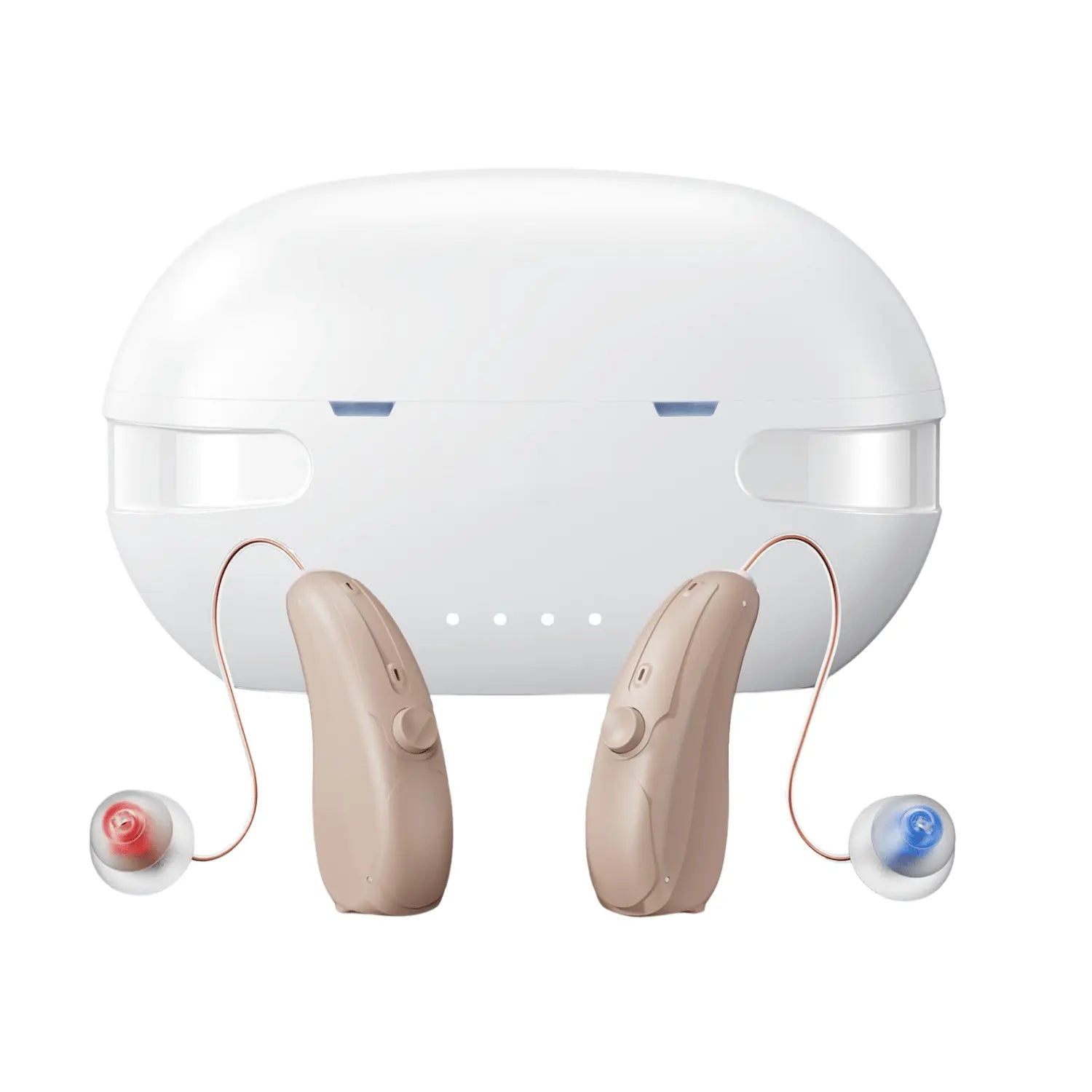
The Panda Quantum is one device aimed at this pattern. It is a 16-channel receiver-in-canal hearing aid with adaptive noise reduction, a charging case that provides up to 80 hours of total battery life, Bluetooth for phone calls, television, and music, a 5-year warranty, and a 45-day return window. Rather than a one-size setting, it uses app-based hearing personalization: after the device arrives, the wearer pairs it with the Panda app, which runs a frequency-specific hearing test through the hearing aid itself and automatically programs the gain and frequency response to match the result, similar to what an audiologist does at a clinical fitting. For high-frequency, age-related loss, that targeted tuning is what helps speech sound clearer in noisy environments instead of just louder.

One caution follows directly from the study. Over-the-counter devices are designed for adults with mild to moderate loss, and the app-based fitting works best when the two ears are reasonably similar. If your hearing is clearly worse in one ear, or it changed suddenly, see a professional before self-fitting, because that kind of asymmetry is the signal the researchers say deserves a closer look.
Limitations of This Research
This was a cross-sectional snapshot, so it captures how common asymmetry is at one point in time but cannot show how it develops or progresses within a person. The definition also rested on a single cutoff of 15 decibels, and because most measured gaps sat near the lower edge of that range, modest shifts in the threshold could move borderline cases in or out of the count.
The data come from a single country, so the exact figures may differ in other populations. Pure-tone testing also measures detection of tones in a quiet booth rather than real-world listening in noise, and the available record does not include a detailed funding or conflict-of-interest statement. These points do not undercut the central finding, but they do frame how far the precise numbers should be stretched.
What to Do With This
If you are over 40, this research is a gentle nudge to take stock of your hearing, including whether your two ears seem to be keeping pace with each other. Gradual, even, high-frequency loss is the ordinary face of aging and is very manageable. A sudden or lopsided change is the version worth checking promptly with a professional. Either way, knowing where you stand is the first step toward hearing the words and not just the voices.
Park J, Woo D, Park J, Im GJ, Song JJ, Chae SW. Prevalence of asymmetric hearing loss in Korean adults. Acta Otolaryngol. 2026. Retrieved from PubMed. https://doi.org/10.1080/00016489.2026.2685217