In Children With Mild Hearing Loss, Ear-to-Ear Differences Matter More Than the Audiogram Average
A new study of 121 children reports that asymmetry between the two ears, not the average pure-tone threshold, predicts subtle deficits in how the developing brain processes frequency changes in sound.
Childhood hearing loss is usually framed in terms of severity: how loud a tone has to be before a child detects it. Severe loss is rarely missed. Minimal and mild loss, however, often slips past early screening, in part because pediatric audiograms are summarized as a single number per ear or even as an average across the two ears.
Animal work has hinted for years that even short stretches of partial auditory deprivation during development can rewire central auditory processing. Whether that translates to measurable perceptual deficits in real children with everyday minimal-to-mild loss has been harder to pin down. The new study takes a focused run at the question by separating two things that audiograms usually blur together: how well each ear hears on its own, and how closely the two ears match.
About This Study
Title: Interaural Asymmetry, Not Hearing Thresholds, Predicts Diotic Frequency Modulation Sensitivity in Children With Minimal-to-Mild Hearing Loss
Authors: Srikanta K. Mishra, Anu Nair, Udit Saxena
Affiliations: Department of Speech, Language and Hearing Sciences, The University of Texas at Austin; Department of Audiology and Speech Language Pathology, Gujarat Medical Education and Research Society Medical College and Civil Hospital, Ahmedabad, India
Journal and publication date: Ear and Hearing, May 21, 2026
Study type: Case-control psychoacoustic study with regression modeling
PubMed DOI: 10.1097/AUD.0000000000001843
Background: Why the Researchers Looked at This
The hearing system is not just a pair of microphones. It is a pair of microphones feeding a brain that compares the two inputs in real time to track who is speaking, where they are, and how their voice rises and falls. The two ears do not have to be identical, but the brain expects them to broadly agree.
Animal experiments in chinchillas, rats, and ferrets have shown that even temporary auditory deprivation during a developmental window can leave fingerprints on central auditory processing, the cascade of brainstem and cortical computations that turn an acoustic wave into a perceived sound. Researchers have long suspected the same is true for children with mild loss, but human data have been thin.
Two specific perceptual abilities have been singled out as suprathreshold markers, meaning skills that depend on what happens above the bare detection threshold. Amplitude modulation sensitivity is the ability to detect small fluctuations in loudness over time. Frequency modulation sensitivity is the ability to detect small fluctuations in pitch over time. Both contribute to perceiving speech in noisy rooms and to following a single talker among many.
How the Study Was Done
The team recruited 121 children aged 4 to 12. Some had normal hearing in both ears, some had unilateral hearing loss, and some had bilateral hearing loss in the minimal-to-mild range. Each child completed a series of psychoacoustic tasks in which two sounds were played and the child indicated which one contained a target modulation, a method called three-alternative forced choice. The procedure adapted: as the child got answers right, the modulation got smaller, until the team converged on the smallest modulation each child could reliably detect.
Three thresholds were obtained per child. Amplitude modulation detection was measured at a 20 Hz modulation rate. Frequency modulation detection was measured at both a slow rate (2 Hz) and a fast rate (20 Hz). All stimuli were diotic, meaning the same signal was presented to both ears at the same time, so the task focused on processing that depends on the two ears acting together.
Statistical analysis ran in two layers. The first layer compared the three groups outright. The second layer used regression, with age, pure-tone average across the audiogram, and interaural asymmetry entered as continuous predictors of each child's modulation thresholds. That second layer is what let the team disentangle "how well does the child hear on average" from "how different are the two ears from each other."
What the Researchers Found
The first finding was, in a sense, a non-finding. Children with minimal-to-mild hearing loss as a group did not differ from normally hearing children on amplitude modulation detection or on either frequency modulation rate. Looking only at group labels would have led to a tidy negative conclusion: mild loss, no deficit.
The regression told a different story. When interaural asymmetry was entered as a continuous variable, asymmetry predicted poorer frequency modulation sensitivity. The pure-tone average did not. Age and pure-tone level on the audiogram explained less variance than the gap between the two ears.
In plain terms, two children with the same average hearing level can look identical on a clinic chart and yet differ in how cleanly their brain tracks pitch changes, simply because one child's ears are more closely matched than the other's. The asymmetric child is the one whose perception suffers, even when the loss in either ear individually is small.
The effect was selective: frequency modulation, not amplitude modulation. That points the finger at central auditory mechanisms that rely on coordinated timing and phase information from the two ears, rather than at peripheral sensitivity to loud-versus-soft.
What It Means for People With Hearing Loss
The most direct implication is for pediatric screening. A child whose two ears do not match, even mildly, can be missed by screens that only flag children whose average loss crosses a threshold. The new data suggest that asymmetry is itself a marker worth tracking, separately from severity.
There is a broader implication too. If asymmetric mild loss disrupts how the brain follows frequency changes during development, the same logic applies in the other direction for adults who acquire asymmetric loss later in life. The hearing brain is built to compare. Treating the two ears as one number on a chart understates what the auditory system is actually doing in conversation.
For adults navigating early signs of mild loss, the takeaway is that fitting should be precise per ear, and precise across the frequency range, not averaged into a single setting.
Why Frequency-Specific, Per-Ear Fitting Matters for Adults With Mild Loss
This study was in children, and pediatric care belongs in a clinic. The broader finding, that the brain is sensitive to how closely the two ears match across the frequency range, still has practical implications for adults with mild-to-moderate loss who are looking at modern hearing aids. The closer a device can match each ear's individual frequency response, the more naturally the two ears can be re-coordinated.
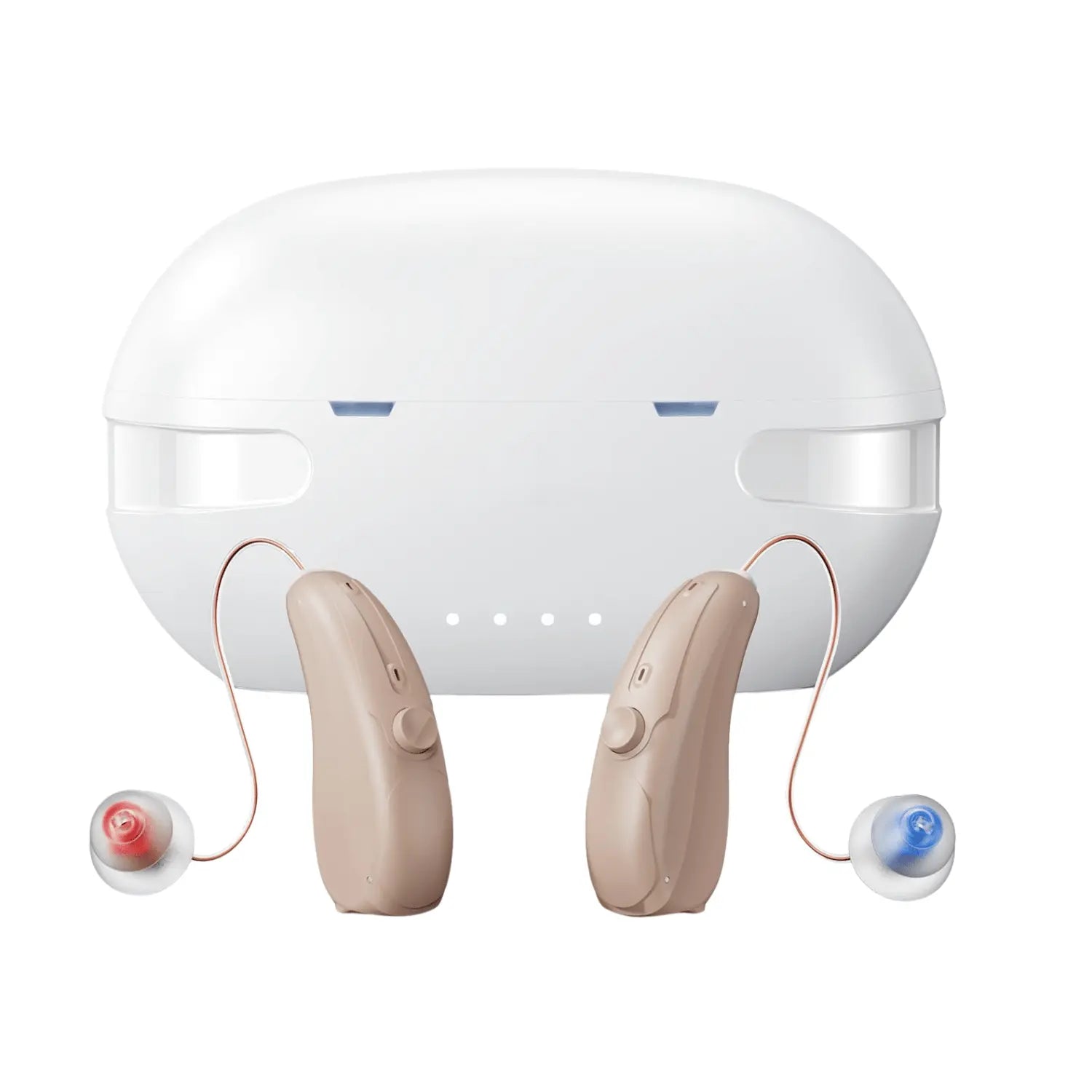
Panda Quantum is a 16-channel receiver-in-canal hearing aid built around that idea. Pair the device with the Panda app after delivery and the app runs an in-ear hearing test through the device itself, then sets gain and frequency response for each ear automatically to match the user's audiogram. It is similar to what an audiologist does at a clinical fitting, applied to each side independently. The same app-based hearing personalization is also available on Panda Air.
For an adult with mild loss that is even slightly different between the two ears, the appeal of frequency-specific hearing adjustment in a 16-channel platform is that the two devices can be tuned independently rather than averaged into one setting. Adaptive noise reduction handles the rest in busy rooms. Quantum is FDA-cleared as an over-the-counter device for adults with mild-to-moderate loss; severe or profound loss still benefits most from a clinical fitting.

Limitations of This Research
The sample, while sizable for a psychoacoustic pediatric study at 121 participants, was assembled in a case-control design rather than a population sample, which limits how directly the asymmetry effect can be generalized to all children with mild loss. The stimuli were diotic, so the experiment did not directly test spatial hearing tasks like locating a speaker in a noisy room, which is where asymmetric loss often shows up most painfully in real life.
The abstract does not disclose study funding or conflicts of interest, which the full paper may address. The regression assigned roles to age, pure-tone average, and interaural asymmetry, but did not break down which specific frequency regions of asymmetry mattered most, leaving room for follow-up work targeting low-versus-high frequency asymmetries separately.
Where This Leaves Us
The headline is small, but the message is not. Average hearing thresholds are a coarse tool for capturing how the brain hears the world. When the two ears disagree, even mildly, perception can wobble in ways the audiogram alone does not predict. For pediatric audiology that argues for earlier, more granular tracking of asymmetric loss. For adults considering a hearing aid for the first time, it is one more reason to treat the two ears as two ears, with fitting that respects the differences between them.
Mishra SK, Nair A, Saxena U. Interaural Asymmetry, Not Hearing Thresholds, Predicts Diotic Frequency Modulation Sensitivity in Children With Minimal-to-Mild Hearing Loss. Ear and Hearing. 2026. Retrieved from PubMed. https://doi.org/10.1097/AUD.0000000000001843