Sustained Auditory Access Drives Language and Academic Outcomes for Kids With Cochlear Implants, Toronto Study Finds
A new study of 96 children, including 66 with bilateral cochlear implants, finds that the quality and consistency of auditory experience after implantation predicts language, memory, and academic outcomes more powerfully than balance function or socioeconomic measures.
Cochlear implants restore hearing for children with severe to profound hearing loss who cannot benefit from conventional hearing aids. The devices have transformed outcomes over the last three decades, yet researchers and families have noticed that implanted children still do not consistently catch up with their typically developing peers in language, working memory, and academic skills, even when implantation happens early.
A team based at the Institute of Medical Science at the University of Toronto set out to disentangle the factors that explain those persistent gaps. They asked which of four big variables, hearing history, etiology of hearing loss, vestibular and balance function, and socioeconomic marginalization, actually drives long-term developmental outcomes.
Title: Impacts of hearing history, etiology, vestibular and balance function, and socioeconomic marginalization on developmental outcomes in children with cochlear implants.
Authors: Hazen M, Cushing SL, Gordon KA.
Affiliations: Institute of Medical Science, The University of Toronto, Toronto, Canada.
Journal & date: Scientific Reports, published online June 3, 2026.
Study type: Observational study using regression and principal component analysis.
Link: PubMed DOI 10.1038/s41598-026-39747-2
Background: Why the Researchers Looked at This
A cochlear implant bypasses the damaged inner ear by sending sound directly to the auditory nerve through a surgically placed electrode array paired with an external sound processor. Many countries now recommend bilateral implantation (BCI), one device in each ear, for children with severe to profound bilateral hearing loss, ideally within the first year of life.
Early implantation gives children a head start, but it is not the whole story. After surgery, outcomes depend on how consistently the child wears the device, the quality of sound they receive, and the supports built around them at home and school. Socioeconomic marginalization, the bundle of factors that includes income, education, neighborhood resources, and access to specialized care, has been linked to weaker outcomes in many pediatric conditions.
The cause of a child's hearing loss also matters. Genetic etiologies, cochleovestibular anomalies (structural inner-ear differences that affect both hearing and balance), and congenital cytomegalovirus (CMV) infection each carry different implications for brain development. Vestibular and balance function is rarely measured but is increasingly seen as part of the picture, since the inner ear handles both hearing and balance.
How the Study Was Done
The research team studied 96 children between roughly 4.7 and 17.9 years old. Sixty-six had bilateral cochlear implants, with an average age of 11.5 years. Thirty were typically developing peers used as a comparison group, with a similar average age of 11.7 years.
Each child completed a battery of standardized tests: the CELF for language, the Dot Matrix and Corsi Block tasks for visuospatial working memory, the Digit Span for verbal working memory, and WIAT-III subtests for math and word reading. Vestibular and balance function was tested directly rather than inferred from reported symptoms.
Researchers then used regression and principal component analysis (PCA), a statistical technique that condenses many overlapping variables into a smaller set of components, to ask which inputs explained the outcomes. The PCA collapsed the data into four components labeled hearing loss history, auditory experience and resources, social marginalization, and vestibular and balance function.
What the Researchers Found
Children with bilateral cochlear implants scored significantly below typically developing peers on language (p = 0.003), visuospatial working memory (p = 0.001), math (p less than 0.001), and word reading (p = 0.048). The gap was real and statistically meaningful across multiple domains.
When the team asked which of the four PCA components predicted these outcomes, only one stood out across the board: auditory experience and resources. Hearing loss history alone, social marginalization on its own, and vestibular and balance function did not predict language, working memory, or academic scores once auditory experience was accounted for.
Vestibular function was clearly impaired in the BCI group compared with peers (p less than 0.001), which the authors note is consistent with the shared anatomy of hearing and balance. But while balance problems were real, they did not translate into measurable cognitive or academic differences in this sample.
Etiology mattered for the magnitude of the gap. Deficits were most pronounced in children whose hearing loss was caused by congenital CMV, cochleovestibular anomalies, or genetic conditions. The pattern suggests that some causes of childhood hearing loss carry developmental weight beyond the loss itself.
Pulled together, the data point to a clear message: in this cohort, sustained, high-quality auditory experience after implantation was the strongest predictor of how children did years later, while balance problems and broader social factors tracked less directly with outcomes.
What It Means for People with Hearing Loss
For families navigating a pediatric implant program, the practical implication is that surgery and activation are only the start. Daily wear time, ongoing programming of the device, consistent input from speech-language pathologists, and an environment where speech is delivered clearly all sit inside what the researchers grouped under auditory experience and resources.
For adults with hearing loss, the same principle scales down. The amount and quality of sound a person actually receives day to day, not just the diagnosis or the prescription, tends to drive how well the brain stays tuned to speech. Treated hearing loss that is well fit and consistently worn is functionally different from treated hearing loss that lives in a drawer.
The Toronto findings also reinforce that etiology shapes the trajectory. Genetic causes and congenital CMV deserve careful follow-up beyond hearing itself, including cognitive and academic monitoring.
A Practical Angle on Daily Auditory Experience for Adults
For adult OTC users, the takeaway about sustained auditory experience translates into something concrete: a device worn consistently, fit to the actual audiogram, and capable of handling the listening environments where speech matters most.
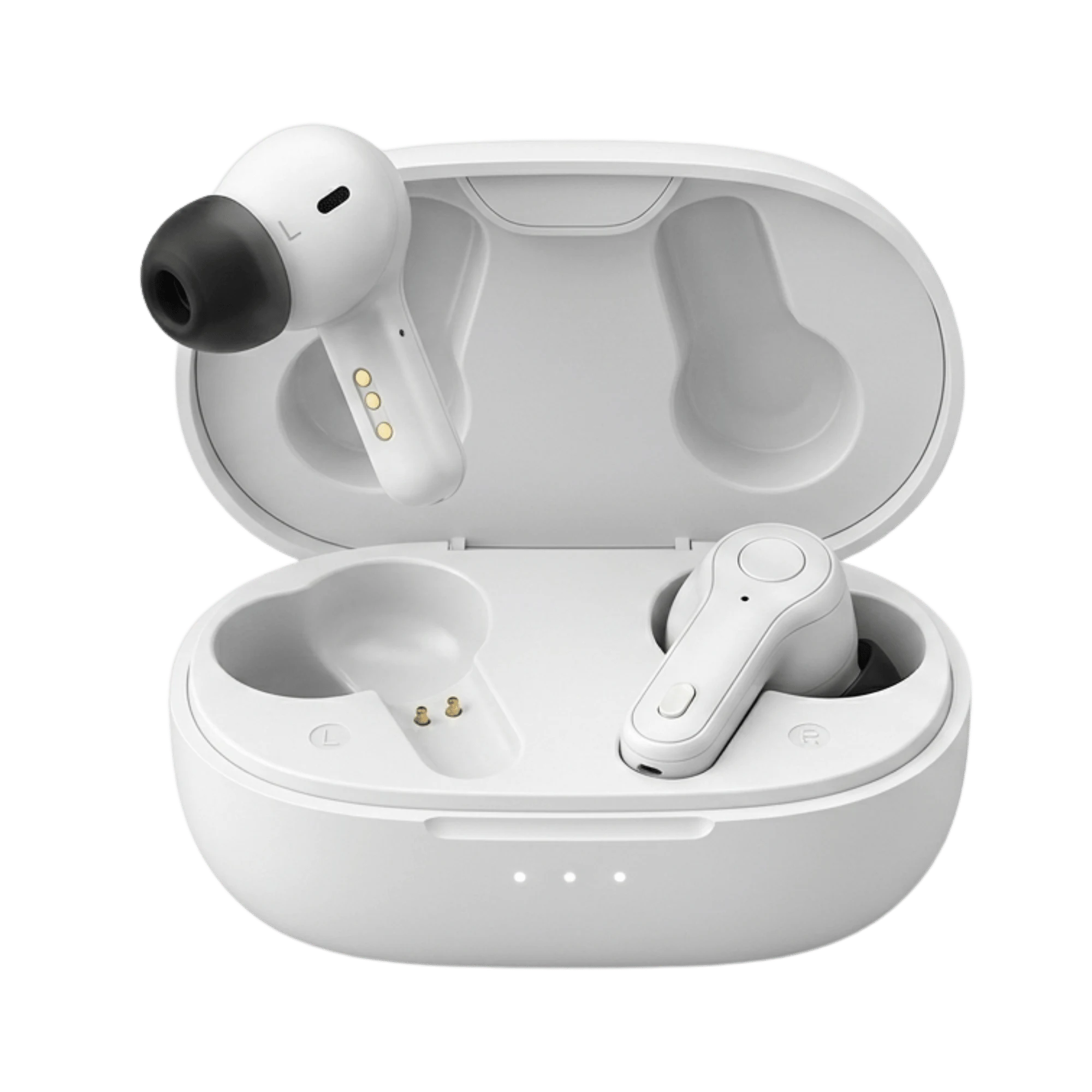
Panda Quantum is a 16-channel receiver-in-canal device designed for adults whose loss is more pronounced but still within the OTC range. After delivery it pairs with the Panda app and runs an in-ear hearing test through the hearing aid itself, then uses that audiogram for app-based hearing personalization, much like a clinical audiologist would do at a fitting. The 16-channel processing is built for clear speech in noisy environments where mild devices tend to struggle.
Quantum supports Bluetooth for calls, TV, and music, which makes consistent, high-quality auditory input easier to sustain across an ordinary day. The case provides up to 80 hours of total battery between charges, and the device comes with a 5-year warranty and a 45-day return window. OTC devices remain limited to perceived mild-to-moderate loss in adults, and severe or profound loss is still better managed through clinical care.

Limitations of This Research
The cohort of 66 children with bilateral cochlear implants is reasonable for a single-center developmental study but limits the precision of subgroup analyses, particularly for individual etiologies like congenital CMV. The cross-sectional design captures children at one moment in time rather than tracking change. Socioeconomic marginalization was measured using a single area-level index, which can flatten real differences between families inside the same neighborhood.
The authors are based at a major Canadian pediatric center, and funding and conflict-of-interest disclosures should be checked in the published manuscript before drawing policy conclusions from the work.
What to Do With This
If you are supporting a child with cochlear implants, the message from this study is that what happens after the surgery, daily wear, language-rich input, etiology-aware monitoring, and ongoing programming, matters at least as much as the surgery itself. For adults with hearing loss, the same logic applies in a less dramatic form: a well-fit device that you actually wear, day in and day out, is doing more for your brain than a better device sitting in its case.
Hazen M, Cushing SL, Gordon KA. Impacts of hearing history, etiology, vestibular and balance function, and socioeconomic marginalization on developmental outcomes in children with cochlear implants. Scientific Reports. 2026. Retrieved from PubMed. https://doi.org/10.1038/s41598-026-39747-2