Schools Are Missing Mild Hearing Loss in Kids, Lower-Threshold Screening Study Finds
A diagnostic-accuracy study in rural Alaska schools shows that screening at 15 decibels catches noticeably more mild hearing loss in children than the more common 20 dB cutoff, and aligns better with the World Health Organization's updated definition.
Mild hearing loss in childhood used to be treated as a footnote. If a child could function in class, the thinking went, the loss was not worth flagging. That view has shifted as evidence accumulated that even small reductions in hearing change how children learn language, follow lessons, and develop social skills. Updated screening standards have followed, but most schools still test at thresholds set decades ago.
A new study from researchers at the University of Arkansas for Medical Sciences, Duke University, and the Southcentral Foundation in Alaska put two screening levels head to head against a clinical audiometric benchmark, asking a simple question: if schools want to catch mild hearing loss in children, how low does the screening tone need to be?
Title: Can schools detect mild hearing loss? Evaluating screening accuracy and feasibility.
Authors: Robler SK, Stewart M, Reaves J, Platt A, Arthur A, Turner EL, Miller AH, Hirschfeld M, Emmett SD.
Affiliations: Center for Hearing Health Access and Department of Otolaryngology, University of Arkansas for Medical Sciences; Duke Global Health Institute and Duke School of Medicine; New York Institute of Technology College of Osteopathic Medicine; Southcentral Foundation, Anchorage, Alaska.
Journal & date: International Journal of Pediatric Otorhinolaryngology, published online May 12, 2026.
Study type: Prospective observational diagnostic-accuracy study.
Link: PubMed DOI 10.1016/j.ijporl.2026.112849
Background: Why the Researchers Looked at This
School hearing screenings are one of the only chances many children get to have their hearing checked outside a clinic. In rural communities, where pediatric audiology is often hours away, the school program is sometimes the only check that happens at all. Yet protocols vary by state and district, and the tone level used during screening, measured in decibels of hearing level (dB HL), determines how subtle a loss the test can catch.
For years, the World Health Organization defined hearing loss as a pure-tone average (PTA) greater than 25 dB. In 2021 the WHO updated its grading so that a PTA of 20 dB or higher counts as mild hearing loss. The change recognized that the older threshold left a band of real, functional loss officially invisible.
The Arkansas and Duke teams wanted to know whether routine school screening, conducted in noisy gymnasiums and classrooms, could realistically pick up children who meet the updated definition. They also wanted to know if dropping the screening tone from the common 20 dB level down to 15 dB would help.
How the Study Was Done
The research team enrolled 318 children attending schools in rural Alaska. Each child was screened twice with a pure-tone test, once at a presentation level of 15 dB and once at 20 dB, in the actual school environment.
All children then received a benchmark audiometric evaluation that defined whether they truly had hearing loss. Two definitions were applied: the older WHO threshold (PTA greater than 25 dB) and the updated WHO threshold (PTA of 20 dB or higher). Sensitivity, the share of children with true hearing loss the screen correctly flagged, and specificity, the share of normal-hearing children the screen correctly cleared, were calculated for each combination.
The setup let the researchers compare not just raw pass and fail rates but the practical tradeoffs that matter in a real school program: how many children would be sent for follow-up, how many would be missed, and how those numbers shift when the screening level and the underlying definition of hearing loss change.
What the Researchers Found
When the team applied the updated WHO definition of hearing loss to the benchmark audiometry, 4.8 percent of the 318 children met the criteria for mild hearing loss or worse. The older WHO definition flagged a smaller share, reinforcing the point that some children with measurable loss were being categorized as normal under the previous standard.
Screening at 15 dB produced a positive result in 18.6 percent of children, compared with 13.8 percent at 20 dB. The lower level caught more children, including more of those who genuinely had mild hearing loss. Sensitivity rose from 75.0 percent at 20 dB to 85.0 percent at 15 dB.
The tradeoff was specificity. The 15 dB screen correctly cleared 90.8 percent of children with normal hearing, while the 20 dB screen cleared 94.3 percent. In absolute numbers, screening at 15 dB generated 21 additional false positives and two fewer false negatives than screening at 20 dB.
Put differently, lowering the screening tone meant a small number of additional children would be referred unnecessarily, but fewer children with real mild hearing loss would be sent home as passing. The authors framed this as a meaningful improvement, especially for a condition where missed cases can quietly shape school progress for years.
What It Means for People with Hearing Loss
The findings line up with a broader shift in how mild hearing loss is treated across all ages. The older idea was that mild loss does not need attention until it becomes moderate. The newer idea, supported by both this study and the updated WHO definition, is that mild loss is real and worth catching early.
For families, the practical takeaway is to push for screening at the lower level if a child seems to be straining to follow speech, especially in noisy environments. If a school screen passes a child but parents or teachers still notice difficulty, a clinical audiogram remains the more sensitive next step.
The same logic carries over into adulthood. Adults with mild loss often delay any check for years because they assume it is not bad enough to matter. The trend in clinical guidelines is moving the other direction: catch it earlier, even when the loss is mild.
A Practical Angle on Lower Detection Thresholds for Adults
The Arkansas team's findings underline a need the study itself names: affordable, reliable ways to detect mild hearing loss outside a clinic. That gap is even wider for adults, who rarely receive routine hearing screening at all.
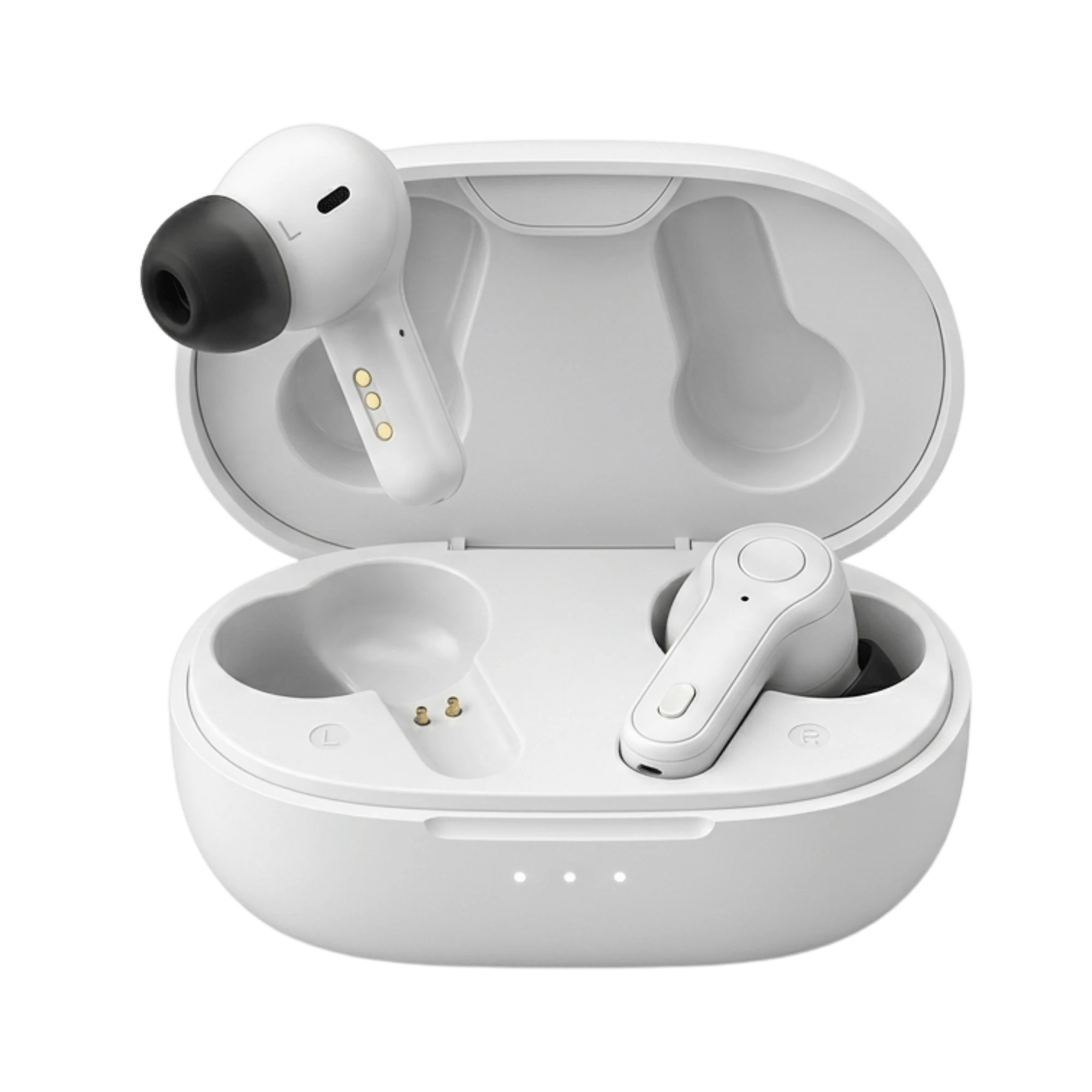
Panda Air is built for exactly this kind of access problem. It is a self-fitting OTC hearing aid that pairs with a phone app and runs a frequency-specific hearing test through the hearing aid itself. The app then uses the results to apply app-based hearing personalization, automatically programming the device's 16-channel processing to the user's audiogram in a way similar to a clinical fitting.
For adults whose mild loss has gone unscreened, that combination matters: a way to characterize the loss frequency by frequency and a device that adapts to it, without an in-person clinic visit. OTC devices are approved for adults with perceived mild-to-moderate loss, so people with severe or profound loss are still better served by a clinical fitting. The Panda Air comes with a 60-hour fast-charge case, a 5-year warranty, and a 45-day return window.
Limitations of This Research
The study was conducted in rural Alaskan school settings, where ambient noise levels and infrastructure differ from suburban or urban schools elsewhere. False-positive rates in quieter testing rooms could look different. The sample of 318 children, while adequate for a diagnostic-accuracy comparison, is not large enough to break out results by age subgroup or by specific etiologies of mild loss.
The authors disclosed academic and global-health affiliations, with no obvious commercial conflict of interest tied to the screening devices used. The work fits within a longer line of public-health research from the same group on rural hearing access.
Where This Leaves Us
If schools want to catch mild hearing loss in line with the updated WHO definition, this study suggests they will need to screen at lower decibel levels and accept a modest rise in referrals as part of the deal. For everyone else, the broader lesson is that mild hearing loss is real, common, and worth identifying earlier than older standards assumed, whether the person being tested is six years old or sixty.
Robler SK, Stewart M, Reaves J, Platt A, Arthur A, Turner EL, Miller AH, Hirschfeld M, Emmett SD. Can schools detect mild hearing loss? Evaluating screening accuracy and feasibility. International Journal of Pediatric Otorhinolaryngology. 2026. Retrieved from PubMed. https://doi.org/10.1016/j.ijporl.2026.112849
