Standard Hearing Tests Miss How Well Older Adults Actually Understand Speech, Japanese Cohort Study Finds
A retrospective study of 317 Japanese adults suggests that the standard tone-by-tone hearing test underestimates how much trouble older adults, particularly men, actually have understanding spoken words.
If you have ever had your hearing tested, you have probably sat in a small booth, raised your hand whenever you heard a beep, and walked out with a single number summary of your hearing. That test is called pure-tone audiometry, and for decades it has been the workhorse measurement of hearing loss in clinics around the world.
A new analysis from a hospital in Yokosuka, Japan, argues that this familiar test, on its own, can quietly miss something that matters at least as much: how well a person can pick a friend's voice out of a sentence at the dinner table, or follow a grandchild on the phone. The researchers looked at how pure-tone results compare to a second test that asks people to repeat back actual words, and found that the gap between the two grows with age and is notably wider in men.
About This Study
Title: Age- and sex-related differences in the relationship between pure-tone audiometry and speech discrimination in a Japanese cohort.
Authors: Hiroshi Hyakusoku, Toshihide Inagi, Aritomo Yamazaki, Shoji Kaneda, Fumiyuki Goto, Kenji Okami, Koichiro Wasano.
Affiliations: Department of Otorhinolaryngology, Yokosuka Kyosai Hospital, Japan; Department of Otolaryngology, Head and Neck Surgery, Tokai University School of Medicine, Kanagawa, Isehara, Japan.
Journal and publication date: Auris Nasus Larynx, May 2026 (volume 53, issue 4, pages 479 to 484).
Study type: Retrospective single-center cohort analysis.
PubMed reference: DOI 10.1016/j.anl.2026.04.009
Background: Why the Researchers Looked at This
Pure-tone audiometry, often abbreviated PTA, measures the softest pure tone a person can detect at each of several frequencies, from low bass tones up to the high-pitched range where consonants live. The result is the familiar audiogram. Speech discrimination testing, by contrast, plays a list of single-syllable words at a comfortable volume and asks the listener to repeat them back. The score is the percentage of words the listener gets right.
In an ideal world, the two tests would track each other neatly. If your audiogram shows mild loss, your speech score should be high; if your audiogram shows severe loss, your speech score should be lower. In practice, clinicians have long noticed that some older patients have audiograms that look only modestly impaired but still struggle badly with conversation, a pattern sometimes called phonemic regression. The Japanese team set out to map this mismatch more precisely, and to see whether the size of the gap depended on age or biological sex.
How the Study Was Done
The researchers pulled records from Yokosuka Kyosai Hospital for patients who had both a pure-tone test and a speech discrimination test between April 2007 and February 2025. Because they wanted to isolate ordinary age-related decline, they excluded anyone with current ear infections, prior inner ear or auditory nerve disease, large differences between the two ears, or a measurable air-bone gap on their audiogram, which would suggest a mechanical, not a sensorineural, hearing problem.
After applying those filters, 317 people remained, 154 male and 163 female, contributing data from 634 ears in total. The team then asked two questions of the data. First, how did pure-tone thresholds and speech discrimination scores change across age groups for each sex? Second, when pure-tone hearing was the same in two patients, did their speech discrimination scores still differ by age or sex, and at which test frequencies were the two measurements most tightly linked?
What the Researchers Found
Both measurements got worse with age in both sexes, which was expected. The more interesting findings showed up when the authors compared the sexes head to head and looked at where the two tests agreed and disagreed.
Female patients had significantly better pure-tone hearing thresholds than male patients at 2000 hertz and above, which is the frequency range that carries most of the sharpness and clarity of consonants like s, f, and th. That alone is consistent with decades of audiology research showing that men, on average, lose high-frequency hearing earlier and faster than women.
More striking was the speech finding. Among patients aged 70 and older, women scored noticeably higher than men on the speech discrimination test, even after the audiogram differences were taken into account. When the authors plotted pure-tone results against speech discrimination scores, the slope of the relationship was steeper in men: every step of additional hearing loss on the audiogram cost men more speech understanding than it cost women. The single best predictor of a collapse in speech discrimination, the authors report, was the hearing threshold at 1000 hertz, a mid-frequency tone that sits squarely in the speech range.
Put together, the results suggest that a male patient in his late 70s with a moderately abnormal audiogram may be functioning, in real-world conversation, considerably worse than a female patient of the same age with the same audiogram. The audiogram alone would not flag the difference.
What It Means for People with Hearing Loss
For anyone who has ever been told their audiogram looks "not that bad" while still feeling lost at a noisy restaurant, this paper is a quiet validation. The audiogram is a useful map, but it is not the territory. Real listening happens in rooms with background chatter, multiple talkers, and rapid speech, and the brain's ability to turn faint, distorted sound into recognizable words can decline in ways the audiogram does not capture, particularly as people move past 70 and particularly in men.
The practical implication is that older adults who suspect their hearing has slipped should not be reassured solely by a clean-looking audiogram. Asking for a speech discrimination test, or noting specific real-world struggles such as missing dialogue on television or losing track of group conversation, can help paint a fuller picture of what kind of help is actually needed.
When the Audiogram Is Only Half the Story, the Fit Matters More

The Japanese study's central point is that pure tones and real speech tell different stories about older ears. Any hearing aid worn by an older adult therefore needs to do more than just amplify a chart. It needs to handle the messy mid-frequency band around 1000 hertz that the authors flagged as most predictive of speech trouble, and it needs to be tuned to the wearer's own audiogram rather than to a one-size guess.
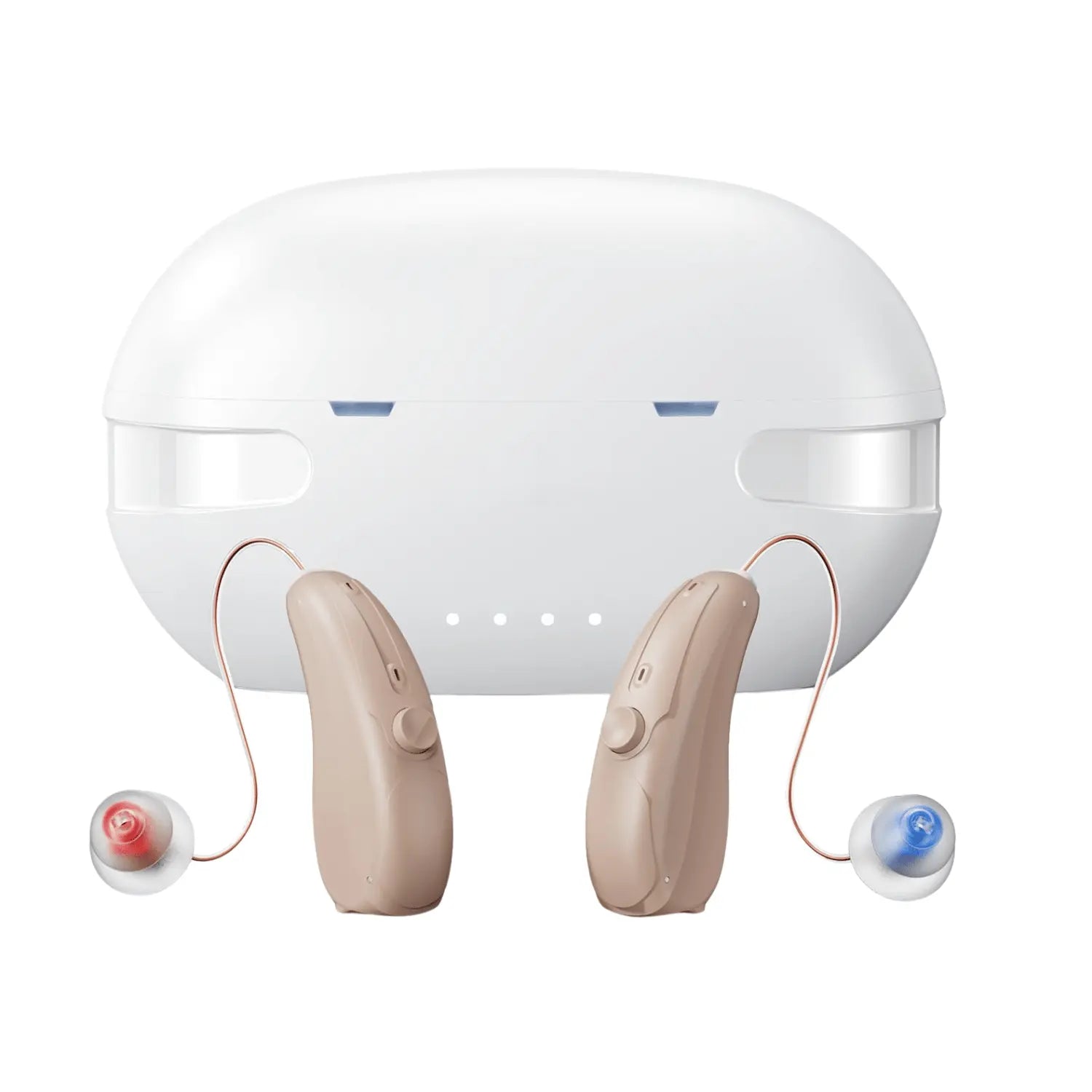
Panda Quantum is the company's 16-channel receiver-in-canal model and is built around exactly that idea. It includes adaptive noise reduction designed to keep speech intelligible in background noise, Bluetooth streaming for phone calls, television, and music, and up to 80 hours of total battery life with the charging case. Quantum also ships with the Panda app-based, in-ear hearing test: after delivery, the wearer pairs the device with the Panda app, runs a frequency-specific hearing check directly through the hearing aid itself, and the device's gain and frequency response are then programmed automatically to match the user's audiogram, similar to what an audiologist does at a clinical fitting. For an older adult whose 1000 hertz threshold is doing more work than the rest of the audiogram suggests, a fitting that actually maps to that person's own audiogram is meaningful.
Quantum is available with a 5-year warranty and a 45-day return window through pandahearing.com. Over-the-counter hearing aids are approved for mild to moderate hearing loss; people with severe or profound loss usually still benefit most from a clinical fitting by a licensed audiologist.
Limitations of This Research
The study is retrospective, which means the authors worked with records that already existed rather than running a controlled trial. All of the patients came from a single hospital in one Japanese city, so the findings may not transfer cleanly to people of other ancestries, language backgrounds, or noise exposure histories. The exclusion of patients with middle ear or inner ear disease was deliberate but also narrows who the results apply to. The team also did not track individual patients over time, so they cannot say how quickly the gap between pure-tone hearing and speech discrimination opens up in any one person.
The authors do not report a specific funding source or commercial conflict of interest in the abstract, but readers who care about either can check the disclosure section in the published paper.
Where This Leaves Us
The audiogram remains the standard opening test of hearing, and it is not going away. The Yokosuka data are a reminder, though, that the audiogram alone tells you what tones a person can detect, not what conversations a person can follow. For older adults, especially older men, asking the simple question "how well do I understand actual speech?" may be more useful than a single decibel number. The findings reinforce, again, that fitting matters as much as amplification.
Hyakusoku H, Inagi T, Yamazaki A, Kaneda S, Goto F, Okami K, Wasano K. Age- and sex-related differences in the relationship between pure-tone audiometry and speech discrimination in a Japanese cohort. Auris Nasus Larynx. 2026. Retrieved from PubMed. DOI 10.1016/j.anl.2026.04.009.