Lab Study: Mitochondrial Transplantation Restores Cellular Energy in Cells with a Genetic Hearing Loss Mutation
A team of researchers in South Korea reports that transferring healthy mitochondria into skin cells from patients with a well-known hearing loss mutation boosted cellular energy production and shifted the cells toward a healthier mitochondrial DNA profile.
Most current treatments for sensorineural hearing loss focus on amplifying or replacing what is no longer working at the inner ear. Hearing aids deliver more sound to damaged hair cells, and cochlear implants bypass them entirely. Neither approach addresses the underlying biology of the cells themselves.
A new laboratory study, published this week in Scientific Reports, takes a different angle. The authors tested whether transplanting healthy mitochondria into the cells of patients with a specific genetic cause of hearing loss could reverse the cellular dysfunction at its source.
About This Study
Title: Therapeutic potential of mitochondrial transfer in reversing mutant-to-wild-type mtDNA ratio and improving mitochondrial dysfunction in 1555A>G mtDNA mutation-associated hearing loss
Authors: Yujin Kim, Chang-Hee Kim, Dong Woo Nam, Bong Jik Kim, Ngoc-Trinh Tran, Jin Hee Han, Minyoung Kim, Shin-Hye Yu, Seo-Eun Lee, Jeong Seon Yeo, Iksun Kwon, Kyuboem Han, Chun-Hyung Kim, Young Cheol Kang, and Byung Yoon Choi
Affiliations: Paean Biotechnology, Inc., Seoul; Konkuk University Medical Center; Seoul National University Bundang Hospital; Chungnam National University Sejong Hospital; Seoul National University Medical Research Center (South Korea)
Journal: Scientific Reports, published 13 May 2026
Study type: Preclinical laboratory study using patient-derived fibroblasts
PubMed / DOI: 10.1038/s41598-026-51402-4
Background: Why the Researchers Looked at This
Mitochondria are the small structures inside almost every cell of the body that generate the chemical energy needed to keep that cell working. They carry their own short loop of DNA, known as mitochondrial DNA or mtDNA. Mutations in mtDNA can disrupt the production of ATP, the molecule cells use to power their daily activities. The hair cells of the inner ear, which convert sound vibrations into nerve signals, are extremely energy-hungry, so they are unusually vulnerable when mitochondrial energy production goes wrong.
One of the most studied mtDNA changes in hearing loss is called m.1555A>G. People who carry it can develop hearing loss on their own, and they are also at very high risk of sudden, severe hearing loss after taking certain antibiotics such as gentamicin or kanamycin, which are known as aminoglycosides. Until now, clinical care for this population has been focused on rehabilitation: fitting hearing aids, or, in more advanced cases, recommending cochlear implants. There has been no widely available treatment aimed at the mitochondria themselves.
The South Korean research team set out to ask a more upstream question. If the problem starts in the mitochondria, can adding healthy mitochondria to the cells partially repair the damage?
How the Study Was Done
The team worked with skin cells, called fibroblasts, taken from two patients who carry the m.1555A>G mutation. Both had been identified during cochlear implant surgery, meaning their hearing loss was advanced enough to warrant an implant. The fibroblasts were grown in the laboratory so the researchers could study mitochondrial function in cells directly affected by the mutation.
The treatment under investigation is called PN-101. It is a preparation of mitochondria isolated from human umbilical cord mesenchymal stem cells, donor cells that come from outside the patient. Working under controlled conditions, the team applied these isolated mitochondria to the patient cells and then measured what happened.
The researchers tracked several indicators of cellular health. They measured how much ATP the cells produced, how active a key part of the energy-producing machinery known as complex I was, how much of the protein machinery for oxidative phosphorylation, the main energy pathway, was present, and how the cells held up after being challenged with kanamycin, an aminoglycoside antibiotic known to harm cells with this mutation. They also tested the cells before and after repeated rounds of mitochondrial transfer and looked at the ratio of mutant to non-mutant mtDNA in each cell.
What the Researchers Found
The team reports that the transferred mitochondria did reach the patient cells and that the cells responded measurably. After treatment, the fibroblasts produced significantly more ATP than untreated cells from the same patients. The activity of complex I, which is one of the points where the m.1555A>G mutation typically causes trouble, also went up.
Levels of several proteins involved in oxidative phosphorylation increased as well. The authors interpret these findings as evidence that the donor mitochondria are not just sitting inertly in the patient cells but are contributing to the energy-producing machinery in a meaningful way.
A separate experiment tested how the treated cells fared when exposed to kanamycin. Aminoglycoside antibiotics are known to be especially toxic in people with the m.1555A>G mutation, and they cause measurable mitochondrial damage in their cells. Treated cells held up better than untreated ones, suggesting that the mitochondrial transfer offered some protection against this stressor.
Perhaps the most striking observation is what happened to the mix of mtDNA inside the cells. People with mtDNA mutations often carry both mutated and normal copies of the mitochondrial genome side by side, a condition called heteroplasmy. After mitochondrial transfer, the balance shifted toward more wild-type, non-mutant mtDNA. Repeated rounds of treatment sustained and increased this shift, the authors write, suggesting a possible way to nudge the mtDNA composition of affected cells in a healthier direction over time.
What It Means for People with Hearing Loss
This is early-stage, laboratory research. The cells came from patients, but they were skin cells in a dish, not inner ear cells inside a living person. So the most accurate way to read this study is as a proof of principle: in human cells that carry one of the best-known genetic causes of hearing loss, a mitochondrial transfer approach was able to improve the underlying energy biology and even tilt the mtDNA balance toward the healthier version.
For people who currently carry the m.1555A>G mutation or other mtDNA changes linked to hearing loss, the practical takeaway is twofold. First, the standard of care for now is still rehabilitation, with hearing aids for most people and cochlear implants for those with severe to profound loss. Second, research is moving toward treatments that target the biology itself, and that direction is worth following.
For everyone else, this study is a useful reminder that hearing loss has many different underlying causes, and that the most appropriate management can depend on what is going on in the inner ear at a cellular level.
Auditory Rehabilitation Is Still the Day-to-Day Reality, and Access Matters
The authors are clear that even if mitochondrial transplantation pans out, it is years away from being part of normal clinical care. In the meantime, the people most affected by mtDNA-related hearing loss continue to depend on hearing aids and cochlear implants for daily life, and access to those devices is uneven.
Affordability and ease of fitting are part of that access problem. Panda Air, a discreet earbud-style in-the-canal hearing aid sold through pandahearing.com, is built around this idea. It uses 16-channel wide dynamic range compression with multi-band adaptive noise reduction, a 60-hour fast-charge case, a 5-year warranty, and a 45-day return window. After delivery, the user pairs the device with the Panda app, which runs a frequency-specific hearing test through the hearing aid itself and then automatically programs the gain and frequency response to match the user's audiogram. The fitting step is similar in spirit to what an audiologist does in a clinic, but it happens at home with no extra appointment.
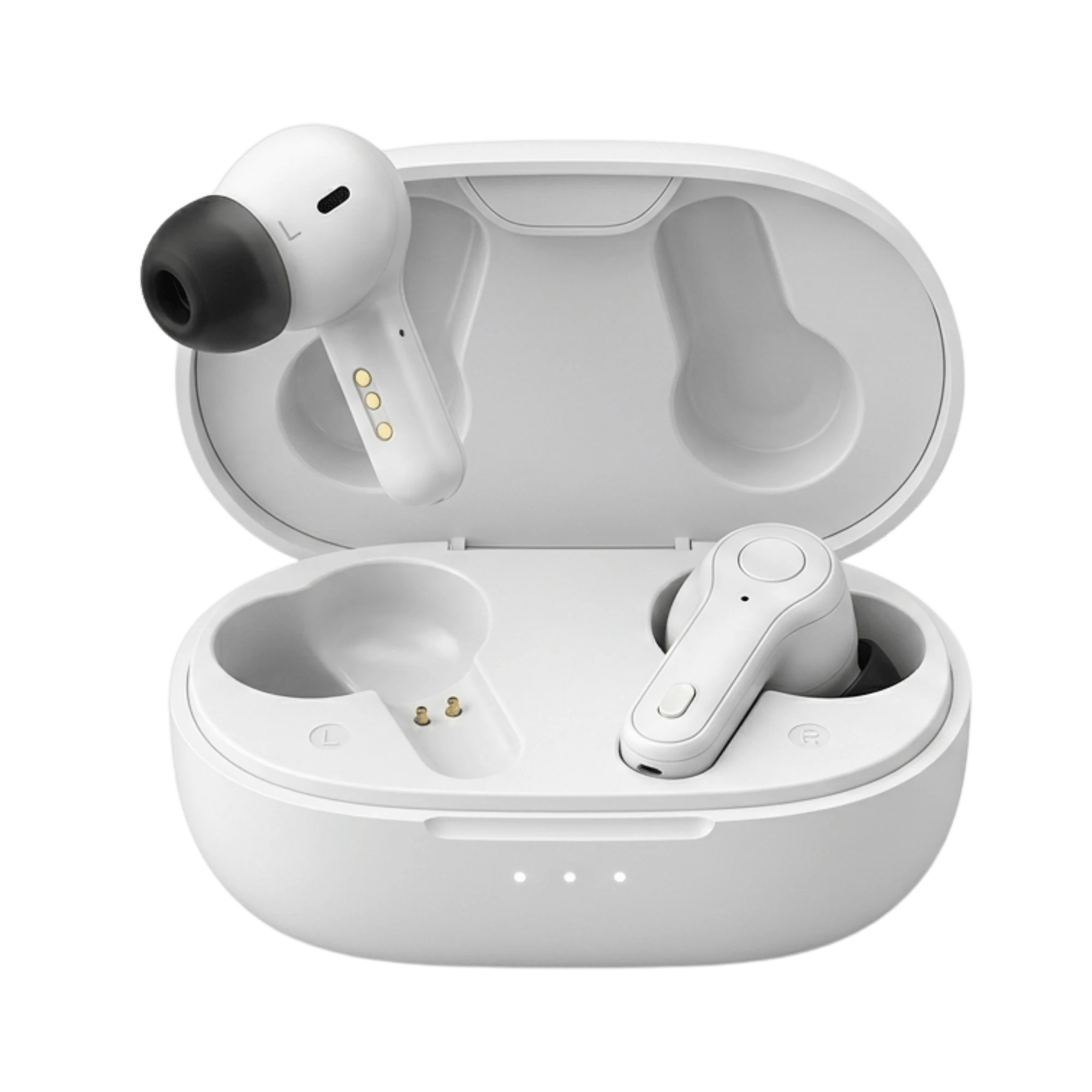
One caveat: over-the-counter devices like Panda Air are approved for mild-to-moderate hearing loss in adults. People with severe or profound loss, including many with advanced mtDNA-related hearing loss, are still best served by a clinical fitting or, where indicated, a cochlear implant evaluation.
Limitations of This Research
The study was carried out entirely in cell culture, in fibroblasts from only two patients with one specific mutation. Fibroblasts are not hair cells, and a dish is not an inner ear. Whether mitochondrial transplantation can be delivered safely and effectively into the cochlea of a living person, with lasting hearing benefit, is not addressed in this paper.
Readers should also note that several of the authors are affiliated with Paean Biotechnology, the company developing PN-101, which is the product tested in this study. The university and hospital co-authors provide an independent clinical and academic perspective, but a clear potential conflict of interest exists and should be kept in mind when interpreting the results.
Where This Leaves Us
Mitochondrial transplantation for genetic hearing loss is still firmly in the laboratory, but it is an interesting first signal that an approach aimed at the underlying biology of the inner ear might one day complement, rather than just compensate for, the cellular damage that drives some forms of hearing loss. For now, well-fitted hearing aids and cochlear implants remain the tools people actually use, and the priority for most readers is simply making sure they have access to a device that fits their hearing and their life.
Kim Y, Kim CH, Nam DW, Kim BJ, Tran NT, Han JH, Kim M, Yu SH, Lee SE, Yeo JS, Kwon I, Han K, Kim CH, Kang YC, Choi BY. Therapeutic potential of mitochondrial transfer in reversing mutant-to-wild-type mtDNA ratio and improving mitochondrial dysfunction in 1555A>G mtDNA mutation-associated hearing loss. Scientific Reports. 2026. Retrieved from PubMed. https://doi.org/10.1038/s41598-026-51402-4