Higher Serum Potassium Was Linked to More Hearing Loss in 10,000 US Adults
In a cross-sectional analysis of national US health survey data, adults with higher blood potassium levels were more likely to have hearing loss across low, speech and high frequencies alike.
Most research into age-related hearing loss looks at noise exposure, genetics and ageing itself. A smaller line of work asks a different question: whether ordinary blood chemistry, the kind measured at any routine physical, carries any signal about how well someone hears.
A new analysis published in Medicine takes that question to a large national dataset. Using audiometric and laboratory data from the US National Health and Nutrition Examination Survey, the researchers tested whether serum potassium levels track with measured hearing loss in the general adult population.
About This Study
Title: Association between serum potassium levels and hearing loss: Evidence from a cross-sectional study based on NHANES
Authors: Xiao-Zou Luo, Jian Luo, Jie Shen, Deng-Chao Wang
Affiliations: Department of Otorhinolaryngology Head and Neck Surgery, The First People's Hospital of Yibin, Yibin, Sichuan, China; Department of General Surgery, Zigong Fourth People's Hospital, Zigong, Sichuan, China
Journal: Medicine (Baltimore), 2026;105(30):e49873, published 24 July 2026
Study type: Cross-sectional population study using NHANES data with multivariable logistic regression
PubMed DOI: 10.1097/MD.0000000000049873
Background: Why the Researchers Looked at This
Potassium is not an obvious candidate until you look at how the inner ear works. The cochlea, the snail-shaped organ that converts sound into nerve signals, is bathed in an unusual fluid called endolymph that is exceptionally rich in potassium. The movement of potassium into and out of the sensory hair cells is what generates the electrical signal the hearing nerve carries to the brain. That physiology is why researchers have wondered whether disturbances in potassium balance might show up as hearing difficulty.
Serum potassium, the value reported on a standard blood panel, is not the same thing as potassium inside the cochlea, and the study does not claim otherwise. It is simply the most widely measured proxy available in a dataset of this size, and until this analysis very little population-level evidence existed either way.
The study also separates hearing loss into three types by the pitch range affected. Low-frequency hearing loss affects the deeper sounds, speech-frequency hearing loss affects the mid range that carries most conversational speech, and high-frequency hearing loss affects the upper range that carries consonants and other fine detail. Age-related hearing loss typically shows up in the high frequencies first.
How the Study Was Done
The researchers analysed data from NHANES, a long-running US survey that combines interviews with physical examinations and laboratory testing on a sample designed to represent the national population. Crucially for a hearing study, NHANES includes audiometric testing rather than relying on participants to report their own hearing. After applying eligibility criteria, 10,009 participants were included.
The main analysis used multivariable logistic regression, which estimates the association between serum potassium and each type of hearing loss while adjusting for other measured characteristics. Results are expressed as odds ratios, where 1.0 means no association and 1.50 means roughly 50 percent higher odds of the outcome.
Two further steps went beyond the basic model. Restricted cubic spline analysis was used to check whether the relationship bends at particular potassium levels rather than rising steadily, and subgroup analyses with formal interaction tests examined whether the association differs across parts of the population.
What the Researchers Found
Hearing loss was common in this national sample, and the pattern by frequency was telling. Of the 10,009 participants, 4,688 had high-frequency hearing loss, or 46.8 percent. Speech-frequency hearing loss affected 2,952 people, or 29.5 percent, and low-frequency hearing loss 2,216 people, or 22.1 percent.
Higher serum potassium was significantly associated with all three types. For speech-frequency hearing loss the odds ratio was 1.49, with a 95 percent confidence interval of 1.15 to 1.94. For low-frequency loss it was 1.45, with an interval of 1.16 to 1.82, and for high-frequency loss 1.57, with an interval of 1.29 to 1.92. The strongest association, in other words, was with the high-frequency loss that is also the most common.
Trend tests across potassium categories were also statistically significant, and the restricted cubic spline analysis found the relationship to be linear for all three outcomes. That matters for interpretation: there was no threshold below which potassium appeared irrelevant and above which it suddenly mattered, but rather a steady gradient across the observed range.
The association was not uniform across everyone. Interaction tests indicated that sex, race and ethnicity, and diabetes status each significantly modified the relationship between serum potassium and hearing loss, meaning the size of the association differed meaningfully between these groups.
What It Means for People with Hearing Loss
The honest reading is that this is a signal worth following up, not a piece of health advice. Nobody should change their potassium intake on the strength of this analysis, and a cross-sectional study cannot tell you whether potassium levels influenced hearing, hearing loss influenced potassium levels, or some third factor drove both. Kidney function, blood pressure medication and diabetes all affect serum potassium and all have their own relationships with hearing.
What is more immediately useful is the prevalence picture underneath the headline finding. Nearly half of this nationally representative adult sample had measurable high-frequency hearing loss on formal audiometric testing. That is a far higher figure than the number of people who would describe themselves as having a hearing problem, which is a reminder of how quietly high-frequency loss establishes itself.
If there is a practical prompt here, it is to get hearing measured rather than estimated. The difference between how people rate their own hearing and what an audiogram shows is exactly the gap this study puts numbers on.
High-Frequency Loss Was the Most Common Pattern by a Wide Margin
At 46.8 percent, high-frequency hearing loss was roughly twice as common in this sample as low-frequency loss. That pattern explains a specific everyday experience: the high frequencies carry consonants such as s, f, th and t, so the first thing to go is not volume but clarity. Speech sounds present but mumbled, and it gets markedly worse in a restaurant or anywhere with background noise.
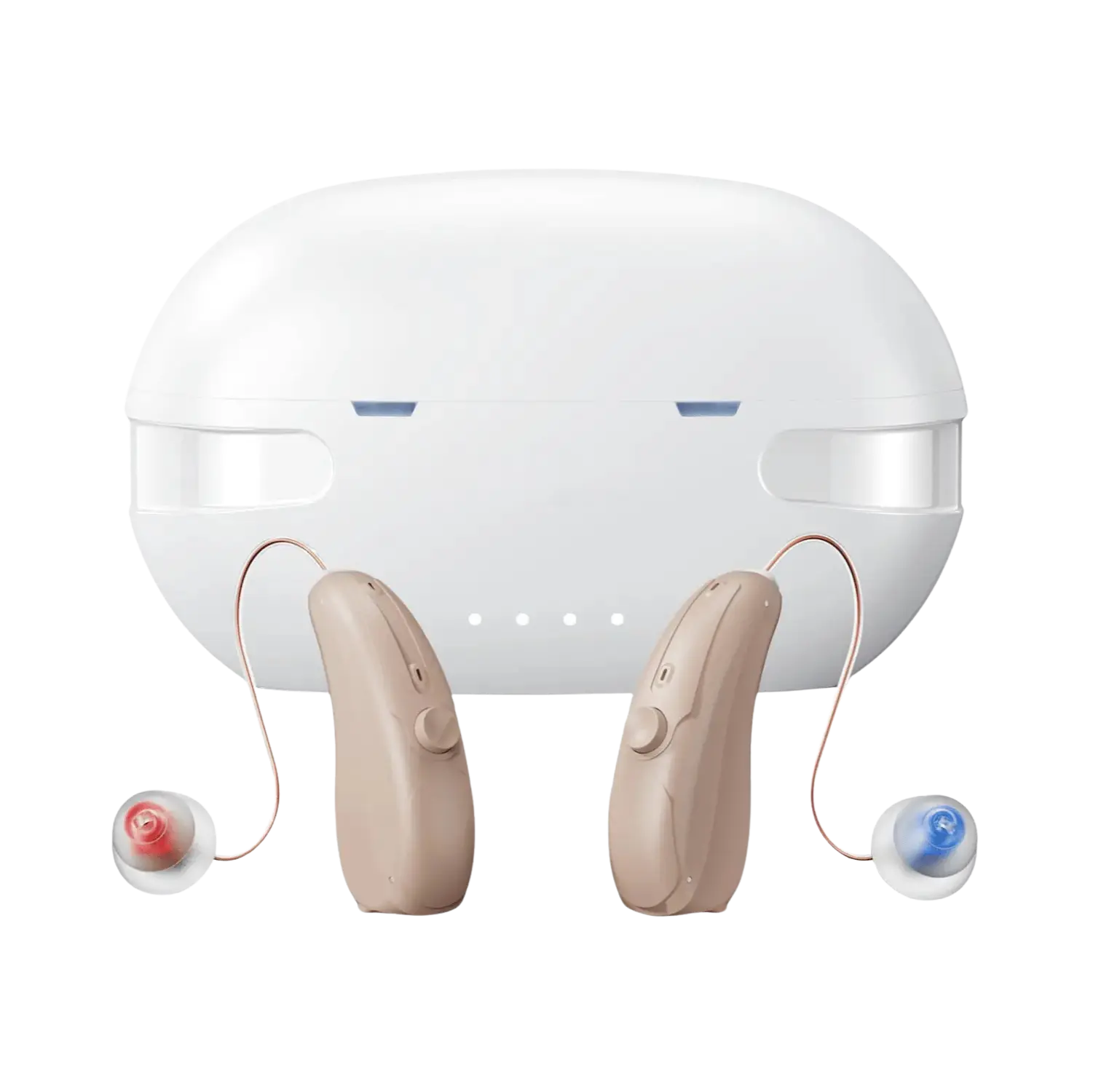
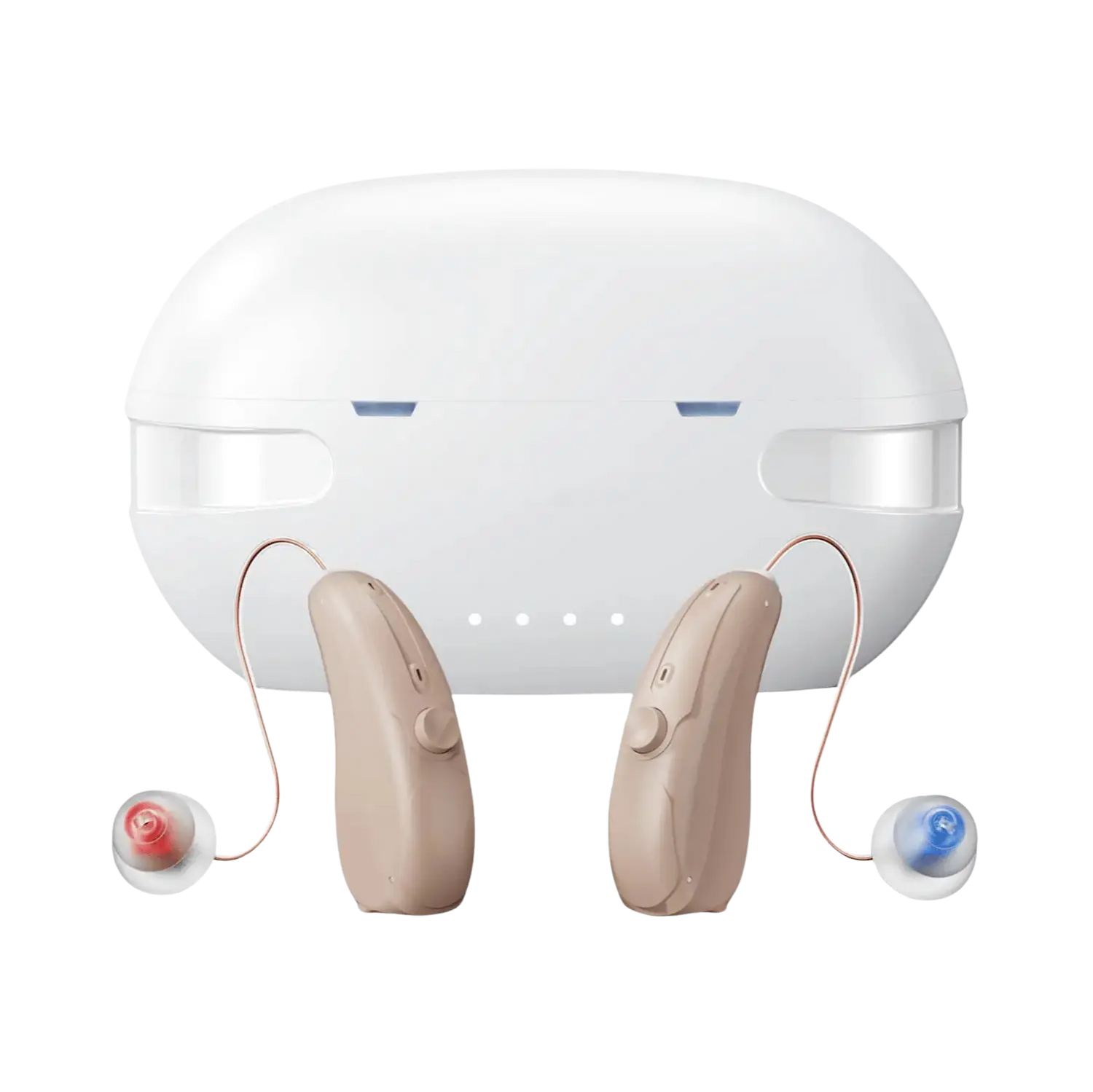
Devices built for that pattern have to do more than turn everything up. Panda Quantum is a receiver-in-canal aid with 16-channel WDRC processing and adaptive noise reduction, designed to lift the frequency bands where consonant detail sits while holding background noise down, which is the technical basis for clear speech in noisy environments. It also runs the same app-based in-ear hearing test as Panda Air, measuring frequency by frequency through the aid and shaping its response to the individual audiogram rather than applying a generic curve.

Quantum runs up to 80 hours in total with its case and connects over Bluetooth for calls, television and music. As with any over-the-counter device, it is cleared for mild to moderate hearing loss; more severe loss still benefits most from a clinical fitting. It carries a 5-year warranty and 45-day returns.
Limitations of This Research
The central limitation is the study design. A cross-sectional analysis measures potassium and hearing at the same moment, so it cannot establish which came first, let alone which caused which. Serum potassium is also a single point-in-time measurement that fluctuates with diet, hydration, kidney function and several common medications, and one reading is a rough stand-in for a person's typical level.
Residual confounding is a live concern given that the significant interactions with diabetes, sex, race and ethnicity all point to the association being entangled with other health factors rather than standing alone. The effect sizes, while statistically significant, are modest, and the confidence intervals are reasonably wide. The published abstract does not report funding sources or competing interests.
What to Do With This
Treat the potassium finding as an open research question, interesting mainly because it points toward metabolic factors that might eventually be modifiable. The part of this study that applies to daily life today is simpler and better established: high-frequency hearing loss is far more widespread than self-reported hearing problems suggest, it degrades clarity before it degrades volume, and a proper hearing measurement is the only way to know which side of that line you are on.
Luo XZ, Luo J, Shen J, Wang DC. Association between serum potassium levels and hearing loss: Evidence from a cross-sectional study based on NHANES. Medicine (Baltimore). 2026;105(30):e49873. Retrieved from PubMed. https://doi.org/10.1097/MD.0000000000049873