A Danish and American research team put listeners inside a simulated noisy room and found that the microphone setting designed to help you hear speech can also make it harder to work out where that speech is coming from.
Anyone who has stood in a crowded restaurant knows the problem. Several people are talking at once, the room bounces sound off hard surfaces, and the voice you actually want is somewhere in the mix. Finding it is not just a matter of hearing loudly enough. It is a matter of hearing where.
A study published in Ear and Hearing set out to measure exactly that. Rather than asking people to repeat sentences from a single loudspeaker, the researchers built a room full of competing voices and watched how listeners moved their heads and eyes to hunt down the one that mattered.
About This Study
Title: Effects of Hearing Loss and Hearing Aid Directionality on Performance and Orienting Behavior in a Multi-Talker Audiovisual Search Task
Authors: Sreeram Kaithali Narayanan, Axel Ahrens, Filip Ronne, Torsten Dau, Virginia Best, Tobias Neher
Affiliations: Hearing Systems Section, Department of Health Technology, Technical University of Denmark; Department of Clinical Research, University of Southern Denmark; Technical Audiology Section, Odense University Hospital and University of Southern Denmark; ORCA Labs, Lynge, Denmark; Department of Speech, Language and Hearing Sciences, Boston University
Journal and date: Ear and Hearing, published 4 August 2026
Study type: Controlled laboratory experiment comparing listeners with and without hearing loss across unaided and aided conditions
PubMed: PMID 42507806 · DOI 10.1097/AUD.0000000000001872
Background: Why the Researchers Looked at This
Most hearing aids sold today offer some form of directional microphone processing. A directional setting uses two or more microphones on the device to favour sound arriving from in front of the wearer and to suppress sound arriving from the sides and behind. The logic is simple: in conversation, you usually face the person you want to hear, so amplifying the front and trimming the rest should lift the target voice out of the background.
That logic holds up well in the classic laboratory test, where the listener sits still and the target talker sits directly ahead. Real rooms do not work that way. Talkers move, the person you want to hear may start speaking from your left, and reverberation, the sound that reflects off walls and ceilings before reaching your ears, smears the spatial cues your brain uses to place a voice in space.
The authors wanted to know what happens when the listener has to search. Their hypothesis was that hearing loss alone would produce poorer performance and messier orienting behaviour, and that directional processing would change things further because it alters the spatial cues arriving at each ear.
How the Study Was Done
Twenty normal-hearing adults and 22 adults with hearing loss took part. Each one was placed inside a moderately reverberant audiovisual environment rendered through a 64-channel loudspeaker array, wearing virtual-reality glasses that supplied the visual scene. Several narratives played at once from 15 possible directions around the listener, and the task was to find the target narrative, work out where it was coming from, and identify it.
The virtual-reality glasses did double duty. Their built-in sensors tracked head position and eye position throughout each trial, so the researchers could see not only whether someone got the answer right but how they went about looking for it. That gave them measures such as misorientation rate, the ratio of head movement to gaze movement, and how efficiently the listener swept the room before settling on an answer.
Everyone completed the task unaided, and then again with hearing aids set to an omnidirectional pattern and to a directional pattern. Performance was scored on response accuracy, localisation error, and response time.
What the Researchers Found
The clearest result was the gap between the two groups. Across every condition tested, participants with hearing loss answered less accurately, misjudged the target direction by a wider margin, and took longer to respond than the normal-hearing participants. That held whether they were aided or unaided.
The head and eye tracking showed why the task felt harder. Listeners with hearing loss searched less directly. They were more likely to turn their head away from the target on the first movement, then correct, and they leaned more on eye movements than on head movements to scan the room. In many trials they ended up with their gaze pointed at the target while their head stayed somewhere else, a pattern the normal-hearing group did not show.
The aided conditions produced the finding most likely to surprise readers. Among the normal-hearing participants, wearing the hearing aids reduced accuracy and increased localisation error, and the effect was strongest with the directional microphone setting. Those listeners also relied slightly more on head movement when aided, which is consistent with a device that rewards pointing your face at what you want to hear.
Eye-movement complexity rose under aided conditions in both groups, and rose most in the group with hearing loss. In plain terms, the aids changed the search strategy, not just the loudness. The authors read this as evidence that directional processing removes some of the spatial information the brain uses to place a sound, even while it improves the signal coming from straight ahead.
What It Means for People with Hearing Loss
The practical lesson is not that directional microphones are bad. It is that they are a tool with a specific job. When you are already facing a person and want their voice to cut through a noisy room, directionality earns its keep. When you are scanning a group, waiting for someone to speak up, or trying to tell which grandchild just called your name, the same setting can work against you.
That is one reason modern devices switch between microphone patterns automatically, or let the wearer change programs. It is also a reason to give yourself a few weeks with a new device before judging it. The study shows that hearing aids reshape how people physically search for sound, and habits built over years of hearing loss take a while to adjust.
There is a smaller point worth holding onto. The participants with hearing loss struggled even before the aids went in, which is a reminder that untreated hearing loss costs more than volume. It costs orientation, speed, and the easy confidence of knowing where a voice sits in a room.
Getting Speech to Stand Out Without Flattening the Room
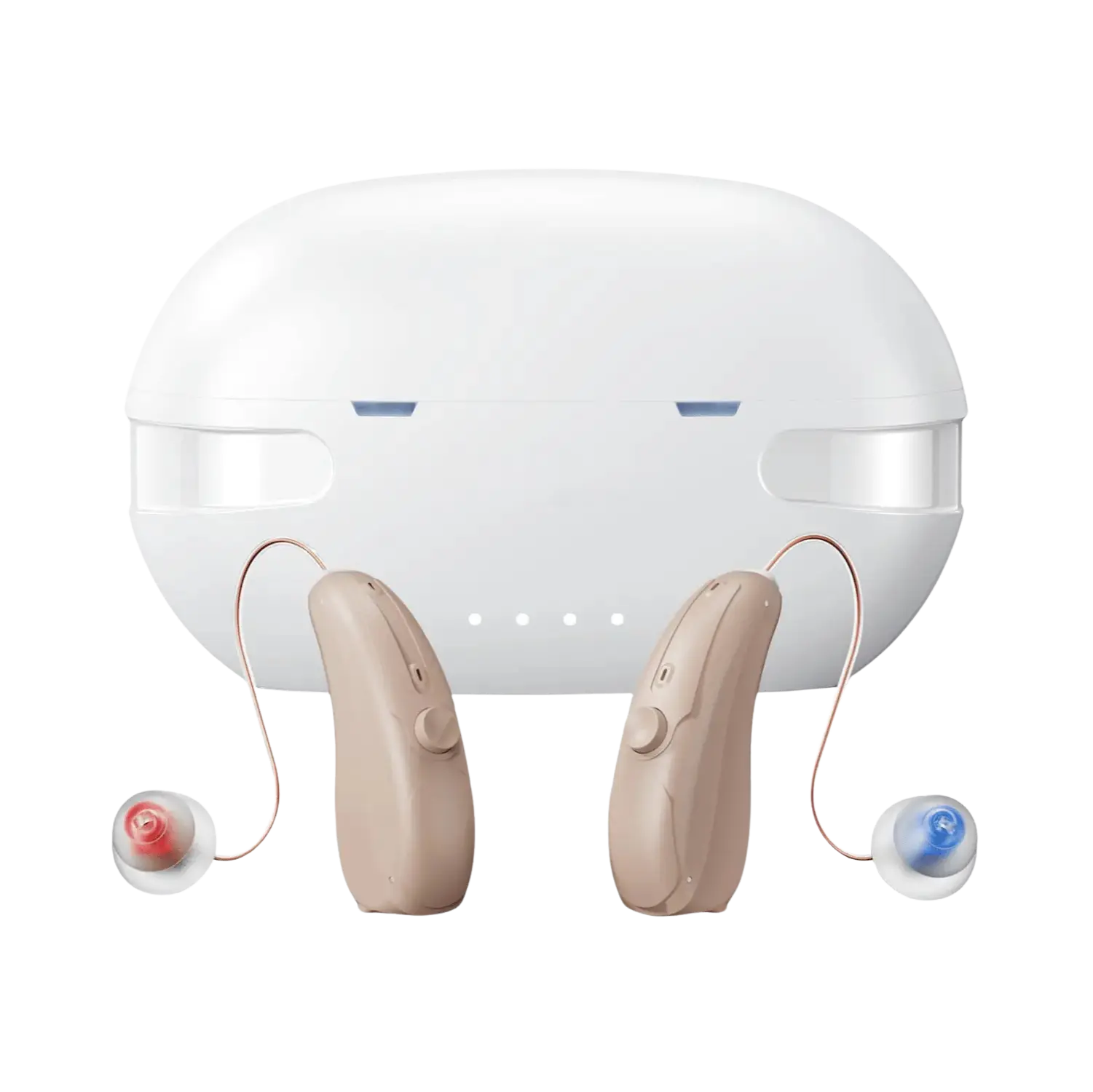
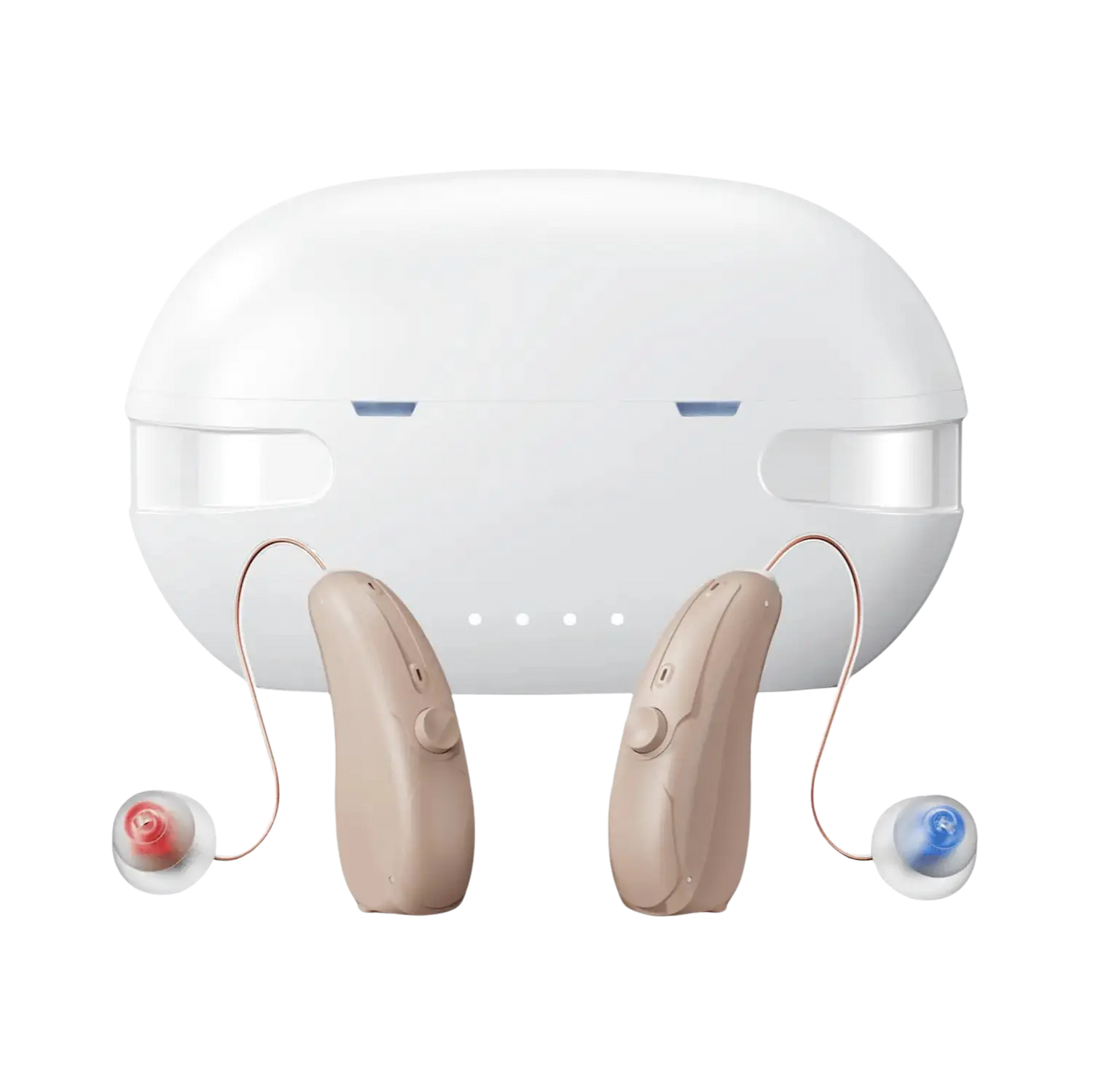
Because this study is really about the balance between suppressing background noise and preserving the cues that tell you where sound comes from, it is worth understanding how that balance is handled in devices people can buy directly. Panda Quantum is one such device, a receiver-in-canal hearing aid built around 16-channel processing with adaptive noise reduction, designed to lift clear speech in noisy environments rather than simply turning everything up.

The study also highlights how much individual hearing differs from person to person, which is where fitting matters. Quantum pairs with the Panda app after delivery and runs a frequency-specific test through the aid itself, then sets gain and frequency response to match the result, so the app-based hearing personalization is tuned to your ears rather than to an average. It carries Bluetooth for calls, television and music, up to 80 hours of total battery with the case, a 5-year warranty and 45-day returns. Details are at pandahearing.com.
One caveat is worth stating plainly. Over-the-counter hearing aids are approved for mild-to-moderate hearing loss. Anyone with severe or profound loss, or with the sort of localisation difficulty that makes crossing a road feel unsafe, still benefits most from a clinical fitting and an audiologist who can measure what is happening in each ear.
Limitations of This Research
This was a laboratory study with 42 participants in total, tested in a single simulated room using a loudspeaker array and virtual-reality glasses. That setup buys precise control over where every sound comes from, but it is not a restaurant, a family dinner or a place of worship, and listeners knew they were being tested. The aided conditions were also short-term, so the results say little about how someone performs after months of daily wear and acclimatisation.
The comparison was between two fixed microphone settings, omnidirectional and directional, rather than the adaptive systems many wearers actually use day to day. One co-author is affiliated with ORCA Labs, an industry research unit, and the PubMed record for this article does not include a funding or competing-interests statement, so readers cannot judge sponsorship from the abstract alone.
Where This Leaves Us
Hearing well in a busy room involves two separate jobs: pulling a voice out of the noise, and knowing where that voice is. This study is a careful reminder that a setting which helps with the first can quietly complicate the second, and that people with hearing loss are already working harder at both. If you wear hearing aids and find yourself turning in the wrong direction when someone calls you, that is not clumsiness. It is a known trade-off, and it is worth raising with whoever fits or programs your devices.
Narayanan SK, Ahrens A, Ronne F, Dau T, Best V, Neher T. Effects of Hearing Loss and Hearing Aid Directionality on Performance and Orienting Behavior in a Multi-Talker Audiovisual Search Task. Ear and Hearing. 2026. Retrieved from PubMed. DOI: 10.1097/AUD.0000000000001872