Sensorineural Hearing Loss Is Common and Stable in Adults With Mucopolysaccharidoses, Large Study Finds
A retrospective analysis of 122 adults reveals that nearly two-thirds of people living with mucopolysaccharidoses have hearing loss, and that the damage appears to plateau once individuals reach adulthood, regardless of the therapies they receive.
Hearing loss is not simply a side effect of aging. For many people living with rare inherited metabolic disorders, it arrives early, progresses silently, and often escapes sustained clinical attention amid the complexity of managing other symptoms. Mucopolysaccharidoses (MPS), a group of inherited lysosomal storage diseases, are a striking example: the conditions are known to involve auditory complications, but the long-term picture in adults has been poorly characterized.
A new retrospective study from a UK tertiary metabolic center offers the most detailed adult-specific picture to date, drawing on clinical and audiological records from 122 adults across multiple MPS subtypes. The findings have direct implications for how clinicians monitor and support hearing in this population throughout the lifespan.
About This Study
Title: Natural history of hearing loss in adults with mucopolysaccharidoses across phenotype and genotype
Authors: McCarron EP, Stepien KM, Summerfield N, Sharma R, Jovanovic A, Gossan N, Burkitt-Wright E, Gadepalli C
Affiliations: Adult Inherited Metabolic Diseases, Salford Care Organisation, Northern Care Alliance NHS Foundation Trust; Sheffield Teaching Hospitals NHS Foundation Trust; University of Sheffield; University of Manchester; Manchester University NHS Foundation Trust (UK)
Journal and Date: Molecular Genetics and Metabolism, May 2026 (Vol. 148, Issue 3, p. 110140)
Study Type: Retrospective cohort study
PubMed DOI: 10.1016/j.ymgme.2026.110140
Background: Why the Researchers Looked at This
Mucopolysaccharidoses are a family of inherited disorders caused by the body's inability to break down certain long-chain sugar molecules called glycosaminoglycans. When these molecules build up in cells and tissues, they interfere with the function of multiple organ systems over time, including the heart, skeleton, airway, nervous system, and ears. Because MPS is rare and multisystem, audiological care can easily become secondary to more life-threatening concerns, and clinicians have historically had limited data to guide how often and how aggressively they should monitor hearing in adult patients.
There are several distinct MPS subtypes, including MPS I (Hurler and Hurler-Scheie syndromes), MPS II (Hunter syndrome), MPS III (Sanfilippo syndrome), MPS IVA (Morquio A syndrome), MPS VI, and others. Each is caused by a deficiency in a different lysosomal enzyme, meaning both the pace and pattern of organ involvement can differ substantially between subtypes. Prior research on hearing loss in MPS has mostly focused on children, leaving adults understudied. This team set out to fill that gap with what they describe as the largest known adult MPS cohort analyzed for auditory outcomes.
Two specific questions drove the study: how prevalent and severe is hearing loss in adults with MPS, and does it progress over time? A secondary question was whether treatments -- specifically enzyme replacement therapy and haematopoietic stem cell transplantation -- have any detectable effect on auditory outcomes in adulthood.
How the Study Was Done
The researchers performed a retrospective review of clinical and audiological records from adults with a confirmed MPS diagnosis seen at a single tertiary metabolic center in the UK. Of 122 adult patients in the cohort, 111 (90.9%) had recent audiological data available for cross-sectional analysis. Hearing thresholds were classified using standard clinical categories: normal, mild, moderate, moderately severe, severe, and profound impairment. Hearing loss was further categorized by type -- sensorineural (damage to the inner ear or auditory nerve), conductive (dysfunction in the outer or middle ear), or mixed.
To assess whether hearing changes over time, the team identified 56 patients who had paired audiograms -- that is, at least two audiological assessments separated by a meaningful interval. The median follow-up between earliest and most recent assessments was 18 years, a remarkably long window that allowed the researchers to detect any systematic progression. They then tested for associations between hearing outcomes and clinical variables including MPS subtype, specific gene mutations (genotype), and history of treatment exposure.
Statistical comparisons between subgroups used non-parametric methods, which are well suited to datasets that include rare conditions and smaller sample sizes in individual categories. The study was not a randomized trial but a careful observational analysis of real-world clinical records, which means it captures what actually happens to patients over long periods in a specialized care setting.
What the Researchers Found
Hearing loss was present in 65.7% of adults in the cohort -- nearly two out of three patients. The most common type was sensorineural, affecting 51.4% of those assessed. This proportion is striking because sensorineural hearing loss, which involves damage to the sensory hair cells in the cochlea or the auditory nerve itself, is typically permanent and not reversible with medication or surgery. Conductive and mixed types also appeared, reflecting the complex anatomy affected by glycosaminoglycan accumulation in the ear canal, middle ear, and inner ear structures.
Severity of hearing loss differed significantly across MPS subtypes (p less than 0.001). Adults with MPS II (Hunter syndrome) and MPS IVA (Morquio A) had greater levels of hearing impairment compared to other subtypes, a finding that aligns with the known biology of how glycosaminoglycan buildup differs between conditions. Patients with attenuated phenotypes -- meaning less severe overall disease presentations -- showed a different auditory profile than those with classic or severe phenotypes.
When the researchers looked at longitudinal change in the 56 patients with paired assessments over 18 years, they found that 14.3% showed worsening by at least one severity category. However, there was no evidence of systematic progression across the cohort as a whole. In other words, at the population level, hearing loss in adults with MPS appeared to be stable -- neither reliably worsening nor improving over nearly two decades of follow-up.
Perhaps most clinically significant was the finding regarding treatment: hearing trajectories were similar regardless of whether patients had received enzyme replacement therapy or haematopoietic stem cell transplantation. Neither intervention appeared to modify adult auditory outcomes. This does not negate the value of these treatments for other disease manifestations -- both can be life-extending and life-improving -- but it does suggest that by adulthood, hearing damage related to MPS may be largely fixed, and that supportive audiological care (such as hearing aids) rather than disease-modifying therapy may be the most practical path to improving hearing function.
The authors conclude that early intervention and lifelong audiological surveillance are essential for this population, given the high prevalence of hearing loss, the lack of effective treatments for established auditory damage, and the potential for hearing impairment to affect quality of life, cognitive load, social participation, and communication across the lifespan.
What It Means for People With Hearing Loss
While this study focuses on a specific rare disease population, it carries lessons that extend to the broader conversation about sensorineural hearing loss. Sensorineural loss -- the kind found most commonly in these MPS adults -- is also the dominant type in age-related hearing loss (presbycusis), noise-induced hearing loss, and hereditary hearing conditions. The core message that established sensorineural damage does not reliably reverse with medical treatment, and that audiological support should begin early and continue throughout life, applies broadly.
For adults with MPS and their care teams, the practical implication is clear: hearing should be assessed regularly, even in the absence of obvious symptoms, because the plateau effect the researchers observed may mean that waiting for hearing loss to "get worse" before intervening delays support that could already be useful. For hearing specialists more generally, the study reinforces that audiological management -- including fitting appropriate amplification -- is not a last resort but a proactive part of comprehensive care for conditions involving sensorineural hearing impairment.
The research also highlights a recurring gap in rare-disease care: because MPS is uncommon, adults with the condition are a small community whose hearing needs can be overlooked in favor of more immediately visible disease manifestations. Studies like this one help quantify the burden and make the case for dedicated audiological follow-up protocols.
When Sensorineural Hearing Loss Requires Long-Term Amplification Support
For people with sensorineural hearing loss that is stable but persistent -- the pattern this study found in MPS adults -- the clinical priority shifts from treatment to support. That typically means consistent use of well-fitted hearing amplification, ideally matched to the individual's specific audiogram. Devices with strong signal processing, reliable battery life, and connectivity for everyday listening situations can make a meaningful difference in daily communication for those with mild-to-moderate sensorineural loss.
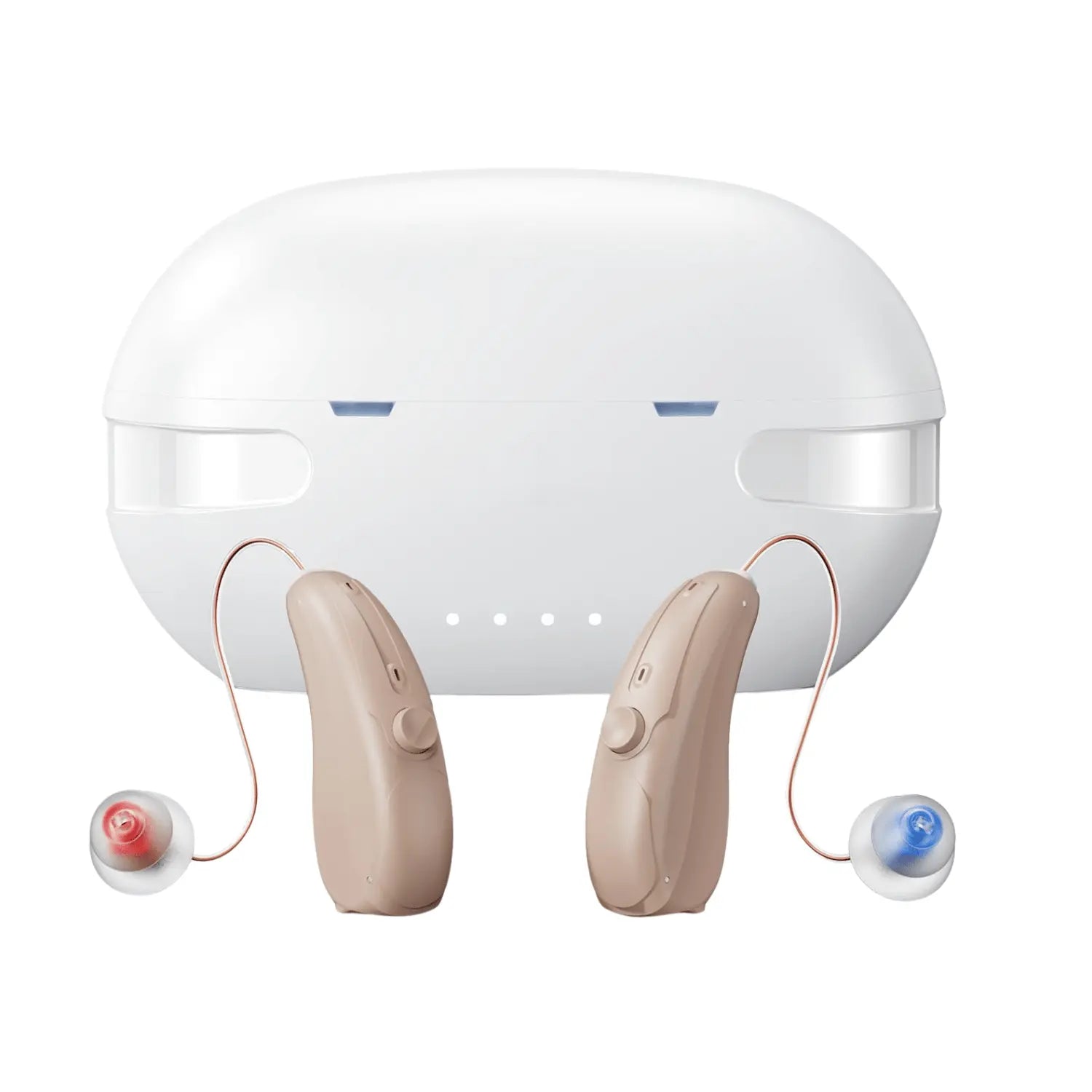
The Panda Quantum is a receiver-in-canal (RIC) hearing aid with 16 channels of processing, active noise reduction (ANR), and Bluetooth connectivity for calls, TV, and music streaming. It offers up to 80 hours of total battery life with its charging case and includes the Panda app-based in-ear hearing test: after receiving the device, users pair it with the Panda app, which runs a frequency-specific hearing test through the hearing aid itself and then automatically programs the device's gain and frequency response to match the user's audiogram -- similar to what an audiologist does at a clinical fitting. This can be particularly valuable for individuals who need audiogram-matched amplification but face practical barriers to frequent in-clinic appointments.

It is worth noting that over-the-counter hearing aids like the Panda Quantum are FDA-cleared for adults with perceived mild-to-moderate hearing loss. People with severe or profound hearing impairment -- or those with complex medical conditions affecting their auditory system -- will generally benefit most from audiologist-directed fittings and ongoing clinical management.
Limitations of This Research
The study's retrospective design means the researchers relied on records that were generated for clinical rather than research purposes, and some patients had incomplete audiological data across the full follow-up period. The cohort comes from a single UK tertiary center, which may introduce selection bias -- patients seen at a specialized metabolic unit may have more severe or better-monitored disease than those managed elsewhere. The relatively small sample sizes within individual MPS subtypes limited the statistical power to detect subgroup-specific trends.
The study did not report industry funding or conflicts of interest, consistent with it being a clinically driven retrospective audit from a National Health Service center. The authors appropriately acknowledge the need for multi-center prospective studies to validate and extend these findings, particularly for rarer MPS subtypes where patient numbers at any single site will always be small.
Where This Leaves Us
This study adds important detail to our understanding of hearing loss as a lifelong concern in mucopolysaccharidoses and, more broadly, in conditions involving permanent sensorineural damage. The key takeaway is actionable: hearing loss in this population is common, predominantly sensorineural, subtype-specific in severity, and stable once established -- making early identification, regular surveillance, and proactive audiological support the most evidence-consistent approach to preserving quality of life for adults living with these conditions.
McCarron EP, Stepien KM, Summerfield N, Sharma R, Jovanovic A, Gossan N, Burkitt-Wright E, Gadepalli C. Natural history of hearing loss in adults with mucopolysaccharidoses across phenotype and genotype. Mol Genet Metab. 2026;148(3):110140. Retrieved from PubMed. DOI: 10.1016/j.ymgme.2026.110140
