Review Finds No Local Drug Yet Matches Standard Therapy for Pediatric Chemotherapy Hearing Loss
A new systematic review covering 78 studies concludes that no locally administered alternative has yet matched sodium thiosulfate, the only systemic agent approved for protecting children's hearing during cisplatin chemotherapy.
Cisplatin remains one of the most powerful chemotherapy drugs in pediatric oncology. It is also one of the most damaging to a child's hearing, with sensorineural hearing loss appearing in a large share of treated patients and rarely reversing once it develops.
For families navigating a cancer diagnosis, the trade-off can be brutal: a treatment that saves lives but quietly takes a piece of communication, schoolwork, and social development with it. A new systematic review published in the journal Drug delivery looks at where the field stands on protecting children's ears during chemotherapy, with a focus on local rather than whole-body drug delivery.
About This Study
Title: Local application of otoprotective compounds other than sodium thiosulfate to prevent cisplatin-induced hearing loss: a systematic review.
Authors: Masroor A, Streefkerk N, Van Grotel M, Geller JI, Ansari M, Bouffet E, Bleyer A, Fresneau B, Sullivan M, Knight K, Kogner P, Maibach R, O'Neill AF, Papadakis V, Rajput KM, Brock PR, Veal GJ, Hoetink AE, Huitema ADR, Van Den Heuvel-Eibrink MM.
Affiliations: Princess Maxima Center for Pediatric Oncology, Utrecht; Rady Children's Hospital and University of California San Diego; University of Geneva and University Geneva Hospitals; Hospital for Sick Children, University of Toronto; Knight Cancer Institute, Oregon Health and Science University; Gustave Roussy and University Paris Saclay; Royal Children's Hospital, Melbourne; Karolinska Institutet; Great Ormond Street Hospital for Children NHS Foundation Trust; Newcastle University Centre for Cancer; University Medical Center Utrecht; Netherlands Cancer Institute; and other collaborating centers.
Journal: Drug delivery, 2026; volume 33, issue 1, article 2665892. Published online 1 May 2026.
Study type: Systematic review of preclinical and clinical literature.
Background: Why the Researchers Looked at This
Cisplatin is a platinum-based chemotherapy used to treat several pediatric cancers, including neuroblastoma, hepatoblastoma, and certain brain tumors. The drug accumulates in the inner ear, where it damages outer hair cells, the structures that translate sound vibration into the nerve signals the brain interprets as hearing. The result is sensorineural hearing loss that typically starts at the highest frequencies and works its way into the speech range as cumulative cisplatin doses rise.
Sodium thiosulfate, often abbreviated as STS, is the only otoprotective agent currently approved for children receiving cisplatin. STS is given systemically, meaning it circulates throughout the body during or after chemotherapy. While effective, this systemic delivery has practical and biological limitations, including concerns about whether STS could blunt the cancer-killing effect of cisplatin in some tumor types and the logistics of timing the infusions around chemotherapy.
The authors of this review wanted to know whether locally delivered drugs, which act inside or near the ear rather than throughout the body, could fill that gap. Local administration could in theory protect hearing without interacting with the cancer treatment in the rest of the body.
How the Study Was Done
The team conducted a systematic review of preclinical and clinical literature on otoprotective agents other than STS that are delivered locally. They identified 70 preclinical studies and 8 clinical studies. Preclinical work covered 45 different drugs across animal and tissue models. Clinical work covered the small number of agents that have progressed into trials in human patients.
The researchers grouped the candidate drugs by their proposed mechanism of action: anti-inflammatory agents, chemical deactivators that bind cisplatin directly, calcium blockers, biologicals, and a miscellaneous category for compounds that did not fit cleanly elsewhere. They also catalogued the routes of administration that have been tested, ranging from intratympanic injection through the eardrum to drug-eluting devices placed in the middle ear.
Outcomes of interest were the change in hearing thresholds measured before and after chemotherapy, the safety profile of each agent, and the practical feasibility of delivering the drug in a pediatric clinical setting.
What the Researchers Found
Across the 45 preclinical agents, two compounds emerged repeatedly as effective enough to move forward: dexamethasone, a steroid long used in ear medicine, and N-acetylcysteine, an antioxidant most familiar to clinicians as a treatment for acetaminophen poisoning. Both have already been tested in human patients.
Dexamethasone has been studied in three randomized controlled trials and three non-randomized clinical studies. Two of the trials showed a statistically significant benefit, but the size of the protection was not large enough to be considered clinically meaningful in those studies.
N-acetylcysteine has been studied in two clinical trials and one randomized controlled trial. The protective effect in the randomized trial and one additional study was minimal.
The headline conclusion is that none of the local agents currently available reliably matches what systemic sodium thiosulfate offers in terms of safety and efficacy in pediatric patients. The authors note that the field still lacks clear answers on optimal dose, the best delivery method, and the right timing relative to chemotherapy infusion.
What It Means for People with Hearing Loss
For families currently navigating childhood cancer treatment, this review is a careful but firm reminder that systemic STS, where it can be safely used, is still the strongest available option for protecting hearing. Local agents are not yet ready to replace it, even though research is active and a small number of compounds are showing promise.
The review also underscores how many children survive their cancer only to live with permanent hearing loss as a long-tail consequence of treatment. That hearing loss is most often in the high frequencies, the part of the auditory range most important for understanding consonants, picking out speech in noisy rooms, and following multi-person conversations.
For survivors who go on to live decades with that pattern of hearing loss, audiologic monitoring and well-fit amplification become a meaningful part of long-term care.
Why Clinical-Grade Amplification Matters for Adult Survivors of Pediatric Chemotherapy
Many adult survivors of childhood cancer carry a high-frequency sensorineural pattern of hearing loss into the rest of their lives. That kind of loss, where soft consonants disappear while vowels and ambient noise come through clearly, is exactly what modern multi-channel hearing aids are designed to address.
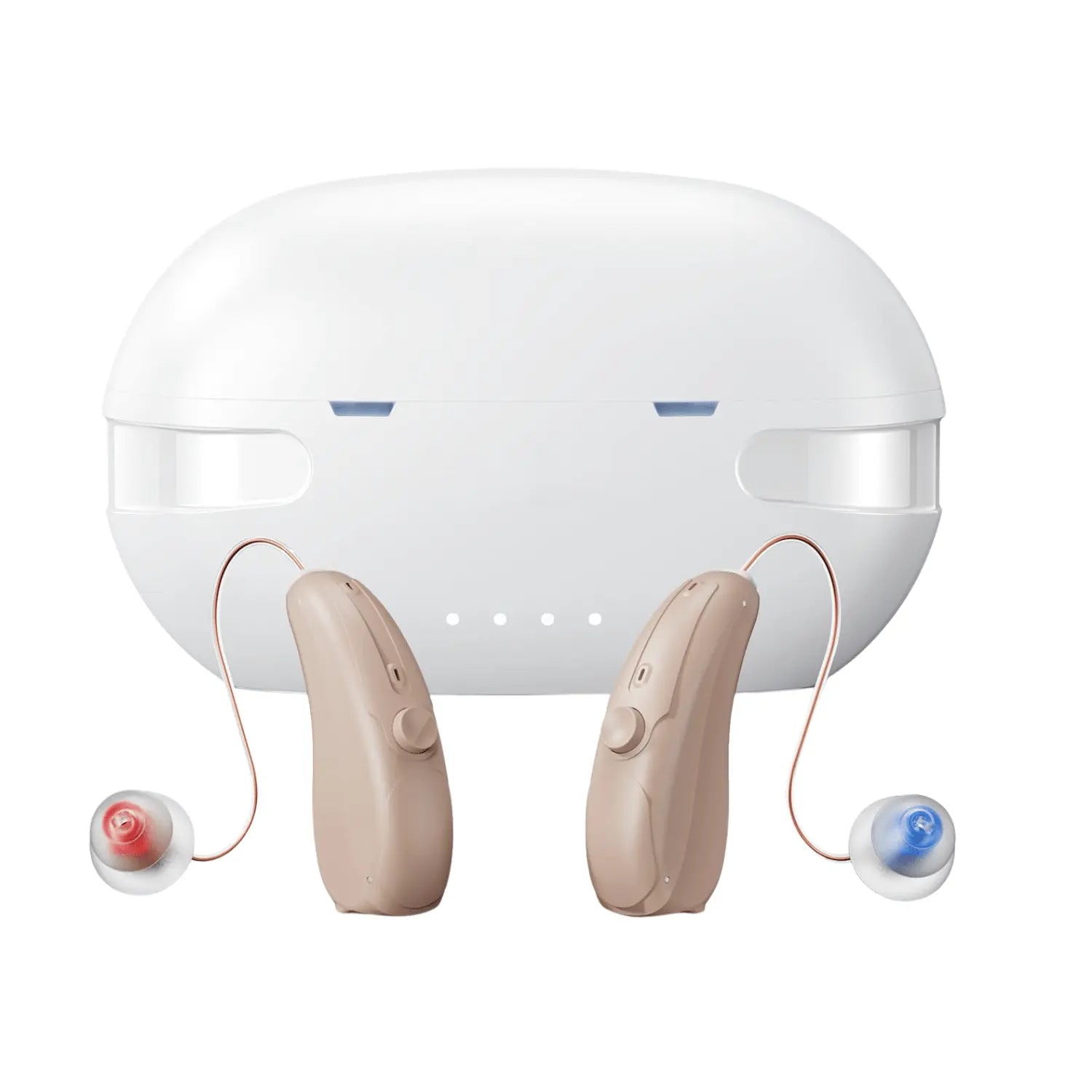
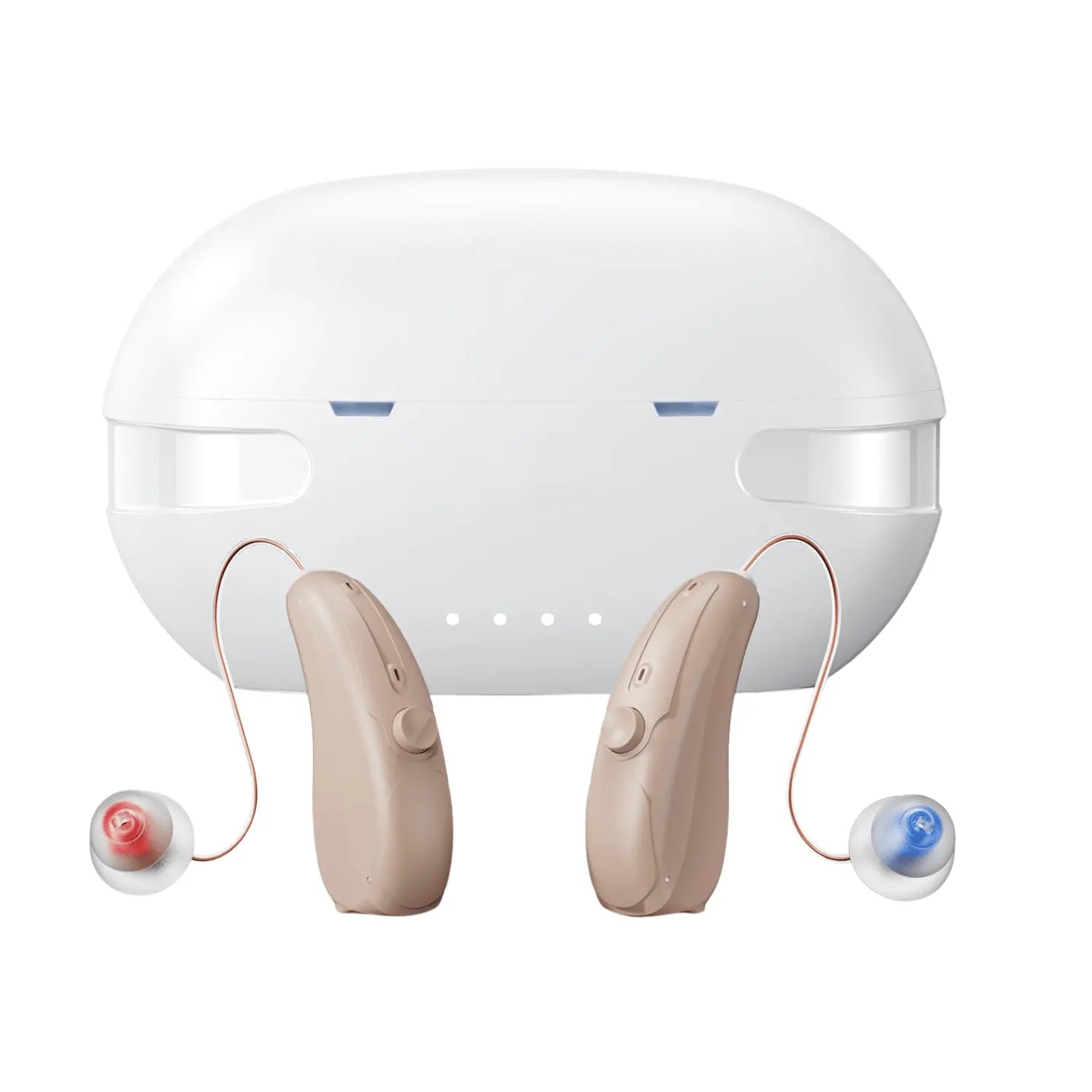
Panda Quantum is a 16-channel receiver-in-canal hearing aid with active noise reduction and Bluetooth connectivity for phone calls, music, and television streaming. It offers up to 80 hours of total runtime with the charging case, a 5-year warranty, and a 45-day return window. Panda Quantum pairs with the Panda app, which runs a frequency-specific hearing test through the device itself and then automatically programs the gain and frequency response to match the user's audiogram, similar to what an audiologist would do at a clinical fitting.
OTC hearing aids are intended for adults with mild-to-moderate hearing loss. Survivors whose loss is severe or profound, or who carry additional medical complexity, will continue to benefit most from a clinical fitting and ongoing follow-up with an audiologist.

Limitations of This Research
Like any systematic review, this one is bounded by the studies it summarizes. The clinical literature on locally applied otoprotective agents is small, with only eight studies in total and only a handful of them randomized. The studies that do exist used different outcome measures, different cisplatin protocols, and different age ranges, making head-to-head comparisons difficult.
Funding sources and conflicts of interest were not detailed in the abstract. Readers reviewing the full publication should look at the funding and disclosure statements there. The authors themselves emphasize that further research on dose, delivery method, and timing is needed before any local agent could be considered ready for routine pediatric clinical use.
Where This Leaves Us
The takeaway is straightforward. Systemic sodium thiosulfate remains the otoprotective agent with the strongest evidence base for children receiving cisplatin. Local alternatives are an active area of research, but for now they are not ready to replace it. Audiologic monitoring before, during, and after chemotherapy remains essential, and survivors who do develop permanent hearing loss should be connected to amplification and follow-up care that fit the kind of damage they have.
Masroor A, Streefkerk N, Van Grotel M, Geller JI, Ansari M, Bouffet E, Bleyer A, Fresneau B, Sullivan M, Knight K, Kogner P, Maibach R, O'Neill AF, Papadakis V, Rajput KM, Brock PR, Veal GJ, Hoetink AE, Huitema ADR, Van Den Heuvel-Eibrink MM. Local application of otoprotective compounds other than sodium thiosulfate to prevent cisplatin-induced hearing loss: a systematic review. Drug delivery. 2026;33(1):2665892. Retrieved from PubMed. https://doi.org/10.1080/10717544.2026.2665892