Brain Small Vessel Markers Did Not Predict Age-Related Hearing Decline in Healthy Older Adults: New ASPREE Sub-Study
An Australian sub-study of the ASPREE trial finds no evidence that two common signs of cerebral small vessel disease forecast hearing changes in adults aged 70 and older.
Age-related hearing loss has long been suspected to share roots with vascular aging in the brain. The cochlea is one of the most metabolically demanding pieces of tissue in the body, and it depends on a tiny network of vessels that look a lot like the small vessels in the brain. If those vessels stiffen, narrow, or leak, the thinking goes, both hearing and brain function could decline together.
A new analysis published in Brain Communications puts that hypothesis to a careful test. Using brain MRI, retinal photographs, and pure tone audiometry from older Australians enrolled in the ASPREE trial, the researchers asked a direct question: do two well-established markers of cerebral small vessel health, white matter hyperintensities on MRI and the calibre of the small vessels in the back of the eye, predict how hearing changes over the next several years?
About This Study
Title: White matter hyperintensities, retinal vascular calibre and changes in age-related hearing loss
Authors: David P Q Clark, Cammie Tran, Sultana Monira Hussain, Catherine Robb, Carlene Britt, Robyn L Woods, Paul A Yates, Amy Brodtmann, Mohamed Salah Khlif, Geoffrey Donnan, Gary Rance, John J McNeil
Affiliations: School of Public Health and Preventive Medicine, Monash University; Department of Medical Education and Department of Audiology and Speech Pathology, University of Melbourne; Austin Health; Royal Melbourne Hospital, Melbourne, Australia
Journal and pub date: Brain Communications, April 2026, Volume 8, Issue 2, fcag133
Study type: Sub-study of the ASPREE randomized trial cohort, with cross-sectional and longitudinal analyses
PubMed DOI: 10.1093/braincomms/fcag133
Background: Why the Researchers Looked at This
Cerebral small vessel disease, often shortened to cSVD, refers to age-related damage in the brain's smallest arteries, arterioles, and capillaries. It is a leading contributor to vascular cognitive impairment and stroke. Two of the most studied non-invasive markers of cSVD are white matter hyperintensities, or WMHs, the bright patches on a brain MRI that signal white matter injury, and retinal vascular calibre, the size of the small vessels visible at the back of the eye, which mirrors the small vessels in the brain.
Several earlier studies hinted that older adults with worse cSVD markers might also hear less well. The proposed mechanism: poor microvascular flow could reduce blood delivery to the cochlea, the inner ear structure that converts sound into nerve signals, or to the brain regions that process sound. If that mechanism is real, it would change how clinicians think about prevention, because vascular risk factor management might double as hearing protection.
The ASPREE trial offered an unusually well-controlled cohort to test this. ASPREE was designed to study aspirin in older adults free of evident cardiovascular disease, dementia, or major physical disability at recruitment, with deep imaging and clinical phenotyping. Crucially for this analysis, a subset of participants underwent hearing assessment, retinal photography, and brain MRI.
How the Study Was Done
The team used data from 308 ASPREE participants aged 70 and over, recruited between 2010 and 2014. Hearing was measured with pure tone audiometry, the standard clinic test in which the listener responds to tones at different frequencies and volumes. The researchers focused on thresholds at 0.5, 4, and 8 kHz, frequencies that span low-pitch speech sounds, mid-range consonants, and the high frequencies that erode first in age-related hearing loss. They also assessed speech perception in background noise, the real-world hearing skill people often complain about most.
Brain MRI was processed with an automated lesion prediction algorithm to calculate total WMH volumes, and the WMHs were then split into deep WMHs and periventricular WMHs, two locations with somewhat different clinical implications. Retinal vascular calibre was captured by central retinal arteriolar equivalent and central retinal venular equivalent, summary measures of the average size of small arteries and veins at the back of the eye.
The analysis ran in two directions. In the cross-sectional model, the researchers asked whether participants with worse small vessel markers at baseline also had worse hearing at baseline. In the longitudinal model, they asked whether baseline small vessel markers predicted how hearing changed over follow-up. Both analyses adjusted for known confounders such as age, sex, and cardiovascular risk factors.
What the Researchers Found
The headline result is a clear null. After adjusting for confounders, baseline central retinal arteriolar equivalent, central retinal venular equivalent, total WMH volume, deep WMH volume, and periventricular WMH volume were not associated with audiometric thresholds at 0.5, 4, or 8 kHz. They were also not associated with speech perception in background noise. That held in both the cross-sectional snapshot and the longitudinal follow-up.
In other words, in this cohort of 308 healthy older Australians, knowing how much white matter injury someone had on MRI, or how thick or thin their retinal arteries and veins looked, did not help predict either how well they were hearing now or how their hearing would shift over the next few years.
The authors interpret this as evidence that microvascular changes in the eye and brain can occur independently of changes in auditory function, at least in older adults who entered the study free of evident cardiovascular disease and major cognitive impairment. They are careful to note that this does not rule out a vascular contribution to hearing loss in sicker populations or at more advanced stages, but it does push back on the idea that small vessel disease markers can serve as a useful screening proxy for hearing decline.
A practical reading of the result: age-related hearing loss in healthy older adults likely runs on its own clock, driven primarily by the well-known peripheral changes in the cochlea and auditory nerve, with central nervous system small vessel changes playing a less direct role than some prior work suggested.
What It Means for People with Hearing Loss
For older adults already noticing hearing changes, the most useful takeaway is what the study does not say. It does not say that managing blood pressure, cholesterol, or other vascular risk factors is irrelevant to overall brain health. It does say that you cannot count on those efforts to also protect or restore your hearing, and you cannot use a clean MRI or healthy-looking retinal vessels as reassurance that your hearing will hold steady.
In practical terms, that means hearing has to be addressed on its own terms. If a 70-year-old struggles to follow speech in a noisy restaurant, treating that struggle directly with proper amplification is the evidence-based path. Waiting on cardiovascular optimization to fix hearing is unlikely to pay off, at least based on what this study found.
It also reinforces the importance of routine hearing checks for older adults, separate from cognitive or vascular workups. Hearing decline can be subtle until it is severe, and waiting until it is severe limits how much improvement amplification can deliver.
Why Clinical-Grade Hearing Performance Matters for Healthy Older Adults
If hearing decline in older adults is not just a downstream symptom of vascular brain aging, then the device people choose to address that decline matters more, not less. The participants in this study were exactly the demographic that benefits most from a hearing aid that handles real-world conditions: speech in noise, phone calls, television, and conversations across a room.
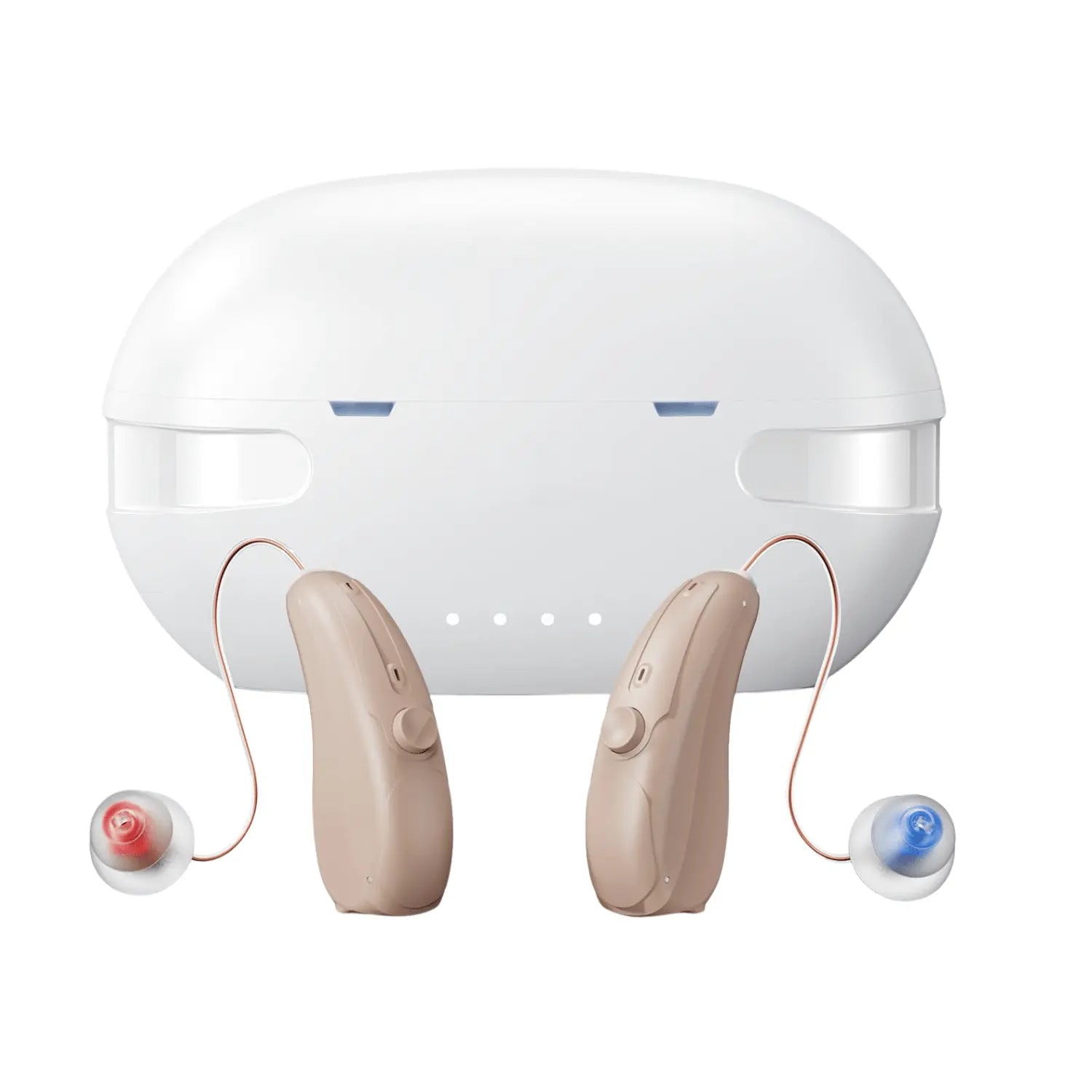
Panda Quantum is built around that profile. It is a 16-channel receiver-in-canal device with active noise reduction, designed to handle the speech-in-noise challenges this study measured. It supports Bluetooth streaming for calls, television, and music, so phone conversations and TV audio go directly into the hearing aid rather than being lost across a noisy room. The charging case provides up to 80 hours of total battery, the warranty is 5 years, and the return window is 45 days. Panda Quantum also includes the Panda app-based in-ear hearing test: after delivery, the user pairs the device with the Panda app, runs the test through the hearing aid itself, and the fitting is then applied automatically based on the user's audiogram, similar to a clinical audiologist fitting. More information is available at pandahearing.com/products/panda-hearing-aids-quantum.

OTC hearing aids are approved in the United States for adults with perceived mild-to-moderate hearing loss. Adults with severe or profound loss are still best served by a clinical fitting and prescription-grade devices. The 70-plus older adults studied here cover a wide hearing range, and a calibrated audiogram from a hearing professional remains the most reliable starting point when loss is significant.
Limitations of This Research
The most important limitation is the cohort itself. ASPREE intentionally enrolled older adults who were free of evident cardiovascular disease, dementia, and major disability. That enrollment criterion narrows the range of small vessel disease severity in the sample, which makes it harder to detect a relationship if one exists at the more advanced end. A null result in a healthy cohort does not necessarily mean a null result in everyone.
Sample size is another consideration. With 308 participants, the study has reasonable power to detect moderate-to-large associations but could miss subtle ones. The follow-up period also captures only a slice of late-life change. The authors do not report a specific funding-related conflict that would bias the interpretation, and ASPREE is a publicly funded trial, but readers should still note that null results in observational sub-studies can be sensitive to how covariates are defined.
Where This Leaves Us
This Brain Communications analysis adds a careful, well-controlled null to a literature that has been mixed on the vascular-hearing link. For now, in healthy older adults, hearing change appears to follow its own course, separate from the small vessel changes that show up on brain MRI and retinal photographs. The action item for older adults is the same as it has been: pay attention to actual hearing, not to imaging proxies, and address hearing loss directly when it shows up.
Clark DPQ, Tran C, Hussain SM, Robb C, Britt C, Woods RL, Yates PA, Brodtmann A, Khlif MS, Donnan G, Rance G, McNeil JJ. White matter hyperintensities, retinal vascular calibre and changes in age-related hearing loss. Brain Communications. 2026;8(2):fcag133. Retrieved from PubMed. https://doi.org/10.1093/braincomms/fcag133