Researchers Develop a Lower-Effort Speech Test That Can Quantify How Much Hearing Aids Actually Help
A new consonant-based test called qVCV measures hearing aid benefit with less mental load than the most widely used clinical speech-in-noise test, and it is sensitive enough to flag underlying neural problems that a standard audiogram can miss.
When someone gets fitted with hearing aids, the most important question is not "are they louder?" but "do they help me understand speech, especially when there is background noise?" Yet measuring that benefit in a clinic is harder than it sounds. Most speech-in-noise tests rely on listeners repeating full sentences from memory, which mixes hearing ability with attention, working memory, and cognitive effort. For older adults, who are the largest group of hearing aid users, that cognitive load can blur the picture of how much the device is doing for them.
A research team has now developed and validated a different kind of test, called the quick vowel-consonant-vowel test, or qVCV. It asks listeners to identify single consonants embedded in short syllables and rapidly produces a numeric score for hearing aid benefit, with much lower demand on memory or attention. The test was published as a medRxiv preprint on April 24, 2026.
About This Study
Title: Development and clinical application of a consonant confusion task to evaluate hearing aid benefit
Authors: Hajicek JJ, Harris SE, Neely ST
Affiliations: Author affiliations are not listed on the medRxiv preprint record. The corresponding author group has historically been associated with Boys Town National Research Hospital in Omaha, Nebraska, but readers should consult the published version once it is peer reviewed.
Journal & pub date: medRxiv preprint, posted April 24, 2026 (not yet peer reviewed)
Study type: Methodological development and validation study
PubMed / DOI: 10.64898/2026.04.23.26351598
Background: Why the Researchers Looked at This
Hearing tests in a clinic typically include a pure-tone audiogram, which measures the softest beep a person can hear at each pitch, and a word recognition test, which measures how clearly speech can be understood. The audiogram is good for diagnosing hearing loss but is a poor predictor of how well someone will follow conversation in the real world. To bridge that gap, audiologists use speech-in-noise tests, the most common of which is QuickSIN, where the listener repeats sentences mixed with babble of other voices.
QuickSIN is sensitive but it taxes memory and attention, especially for older listeners. It also depends on language familiarity. The authors of this new study wanted a test that would isolate the basic act of hearing distinct speech sounds without asking the listener to remember and repeat anything, while still being sensitive to the kind of hearing loss that hearing aids are meant to help.
Their solution borrows from a long tradition in speech research called consonant confusion testing. Listeners hear a single consonant tucked between two vowels, for example "aba" or "asa," with noise added in the background, and simply pick from a closed list which consonant they think they heard. Because the response is multiple choice, the test scores itself; because the unit is a single sound, the cognitive load is small.
How the Study Was Done
The researchers started with a large pool of consonants and vowel contexts presented in speech-shaped noise. By analyzing which sounds people with hearing loss tended to confuse with which other sounds, they narrowed the test down to a core set of ten consonants ("b, d, g, t, k, v, z, s, sh, n") in a single vowel context, presented at signal-to-noise ratios chosen to be most sensitive to hearing loss.
They then validated the resulting qVCV test in two ways. First, they checked whether qVCV scores could predict a listener's pure-tone average, the standard audiogram summary number, using a cross-validation approach. Second, they compared qVCV directly against QuickSIN in a clinical setting, looking at how reliable each test was for the same listening time and how well each reflected the boost provided by a hearing aid. Hearing aid benefit was quantified as a decibel reduction in the apparent hearing loss.
Because the test is closed-set and automatically scored, it can be administered without a trained tester sitting alongside the listener for every trial.
What the Researchers Found
When the qVCV-predicted pure-tone average was compared with the listener's actual audiometric pure-tone average, the cross-validated mean absolute error was 5.7 decibels. That is close enough that, for many practical purposes, the qVCV alone gives a useful estimate of hearing thresholds without a separate beep test.
For test-retest reliability, qVCV scored at 50 trials matched the repeatability of the average of two QuickSIN lists. In other words, when you give the two tests roughly the same amount of administration time, they hold up about equally well from one sitting to the next.
Most relevant for hearing aid users, the qVCV produced a numeric estimate of hearing aid benefit, expressed as a decibel reduction in the listener's apparent hearing loss when the device was switched on. That gives clinicians, and arguably users themselves, an objective number rather than a subjective "yes, it helps" answer.
The authors also flag an interesting diagnostic side effect. When a listener's qVCV-predicted pure-tone average is much worse than the actual audiogram, that gap can be a signal of either cognitive deficits or cochlear neural degeneration, sometimes called hidden hearing loss. In other words, the test could help identify people whose real-world listening problems are not fully explained by their audiogram.
What It Means for People with Hearing Loss
For people thinking about hearing aids, the most useful idea here may not be qVCV itself but the larger principle behind it. The audiogram is a starting point, not a complete answer. Two people with the same audiogram can have very different real-world listening abilities, especially in noise, and any hearing aid worth its price should be evaluated on what it does for speech understanding, not just on what it does for loudness.
A test that quantifies hearing aid benefit in a few minutes, with low cognitive load and automated scoring, is also the kind of tool that could move outside the clinic. The same logic that makes qVCV good for older adults sitting in a sound booth could make a future version of it useful inside a smartphone app, used to confirm that a self-fit device is actually delivering the audibility gains it should.
More broadly, this is part of a wider shift in audiology toward functional, outcomes-oriented testing rather than relying solely on the classic pure-tone beeps.
Self-Verifiable Hearing Aid Benefit Is Where Modern OTC Devices Are Heading
The qVCV work points to a future in which the user, not just the audiologist, can confirm that a hearing aid is actually doing its job. That same direction is already shaping how today's over-the-counter devices are designed: instead of a one-size-fits-all amplifier, the goal is a device that is fitted to the individual's hearing profile and then verified.
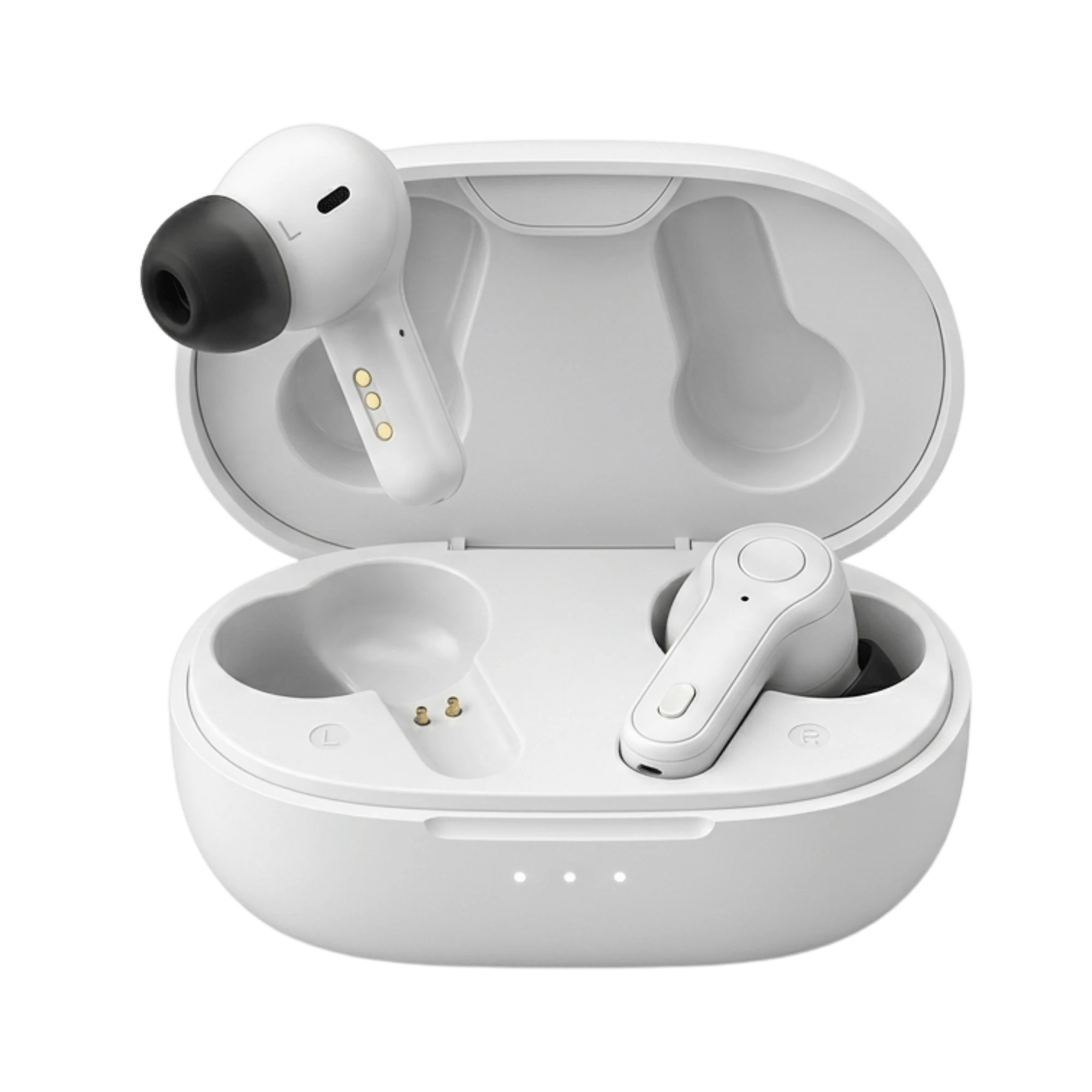
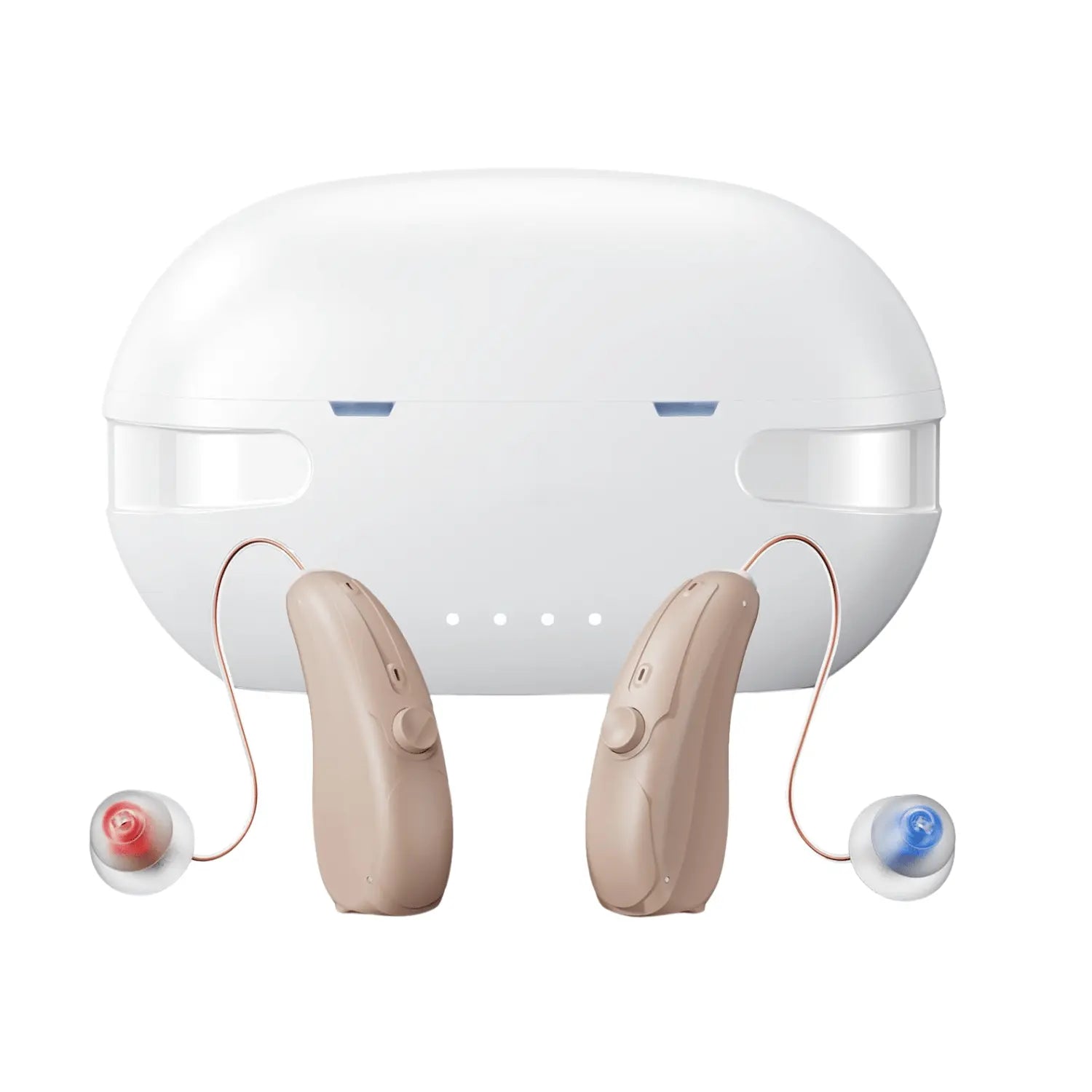
The Panda Air is an earbud-style in-the-canal device that takes that approach. After delivery, the user pairs the hearing aids with the Panda app, which runs a frequency-specific hearing test through the device itself and then automatically programs gain and frequency response to match the user's audiogram, similar to what an audiologist does at a clinical fitting. The hardware itself includes 16-channel wide dynamic range compression and multi-band adaptive noise reduction, the kind of processing that improves how clearly individual consonants survive in background noise. The fast-charge case provides up to 60 hours of total runtime, and the device is backed by a 5-year warranty and a 45-day return window so users have time to confirm the fit is working in their own everyday environments.
Worth keeping in mind: over-the-counter hearing aids in the United States, including the Panda Air, are intended for adults with mild-to-moderate hearing loss. Severe or profound hearing loss usually still benefits most from a clinical fitting.
Limitations of This Research
This is a preprint, which means it has not yet completed peer review, and the affiliation and funding details visible on the public record are limited. The validation work focused on adults with sensorineural hearing loss who use hearing aids; the test's behavior in other populations, including children and people with conductive losses, was not the focus of this report.
The authors also note that a large gap between qVCV-predicted and audiometric pure-tone averages is suggestive but not diagnostic. A formal clinical workup is still needed before attributing such a gap to cognitive issues or hidden neural damage.
What to Do With This
If you are considering hearing aids, or already wear them, the practical takeaway from this research is to ask, for any device, how its benefit is actually being measured. The audiogram tells you whether you have hearing loss; tests like qVCV, and the next generation of app-based and self-administered versions of them, tell you whether the hearing aid is doing what you bought it to do. As more of that measurement moves out of the clinic and onto a phone, users will have more direct evidence about how well their devices are working in the situations that matter to them.
Hajicek JJ, Harris SE, Neely ST. Development and Clinical Application of a Consonant Confusion Task to Evaluate Hearing Aid Benefit. medRxiv preprint. 2026. Retrieved from PubMed. DOI: 10.64898/2026.04.23.26351598