24-Year Study Tracks How Hearing Loss Reshapes the Trajectory of Cognitive Decline
A new analysis of nearly 7,600 older adults followed for more than two decades finds that the arrival of hearing loss is followed by both an immediate drop and a faster long-term decline in memory, orientation, and overall thinking ability.
For years, researchers have noticed that older adults with untreated hearing loss tend to score worse on memory and thinking tests over time. What has been harder to pin down is the actual shape of that decline. Does the brain dip suddenly when hearing fades, or does the slope simply tilt downward more steeply year after year? A new study published in the Journal of Applied Gerontology takes one of the most ambitious looks at this question to date, drawing on 24 years of data from a nationally representative U.S. cohort.
The findings suggest that hearing loss does not just nudge the trajectory of cognitive aging. It reshapes it, with measurable changes happening at the very moment hearing problems begin and continuing in a steeper line for years afterward.
About This Study
Title: Trajectory of Cognitive Decline After Incident Hearing Loss: A 24-year Population-Based Longitudinal Cohort Study
Authors: Qin Li, Haohong Lai, Juntao Wu, Haidi Yang
Affiliations: Chaozhou People's Hospital, Chaozhou Hospital Affiliated to Shantou University Medical College, Chaozhou, China; Department of Otolaryngology, Sun Yat-sen Memorial Hospital, Sun Yat-sen University, Guangzhou, China; Department of Otolaryngology, The Fifth Affiliated Hospital, Sun Yat-sen University, Zhuhai, China.
Journal and date: Journal of Applied Gerontology, published online May 5, 2026.
Study type: Population-based longitudinal cohort study (Health and Retirement Study, 1998 to 2022) using linear mixed-effects models.
PubMed DOI: 10.1177/07334648261449869
Background: Why the Researchers Looked at This
Hearing loss is one of the most common chronic conditions of later life. Recent years have seen growing evidence that it is also one of the more important modifiable risk factors for dementia. The standard explanation involves two ideas. First, when speech becomes harder to follow, the brain has to spend more attention on simply decoding sound, leaving fewer resources for memory and reasoning. Second, people with untreated hearing loss tend to pull back from conversation and social activity, and that quieter life is itself associated with faster cognitive aging.
What has been less clear is the timing. Earlier work has tended to compare older adults with and without hearing loss at one moment in time, or has tracked changes for only a few years. That has made it difficult to separate two possibilities. One is that hearing loss simply steepens the slope of cognitive decline gradually over many years. The other is that something more abrupt happens around the time hearing impairment first sets in. The current study was designed to look directly at both.
Some terms used in the paper are worth defining. Global cognition is a combined score across several thinking tasks. Orientation refers to a person's awareness of time and place, such as knowing the date or the day of the week. Calculation refers to simple arithmetic done from memory, such as serial subtraction. Each of these was measured repeatedly across study waves so that researchers could draw individual decline curves.
How the Study Was Done
The team used data from the Health and Retirement Study, a long-running U.S. survey of adults over age 50. Participants are interviewed every two years and complete the same set of cognitive tests at each wave, which allows researchers to plot how individual scores change over time. The current analysis pulled records from 1998 through 2022, covering 24 years of follow-up.
A total of 7,598 participants were included. Of those, 2,241 developed hearing loss during the study period, and the remaining participants served as a comparison group. The investigators applied linear mixed-effects models, a statistical approach that fits a separate decline curve for each person and then summarizes patterns across the group. This let them estimate two things at once. The first was the speed of cognitive change in the years after hearing loss began. The second was whether scores took a noticeable step downward right at the point of onset, separate from the longer slope.
Results were reported in standard deviation units per year, a way of expressing how much faster cognitive scores fell relative to the natural rate of decline seen in healthy older adults. The same approach was applied to global cognition and to memory, orientation, and calculation separately.
What the Researchers Found
The data pointed to a clear pattern. After hearing loss began, the rate of decline in global cognition accelerated by roughly 0.080 standard deviations per year, with a tight 95 percent confidence interval running from 0.069 to 0.092. In plain language, the curve of cognitive aging tilted noticeably steeper as soon as a person crossed into hearing loss.
The same accelerated decline showed up across the individual domains the researchers measured. Memory dropped about 0.017 standard deviations per year faster than before. Orientation showed the largest annual change, slipping by an additional 0.106 standard deviations per year. Calculation also fell by an additional 0.014 standard deviations per year. Each of these numbers comes with confidence intervals that do not cross zero, so the pattern was statistically robust.
Just as striking, the analysis found acute drops at the very moment of hearing loss onset. Global cognition dipped by about 0.101 standard deviations as a one-time step. Memory fell sharply by about 0.119 standard deviations. Calculation slid by 0.067 standard deviations. These step changes were on top of, not instead of, the steeper long-term slope.
Put together, the pattern looks less like a slow-motion erosion and more like a one-two punch. The brain takes a hit at the point hearing loss is recognized, and then it continues to decline at a faster rate in the years that follow. The authors note that this dual pattern was visible in global cognition, memory, and orientation, and was clearest in tasks that depend most on processing language and remembering recent information.
What It Means for People with Hearing Loss
If acute drops happen around the time hearing loss begins, then the early years after onset may matter more than people often assume. By the time someone gets used to asking others to repeat themselves, or starts pulling back from gatherings, the cognitive picture has already changed in measurable ways. That is consistent with what audiologists have long argued. The question is not whether to treat hearing loss eventually. The question is how soon.
The study itself is observational and cannot prove that wearing hearing aids would erase the declines it identified. But it does sharpen the case for taking early hearing loss seriously, getting baseline tests when speech in noise starts to feel harder, and removing barriers that keep people from using a hearing aid in the first place. Cost and friction in getting fitted are two of the largest of those barriers in the United States.
For families, the takeaway is similar. Noticing that an older relative struggles to follow conversation at a busy restaurant is not just a hearing concern. It is also a brain-health concern, and one that is worth raising as soon as the pattern becomes clear.
Removing the Cost Barrier With an OTC Option
One reason hearing loss often goes untreated for years is the price tag attached to traditional clinical fittings. Surveys consistently find that out-of-pocket cost is the top reason older adults report for putting off hearing aids, and a 24-year window of cognitive decline is a long time to wait. Modern over-the-counter options were designed to remove that hurdle.
Panda Air is one example. It is an earbud-style in-the-canal device built around 16-channel wide dynamic range compression and multi-band adaptive noise reduction, the same general signal-processing categories used in clinical-grade hearing aids. The case offers around 60 hours of run time on a fast charge, the warranty runs five years, and the return window is 45 days. After delivery, the user pairs Panda Air with the Panda app, which then runs a frequency-specific hearing test through the hearing aid itself and automatically programs the device's gain and frequency response to match the resulting audiogram, much like the curve an audiologist would dial in during a clinical fitting.
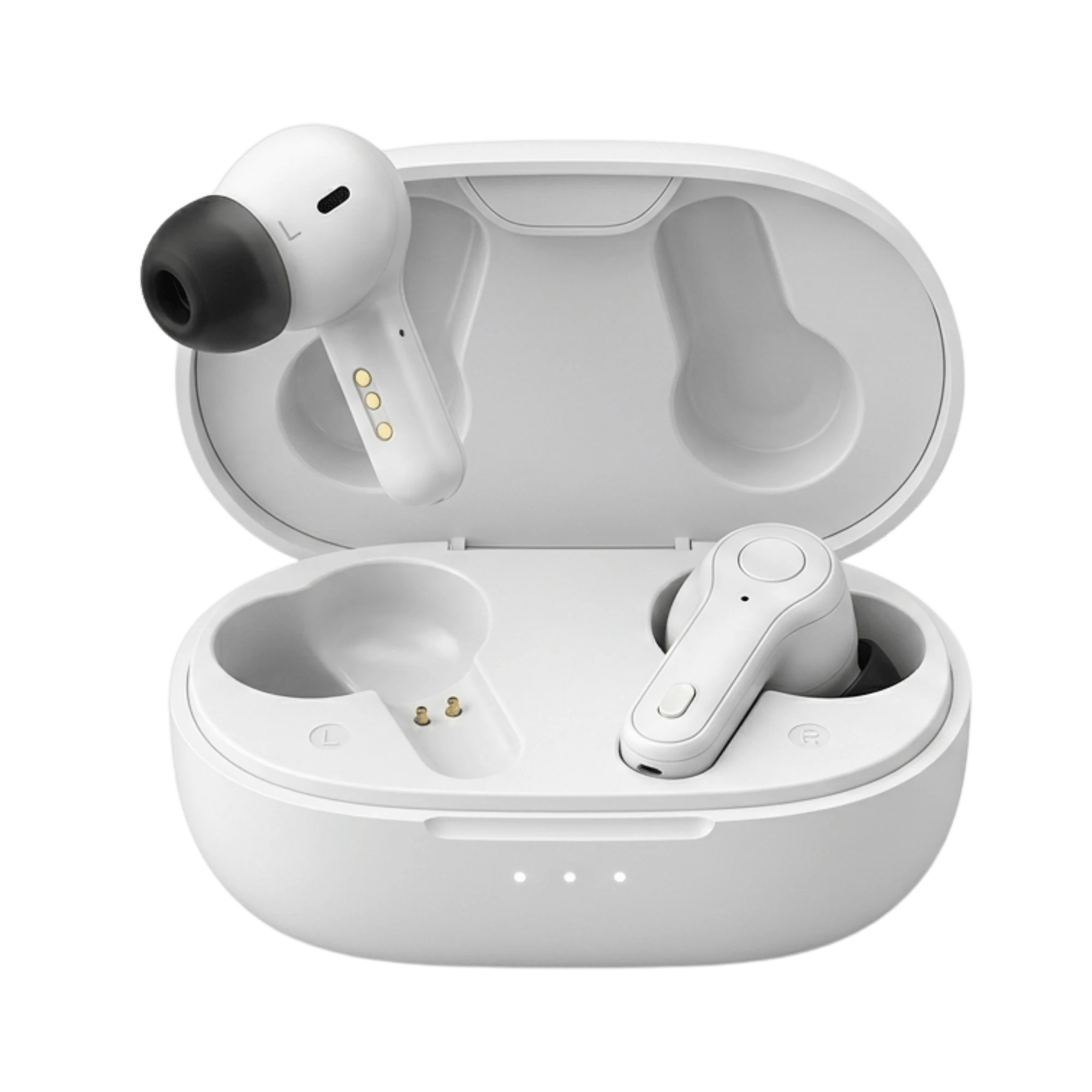
The point of an option like this in the context of the new study is simple. The cognitive cost of hearing loss appears to begin accumulating as soon as hearing loss does, so the early years after onset are not a good time to be priced out of intervention. OTC devices are approved for mild-to-moderate hearing loss. Severe or profound hearing loss still benefits most from a clinical fitting and ongoing audiologist support.
Limitations of This Research
Several caveats are worth noting. Hearing loss in the Health and Retirement Study is identified largely through self-report and survey questions rather than calibrated audiometry, which can blur the exact onset date. The cognitive battery used in the study is brief by clinical standards, so it is more useful for tracking population-level trends than for individual diagnosis. The study is also observational, meaning it cannot rule out the possibility that some shared underlying factor, such as vascular health, drives both hearing loss and cognitive change.
The authors did not report any specific industry funding, and no commercial conflicts of interest were highlighted in the abstract. Even so, results from a single cohort, however large, should be read alongside future work in different populations and with objective audiometric data.
What to Do With This
For older adults who have started to notice their hearing slipping, the practical message from this 24-year study is that the time soon after onset is not a quiet pause before things get worse. It is itself a period of measurable cognitive change. Getting a baseline hearing assessment, taking advantage of remote and self-fitting tools where appropriate, and addressing hearing loss before it pulls a person away from conversation are all reasonable next steps.
Citation: Li Q, Lai H, Wu J, Yang H. Trajectory of Cognitive Decline After Incident Hearing Loss: A 24-year Population-Based Longitudinal Cohort Study. Journal of Applied Gerontology. 2026. Retrieved from PubMed. https://doi.org/10.1177/07334648261449869