New Research Confirms App-Based Tuning Can Help Over-the-Counter Hearing Devices Meet Clinical Fitting Standards
A Vanderbilt University study published in the International Journal of Audiology found that the Apple AirPods Pro 2 hearing aid feature can reach audiologist-prescribed amplification targets when users take advantage of the device's onboard fine-tuning controls.
Over-the-counter hearing aids have opened a new chapter in accessible hearing care, placing amplification technology directly in the hands of millions of adults with mild to moderate hearing loss. As manufacturers compete for this growing market, researchers have begun asking a fundamental question: can consumer-grade devices actually deliver the level of amplification that audiologists would prescribe?
The NAL-NL2 formula, developed by the National Acoustic Laboratories in Australia, is a gold standard prescriptive method that hearing care professionals use to calculate how much amplification a device should deliver at different pitches and volumes for a given degree of hearing loss. Meeting these targets is associated with better speech understanding in noise, improved communication, and higher user satisfaction. Whether popular consumer earbuds can match this standard is an open scientific question with major practical consequences for the growing number of people who choose to fit their own hearing devices.
About This Study
Title: Does the Apple AirPods Pro 2 Hearing Aid Feature Meet Prescribed Targets for Standardized Audiograms?
Authors: Haiping Huang, Taylor Dalzell, Erin M. Picou
Affiliations: Department of Hearing and Speech Sciences, Vanderbilt University and Vanderbilt University Medical Center, Nashville, Tennessee
Journal & Date: International Journal of Audiology, June 27, 2026
Study Type: Laboratory measurement study (real-ear aided response on acoustic manikin)
PubMed DOI: 10.1080/14992027.2026.2685112
Background: Why Researchers Looked at This
In 2022, the U.S. Food and Drug Administration created a new category of over-the-counter hearing aids, allowing adults with perceived mild to moderate hearing loss to purchase amplification devices directly, without a prescription or a visit to an audiologist. This regulatory change opened the door for major consumer electronics companies to enter the hearing health market, and Apple responded by introducing a built-in Hearing Aid Feature in the AirPods Pro 2.
Unlike purpose-built hearing aids that are typically programmed by a clinician using measured audiogram data, the AirPods Pro 2 Hearing Aid Feature allows users to manually enter their audiogram results into an iPhone and then adjust the output using two onboard controls: the Amplification slider and the Tone slider. The question Vanderbilt researchers set out to answer was whether these user-controlled settings could realistically achieve the amplification levels that audiologists would actually prescribe.
Understanding this gap matters because many people who purchase OTC hearing aids rely entirely on default or self-adjusted settings. If those settings fall short of what is clinically recommended, users may not receive the full benefit the technology could provide. This kind of verification research gives both users and clinicians the data they need to get the most out of these devices.
How the Study Was Done
Researchers at Vanderbilt used a head-and-torso acoustic manikin to simulate how the AirPods Pro 2 would behave in a real ear. This type of manikin is designed to replicate the acoustics of an adult human head and ear canal, making it possible to measure hearing aid output under controlled and repeatable laboratory conditions. Measurements were taken for both left and right earbuds, using two separate pairs of AirPods Pro 2 devices to check whether results were consistent across units.
The team created two standardized audiograms representing common hearing loss profiles: one for mild-sloping hearing loss and one for moderate-sloping hearing loss. These were manually entered into the device's companion app on an iPhone, which is how the AirPods Pro 2 Hearing Aid Feature receives its fitting information. Speech recordings played at three different volume levels -- 55, 65, and 75 dB sound pressure level, representing quiet, normal, and somewhat louder speech -- were used to test the device across the range of input levels a person would encounter in daily life.
First, measurements were taken at the device's default settings immediately after the audiogram was entered. Then, a researcher used the Amplification and Tone controls in the iPhone settings to fine-tune the output toward the NAL-NL2 prescriptive targets for each audiogram. The difference between these two conditions -- default versus fine-tuned -- was the central comparison of the study.
What the Researchers Found
For both audiograms and across all tested input levels, the AirPods Pro 2 Hearing Aid Feature at its default setting delivered less amplification than the NAL-NL2 prescription called for. Users who simply entered their audiogram and left the settings as they were received meaningfully less amplification than an audiologist would typically target. This under-amplification pattern held for both the mild-sloping and the moderate-sloping hearing loss profiles.
However, the fine-tuning controls provided enough range to close this gap. The Amplification slider was found to provide approximately 10 dB of broadband level adjustment, meaning it could raise or lower overall loudness across all frequencies. The Tone slider offered roughly 5 to 10 dB of spectral tilt, allowing the user to shift the balance of amplification between lower and higher frequencies. Together, these two adjustments gave the researcher sufficient tools to bring the device's output into alignment with prescriptive targets for both audiogram profiles.
Results were consistent across both pairs of AirPods Pro 2 tested, suggesting that the acoustic performance of the device is predictable and reproducible. The researchers described these findings as preliminary data supporting the potential of the Hearing Aid Feature for users with manually-entered mild- and moderate-sloping audiograms, provided they take the time to fine-tune the output.
This points to both the promise and the practical limitation of the current approach: the device has the technical range to deliver clinically appropriate amplification, but whether a typical user without audiological training can achieve that through manual adjustment remains an unanswered question.
What It Means for People with Hearing Loss
This study reinforces what hearing researchers have suspected since OTC hearing aids became legal: default settings are likely to underperform what a clinical fitting would achieve. Consumers who purchase an OTC hearing device and try it straight out of the box may receive noticeably less amplification than audiologists would recommend for their level of hearing loss. This gap could lead to underwhelming experiences and early abandonment of the device.
The research also highlights the value of self-fitting tools that automate the fitting process rather than requiring the user to manually experiment with sliders. When tuning was done by an experienced researcher at Vanderbilt, the targets could be met. In the real world, however, most users lack that expertise. Devices that can run a hearing test through the device itself and translate the result directly into gain and frequency settings remove the need for this technical judgment from the user entirely.
The findings are also useful for hearing care professionals working with patients who use OTC devices. Understanding that these products can, in principle, reach prescriptive targets with appropriate adjustment gives audiologists and hearing instrument specialists a framework for providing practical guidance, even to patients who have chosen self-care over a traditional clinical fitting.
Automated Self-Fitting: How App-Based Hearing Testing Addresses the Gap This Study Identifies
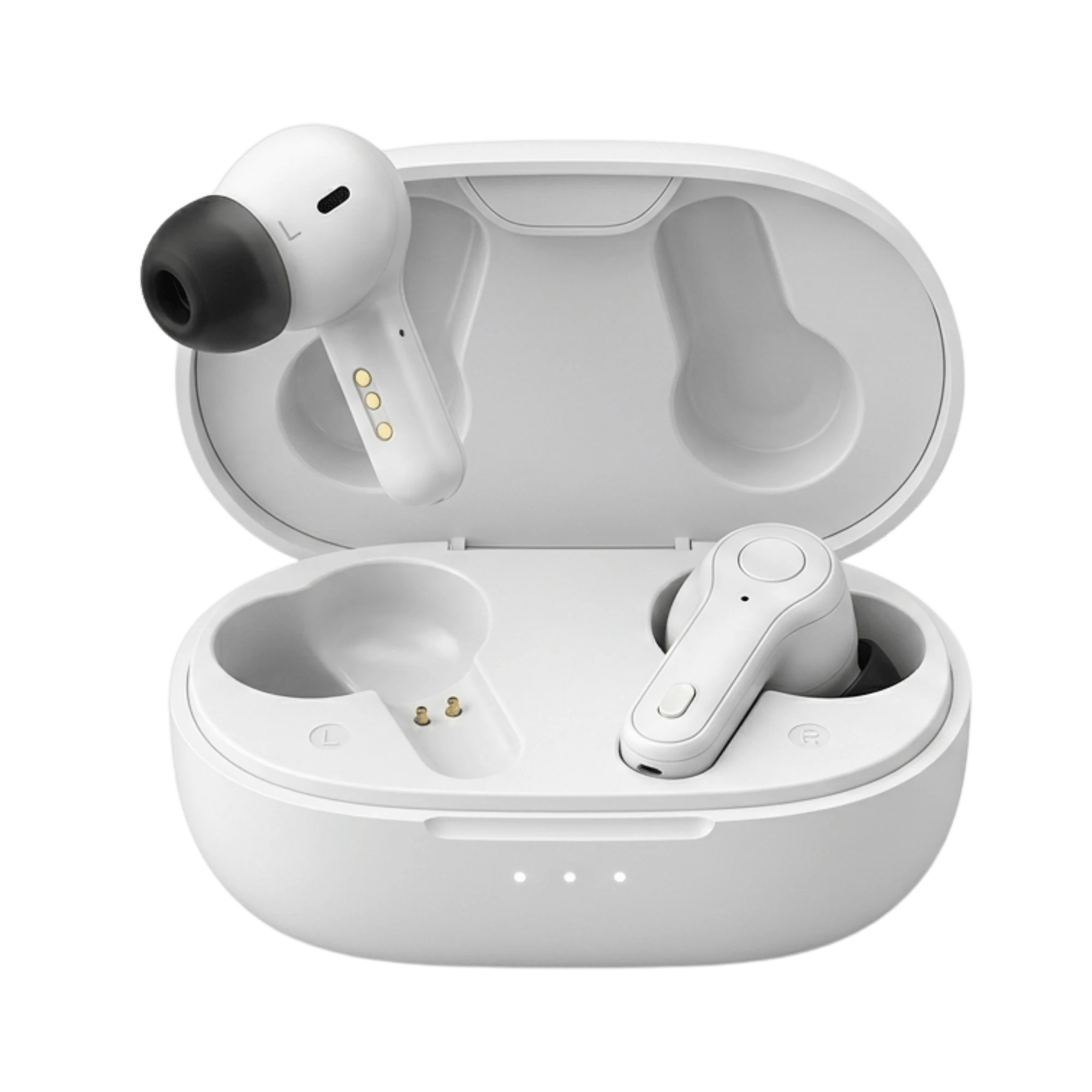
Because this study highlights the performance gap between default OTC settings and audiologist-prescribed targets, newer self-fitting OTC hearing aids are designed to close that gap automatically. Panda Air is one such device -- an earbud-style, self-fitting OTC hearing aid that pairs with the Panda app after delivery. Instead of requiring the user to manually enter an audiogram and then adjust sliders by feel, the app runs a frequency-specific hearing test directly through the hearing aid itself. The results automatically program the device's gain and frequency response to match the user's measured audiogram, similar to what an audiologist does at a clinical fitting. This kind of app-based hearing personalization happens without the user needing to understand decibels, spectral tilt, or prescriptive formulas.
For adults with mild to moderate hearing loss who want a self-fitting OTC hearing aid without the guesswork, automated frequency-specific hearing adjustment is designed to remove exactly the gap this study identified. Rather than leaving users to experiment with broadband and spectral controls, the Panda Air's in-ear hearing test guides the fitting automatically, using the audiogram the device itself measures. It is worth noting that OTC hearing aids, including the Panda Air, are cleared by the FDA for adults with perceived mild to moderate hearing loss. Adults with more severe or profound loss generally benefit most from clinical evaluation and fitting. Learn more at pandahearing.com/products/panda-air.
Limitations of This Research
The study used an acoustic manikin rather than measuring real-ear aided responses in actual human participants. Individual differences in ear canal shape and earbud fit are not captured by this method, and real ears vary considerably. What performs on target in a manikin may behave differently from person to person. The researchers also performed the fine-tuning themselves, a trained researcher rather than a typical consumer without audiological background, which is an important caveat for interpreting the practical significance of the findings.
No speech recognition scores or user satisfaction data were collected, so the study does not tell us how well participants actually hear with the device at these settings in everyday conditions. Only two standardized audiogram profiles were tested, which are representative but do not reflect the full variety of hearing loss configurations seen in clinical practice. Funding sources and potential conflicts of interest were not described in the published abstract.
Where This Leaves Us
This Vanderbilt study is an important early step in understanding what consumer earbud-style OTC devices can realistically deliver. The core finding is encouraging: these devices have the technical range to meet clinical prescription standards for mild to moderate hearing loss, and the fine-tuning controls are functional tools for closing the amplification gap. What the study also makes clear is that reaching those targets requires more than a default setting. As OTC hearing devices become a permanent part of the hearing health landscape, research like this will help consumers, audiologists, and manufacturers understand both the potential and the limits of self-fitted amplification.
Huang H, Dalzell T, Picou EM. Does the Apple airpods pro 2 hearing aid feature meet prescribed targets for standardized audiograms? International Journal of Audiology. 2026. Retrieved from PubMed. DOI: 10.1080/14992027.2026.2685112