NAL-NL3: A New Modular Hearing Aid Fitting System Built for Real-World Listening
Audiology researchers have introduced NAL-NL3, the next generation of one of the world's most widely used hearing aid prescription methods, redesigned around how people actually listen in noise and at the edges of normal hearing.
The way a hearing aid is programmed matters just as much as the device itself. For decades, clinicians around the world have relied on prescription formulas from Australia's National Acoustic Laboratories to decide how much amplification each person should receive at each pitch. A new paper introduces the latest version, NAL-NL3, and explains how hearing care professionals are meant to put it to work in the clinic.
What makes NAL-NL3 notable is that it is not a single formula but a modular system. It pairs a core prescription with separate components aimed at comfort in noisy places and at people whose hearing tests look almost normal yet who still struggle to follow conversation. The goal is a first fit that lands closer to each person's real listening life.
Title: Using NAL-NL3 in clinical practice: a modular NAL fitting system for real-world listening needs
Authors: Matthew Croteau, Catherine Kwok
Affiliations: National Acoustic Laboratories, Macquarie University, Sydney, Australia
Journal and date: International Journal of Audiology, published June 27, 2026
Study type: Clinical Note providing practice guidance on a hearing aid fitting system
Reference: PubMed, DOI 10.1080/14992027.2026.2680131
Background: Why the Researchers Looked at This
A prescription, in hearing care, is the set of amplification targets calculated from a person's audiogram. It tells the hearing aid how much gain to apply at each frequency so that soft sounds become audible, average speech is clear, and loud sounds stay comfortable. The National Acoustic Laboratories, or NAL, formulas have been a global reference point for this calculation for many years, and the previous generation, NAL-NL2, is built into hearing aid fitting software worldwide.
The term first fit describes the starting point a clinician gets when they load a patient's audiogram and the software applies the prescription. A better first fit means fewer follow-up adjustments, faster appointments, and a higher chance the wearer is satisfied from the start. The authors position NAL-NL3 as an effort to improve that first fit across a wider range of patients and listening situations.
Two everyday realities motivated the update. First, many hearing aid wearers say their hardest moments come in background noise, where listening can be tiring even when speech is technically audible. Second, a growing number of adults have hearing thresholds that look normal or near normal on a standard test but still report real difficulty, a group that older prescriptions were not designed to serve.
How the Study Was Done
This paper is a Clinical Note rather than a single experiment. Its purpose is to translate the research underpinning NAL-NL3 into practical guidance that hearing care professionals can apply at the chair. It describes the rationale behind the system and walks through how each component is meant to be used.
The authors explain that NAL-NL3 was developed through a combination of laboratory work, field testing, and feedback gathered from hearing care professionals using earlier methods. That blend of controlled measurement and real-world clinical input shaped both the core prescription and the optional modules that sit alongside it.
What the Researchers Found
At launch, the system has three parts. The first is the NAL-NL3 Prescription itself, the updated core formula. The authors report that it provides amplification aligning more closely with clinical needs, improving first-fit satisfaction and clinical efficiency across a wider range of cases than its predecessor. In practice, that is meant to translate into starting points that need less tweaking.
The second part is the Comfort in Noise Module. It offers a comfort-focused amplification profile adapted for noisy environments, intended to reduce listening fatigue while still maintaining speech intelligibility. The balance it tries to strike is important, because turning everything down to feel comfortable can sacrifice the very speech cues a listener needs, and the module is designed to ease strain without giving up clarity.
The third part is the Minimal Hearing Loss Module. It extends hearing aid fitting to adults with normal or near-normal thresholds who nonetheless experience hearing difficulty, giving clinicians a safe, structured way to provide amplification to people who would previously have fallen outside standard fitting guidance.
Taken together, the authors frame NAL-NL3 as the next generation of NAL's evidence-based approach to prescribing amplification. The unifying idea is its modular design, which lets professionals personalize a fitting to a patient's specific communication needs rather than applying one formula to everyone, in service of more patient-centered care.
What It Means for People with Hearing Loss
For wearers, the practical promise is a hearing aid that suits real life sooner. A stronger first fit means less of the frustrating back-and-forth that can follow a new fitting, and dedicated handling of noisy settings speaks directly to the complaint heard most often, that restaurants, gatherings, and busy rooms are where hearing aids are pushed hardest.
The minimal hearing loss component is a quieter but meaningful shift. It acknowledges that an audiogram in the normal range does not always mean easy listening, and it gives people who have been told their hearing is fine a recognized path to help. Across all three modules, the throughline is personalization, matching amplification to how a particular person lives and listens.
Personalizing the Fit for Noisy, Real-World Listening
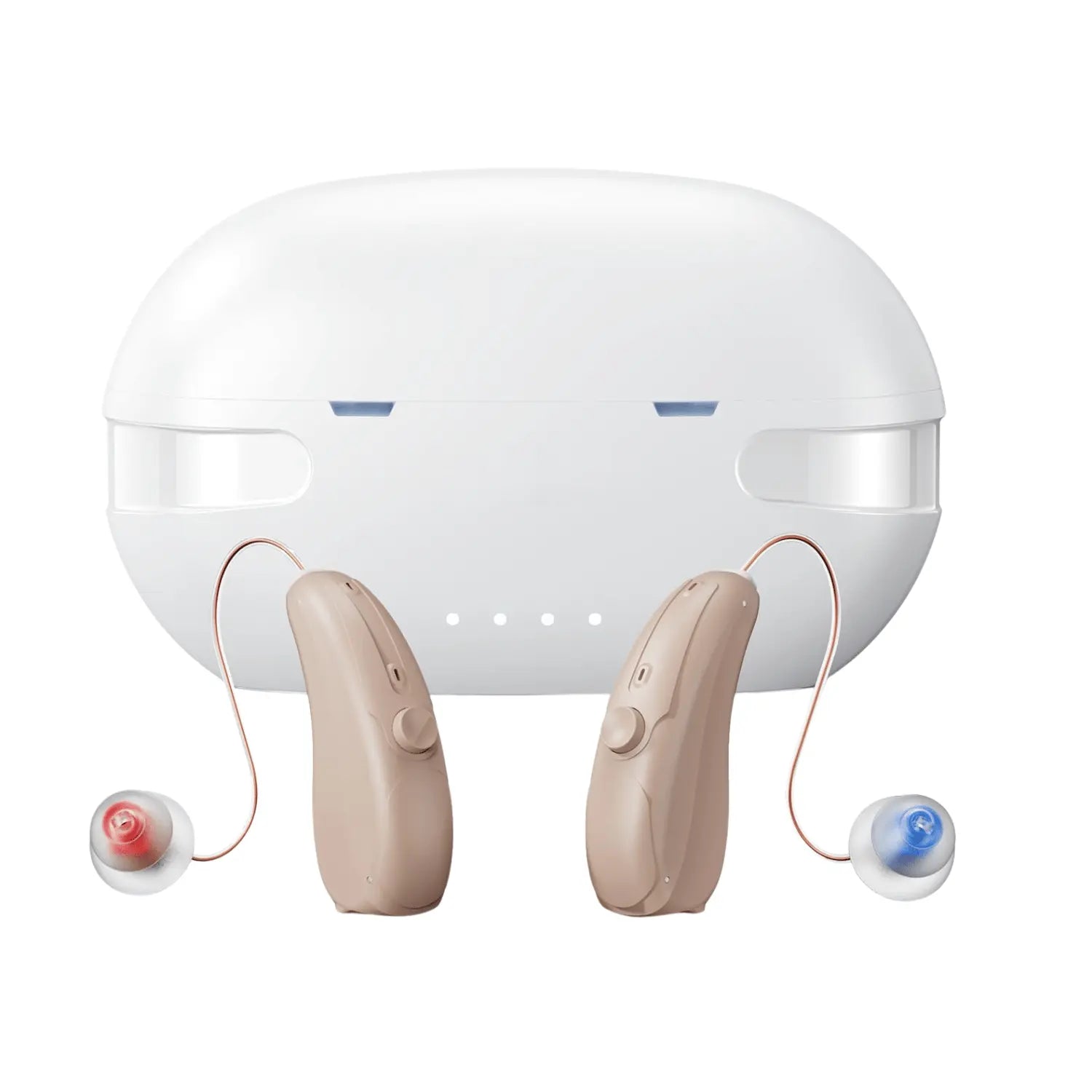
The center of gravity in this work is personalization for real-world listening, especially staying comfortable in noise without losing speech clarity. That same priority shapes how some over-the-counter devices are built. The Panda Quantum, a 16-channel receiver-in-canal device with adaptive noise reduction, is designed around clear speech in noisy environments, the situation the study flags as the hardest for listeners.
It also brings the study's personalization theme to the self-fit setting through app-based hearing personalization. After the Quantum arrives, the user pairs it with the Panda app, which runs a frequency-specific hearing test through the device and then applies the fitting automatically based on the resulting audiogram, similar to a clinical audiologist fitting. Its adaptive noise reduction works to ease the listening fatigue that the Comfort in Noise idea targets, while Bluetooth streaming for calls, TV, and music keeps speech direct in the situations where it matters most.

The Panda Quantum carries up to 80 hours of total battery life with its case, a 5-year warranty, and a 45-day return window. As always, over-the-counter devices are intended for mild to moderate hearing loss, and people with severe or profound loss are still best served by a professional clinical fitting. You can read more about the Panda Quantum here.
Limitations of This Research
Readers should weigh this paper for what it is, a clinical overview written by researchers at the National Acoustic Laboratories, the organization that developed NAL-NL3. That makes it an authoritative description of the system's design and intent, but not an independent, head-to-head trial. The benefits it describes, such as improved first-fit satisfaction and reduced listening fatigue, are drawn from the system's development testing and professional feedback rather than from a controlled comparison reported in this note.
Because a Clinical Note is guidance rather than primary data, it does not provide the outcome statistics a randomized study would. How much NAL-NL3 improves real-world satisfaction compared with NAL-NL2, and how the noise and minimal-loss modules perform across diverse patients, will become clearer as independent evaluations are published.
Where This Leaves Us
NAL-NL3 reflects a broader direction in hearing care, away from one-size-fits-all amplification and toward fittings shaped by how each person actually listens, with particular attention to noise and to the people whose struggles do not show up clearly on a standard test. Whether someone is fitted in a clinic or sets up a self-fitting device at home, the useful question to carry forward is the same: does the fit account for my hearing and my hardest listening situations, not just the average case?
Croteau M, Kwok C. Using NAL-NL3 in clinical practice: a modular NAL fitting system for real-world listening needs. International Journal of Audiology. 2026. Retrieved from PubMed. DOI 10.1080/14992027.2026.2680131.