Hearing Loss at Work: What a New Norwegian Study Reveals About Managing, Disclosing, and Thriving in the Workplace
Norwegian researchers conducted in-depth focus group interviews with working adults with hearing impairment, finding that a sense of personal control, access to appropriate technical aids, and genuine workplace understanding are the central factors separating those who flourish professionally from those who struggle.
Approximately 1.5 billion people worldwide live with some degree of hearing loss, and many of them are of working age. Yet hearing impairment remains one of the most underaddressed conditions in occupational health and vocational rehabilitation. The daily demands of understanding speech in meetings, following conversations in noisy open-plan offices, and deciding whether or not to tell colleagues about a hearing condition can combine into a burden that most workplace systems are poorly equipped to support.
Research has consistently linked hearing loss to lower employment rates, reduced job satisfaction, and higher rates of fatigue and burnout compared to workers with normal hearing. What has remained less well understood is the lived reality behind these statistics: what strategies people actually use to cope, what kinds of support genuinely make a difference, and how individuals navigate the psychologically complex decision of whether and when to disclose their condition to an employer or colleagues.
About This Study
Title: Working life with a hearing impairment: How to stay on top of things
Authors: Eline Lello, Kjersti Vik, Anita Blakstad Bjornerås, Patrick Kermit
Affiliations: Department of Neuromedicine and Movement Science; Department of Mental Health, Faculty of Medicine and Health Sciences, Norwegian University of Science and Technology (NTNU), Trondheim, Norway
Journal & Date: Work (Reading, Mass.), June 30, 2026
Study Type: Qualitative focus group study
PubMed DOI: 10.1177/10519815261463507
Background: Why the Researchers Looked at This
Hearing loss affects work participation in ways that extend far beyond simple sound amplification. A person with impaired hearing in a modern workplace must continuously manage communication across meetings, phone calls, hallway conversations, and noisy common areas, each of which presents different acoustic and social challenges. Fatigue from the sustained cognitive effort of listening, sometimes called listening fatigue, is a well-documented consequence of untreated or undertreated hearing loss in professional settings.
Despite the scale of this challenge, vocational rehabilitation -- the professional support system designed to help people with health conditions maintain and advance in employment -- has historically paid limited attention to hearing impairment as a distinct category of need. The research team at the Norwegian University of Science and Technology set out to capture, in participants' own words, what it actually feels like to navigate a working life with hearing loss, with particular attention to what helps and what gets in the way.
Focus groups were chosen as the research method because they allow participants to build on each other's experiences, surface shared themes, and speak more freely about sensitive topics like stigma and disclosure than they might in individual interviews.
How the Study Was Done
Ten adults with hearing impairment participated in two audio-recorded focus group interviews, with five participants in each group. The sample included six women and four men with a mean age of 57 years, ranging from 45 to 70. All were employed and had experience managing hearing loss in a professional setting.
In terms of hearing loss type, five participants had sensorineural hearing impairment (the most common form, arising from damage to inner ear structures or the auditory nerve), two had a combined neurological and conductive impairment (involving both inner and outer or middle ear structures), and three were uncertain of their diagnostic classification. Eight of the ten had acquired hearing loss over their lifetime, while two had been born with the condition. This variety in experience and onset type was intentional, as the researchers wanted perspectives representing a wide range of journeys with hearing loss in professional life.
The interviews were transcribed and analyzed using systematic text condensation, a structured qualitative method that groups meaningful statements from participants into conceptual categories and then identifies overarching interpretive themes across categories. This process allows researchers to move from individual accounts to patterns that apply more broadly across the group.
What the Researchers Found
The analysis produced four tightly linked concepts that together described the core experience of participants: control, disclosure, support and understanding, and accommodation and technical aids. These were not isolated issues but deeply interconnected -- what happened in one area consistently shaped what was possible in the others.
Control was the most foundational concept. Participants who felt able to shape their communication environment -- choosing where to sit in a meeting, arriving early to set up assistive technology, or structuring conversations in advance -- reported more positive work experiences than those who felt at the mercy of unpredictable acoustic situations. Control, in this context, was not about dominance but about having enough advance information and environmental flexibility to manage when and how hearing demands would arise.
Disclosure was described as a recurring and evolving process rather than a one-time event. Many participants had informed some people at work about their hearing loss but not others, and this partial disclosure required ongoing management and judgment. The decision about whether to disclose was shaped by fear of being perceived as less capable, previous experiences of having concerns minimized or dismissed, and uncertainty about how the information would be used professionally. For some participants, wearing hearing aids that were easily visible effectively removed their agency over this decision.
Support and understanding from colleagues and managers was consistently described as a significant factor in whether participants could stay engaged and effective at work. Employers who knew about the hearing loss and actively made accommodations -- asking speakers to face the person directly, providing written summaries of meetings, or reducing background noise where possible -- were credited with making a substantial positive difference. The absence of this support was experienced as a source of both isolation and exhaustion.
Accommodation and technical aids, including hearing aids and assistive listening devices, were cited as important enablers of work participation but were not described as standalone solutions. Participants valued devices that performed reliably across varied acoustic environments, not just in quiet one-on-one settings. The combination of effective technology with appropriate environmental accommodations and colleagues who understood the situation was described as the most consistently useful approach.
Three overarching interpretive themes emerged from these concepts: chasing consistency (finding strategies to keep communication performance stable across changing work situations), managing inconsistency (coping when those strategies did not work and outcomes felt unpredictable), and expecting normalcy (the persistent desire to be seen and treated as a capable professional rather than a person defined by disability). These themes pointed to the deep psychological dimension of hearing loss at work, which extends well beyond acoustics into questions of identity, belonging, and professional self-worth.
What It Means for People with Hearing Loss
This study makes clear that effective hearing technology is a necessary but not sufficient condition for good work participation. Participants who used hearing aids still struggled when their workplace environment was unsupportive, when they had not disclosed their condition to key colleagues, or when the pace and format of workplace communication left no room for adaptation. Technology and social support need to work in combination.
The findings also point to the importance of vocational rehabilitation that addresses the full complexity of the experience, not just device fitting. Workers with hearing loss benefit from support with disclosure coaching, help navigating conversations with employers about appropriate accommodations, and practical strategies for managing the listening fatigue that accumulates across a full working day in environments not designed for people with hearing difficulty.
For individuals with hearing loss who are weighing their options, the message from this research is that early, consistent use of hearing technology is worth prioritizing. The longer the gap between onset and treatment, the longer the period of unnecessary strain on professional relationships and personal well-being. Devices that are comfortable and unobtrusive enough to wear throughout the full working day make consistent use more achievable.
The Disclosure Decision and the Case for Discreet Hearing Aids in Professional Settings
One of the clearest findings in this research is that the decision to disclose hearing loss at work is deeply personal, often anxiety-provoking, and rarely made just once. Visible hearing aids can effectively remove that choice, forcing disclosure before a person is ready and on terms they did not choose. For many working professionals, a device that colleagues are unlikely to notice allows them to manage that conversation on their own timeline -- and this study suggests that having that control matters for both confidence and daily performance.
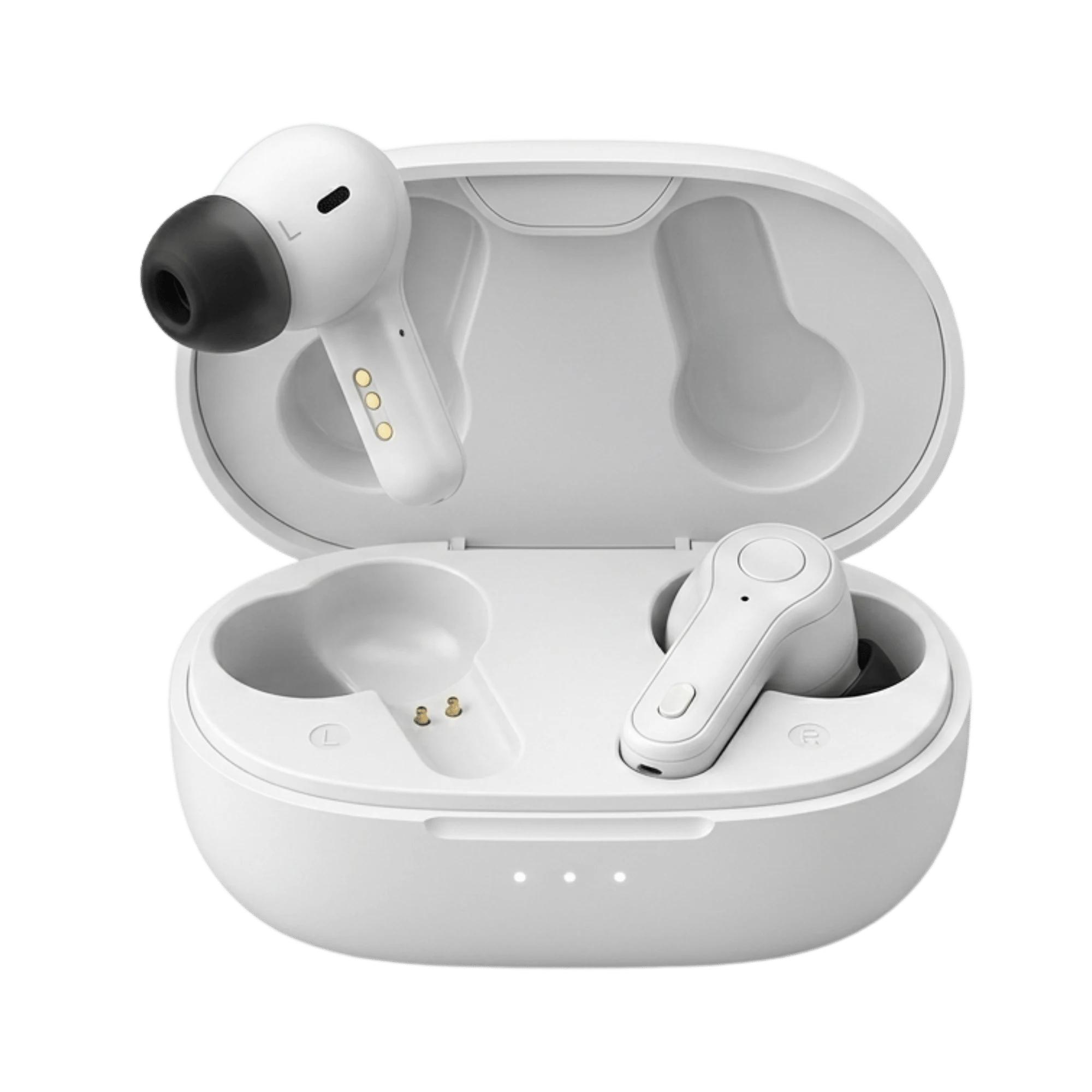
The Panda Stealth is a nearly invisible OTC hearing aid designed for exactly this kind of user. At 2.3 grams and positioned inside the ear canal, it qualifies as a discreet hearing aid that most colleagues will not notice during a typical workday. It does not require an app, smartphone pairing, or a clinic appointment -- it is a plug-and-play hearing aid that works immediately without a learning curve. For professionals who want an invisible hearing aid that fits seamlessly into a professional day without drawing attention or requiring setup, this simplicity can be a deciding factor in whether a device is worn consistently or left unused.
As this study makes clear, consistent daily use of hearing technology is one of the most reliable contributors to better work participation for people with hearing loss. Easy hearing aids for adults in professional settings should combine effective amplification with the discretion and simplicity that make all-day wear feel manageable rather than burdensome. Learn more at pandahearing.com/products/panda-stealth.

Limitations of This Research
This study enrolled ten participants, a standard sample size for qualitative focus group research but one that limits the statistical generalizability of the findings. The Norwegian context, with its particular social welfare architecture and cultural norms around disability disclosure, may not translate directly to workplaces in countries where employer obligations, healthcare access, and social attitudes differ significantly. Participants were recruited through channels that may have favored people already engaged with hearing rehabilitation services, potentially over-representing those with higher awareness and more developed self-advocacy skills.
Focus groups are well-suited for generating themes and hypotheses, but they are not designed to measure the frequency or severity of specific experiences across a broader population. The sensitive nature of topics like stigma and non-disclosure may also have led some participants to underreport certain experiences even within a peer group setting. No information about research funding or potential conflicts of interest was provided in the available materials.
Where This Leaves Us
Research on hearing impairment in the workplace is slowly catching up to the scale of the problem. This Norwegian study adds qualitative depth to what we know about how working adults with hearing loss negotiate their professional identities, their relationships with colleagues and managers, and their access to the tools and environments that help them perform at their best. For people navigating these challenges day to day, the takeaway from this research is direct: the right hearing technology is part of the answer, but so is a workplace willing to meet people with hearing loss halfway. Neither alone is enough to close the gap.
Lello E, Vik K, Bjornerås AB, Kermit P. Working life with a hearing impairment: How to stay on top of things. Work. 2026. Retrieved from PubMed. DOI: 10.1177/10519815261463507