New National Guidelines Push for Broader Hearing Screening in Adults and Children
A newly published national clinical practice guideline lays out ten recommendations for screening apparently healthy children and adults for hearing disorders, drawing new attention to how many people are still missed by routine checkups.
Hearing loss is often described as a silent condition, and one big reason is that it rarely shows up in general primary care exams. Blood pressure, weight, and vision checks are standard. Hearing checks, in most countries, are not.
A group of Philippine physicians, audiologists, and public health experts set out to change that in their own country. Their new national Clinical Practice Guidelines for Periodic Health Examination on hearing disorder screening are meant to define, at the national level, who should be screened, when, and how, in ordinary healthcare settings rather than only inside specialty clinics.
Title: Philippine Clinical Practice Guidelines for Periodic Health Examination: Screening for Hearing Disorders
Authors: Carrillo RJD, Salcedo AS, Pascual JLR V, Alcances LRA, Baltazar-Braganza K, and 20 additional multisectoral task-force members
Affiliations: University of the Philippines Manila; Philippine General Hospital; Philippine National Ear Institute; National Institutes of Health, University of the Philippines Manila; Newborn Hearing Screening Reference Center; multiple regional and specialty hospitals across the Philippines
Journal: Acta Medica Philippina, 2026, Vol. 60, Issue 10, pages 144-155
Study type: National clinical practice guideline developed using the GRADE approach
PubMed DOI: 10.47895/amp.v60i10.12730
Background: Why the Researchers Looked at This
Guidelines like this one exist because hearing loss is common, treatable, and consequential, but it is also easy to miss. A person can lose the ability to follow speech in noise, or the ability to hear soft high-frequency consonants, without ever telling a physician about it. Family members often notice first. Screening is the tool that gets these cases into the healthcare system before communication, cognition, learning, or work start to suffer.
The authors note that ear diseases account for a significant share of childhood disability in some populations, and that hearing loss in adults is linked to isolation, reduced quality of life, and cognitive decline. Yet outside of newborn hearing screening programs, hearing checks in otherwise healthy people are inconsistent. Two people with the same degree of untreated hearing loss can walk into two different clinics and get two completely different responses. National practice guidelines are one of the main tools health systems use to standardize that response.
The Philippine Department of Health commissioned this work through its formal CPG manual process. The task force used GRADE, the same evidence rating framework that international bodies such as the World Health Organization rely on, so the recommendations rest on graded evidence rather than expert opinion alone.
How the Study Was Done
This work is a clinical practice guideline, not a single trial. That means the panel's job was to pull together existing evidence and translate it into practical recommendations. The steering committee first identified four key questions covering when and how to screen apparently healthy children and adults for hearing and vestibular disorders. Vestibular refers to balance function, which shares its inner-ear anatomy with hearing.
Evidence review experts then hunted down existing guidelines from other countries and appraised them, along with primary studies, using the GRADE approach. Every recommendation was assigned a strength (strong or conditional) and a certainty of evidence (high, moderate, low, or very low), giving front-line clinicians a sense of how firmly to apply it.
A multisectoral consensus panel then reviewed those evidence summaries and voted on wording. Three independent stakeholders reviewed the draft for clarity, acceptability, applicability, and feasibility before finalization. That layered process is meant to catch recommendations that look good on paper but do not work in real clinics.
What the Researchers Found
The final guideline contains ten recommendations organized around four prioritized questions. Together they cover screening from the prenatal window through school age in children, and screening in adult populations who are otherwise apparently healthy.
On the pediatric side, the guideline supports screening in defined population groups, following the pattern set by earlier universal newborn hearing screening programs. Early detection matters: children born with sensorineural hearing loss who are identified late can miss developmental windows for speech and language acquisition. School-age screening rounds out coverage by picking up children whose loss is acquired or progressive, or who slipped through newborn screening.
On the adult side, the panel weighed the same four questions used throughout the guideline: How common is the condition in the target group? How well do screening tests perform? Are follow-up and treatment available and acceptable? And is it cost-effective? Each adult recommendation was crafted to reflect the balance of those four factors, so the strength of a given recommendation reflects both biology and practical feasibility.
The authors also flag vestibular screening, which is often lumped in with hearing but requires different tests. Screening for balance disorders is not routine in most primary care settings anywhere in the world, and the panel's recommendations on that side are more selective.
Underlying all ten recommendations is a single message: screening only makes sense when there is a real path to treatment on the other side. A referral network that ends at a specialist the patient cannot afford or reach does not produce better outcomes. The guideline is therefore explicit that recommendations depend on the availability of confirmatory testing and follow-up care.
What It Means for People with Hearing Loss
For patients, national guidelines like this one shape what happens during a routine checkup. When a country's Department of Health formally recommends screening a particular group, that group is more likely to actually get screened. Insurance rules, public health funding, and clinic workflows all tend to follow national guidelines.
More screening also creates a bigger downstream challenge. Every person newly identified as having hearing loss will need to decide what to do about it. In wealthy countries, historical estimates suggest that a large share of adults with clinically significant hearing loss go untreated, often because of cost, access, or reluctance. Guidelines that expand screening will make that treatment gap more visible and more urgent.
That is one reason the guideline explicitly asks its own question about the applicability of follow-up testing and treatment to the target population. Detection without action is not a health improvement.
Why Wider Screening Puts Affordable Hearing Care Front and Center
The Philippine guideline highlights something familiar to every country working on adult hearing loss: even where screening improves, cost and access still decide whether people actually get help. Traditional hearing aids priced in the thousands of dollars per pair remain out of reach for a large share of the newly identified adults these screening programs will surface.
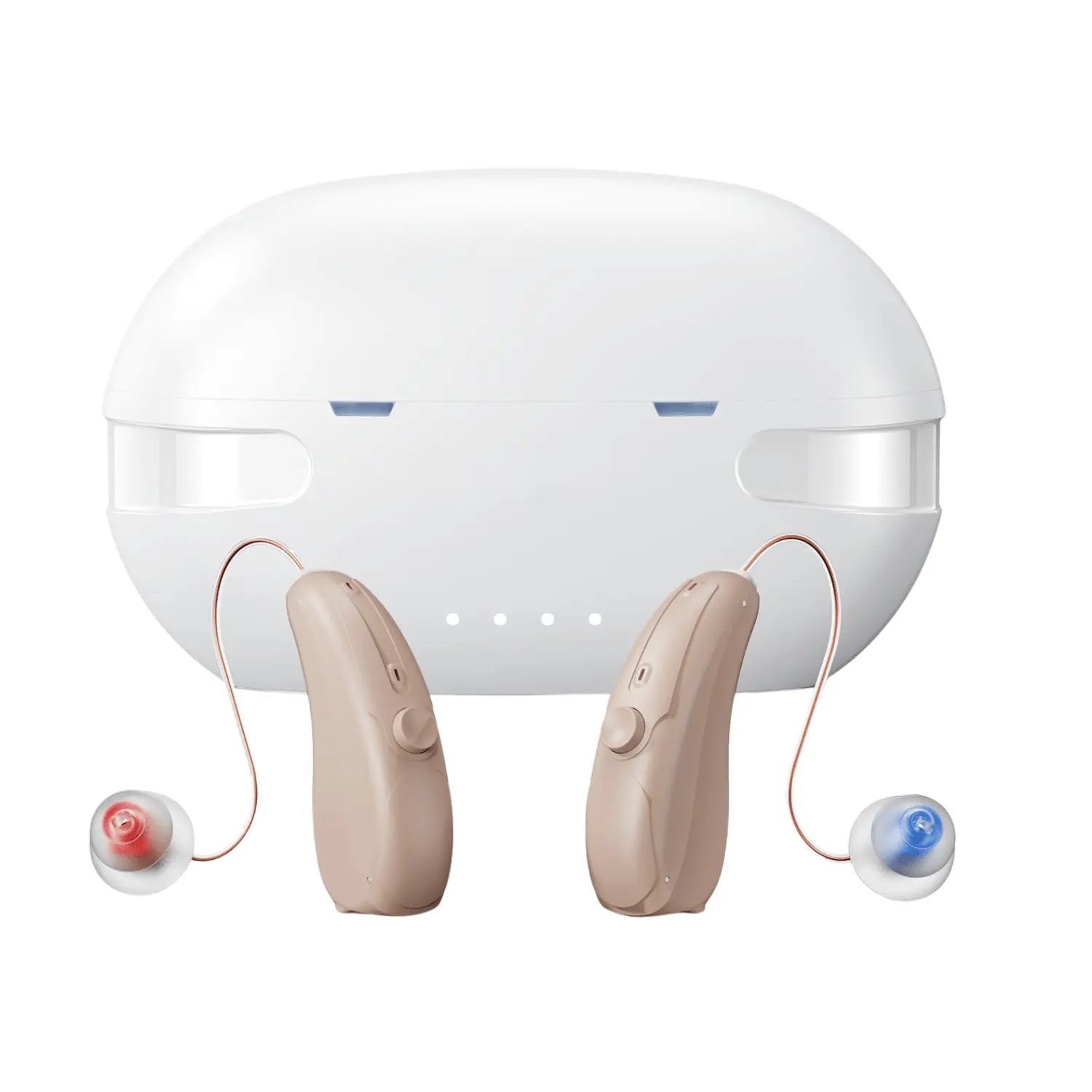
Panda Air is designed for exactly that gap. It is a self-fitting OTC hearing aid built around the reality that most adults with mild-to-moderate loss will not visit an audiology clinic. It uses 16-channel wide dynamic range compression with multi-band adaptive noise reduction, comes with a 60-hour fast-charge case, and is backed by a 5-year warranty and a 45-day return window. After delivery, users pair the device with the Panda app and run an app-based hearing test straight through the hearing aid itself; the app then automatically programs the device's gain and frequency response to match the user's own audiogram, similar to what an audiologist does at a clinical fitting.
The Philippine guideline is careful to note that OTC and self-fitting devices are aimed at adults with mild-to-moderate loss. People with severe or profound loss, complex ear pathology, or pediatric hearing loss still benefit most from a full clinical evaluation and a professional fitting. What OTC devices like Panda Air add is a viable option for the majority of newly screened adults who fall in the mild-to-moderate range and would otherwise walk away untreated.
Limitations of This Research
This is a national clinical practice guideline developed for the Philippines. Its specific recommendations, especially around cost-effectiveness and target populations, are calibrated to Filipino demographics, prevalence, health system capacity, and cultural context. They are not automatically transportable to other health systems, though the underlying evidence base largely is.
The paper does not appear to disclose competing financial interests or an industry sponsor for the guideline process itself, but as with any consensus document, it reflects the judgment of the panel members who wrote it, not a single randomized trial. Some recommendations will inevitably rest on lower-certainty evidence, which is why GRADE reports strength and certainty side by side.
Where This Leaves Us
If you have not had your hearing checked as an adult, this guideline is a reminder that a hearing check belongs on the list of things you can ask about at a regular physical. If a screen picks something up, ask your clinician about your options, including OTC hearing aids for mild-to-moderate loss and a professional audiology referral for anything more complex. Screening is only the first step. What matters is what happens next.
Carrillo RJD, Salcedo AS, Pascual JLR V, et al. Philippine Clinical Practice Guidelines for Periodic Health Examination: Screening for Hearing Disorders. Acta Medica Philippina. 2026;60(10):144-155. Retrieved from PubMed. https://doi.org/10.47895/amp.v60i10.12730