Nearly One in Three Adults Reported Tinnitus in a Regional Saudi Survey, and Three Quarters Never Sought Care
A community study of 501 adults across four regions of southern Saudi Arabia found tinnitus in 31.1 percent of respondents, with weekly noise exposure and higher body mass index the only two factors independently linked to it.
Tinnitus, the perception of sound with no external source, is one of the most commonly reported and least commonly treated symptoms in medicine. Global prevalence estimates typically land somewhere between 10 and 15 percent of adults, though the range across individual studies is wide enough that researchers have long suspected the differences reflect genuine geographic variation rather than measurement noise alone.
Southern Saudi Arabia has been largely absent from that literature, despite scattered evidence pointing to a heavier than average regional burden. A team drawing on medical faculties across Jazan, Aseer, Najran, Taif, and Al Baha set out to fill the gap with a community survey, and the number they came back with is considerably higher than the global benchmark.
Title: Prevalence and Epidemiological Determinants of Tinnitus in the Southern Region of Saudi Arabia: A Community-Based Cross-Sectional Study
Authors: Abdulrahman Ali Otaif, Musleh Hussain Mubarki, Khalid Talat Ardi, Abdulelah A Otaif, Dhiyaa A H Otayf, Ghala S Al Ahmari, Danah M Al Mutib, Razan M Althumali, Tif A Jawahi, Najla M Al Yami, Abdullah M Algarni
Affiliations: Faculty of Medicine, Jazan University; Otorhinolaryngology, Head and Neck Department, Samtah General Hospital, Jazan; Department of Otorhinolaryngology and Head and Neck Surgery, Aseer Central Hospital, Abha; College of Medicine, King Khalid University, Abha; College of Medicine, Taif University; College of Medicine, Najran University; Faculty of Dentistry, Al Baha University, Saudi Arabia
Journal and publication date: Audiology Research, 10 July 2026, volume 16, issue 4
Study type: Community-based cross-sectional survey
PubMed DOI: 10.3390/audiolres16040101
Background: Why the Researchers Looked at This
Tinnitus is a symptom rather than a disease. It is generated inside the auditory system, usually as a consequence of damage somewhere along the pathway from the inner ear to the brain, and it can accompany noise injury, age-related hearing loss, ear infections, certain medications, and a long list of other conditions. Because it is a symptom, prevalence figures depend heavily on how the question is asked and who is asked.
That methodological sensitivity is exactly why regional data matter. Noise exposure patterns, occupational structures, age distributions, and health-seeking norms all differ between populations, and a figure derived from a European or North American sample cannot simply be transplanted. Health systems planning tinnitus services need to know what their own population reports.
The southern regions of Saudi Arabia had little such data. The researchers designed this survey to answer two questions at once: how common tinnitus is among adults there, and which measurable characteristics distinguish the people who have it from the people who do not. A third question emerged from the data almost incidentally, and it turned out to be the most striking result in the paper.
How the Study Was Done
The team recruited 501 adults from four regions, Jazan, Aseer, Najran, and Al Baha. Participants provided sociodemographic details, reported any chronic medical conditions, described their patterns of noise exposure, and answered questions about the clinical features of tinnitus if they experienced it, including which ears were affected, how long symptoms had lasted, how severe they were, and what made them worse.
This is a cross-sectional design, meaning everything was captured at a single point in time. That structure is efficient for estimating how common something is, but it cannot establish that one thing caused another, only that two things appear together more often than chance would predict.
To separate genuinely independent associations from ones that merely reflect overlapping characteristics, the researchers used multivariable logistic regression. The method tests each candidate factor while holding the others constant, so that a variable like age does not get credit for an effect actually driven by something correlated with it. Results are reported as odds ratios with 95 percent confidence intervals.
What the Researchers Found
Tinnitus was reported by 156 of the 501 participants, a prevalence of 31.1 percent. That is roughly double to triple the figures commonly cited for global adult populations, and the authors describe it as substantially exceeding global estimates. The sample skewed young, with a mean age of 30 plus or minus 11 years, and 61.7 percent of participants were female.
Among those affected, bilateral tinnitus was the most common presentation at 47.4 percent. Symptom duration was fairly evenly split at the shorter end: 31.4 percent reported symptoms lasting under three months, and another 31.4 percent reported between three months and one year. Mean severity, on the scale used in the survey, was 3.7 plus or minus 1.9. The factors participants most often identified as making symptoms worse were sleep deprivation at 41.7 percent, noise exposure at 41.0 percent, and stress at 39.1 percent.
The multivariable analysis narrowed a long list of candidate factors down to two independent predictors. Weekly noise exposure exceeding five hours was associated with roughly double the odds of tinnitus, with an odds ratio of 2.14 and a confidence interval running from 1.34 to 3.42. Higher body mass index carried an odds ratio of 1.06 per unit, with an interval of 1.02 to 1.10. Both associations were statistically significant, and both point to factors that are, at least in principle, modifiable.
Among underlying conditions occurring alongside tinnitus, ear infections were the most frequent at 25.6 percent, followed by hearing loss at 24.4 percent. So roughly a quarter of the people reporting tinnitus in this sample also had a documented hearing problem.
The finding the authors return to in their conclusion, however, is about behaviour rather than biology. Of the participants who reported tinnitus, 76.9 percent had never sought medical care for it. More than three quarters of an affected population, in a survey where the condition was common enough to touch nearly a third of respondents, had simply lived with it.
What It Means for People with Hearing Loss
The care-seeking figure is the part of this study that travels beyond Saudi Arabia. Low treatment-seeking for tinnitus and for hearing loss is documented across very different health systems, including ones where cost is not the primary obstacle. The pattern appears to be driven less by any single barrier than by a widely shared assumption that nothing much can be done, reinforced by the fact that tinnitus often arrives gradually and fluctuates, which makes it easy to normalise.
That assumption is only partly true. There is no universal cure for tinnitus, and it would be dishonest to suggest otherwise. But the subgroup finding here points to something actionable: about a quarter of the people reporting tinnitus also had hearing loss. For that group specifically, addressing the hearing loss is a recognised part of tinnitus management, because amplification restores ambient sound that partially masks the internal signal and reduces the strain of listening effort that tends to make tinnitus more intrusive.
The noise finding is equally practical and rather more universal. Exceeding five hours of noise exposure a week roughly doubled the odds of reporting tinnitus in this sample. Hearing protection during loud work, loud hobbies, and loud leisure remains the single most reliable thing anyone can do to avoid ending up in that column.
When Three Quarters Never Reach a Clinic, the First Step Has to Be Simple
A 76.9 percent care-avoidance rate is not a knowledge problem that a leaflet fixes. It reflects how much friction sits between noticing a symptom and doing something about it: booking an appointment, taking time off, sitting for a fitting, returning for adjustments. For the subgroup in this study whose tinnitus came alongside hearing loss, lowering that friction is the whole game, and this is where over-the-counter devices designed to work straight out of the box have a role.
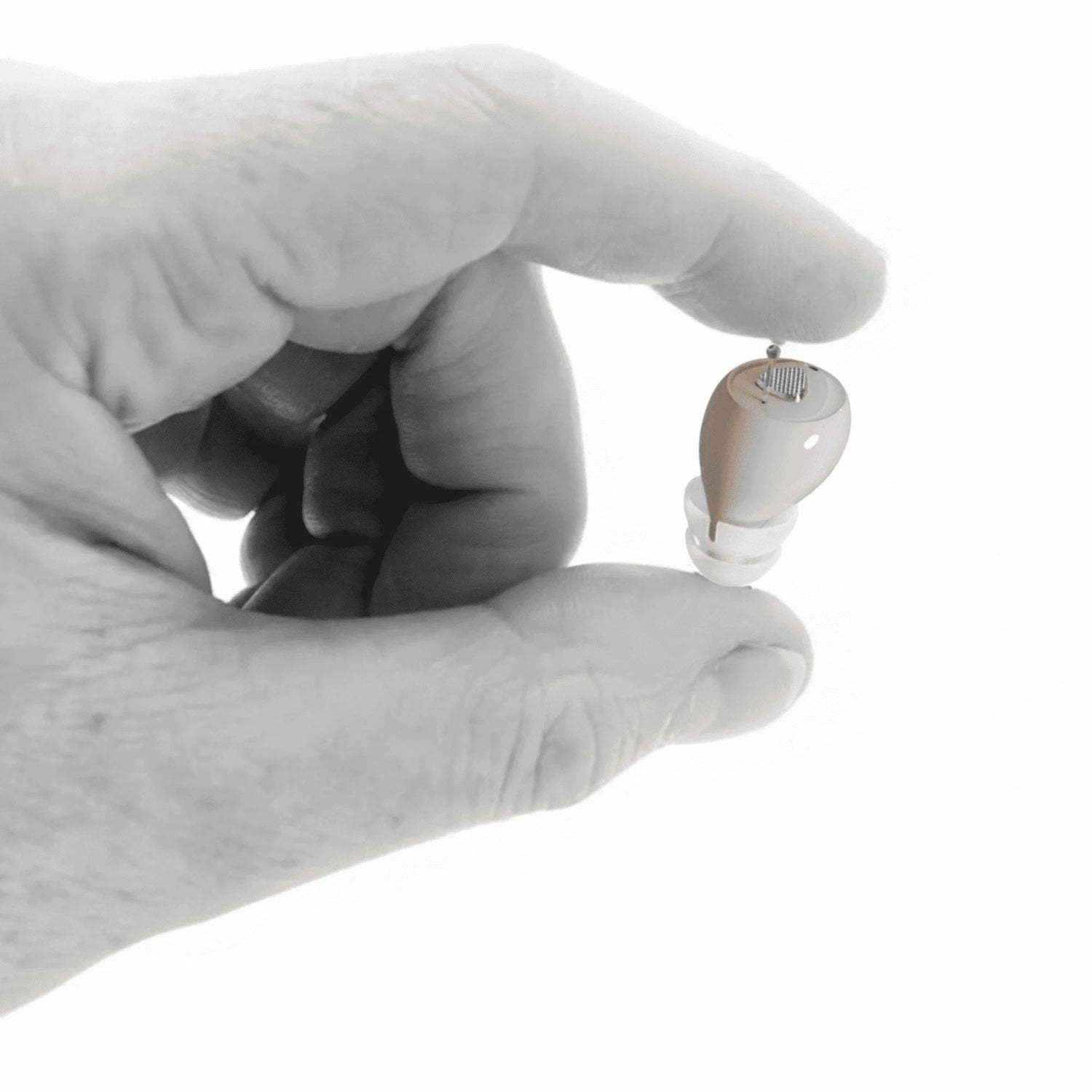
Panda Stealth is built around that idea. It weighs 2.3 grams and sits inside the ear canal, and it uses 12-band smart noise reduction to lift speech out of background sound. There is no app and no setup routine, which is the point: these are plug-and-play hearing aids for someone who would not otherwise start the process at all. The charging case doubles as a wireless remote for volume and programme changes, so adjustments happen in the moment rather than through a phone. It carries a 5-year warranty and 45-day returns, and the model is at pandahearing.com/products/panda-stealth.
Two honest qualifications. Over-the-counter devices are approved for mild to moderate hearing loss, and severe or profound loss still calls for a clinical fitting. And amplification addresses hearing loss, not tinnitus itself. Anyone with sudden tinnitus, one-sided tinnitus, or tinnitus with pain, discharge, or dizziness should see a clinician rather than reach for a device, since those patterns can signal something that needs diagnosing.

Limitations of This Research
The cross-sectional design is the main constraint. Noise exposure and body mass index were measured at the same moment as tinnitus, so the study can show they travel together but cannot demonstrate that either causes the condition. Tinnitus itself was self-reported rather than confirmed by audiometric testing across the whole sample, which tends to inflate prevalence relative to clinically verified estimates and may partly explain why 31.1 percent sits so far above global figures.
The sample also skews young, with a mean age of 30. That is unusual for a tinnitus study, since both tinnitus and age-related hearing loss become more common in later decades, and it means these results should not be read as describing older adults in the region. Recruitment covered four southern regions rather than the country as a whole, and the abstract does not report funding sources or competing interests, so readers cannot assess those from the record available through PubMed.
Where This Leaves Us
The prevalence figure will need confirmation with audiometric verification before anyone treats 31.1 percent as the settled regional rate. The care-seeking figure needs no such caution. Whatever the true prevalence turns out to be, a population in which more than three quarters of affected people never mention the problem to anyone is a population where the barrier is not diagnosis but engagement, and that is a problem measured in appointment friction and low expectations rather than in decibels.
Otaif AA, Mubarki MH, Ardi KT, Otaif AA, Otayf DAH, Al Ahmari GS, Al Mutib DM, Althumali RM, Jawahi TA, Al Yami NM, Algarni AM. Prevalence and Epidemiological Determinants of Tinnitus in the Southern Region of Saudi Arabia: A Community-Based Cross-Sectional Study. Audiology Research. 2026;16(4). Retrieved from PubMed. DOI: 10.3390/audiolres16040101