Age-Related Hearing Loss Ranks Among the Leading Contributors to Years Lived in Poor Health Worldwide
A 204-country analysis covering 1990 to 2023 finds that people are gaining years of life faster than they are gaining years of good health, and age-related hearing loss sits inside the small group of chronic conditions driving that widening gap.
For most of the past century, global health progress was measured in one currency: how long people live. By that measure the record is remarkable. Life expectancy has climbed in nearly every country on earth. But a second question has been much harder to answer, and it is arguably the one that matters more to the people living those extra years. Are the added years healthy ones?
A new analysis published in The Lancet Public Health puts a number on it. Researchers at the Institute for Health Metrics and Evaluation and their collaborators measured what they call the morbidity gap, the stretch of life a person can expect to spend in poor health, across 204 countries and territories over 33 years. The gap did not shrink. It grew almost everywhere, and the conditions responsible are not the ones that dominate mortality statistics.
Title: Global, regional, and national trends in the morbidity gap and contributing diseases, injuries, and risk factors, 1990-2023: a systematic analysis for the Global Burden of Disease Study 2023
Authors: Simon I Hay, Paul Nam, Haaris Saqib, Susan A McLaughlin, Catherine Bisignano, Samuel M Ostroff, Marie Ng, Shuhei Nomura, Austin E Schumacher, Christopher J L Murray, and GBD 2023 collaborators
Affiliations: Institute for Health Metrics and Evaluation and Department of Health Metrics Sciences, School of Medicine, University of Washington, Seattle, USA; Jackson School of International Studies, University of Washington; Yong Loo Lin School of Medicine, National University of Singapore; Global Health Policy Lab, International Research Institute of Disaster Science, Tohoku University, Japan
Journal and publication date: The Lancet Public Health, August 2026, volume 11, issue 8, pages e487-e505
Study type: Systematic analysis of modelled global health estimates
PubMed DOI: 10.1016/S2468-2667(26)00098-8
Background: Why the Researchers Looked at This
There is a long-standing idea in public health called the compression of morbidity hypothesis. The theory, first proposed in the 1980s, holds that as prevention and medical care improve, the onset of disability will be pushed back faster than the onset of death. Illness would then be squeezed into a shorter window at the very end of life. People would not just live longer, they would stay well for almost all of it and decline quickly at the end.
Testing that idea requires two numbers. The first is life expectancy, the average number of years a person can expect to live. The second is healthy life expectancy, often shortened to HALE, which is the number of years a person can expect to live in good health after subtracting time lost to disability and illness. The difference between the two is the morbidity gap. If the compression hypothesis were correct, that gap should be narrowing over time.
Nobody had measured the gap comprehensively across every country and across three decades. That is what this team set out to do, and they went a step further by decomposing the gap into the specific diseases and risk factors responsible for it. This matters because the causes of death and the causes of disability are very different lists. Heart disease and stroke dominate the first. Chronic, largely non-fatal conditions dominate the second, and those conditions tend to receive far less policy attention and far less funding.
How the Study Was Done
The researchers drew on the Global Burden of Disease Study 2023, an ongoing international effort that pools census data, household surveys, disease registries, hospital records, and published studies to produce comparable health estimates for every country. From that database they took life expectancy and healthy life expectancy at birth for 204 countries and territories for each year from 1990 to 2023.
For each population they calculated the morbidity gap by subtracting healthy life expectancy from life expectancy. They also calculated a proportional version, dividing that difference by total life expectancy, which answers a slightly different question: what share of an average life is spent in poor health. Results were broken out by sex, by world region, and by a measure called the Socio-demographic Index, which sorts countries into five groups based on income, education, and fertility.
They then decomposed the gap by cause. Each disease group was assigned its proportional share of years lived with disability, with an adjustment for comorbidity so that a person living with several conditions at once was not counted multiple times over. The same decomposition was repeated for underlying risk factors. All estimates are reported with 95% uncertainty intervals derived from at least 250 draws from posterior distributions, which is the standard way this kind of modelled estimate expresses how confident the researchers are in each figure.
What the Researchers Found
The morbidity gap widened. Globally it rose from 8.8 years in 1990, with an uncertainty interval of 6.7 to 11.2 years, to 10.7 years in 2023, with an interval of 8.2 to 13.7. That is an increase of 1.9 years, or roughly 21.9 percent. The point estimates suggest the gap widened in 203 of the 204 countries and territories studied. Whatever compression of morbidity was supposed to look like, this is not it.
Measured as a share of life rather than a count of years, the picture is similar but less dramatic. In 2023 an average of 14.5 percent of life was spent in poor health, up from 13.6 percent in 1990. The distinction matters. Part of the widening gap is simply arithmetic, because longer lives create more room for years of poor health. But the proportional figure rose too, which means the increase is not purely a side effect of longevity.
The researchers also found that the widening was spread across the adult life course rather than concentrated in the final years before death. This cuts against the intuition that extra unhealthy years are mostly a late-life phenomenon. People are accumulating disability earlier and carrying it longer.
Counterintuitively, the largest morbidity gaps were found in the highest Socio-demographic Index quintile and the smallest in the lowest quintile. Countries with longer life expectancies had larger absolute morbidity gaps. The relationship between life expectancy and the proportional gap was considerably less clear, which suggests wealthier countries are not simply worse at keeping people well, but rather that their populations survive long enough to accumulate chronic conditions that would have gone unrecorded elsewhere.
The cause decomposition is where hearing enters the picture. A small number of chronic, largely non-fatal conditions accounted for the bulk of unhealthy years. Five groups together made up 57.4 percent of all unhealthy years globally in 2023: musculoskeletal disorders, with low back pain the largest single contributor; mental disorders, chiefly depressive and anxiety disorders; sense organ diseases, where the researchers single out age-related hearing loss; unintentional injuries, chiefly falls; and a residual group of other non-communicable diseases. On the risk factor side, high fasting plasma glucose, high body mass index, and child and maternal malnutrition led the list.
What It Means for People with Hearing Loss
Age-related hearing loss almost never appears in mortality statistics. It does not kill people, and for that reason it has historically been treated as a quality-of-life issue rather than a public health priority. This analysis reframes that. When health is measured in years lived well rather than years lived at all, hearing loss moves from the margins toward the centre, sitting alongside back pain, depression, and falls as one of the conditions doing the most to keep populations in poor health.
It is worth being precise about what the study does and does not say. It does not report a standalone figure for hearing loss, and it does not claim that hearing loss alone accounts for a large share of unhealthy years. What it says is that sense organ diseases, with age-related hearing loss named as the principal contributor within that group, belong to the handful of cause groups that together explain more than half of global disability. That is a statement about company, not about magnitude, but the company is telling.
The practical implication follows from a feature these conditions share. Unlike many drivers of mortality, most are manageable with existing tools. Hearing loss in particular has a well-established, non-surgical, widely available intervention in the form of amplification. The obstacle has rarely been whether treatment exists. It has been whether people reach it.
When a Treatable Condition Goes Untreated, Cost Is Usually Part of the Reason
If age-related hearing loss is contributing meaningfully to the years people spend in poor health, the gap worth closing is the one between the people who could benefit from hearing help and the people who actually get it. Historically the price of a clinically fitted pair of hearing aids, often several thousand dollars and rarely covered by insurance, has been one of the most consistent reasons that gap stays open. The regulatory shift that created an FDA-cleared over-the-counter category for adults with mild to moderate hearing loss was aimed squarely at that barrier.
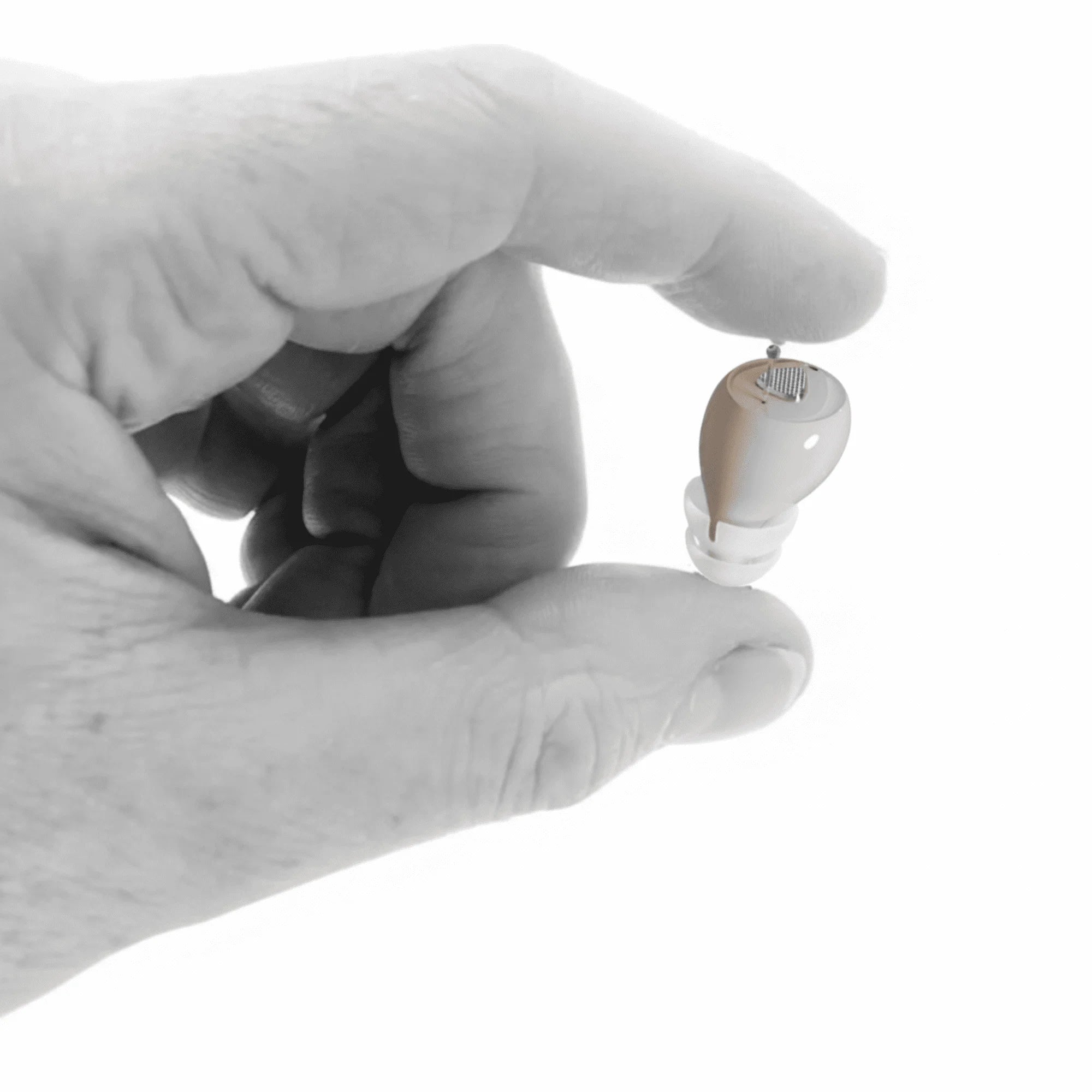
Panda Air is one device built for that opening. It is an earbud-style in-the-canal aid with 16-channel wide dynamic range compression and multi-band adaptive noise reduction, and it pairs with the Panda app after delivery to run a frequency-specific hearing test through the aid itself, then programs gain and frequency response to the result. That app-tuned approach is what makes a self-fitting OTC hearing aid workable without a clinic visit, since the device adapts to the individual audiogram rather than applying a generic amplification curve. The fast-charge case carries about 60 hours of use, and the aids come with a 5-year warranty and 45-day returns. You can see the model at pandahearing.com/products/panda-air.
The caveat matters as much as the offer. The over-the-counter category is approved for mild to moderate hearing loss. People with severe or profound loss still benefit most from a clinical fitting with an audiologist, and this study's framing of hearing loss as a driver of unhealthy years is not an argument for skipping professional care when it is warranted.

Limitations of This Research
Every figure in this analysis is a modelled estimate rather than a direct measurement, which is why the uncertainty intervals are wide. The global morbidity gap for 2023 could plausibly be anywhere from 8.2 to 13.7 years. Data quality also varies enormously between countries, and estimates for places with sparse vital registration or few health surveys lean more heavily on statistical modelling and borrowed regional patterns than on local observation.
Years lived with disability depend on disability weights, which are assigned values reflecting how severely a given condition impairs health. Those weights come from population surveys and carry their own assumptions, and the comorbidity adjustment used to avoid double counting is itself a modelling choice. Part of the apparent rise in the morbidity gap in wealthier countries may also reflect better detection and recording of chronic conditions rather than a real increase in illness. The study was funded by the Gates Foundation.
What to Do With This
The headline finding is a course correction for how health progress gets judged. Adding years to life has worked; adding health to those years has not kept pace, and the conditions holding it back are chronic, common, and largely treatable. For anyone who has been putting off doing something about their hearing on the grounds that it is an inconvenience rather than a health issue, this analysis suggests the distinction is less clean than it looks. Hearing loss is one of the conditions quietly filling up the years that people would otherwise spend well.
Hay SI, Nam P, Saqib H, McLaughlin SA, Bisignano C, Ostroff SM, Ng M, Nomura S, Schumacher AE, Murray CJL. Global, regional, and national trends in the morbidity gap and contributing diseases, injuries, and risk factors, 1990-2023: a systematic analysis for the Global Burden of Disease Study 2023. The Lancet Public Health. 2026;11(8):e487-e505. Retrieved from PubMed. DOI: 10.1016/S2468-2667(26)00098-8