Longer Hearing-Aid Sound Therapy Linked to Greater Tinnitus Relief in New Cohort Study
A new observational study from China suggests that patients with chronic tinnitus and hearing loss may see continued improvement in tinnitus-related distress and perceived loudness as treatment with hearing-aid-based sound therapy stretches from three to nine months.
Tinnitus, the perception of sound when no external source is present, affects a substantial share of adults with sensorineural hearing loss. People often describe it as a constant ringing, buzzing, hissing, or roaring that can interfere with concentration, sleep, and emotional well-being. Although there is no universally curative treatment, sound therapy delivered through a hearing aid has long been one of the most widely used interventions because it both improves audibility and provides a low-level masking sound.
Until now, however, the question of how long someone needs to use hearing-aid-based sound therapy before the benefits plateau has been only loosely addressed in the literature. A retrospective cohort study published in April 2026 in the American Journal of Otolaryngology examines that question and finds that patients treated for nine months were more likely to show clinical improvement than those treated for three.
Title: Duration-dependent associations of sound therapy on tinnitus in hearing loss: A cross-sectional analysis of treatment duration cohorts.
Authors: Yingxi Wu, Yuan Wang, Wendi Shi, Yongtao Xiao, Jian Zhang, Yonghua Wang, Lei Tu, Shanchen Zhou.
Affiliations: Zhejiang Chinese Medical University, Hangzhou; Hangzhou Huier Hearing Instrument and Technique Co., Ltd, Hangzhou; Department of Otolaryngology-Head and Neck Surgery, Ningbo Medical Center Lihuili Hospital, Ningbo.
Journal and date: American Journal of Otolaryngology, vol. 47, issue 3, article 104850, April 28, 2026.
Study type: Retrospective observational cohort study with three independent treatment-duration groups.
Background: Why the Researchers Looked at This
Sound therapy refers to the use of low-level external sound, often delivered through a hearing aid, to reduce the contrast between the tinnitus signal in the brain and the surrounding auditory environment. The clinical idea is that when the brain is no longer working in relative silence, the central nervous system gradually pays less attention to the tinnitus signal, a process clinicians sometimes describe as habituation. In patients who also have hearing loss, the hearing aid serves a double role by amplifying speech and ambient sound and by carrying a therapeutic signal.
Patients and clinicians often want to know how soon to expect benefit and at what point further wear time stops adding value. Earlier work has suggested that several months of consistent use is typically required before tinnitus distress meaningfully drops, but published evidence has rarely compared specific durations head to head. The authors of the new study set out to fill that gap by analyzing routine clinical records from people who had already used hearing-aid-based sound therapy for three, six, or nine months.
A central instrument in tinnitus research, including in this study, is the Tinnitus Handicap Inventory, or THI. The THI is a validated questionnaire that asks people how much their tinnitus affects daily life across emotional, functional, and catastrophic domains. Higher scores indicate greater handicap, and clinically meaningful change is typically discussed in terms of multi-point reductions over time.
How the Study Was Done
The investigators reviewed clinical records from 85 adults who had chronic tinnitus, defined as tinnitus lasting six months or longer, and accompanying hearing loss. All participants used hearing aids configured to provide sound therapy as part of routine care. The patients were divided into three independent groups based on how long they had been wearing the devices in the program: three months, six months, or nine months.
At baseline and at the end of each treatment period, clinicians measured pure-tone audiometry to track hearing thresholds, performed psychoacoustic matching to estimate the pitch and loudness of each patient's tinnitus, and administered the THI to capture self-reported handicap. The researchers used repeated-measures analysis of variance to look at change over time within each group and ordinal logistic regression to identify factors independently associated with clinical improvement.
Importantly, the design is observational rather than randomized. Patients were not assigned to a treatment duration by chance; instead, the duration reflected real-world clinical circumstances such as how long an individual chose to remain in the program. The authors are explicit that this design allows them to describe associations but not to prove that more time directly causes more relief.
What the Researchers Found
Across all three duration cohorts, post-treatment THI scores and tinnitus loudness ratings were significantly lower than baseline values, with each comparison meeting the conventional threshold of P less than 0.05. In other words, patients in every group, on average, reported less tinnitus distress and perceived a quieter tinnitus signal after wearing the hearing aids than before they started.
The more interesting comparison was across the cohorts. Repeated-measures ANOVA found a significant time-by-group interaction for THI changes, with F equal to 5.856 and P equal to 0.004, indicating that the trajectory of improvement differed by treatment duration. However, when the team applied Bonferroni-corrected pairwise comparisons, no single between-group contrast crossed the corrected significance threshold, which speaks to both the cumulative pattern and the modest sample size.
A multivariate ordinal regression model offered the clearest signal. Compared with patients in the nine-month cohort, those in the three-month cohort were substantially less likely to fall into a high category of improvement, with an odds ratio of 0.141 and a 95 percent confidence interval from 0.038 to 0.513 (P equal to 0.003). Patients in the six-month cohort, by contrast, were not statistically different from those at nine months.
Severity of hearing loss at baseline did not appear to predict whether sound therapy would help, suggesting that benefit is not confined to people with mild loss. Taken together, the data suggest that there is room for continued progress between three and nine months of consistent use, with the curve possibly flattening between six and nine months.
What It Means for People with Hearing Loss
For adults with chronic tinnitus and hearing loss, the practical takeaway is that patience and consistency may matter at least as much as the specific configuration of the device. People who try sound therapy for only a few weeks and then conclude that it is not working may be giving up before the most likely window of benefit. The data here are consistent with what many clinicians already counsel, namely that meaningful change in tinnitus handicap usually unfolds over months rather than days.
The finding that hearing-loss severity was not associated with efficacy is also reassuring. People with mild high-frequency loss who have been hesitant to try amplification because their tinnitus, not their hearing, is the primary complaint may still see tinnitus benefit when sound therapy is delivered consistently through a properly fitted hearing aid.
Why Bluetooth Streaming Devices Like Panda Quantum Matter When Sound Therapy Needs Months of Consistent Use
If the central message of this study is that benefit accumulates over months of consistent wear, then the practical question for many people is whether their device can support that level of daily use. Hearing aids that pair with a phone and stream audio directly to the ear give people more reasons to keep the device in throughout the day, since the same hardware that amplifies environmental sound can also carry phone calls, television audio, music, and tinnitus-masking tracks from a smartphone app.
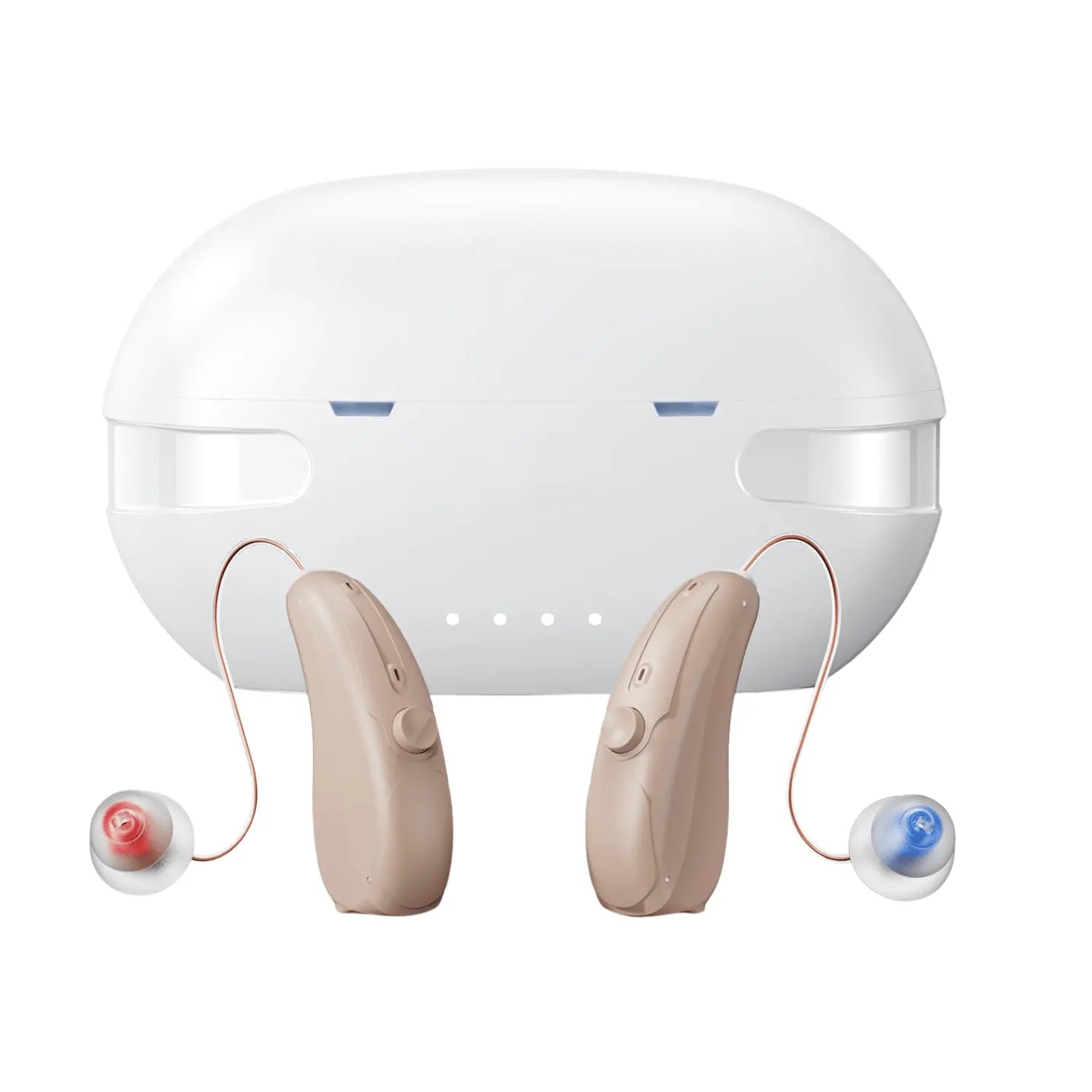
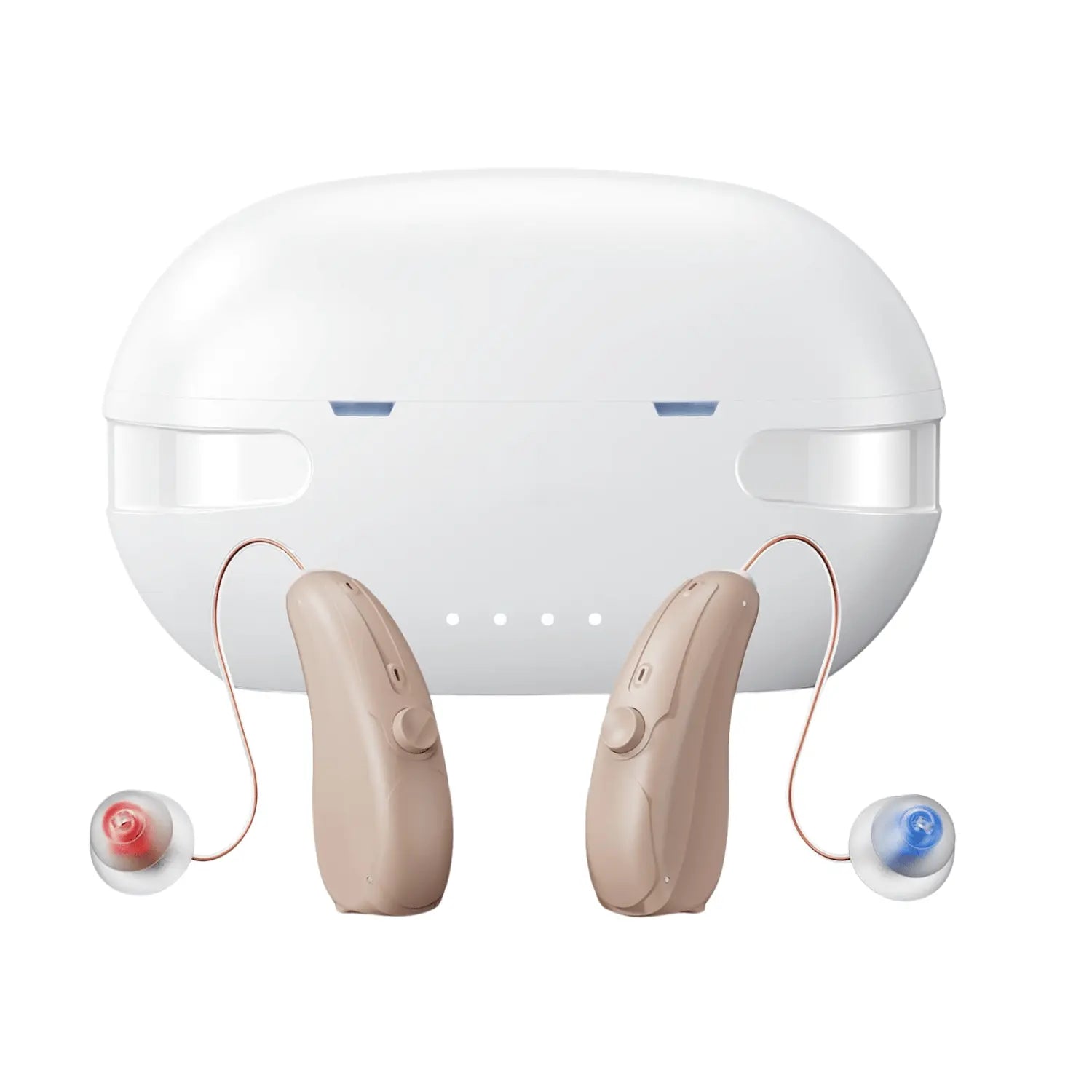
The Panda Quantum is a 16-channel receiver-in-canal hearing aid with adaptive noise reduction, Bluetooth for calls, TV, and music, and up to 80 hours of total battery life when paired with its charging case. It is also one of the Panda models that includes the in-ear app-based hearing test: after delivery, the user pairs the device with the Panda app, which runs a frequency-specific test through the hearing aid itself and then automatically applies a fit based on the user's audiogram, similar to what an audiologist would do at a clinical fitting. For someone planning to wear a device daily for many months, getting an audiogram-matched starting point at home, then having generous battery and Bluetooth-streamed sound on tap, removes a lot of the friction that often makes long-term wear hard. Panda Quantum carries a 5-year warranty and a 45-day return window.

It is worth noting that OTC hearing aids are intended for adults with self-perceived mild to moderate hearing loss. People with severe or profound loss, or whose tinnitus is unusually disabling, will typically still benefit most from a clinical fitting and a tinnitus-specific care plan. Information about the Panda Quantum is available at pandahearing.com.
Limitations of This Research
The study has several limitations the authors themselves emphasize. Because the design is retrospective and observational with no randomization, the apparent dose-response between months of wear and tinnitus improvement could reflect unmeasured patient factors rather than the therapy alone. People who continue with treatment for nine months may differ from those who stop earlier in motivation, baseline severity, social support, or financial resources. The total sample of 85 participants is also modest, which is reflected in the lack of significant pairwise contrasts after Bonferroni correction.
Several of the authors are affiliated with Hangzhou Huier Hearing Instrument and Technique Co., Ltd, a hearing-aid company. Readers should weigh the findings with that industry connection in mind. Replication in randomized studies, ideally with predefined wear-time targets and broader patient populations, will be needed before clinicians can confidently counsel patients about the optimal length of sound therapy.
Where This Leaves Us
The new data add to a growing case that hearing-aid-based sound therapy is best thought of as a multi-month commitment rather than a quick test, and that gains can keep accruing for at least half a year. For anyone living with chronic tinnitus alongside hearing loss, the message is to give consistent daily use enough time to work, ideally with periodic check-ins to fine-tune the device and to track how tinnitus distress is changing over time.
Wu Y, Wang Y, Shi W, Xiao Y, Zhang J, Wang Y, Tu L, Zhou S. Duration-dependent associations of sound therapy on tinnitus in hearing loss: A cross-sectional analysis of treatment duration cohorts. American Journal of Otolaryngology. 2026; 47(3): 104850. Retrieved from PubMed. DOI 10.1016/j.amjoto.2026.104850.