Cervical Disc Procedure Eased Tinnitus and Vertigo in Patients With Neck-Linked Symptoms, Small Study Reports
A small Polish prospective study suggests that a minimally invasive cervical disc procedure can quiet tinnitus and vertigo in patients whose ear and balance complaints appear linked to neck pathology.
Tinnitus, vertigo, and persistent headache do not always start in the ear. In a subset of patients, those symptoms travel with neck pain, and clinicians have long suspected that mechanical problems in the upper cervical spine can produce ear and balance complaints by way of shared nerve pathways. Standard care tends to bounce these patients between primary care, ENT, and physical therapy, and conservative treatment does not always resolve the ringing or the dizziness.
A new preliminary prospective study from Bialystok, Poland asks a narrower question: in patients with cervical disc protrusion or internal annular rupture and matching cervicogenic symptoms, can a minimally invasive disc procedure reduce not only neck pain and disability, but also the tinnitus, vertigo, and headache that travel with them?
Authors: Magdalena Rybaczek, Barbara Politynska-Lewko, Zenon Mariak, Kacper Prokop, Karol Sawicki, Aleksandra Opęchowska, Paweł Grabala, Tomasz Lyson.
Affiliations: Department of Neurosurgery and Department of Psychology and Philosophy, Medical University of Bialystok, Poland.
Journal and date: Advances in medical sciences, published online 29 April 2026.
Study type: Preliminary prospective study with a non-randomized comparator group (17 treated patients, 15 conservative-care controls).
PubMed DOI: 10.1016/j.advms.2026.04.004
Background: Why the Researchers Looked at This
Cervicogenic symptoms are ear, head, and balance complaints that appear to originate in problems of the cervical spine rather than in the ear or brain themselves. Patients in this group often describe headaches that radiate from the back of the neck, episodes of dizziness or unsteadiness, and tinnitus that worsens with neck position. The clinical term sometimes used is somatic or cervicogenic tinnitus, meaning tinnitus that can be modulated by movement or pressure on the neck and jaw.
Two cervical findings often line up with these complaints. The first is internal annular rupture, a tear in the inner fibers of the cervical disc that does not always show up dramatically on imaging. The second is contained disc protrusion, where disc material bulges but does not fully herniate. Both can compress or irritate nearby nerve roots and may, through pathways shared with the inner ear and trigeminal system, generate ear and head symptoms.
Many of these patients are not surgical candidates in the traditional sense. Their imaging looks subtle, and their primary complaint is often tinnitus or headache rather than weakness or numbness. The Polish team wanted to know whether a less invasive disc procedure, sitting between conservative care and open surgery, could help.
How the Study Was Done
The investigators enrolled 17 adults with cervical radiculopathy and accompanying cervicogenic symptoms such as headache, vertigo or tinnitus, and facial numbness. Imaging confirmed either internal annular rupture or contained disc protrusion. These patients underwent a percutaneous procedure called the Disc-FX Mini technique, which combines three steps performed through a small needle access: nucleoplasty to reduce intradiscal pressure, annuloplasty to address the disc wall, and manual nucleotomy to remove a small amount of disc material.
A separate group of 15 patients with similar clinical and radiological findings continued with conservative therapy and served as a comparator. The team tracked outcomes using two standard tools: the Visual Analogue Scale for pain intensity, scored from 0 to 10, and the Neck Disability Index, which captures functional impact. Pain and disability were measured at baseline and during follow-up out to about one year. A psychological evaluation was added to rule out a primary psychiatric driver of the symptoms.
Importantly, the team also recorded changes in the cervicogenic ear and head symptoms, including tinnitus, vertigo, and persistent headache, which were not the primary endpoints but matter most for readers focused on hearing-related outcomes.
What the Researchers Found
The treated group reported a substantial drop in pain. Mean Visual Analogue Scale scores fell from 8.1 with a standard deviation of 1.2 at baseline to 1.6 with a standard deviation of 1.0 at one-year follow-up. Function improved in parallel: Neck Disability Index scores moved from 29.8 plus or minus 6.8 down to 7.6 plus or minus 2.3.
The conservative-care comparator group also improved, but by a noticeably smaller margin. Their pain scores dropped from 7.5 plus or minus 1.4 to 3.9 plus or minus 1.2, and disability scores fell from 26.0 plus or minus 9.6 to 12.1 plus or minus 6.1. So both groups got better, but the procedure group ended up with much lower residual pain and disability after one year.
Of the 13 treated patients who reported persistent or recurrent headache before the procedure, 9 reported clear relief of headache afterward. The team also wrote that vertigo and other atypical symptoms, which in this study included tinnitus, subsided or markedly decreased in most cases. Specific tinnitus measurement scales were not the primary outcome, so the abstract does not provide a numeric tinnitus score, but the qualitative direction is consistent.
The investigators frame this combination as a possible bridge for patients whose imaging is too subtle to justify open surgery and whose conservative therapy has not been enough to control cervicogenic symptoms.
What It Means for People With Tinnitus and Hearing Loss
For people whose tinnitus or vertigo travels with neck pain, headache, or jaw symptoms, this study is a reminder that the source of ear-related complaints is not always the ear. A careful workup that includes the cervical spine may surface treatable problems that drive the perceived ringing or dizziness.
For people whose tinnitus is not related to the neck, the most common drivers remain age-related hearing loss, noise exposure, and inner-ear pathology. Those forms of tinnitus tend to respond to a different toolkit, including hearing aids, sound therapy, cognitive-behavioral approaches, and good hearing-loss management.
The practical takeaway is that anyone with persistent tinnitus should still get a baseline hearing test. The audiogram tells you whether hearing loss is part of the picture, and that single piece of information shapes which path is likely to help most.
When Tinnitus Travels With Hearing Loss: Sound-Therapy Options
For the much larger group of tinnitus sufferers whose ringing is tied to age-related or noise-induced hearing loss rather than to the cervical spine, daily-wear hearing aids that can stream masking audio remain one of the most evidence-supported non-surgical management options. Filling in the missing high frequencies tends to reduce the brain's compensatory amplification, and being able to layer in low-volume nature sounds, white noise, or pink noise via Bluetooth gives the user a way to soften the perception of the tinnitus during quiet moments.
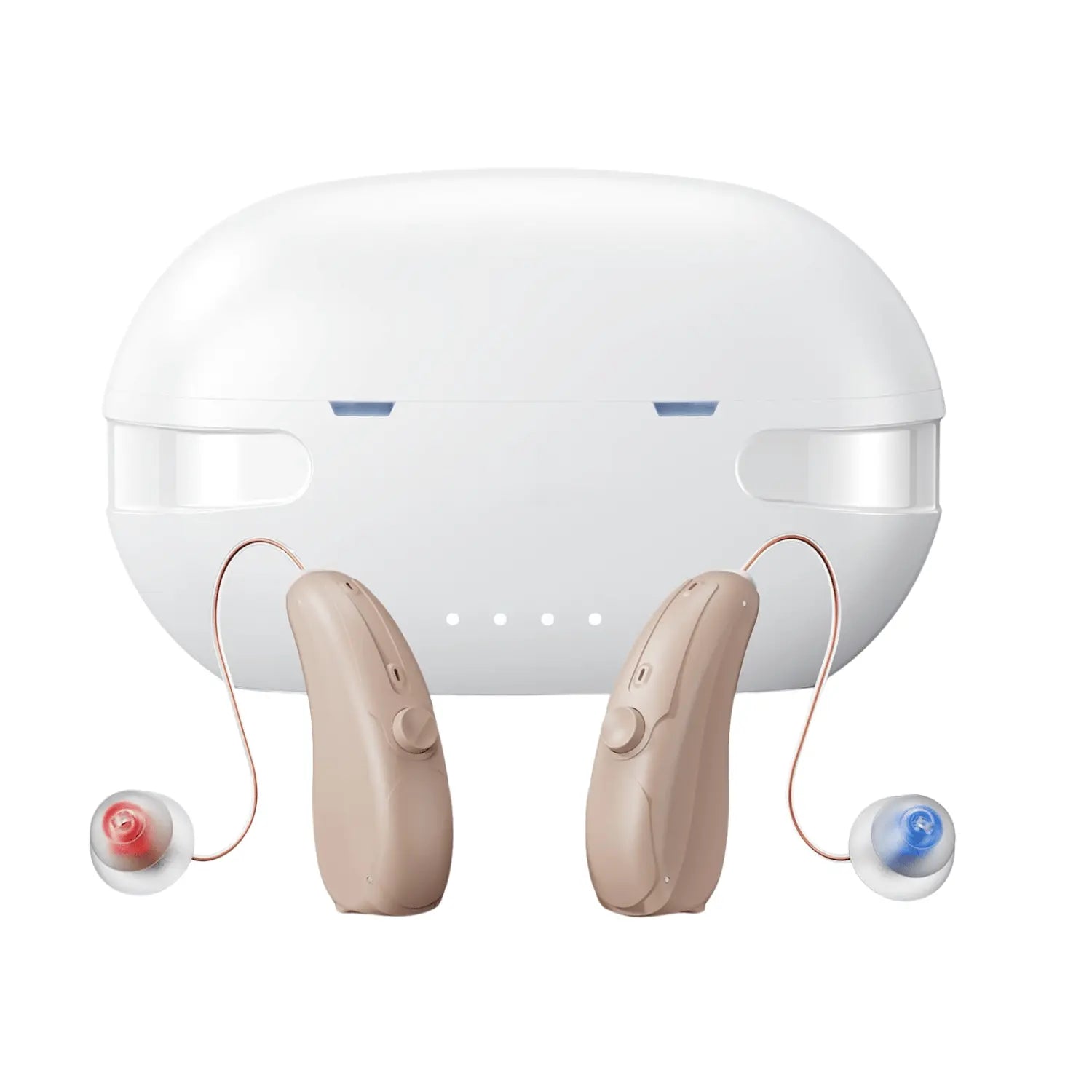
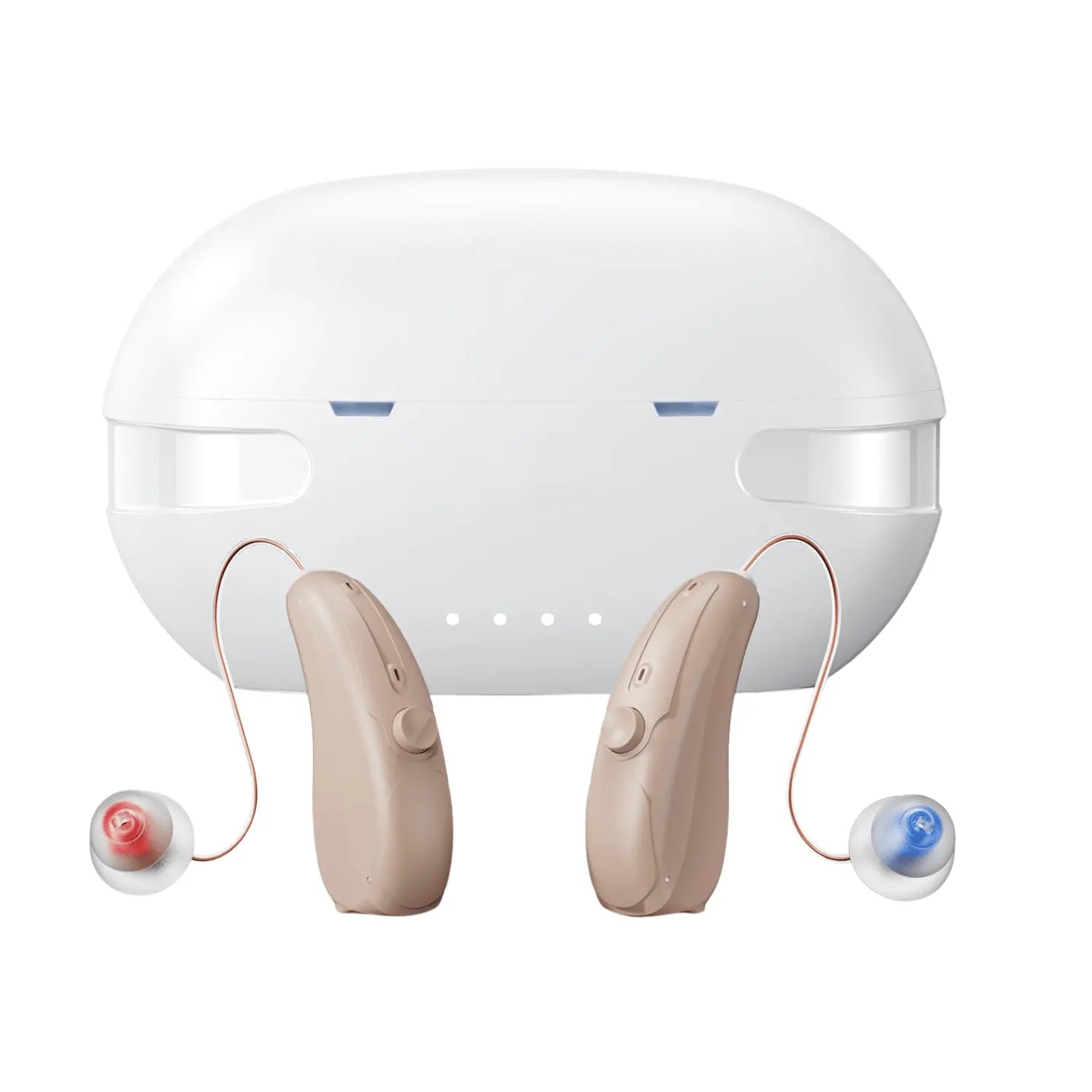
Panda Quantum is a 16-channel receiver-in-canal hearing aid with adaptive noise reduction and Bluetooth, which means a user can stream tinnitus-masking audio from a phone or TV directly into the device. The case provides up to 80 hours of total battery life, and the system includes the Panda app-based in-ear hearing test: after the device arrives, the user pairs it with the Panda app, the app runs a frequency-specific hearing test through the hearing aid itself, and the device's gain and frequency response are then programmed to match the user's audiogram, similar to what an audiologist does at a clinical fitting. Panda Quantum carries a 5-year warranty and a 45-day return window.

A practical caveat: over-the-counter hearing aids, including Panda Quantum, are designed for adults with self-perceived mild to moderate hearing loss. Severe or profound hearing loss, single-sided deafness with troublesome tinnitus, or tinnitus clearly tied to a neck or jaw problem still warrants in-person evaluation. The cervical findings in this Polish study are a good example of why a one-size-fits-all approach to tinnitus is rarely appropriate.
Limitations of This Research
This is a small, single-center, non-randomized study. Seventeen treated patients and fifteen comparator patients is enough to generate a hypothesis but not enough to change practice. Allocation was not randomized, which leaves room for selection bias, and there was no blinding, which is an inherent challenge for procedural studies. The follow-up window is roughly one year, so durability beyond that is unknown.
The tinnitus and vertigo outcomes were secondary and were reported qualitatively rather than with validated tinnitus instruments such as the Tinnitus Handicap Inventory. Funding sources and conflicts of interest are not visible in the public abstract and would need to be checked in the full paper. Larger, randomized, multi-center studies with structured tinnitus measurement would be needed before recommending the procedure broadly for cervicogenic ear symptoms.
Where This Leaves Us
The signal in this preliminary study is interesting but narrow: when tinnitus, vertigo, and headache appear to be driven by a contained cervical disc problem, treating that disc with a minimally invasive percutaneous technique was associated with substantially better pain, disability, and ear-symptom outcomes than conservative care alone. For most people with tinnitus and hearing loss, however, the path forward still starts with a hearing test and an honest look at the audiogram, with hearing aids and sound therapy as proven everyday tools.
Rybaczek M, Politynska-Lewko B, Mariak Z, Prokop K, Sawicki K, Opęchowska A, Grabala P, Lyson T. Minimally invasive percutaneous procedure for the treatment of a contained cervical disc herniation - a preliminary prospective study. Advances in medical sciences. 2026. Retrieved from PubMed. DOI: 10.1016/j.advms.2026.04.004
When Hearing Aids May Help, and When to Get Checked First
Hearing aids may improve access to speech for many adults with hearing difficulty, but comfort problems, dizziness, headaches, sudden hearing changes, pain, or drainage should not be treated as normal device-adjustment issues. Get medical evaluation for those warning signs before buying or adjusting hearing aids.
| Situation | Best next step |
|---|---|
| Gradual trouble following conversation | Compare OTC and professional options |
| Sudden hearing loss | Seek urgent medical advice |
| Pain, drainage, or severe dizziness | Get evaluated before using a device |
| Mild to moderate perceived hearing loss | Review OTC options and fit guidance |
Buying guide: Compare Panda OTC hearing aid models