Air Pollution and Genetic Risk Together Raise Tinnitus Odds in UK Biobank Study
A new analysis of nearly 80,000 adults finds that people exposed to higher levels of air pollution had higher odds of reporting tinnitus, with the strongest signal in those who were also genetically predisposed.
Tinnitus, the perception of sound such as ringing, hissing, or buzzing in the absence of an external source, affects an estimated 10 to 15 percent of people worldwide. It is often described alongside hearing loss, sleep disturbance, and difficulty concentrating, and clinicians have long suspected that environmental exposures play a role in who develops it.
A research team based at Sun Yat-sen University in Guangzhou, China, decided to look at one specific environmental factor that has been studied much more for its effects on the heart and lungs than on the ears: ambient air pollution. Their question was whether long-term exposure to particulate and gaseous pollutants is independently associated with tinnitus prevalence, and whether genetic susceptibility makes that association stronger.
About This Study
Title: Effects of Composite Air Pollution and Genetic Susceptibility on Tinnitus Risk: A Large Population-Based Study
Authors: Ding Yang, Zi-Xuan Huang, Lin-Qiu Li, Hang Li, Jie Deng, Yi Wei, Kai-Tian Chen, Guan-Xia Xiong, Wen-Bin Lei, Lin Chen, Shu-Bin Fang
Affiliations: Otorhinolaryngology Hospital, The First Affiliated Hospital, Sun Yat-sen University, Guangzhou, China; Department of Otolaryngology, The Sixth Affiliated Hospital, Sun Yat-sen University, Guangzhou, China.
Journal and date: Journal of Otolaryngology - Head & Neck Surgery, May 4, 2026.
Study type: Cross-sectional, population-based analysis of UK Biobank data.
PubMed DOI: 10.1177/19160216261442718
Background: Why the Researchers Looked at This
Air pollution is well established as a contributor to lung disease, heart attacks, and stroke. Smaller particles such as PM2.5 are inhaled deeply into the lungs, but they also enter the bloodstream and can trigger systemic inflammation and oxidative stress. Both processes have been linked in animal and laboratory work to damage in the inner ear, where delicate sensory hair cells convert sound into nerve signals.
Tinnitus is not a single disease. It is a symptom that can follow noise exposure, age-related hearing loss, head injury, certain medications, and a variety of other conditions. Genetic factors are also part of the picture. A polygenic risk score, or PRS, is a number that summarizes how many tinnitus-associated genetic variants a person carries. The authors wanted to know whether environmental exposure and genetic susceptibility act independently or whether they combine to raise risk further than either alone.
How the Study Was Done
The investigators drew on the UK Biobank, a large cohort of adults in the United Kingdom who have provided health, genetic, and lifestyle data. After applying inclusion criteria, the analysis covered 79,277 individuals for whom information was available on tinnitus status, residential air pollution estimates, and genetic data.
For each participant, the authors compiled a composite air pollution score combining particulate matter measures (PM2.5, PM10, and PMcoarse) and nitrogen-based pollutants (NO2 and NOx). They also computed a polygenic risk score from six single-nucleotide polymorphisms previously associated with tinnitus. Logistic regression models then estimated the odds of current, transient, or persistent tinnitus, while adjusting for age, sex, education, smoking, alcohol use, body mass index, hypertension, diabetes, and self-reported hearing difficulty.
Because the study is cross-sectional, it captures associations at a single point in time rather than tracking the same person over years. The authors also looked at gene-environment interaction, meaning whether the effect of pollution on tinnitus differed depending on a person's genetic risk profile.
What the Researchers Found
Higher composite air pollution scores were associated with higher odds of current tinnitus. Each interquartile range increase in the pollution score raised the odds by about 6 percent (odds ratio 1.06, 95 percent confidence interval 1.03 to 1.08). The signal was somewhat stronger for transient tinnitus than for persistent tinnitus.
When the researchers examined individual pollutants on their own, the associations were weaker. The combined exposure score appeared to capture more of the risk than any single pollutant, suggesting that everyday air contains a mixture of irritants whose effects may add up.
The polygenic risk score was independently linked with prevalent tinnitus. Among people in the highest categories for both pollution exposure and genetic risk, the odds of tinnitus were noticeably higher than the population baseline (odds ratio 1.34, 95 percent confidence interval 1.18 to 1.52).
Taken together, the analysis points to a joint association of environmental and genetic factors with tinnitus prevalence. The authors describe this as evidence that auditory health risk assessment may benefit from looking at both layers rather than treating them in isolation.
What It Means for People with Hearing Loss
For most adults, the takeaway is not that air pollution causes tinnitus on its own, but that it appears to be one of several modifiable contributors. People who already live with bothersome ringing or buzzing, especially those with a family history of tinnitus or hearing loss, may have an extra reason to limit time near heavy traffic, use indoor air filtration, and follow public health alerts on poor air quality days.
The study also reinforces something audiologists have observed for years: tinnitus and hearing loss often travel together. Many adults who notice ringing later discover a degree of high-frequency hearing loss they were not aware of. Treating the underlying hearing loss with well-fitted hearing aids is one of the most effective ways to reduce the perceived loudness of tinnitus, because the brain is given more outside sound to work with.
Why Affordable, Self-Fitting Hearing Aids Matter for People Whose Tinnitus Is Linked to Hearing Loss
A finding like this one tends to widen the pool of adults who think they might benefit from a hearing check. Tinnitus alone often nudges someone to take their hearing seriously for the first time. Cost and the time involved in a clinic visit are two of the most common reasons people delay action.
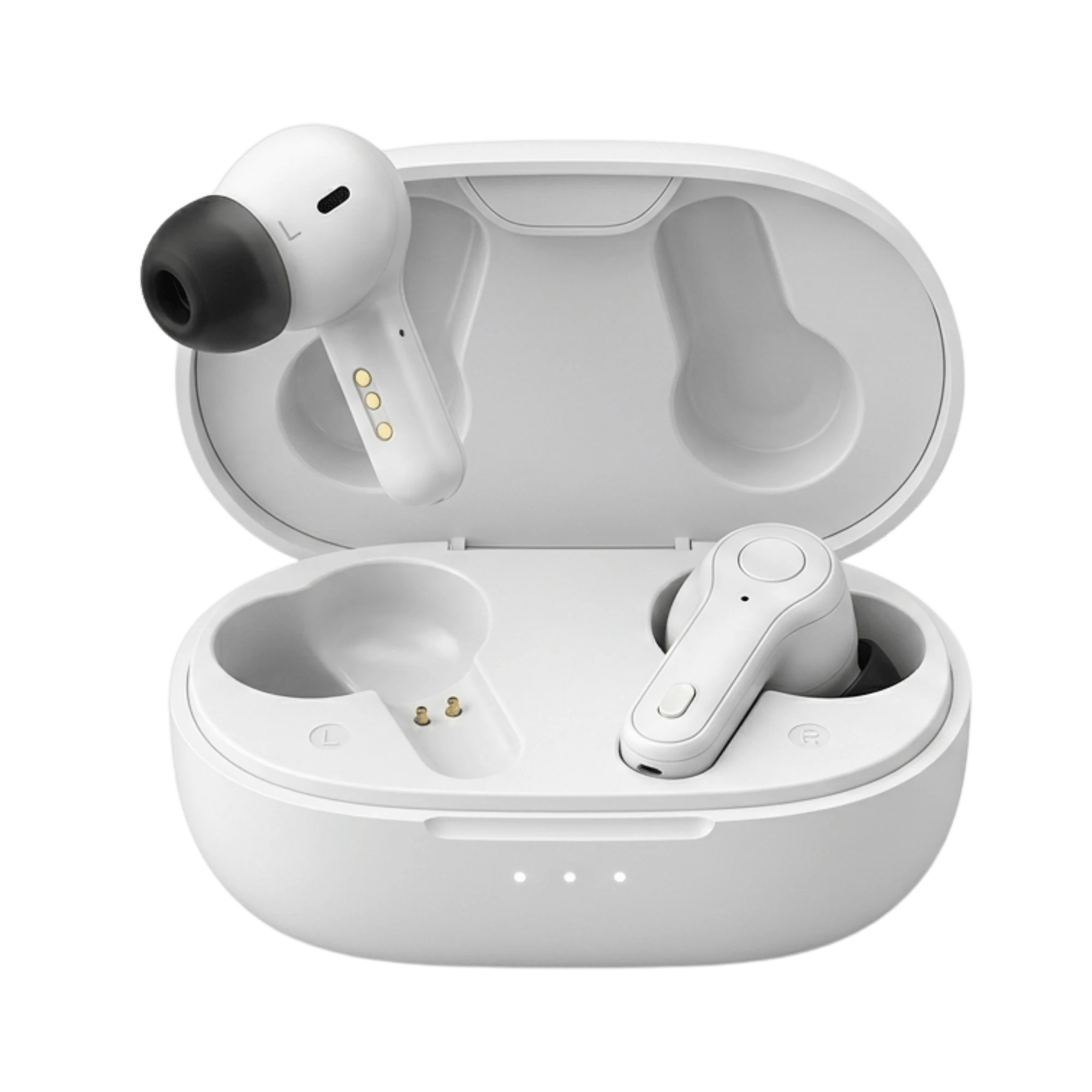
For adults with mild to moderate hearing loss whose tinnitus may be linked to that loss, Panda Air is designed to lower those barriers. It is an OTC, earbud-style in-the-canal hearing aid with 16-channel wide dynamic range compression and multi-band adaptive noise reduction. The 60-hour fast-charge case lets the device travel with the wearer through a normal day without scrambling for a charger. It comes with a 5-year warranty and a 45-day return window.
Panda Air also includes the Panda app-based in-ear hearing test. After the device arrives, the user pairs it with the Panda app, which then runs a frequency-specific hearing test through the hearing aid itself and automatically programs the gain and frequency response to match the user's audiogram, similar to what an audiologist does at a clinical fitting. For people who simply want to find out whether amplification helps their tinnitus and conversation clarity, that removes a real-world hurdle. OTC hearing aids are approved for mild to moderate hearing loss; people with severe or profound loss still benefit most from clinical fittings.
Limitations of This Research
The analysis is cross-sectional, which means it cannot prove that air pollution causes tinnitus or that exposure preceded symptoms. Tinnitus was self-reported, which can introduce misclassification, and the UK Biobank cohort is older and largely of European ancestry, so the polygenic risk results may not transfer cleanly to other populations. Air pollution exposure was estimated from residential addresses rather than personal monitoring, and lifetime noise exposure history was not deeply characterized.
The authors did not report any commercial sponsorship in the abstract. The effect sizes for individual pollutants were modest, so the practical significance for any one person depends on how high their exposure is in absolute terms.
Where This Leaves Us
For people who already notice ringing or buzzing, this study is one more reason to take both environmental exposures and underlying hearing health seriously. Reducing avoidable exposure to dirty air, addressing untreated hearing loss, and protecting the ears from loud noise are all parts of the same picture, and they reinforce each other.
Yang D, Huang ZX, Li LQ, Li H, Deng J, Wei Y, Chen KT, Xiong GX, Lei WB, Chen L, Fang SB. Effects of Composite Air Pollution and Genetic Susceptibility on Tinnitus Risk: A Large Population-Based Study. Journal of Otolaryngology - Head & Neck Surgery. 2026. Retrieved from PubMed. https://doi.org/10.1177/19160216261442718