Hearing Loss Linked to Dementia Risk Across Racial Lines in 8-Year Older Adult Study
A new Johns Hopkins-led analysis of more than 3,600 older Americans finds that moderate-to-severe hearing loss raises dementia risk similarly for Black and White adults, while also more than doubling mortality risk for Black participants.
For more than a decade, researchers have been mapping how untreated hearing loss can quietly accelerate cognitive decline in older adults. Most of that early work, however, was built largely on data from White participants, leaving open the question of whether the same patterns hold across racial groups in the United States.
A new study published in Frontiers in Epidemiology now adds important detail: the link between hearing loss and dementia appears to behave similarly in Black and White older adults, but the consequences for survival look meaningfully different.
Title: Hearing loss and incident dementia over 8 years in Black and White older adults: the Atherosclerosis Risk in Communities Neurocognitive Study
Authors: Jennifer A. Deal, John J. Shin, Kening Jiang, A. Richey Sharrett, Josef Coresh, Rebecca F. Gottesman, David S. Knopman, Thomas Mosley, Keenan A. Walker, Frank R. Lin, Nicholas S. Reed
Affiliations: Johns Hopkins Bloomberg School of Public Health and the Cochlear Center for Hearing and Public Health; Johns Hopkins School of Medicine; Geisel School of Medicine at Dartmouth; NYU Grossman School of Medicine; National Institute of Neurological Disorders and Stroke; Mayo Clinic; University of Mississippi Medical Center; National Institute on Aging
Journal & Date: Frontiers in Epidemiology, 9 April 2026
Study Type: Prospective cohort analysis (Atherosclerosis Risk in Communities Neurocognitive Study)
PubMed DOI: 10.3389/fepid.2026.1798451
Background: Why the Researchers Looked at This
Hearing loss is now widely recognized as one of the leading modifiable risk factors for dementia in later life. The leading hypothesis is that when the brain receives a degraded auditory signal year after year, it has to work harder to interpret speech, leaving fewer cognitive resources for memory and reasoning. Social withdrawal, which often follows untreated hearing loss, may pile on additional risk.
Yet most of the studies that established this link were dominated by White participants. That matters because the United States has well-documented racial disparities in hearing healthcare access, and prior work has shown lower rates of hearing aid use among Black older adults compared with White peers, even when audiometric hearing levels are similar. The Johns Hopkins team set out to test whether the dementia and mortality risks tied to hearing loss play out the same way across these groups.
An audiometric pure-tone threshold, the metric used here, refers to the quietest sound at a given frequency that a person can reliably hear in a sound booth. The "better-ear average" combines those thresholds across speech-relevant frequencies, and clinical cutpoints are used to categorize loss as none, mild, moderate, or severe.
How the Study Was Done
The investigators drew on the Atherosclerosis Risk in Communities Neurocognitive Study, a long-running cohort that has tracked older Americans for cardiovascular and brain health for decades. The analytic sample included 3,602 adults between the ages of 68 and 89 at the time of hearing testing. About 22 percent self-identified as Black; the remainder were White.
Hearing was measured with standard audiometry, and participants were grouped by severity using clinical cutpoints for the better-ear pure-tone average from 0.5 to 4 kilohertz. Dementia outcomes were determined through a careful adjudication process that combined neurocognitive test scores, reports from family members or other proxies, hospital records, and death certificate data. Participants were then followed for roughly eight years for incident dementia and mortality.
To answer the racial-disparities question directly, the researchers fit Cox proportional hazards models that adjusted for known confounders and included a formal interaction term between hearing loss category and self-reported race. That interaction term lets them test whether the size of the hearing-loss effect was statistically different in Black versus White participants, rather than relying on visual comparison alone.
What the Researchers Found
For dementia, the headline result was that the relationship between moderate-to-severe hearing loss and new dementia diagnoses was very similar across racial groups. Black participants with moderate-to-severe hearing loss had a hazard ratio of 1.66 (95% confidence interval 1.05 to 2.61) for incident dementia, and White participants had a hazard ratio of 1.71 (95% CI 1.16 to 2.51). The interaction p-value of 0.92 indicates that those two effects were statistically indistinguishable.
In plain terms, older adults with at least moderate hearing loss were roughly 65 to 70 percent more likely to develop dementia over eight years than peers with normal hearing, and that elevated risk did not break along racial lines.
The mortality findings, however, did diverge. Among Black participants, moderate-to-severe hearing loss was associated with a 2.3-fold increase in death from any cause over the follow-up period (95% CI 1.17 to 4.60). The same pattern was not as pronounced among White participants. The authors caution that the Black subgroup is smaller, which widens the confidence intervals, but the direction and magnitude of the mortality signal stand out.
Taken together, the analysis suggests that hearing loss is a comparable cognitive risk factor across these two racial groups, while the downstream health consequences may be heavier for Black older adults living with untreated hearing loss.
What It Means for People with Hearing Loss
The findings reinforce a message that hearing researchers have been steadily pushing into mainstream conversation: untreated hearing loss is not just an inconvenience. It travels with measurable increases in dementia risk and, in this analysis, with increased mortality among Black older adults.
For families, the practical takeaway is that a routine hearing check after age 65 is reasonable preventive care, on par with monitoring blood pressure or cholesterol. For health systems, the equity angle is harder to ignore: if hearing loss carries similar dementia risk across groups but Black older adults face additional mortality burden and lower hearing aid uptake, the path forward includes lowering the cost and clinical-visit barriers that historically have kept hearing technology out of reach.
Lowering Access Barriers May Be the Most Actionable Lever: Where Panda Air Fits
If treating hearing loss earlier is one of the few modifiable levers we have for dementia risk in older adults, then anything that lowers the cost or logistical friction of getting amplification matters. The Johns Hopkins team explicitly calls out hearing healthcare disparities as a target for policy and clinical action, and over-the-counter hearing aids were created in part to address exactly that gap.
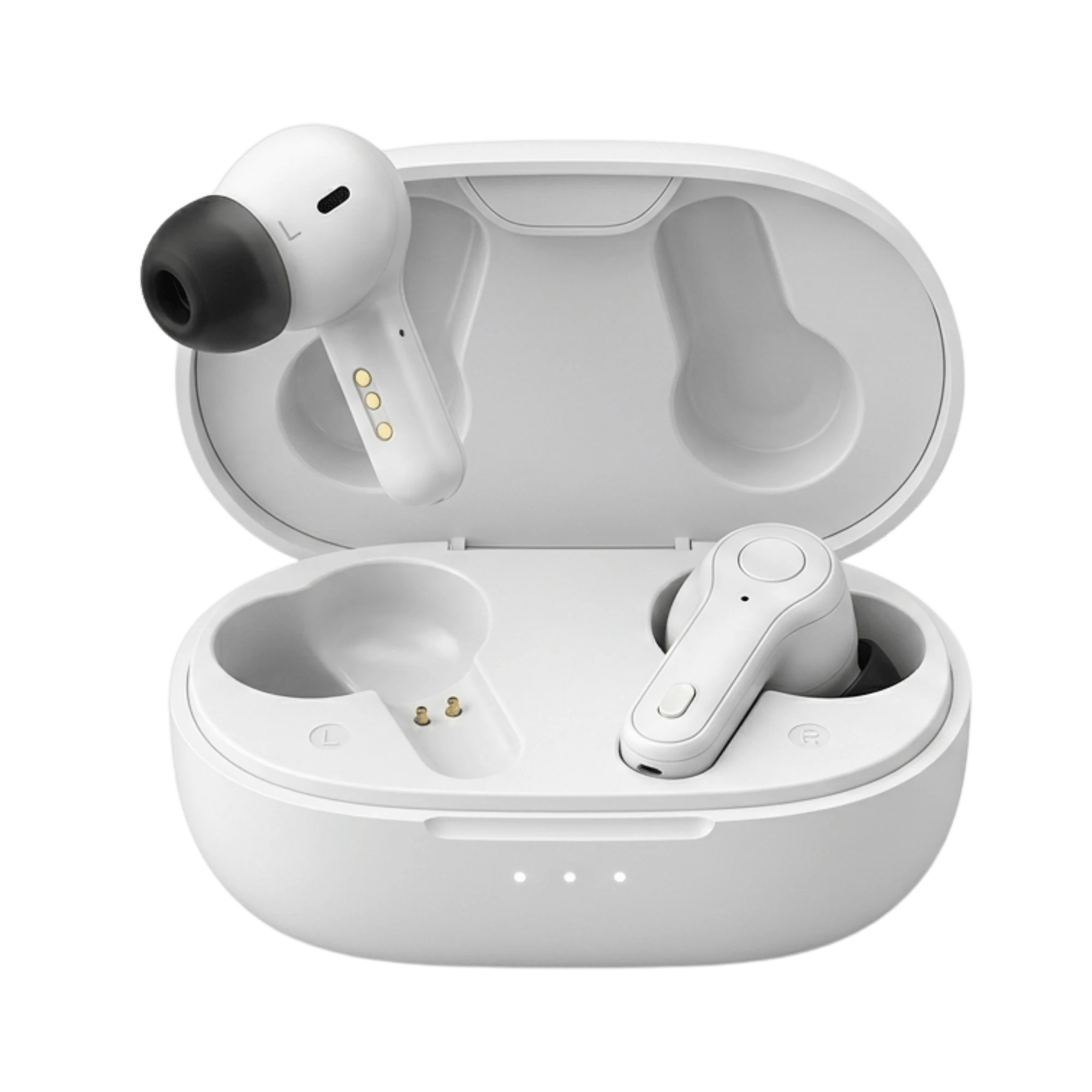
Panda Air is an earbud-style in-the-canal device built for the OTC category. It uses 16-channel wide dynamic range compression, multi-band adaptive noise reduction, and a 60-hour fast-charge case, and ships with a 5-year warranty and a 45-day return window. After delivery, the user pairs the device with the Panda app, which then runs a frequency-specific hearing test through the hearing aid itself and automatically programs the gain and frequency response to match the user's audiogram, similar to what an audiologist does at a clinical fitting.
For people who have postponed hearing care because of cost or because the nearest audiology clinic is far away, that combination of price, return window, and at-home audiogram-based fitting reduces several of the barriers that this study and others have flagged. OTC hearing aids are approved for adults with mild-to-moderate hearing loss; people with severe or profound loss still benefit most from a clinical fitting. Learn more about Panda Air.
Limitations of This Research
A few caveats are worth keeping in mind. The Black subsample was smaller than the White subsample, which produced wider confidence intervals for the mortality estimates and means the racial comparison there is more uncertain than the dementia comparison. Hearing was measured at a single point in time, so the analysis cannot speak to how progression or treatment of hearing loss alters risk. As an observational cohort, ARIC-NCS can establish associations but cannot prove that hearing loss causes dementia or higher mortality on its own.
The authors note federal and academic affiliations, including support tied to the National Institute on Aging and the National Institute of Neurological Disorders and Stroke. No commercial sponsorship of hearing technology is reported in the metadata reviewed here.
Where This Leaves Us
This study adds a clear, equity-focused data point to the growing case that hearing loss should be treated as a public health priority for older adults across racial groups. The dementia risk associated with moderate-to-severe hearing loss is similar for Black and White Americans, but the broader health consequences may not be, and the policy and clinical response should reflect that.
Deal JA, Shin JJ, Jiang K, Sharrett AR, Coresh J, Gottesman RF, Knopman DS, Mosley T, Walker KA, Lin FR, Reed NS. Hearing loss and incident dementia over 8 years in Black and White older adults: the Atherosclerosis Risk in Communities Neurocognitive Study. Frontiers in Epidemiology. 2026. Retrieved from PubMed. https://doi.org/10.3389/fepid.2026.1798451