A new review in Reviews in Medical Virology lays out why congenital cytomegalovirus is one of the most common non-genetic causes of permanent childhood hearing loss, and what stands in the way of preventing it.
Most parents have never heard of cytomegalovirus, or CMV. Yet the virus, which is found in every population that has been studied for it, is responsible for a meaningful share of the children who grow up with permanent sensorineural hearing loss. Some of those children are born with hearing loss already in place. Others pass their newborn hearing screen, then begin to lose hearing in their first few years of life.
A new review article from the University of Alabama at Birmingham pulls together more than half a century of research on congenital CMV (cCMV) and the inner-ear damage it can cause. The piece is aimed at clinicians and public-health researchers, but it also tells a broader story about a hearing-loss risk factor that most families do not know exists.
About This Study
Title: Congenital CMV and Hearing Loss: How Does it Happen and How to Prevent it
Authors: Karen B. Fowler
Affiliations: Department of Pediatrics, Heersink School of Medicine, University of Alabama at Birmingham, Birmingham, Alabama, USA
Journal and pub date: Reviews in Medical Virology, May 2026 (volume 36, issue 3, article e70156)
Study type: Narrative review article
PubMed DOI: 10.1002/rmv.70156
Background: Why the Researchers Looked at This
Cytomegalovirus is a member of the herpesvirus family. Most people pick it up at some point in life, often without ever feeling sick. The complication arises when a person catches CMV for the first time, or reactivates an existing infection, while pregnant. The virus can cross the placenta and infect the developing fetus. When that happens, the baby is said to have congenital cytomegalovirus, or cCMV.
Sensorineural hearing loss, abbreviated SNHL, is hearing loss that comes from damage to the inner ear or the auditory nerve rather than from a problem with the eardrum or the bones of the middle ear. SNHL is the kind of hearing loss that is usually permanent and the kind most often supported by hearing aids or cochlear implants. cCMV is one of the leading non-genetic causes of SNHL in children, and the review notes it has been linked to permanent childhood hearing loss in every population where babies have been screened for cCMV and tracked over time.
Despite this long-running evidence, awareness of CMV among the general public and even among many pregnant patients has remained low. The author wrote this review to consolidate what is known about how CMV damages hearing, what treatments and preventive measures are currently available, and where the biggest gaps in research and policy still sit.
How the Study Was Done
This article is a narrative review rather than a clinical trial. The author synthesized findings from prior epidemiologic studies, animal models, human temporal-bone studies, newborn-screening programs, and treatment trials, then organized that evidence around a series of practical questions: how often does cCMV cause hearing loss, when does it appear, why does it happen biologically, what can clinicians do once a child is diagnosed, and what would meaningful prevention actually look like.
The review draws together work that spans decades of CMV research, including studies that followed infants identified with cCMV through their first several years of life and studies in animal models that exposed how the virus interacts with cells in the cochlea, the spiral structure in the inner ear that converts sound into nerve signals.
What the Researchers Found
The review reaches several conclusions that matter for families, clinicians, and policymakers.
First, the timing of cCMV-related hearing loss is highly variable. Some affected children have hearing loss at birth that the newborn hearing screen catches. Others pass that screen and only develop hearing loss later, in some cases within the first five years of life. The review describes a mix of patterns: hearing loss that stays stable, hearing loss that gets worse over time, and even hearing loss that fluctuates, where a child seems to hear better on some days than others.
Second, the biology behind the damage appears to involve two parallel processes. The virus itself can directly infect cells inside the cochlea, and the body's own immune and inflammatory response to that infection can also damage delicate inner-ear structures. Studies in animal models and in donated human temporal bones support this dual-injury picture.
Third, on the treatment side, current guidance is to consider valganciclovir, an antiviral medication, in newborns who have cCMV and confirmed SNHL. The review notes, however, that important questions about how durable that hearing benefit is over the long term remain unsettled.
Fourth, on prevention, no licensed CMV vaccine yet exists. The only primary prevention available right now is behavioral: pregnant people are advised to limit exposure to the saliva and urine of young children, who are common sources of CMV. That includes practices such as not sharing utensils with toddlers, washing hands after diaper changes, and avoiding kissing young children directly on the lips. Awareness of these steps remains low.
Fifth, the public-health burden of cCMV, including the lifetime cost of caring for the children most affected, has not been measured well enough to support a clean cost-effectiveness analysis of broader screening or future vaccination. That gap, the review argues, slows down policy decisions.
What It Means for People with Hearing Loss
For families, the practical takeaway is that childhood hearing loss does not always show up at birth. A baby who passes the newborn hearing screen can still develop SNHL in the toddler or early school years. The review reinforces the case for periodic hearing checks during childhood, especially when a child has been diagnosed with cCMV or has any other identifiable risk factor.
For adults, the review is also a reminder that many people now living with sensorineural hearing loss were not born with it. Some lost hearing in childhood, including from causes like CMV, and have been managing the day-to-day reality of hearing loss for decades. As more children are tested at birth and tracked through the years that follow, the population of teens and adults whose hearing-loss history is known will keep growing.
For public-health professionals, the message is clearer: CMV is a hearing-loss risk factor that does not get talked about enough. More awareness, better data on how often the virus is causing childhood hearing loss in any given community, and a clearer accounting of lifetime costs are all needed before broader prevention strategies can be put in place.
For Adults Living With Long-Term Sensorineural Hearing Loss, Daily Support Still Matters
One thread running through the review is that sensorineural hearing loss caused by congenital CMV is often a lifelong companion. Children who grew up wearing hearing aids in school often need them as adults too. They tend to value features that handle real life: clear speech in restaurants, reliable phone calls, easy streaming for TV and meetings, and a battery that lasts through a long day.

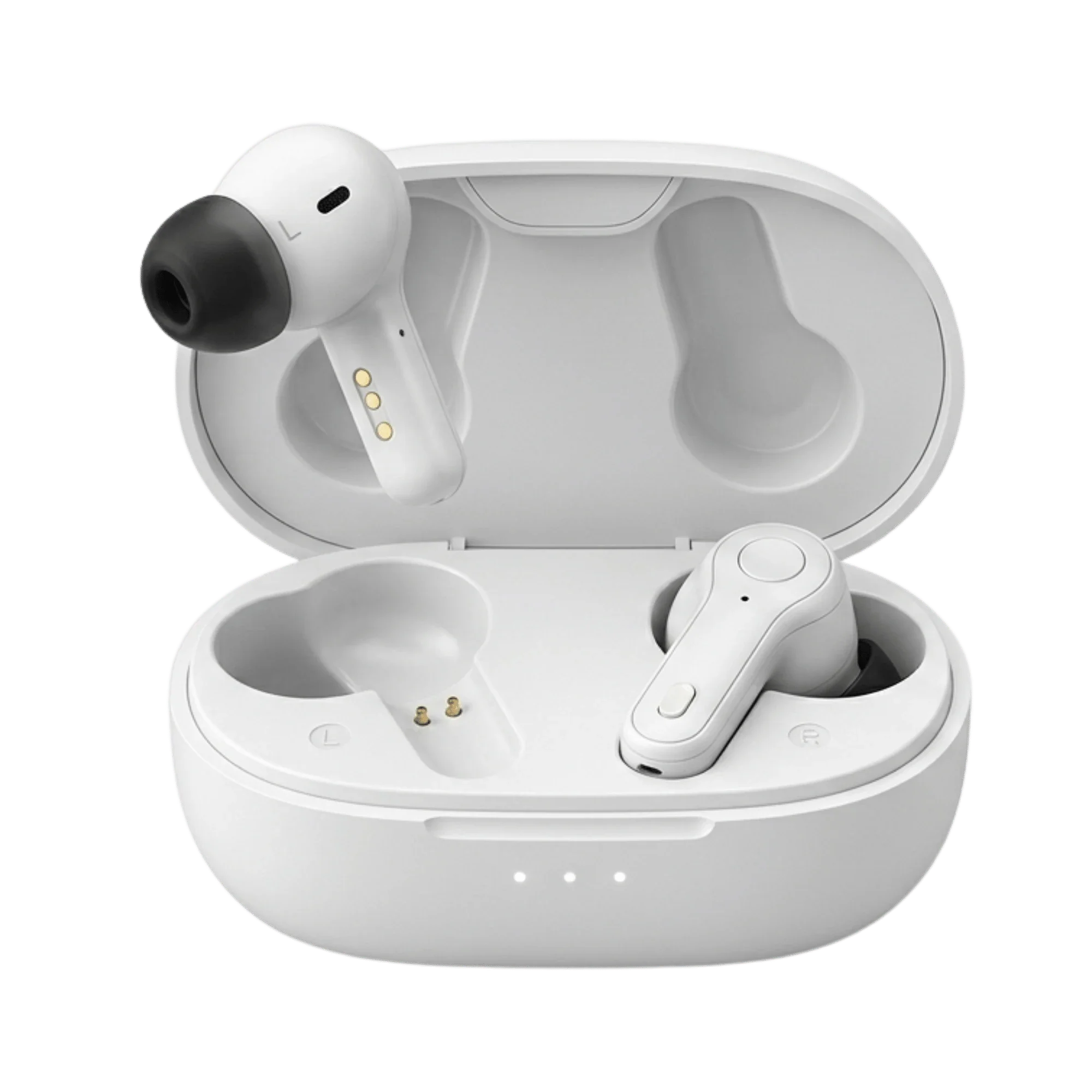
The Panda Quantum is a 16-channel receiver-in-canal hearing aid built around that adult use case. It includes adaptive noise reduction, Bluetooth for phone calls, TV, and music, and up to 80 hours of total battery life with the charging case. After delivery, the Panda Quantum pairs with the Panda app, which runs an in-ear hearing test through the device itself and then automatically programs the hearing aid's gain and frequency response to match the user's own audiogram, similar to what an audiologist does at a clinical fitting. It comes with a 5-year warranty and a 45-day return window.
Over-the-counter hearing aids in the United States are approved for adults 18 and older with perceived mild-to-moderate hearing loss. Adults whose CMV-related hearing loss is severe or profound may still get the most benefit from clinical fittings and clinician follow-up, especially when amplification needs are complex.
Limitations of This Research
As a narrative review by a single author, this article does not follow a systematic-review protocol with predefined search terms and pooled effect estimates. It is instead a synthesis of decades of evidence, weighted by the author's expertise. Readers who want strict effect sizes for any specific question, such as how much valganciclovir improves hearing outcomes at age 5, will need to look at the underlying randomized trials and cohort studies the review draws on.
The review itself is candid about what the field still does not know: which children with cCMV will progress to SNHL, the long-term hearing trajectory after antiviral treatment, and the true population-level cost of cCMV-related disability. Funding sources and conflict-of-interest disclosures should be checked in the published article for readers who want that detail.
Where This Leaves Us
CMV remains a quietly common cause of permanent childhood hearing loss, with effects that often follow a person into adulthood. Better awareness during pregnancy, broader newborn screening, more research on long-term outcomes after antiviral treatment, and a serious accounting of the lifetime burden of cCMV are all on the to-do list. For the millions of people already living with sensorineural hearing loss, whatever its origin, the more immediate goal is steady, well-fit hearing support that helps them stay connected to the people and conversations that matter.
Fowler KB. Congenital CMV and Hearing Loss: How Does it Happen and How to Prevent it. Reviews in Medical Virology. 2026;36(3):e70156. Retrieved from PubMed. https://doi.org/10.1002/rmv.70156