In 524 adults aged 60 and older with hearing loss, researchers built a five-variable model to flag who was most likely to show cognitive impairment, and two of the five variables were things a person can change.
The link between hearing loss and cognitive decline has been one of the more closely watched findings in aging research for the past decade. Large studies have repeatedly reported that older adults with untreated hearing loss show higher rates of cognitive impairment than their peers with normal hearing, though the reason for that association is still argued over.
Knowing that a link exists is not the same as knowing which individual patients to watch. A team in Anhui, China set out to build something more practical: a screening tool that could take a handful of easily collected facts about an older adult with hearing loss and estimate that person's risk of cognitive impairment.
About This Study
Title: Development and temporal validation of a prediction model for cognitive impairment in older adults with hearing loss based on the population health risk management framework
Authors: Xianyan Xu, Mengting Li, Xuling Gao, Yan Wang, Jun Ge, Rong Zhao, Li Ma, Qiankun Liu
Affiliations: Department of Nursing, Bengbu First People's Hospital, Bengbu, Anhui, China; School of Nursing, Bengbu Medical University, Bengbu, Anhui, China
Journal and date: Frontiers in Public Health, published July 16, 2026
Study type: Cross-sectional study with temporal validation, machine learning prediction model, 524 participants
PubMed DOI: 10.3389/fpubh.2026.1873714
Background: Why the Researchers Looked at This
Cognitive impairment covers a range of difficulty with memory, attention, language, and reasoning that goes beyond ordinary aging but falls short of dementia. It is often the stage at which intervention has the most room to work, which is why identifying it early has become a priority in geriatric care.
Older adults with hearing loss carry elevated risk, but clinics have had few tools for sorting which of those patients most need attention. The authors framed their work around what is called a population health risk management approach, which is essentially the idea that you should stratify a population by risk and direct resources accordingly rather than treating everyone in the group identically.
A useful screening tool for a busy clinic has to be cheap, quick, and built from information that is already on hand. That constraint shaped the study: rather than seeking exotic biomarkers, the team looked for the smallest set of routine variables that could do the job.
How the Study Was Done
Between June 2023 and September 2024, the researchers enrolled 524 adults aged 60 or older who had hearing loss. Participants were split by when they enrolled rather than at random: 367 people who joined between June 2023 and May 2024 formed the development cohort, and 157 who joined between June and September 2024 formed a temporally independent validation cohort. Splitting by time rather than by coin flip is a more demanding test, because it asks whether a model trained on one period still works on a later one.
Cognitive function was measured with the Montreal Cognitive Assessment, a widely used screening questionnaire. A score below 26, after adjusting for the participant's education level, was treated as indicating cognitive impairment. Hearing was quantified using pure-tone average, the standard summary of how loud sounds must be across several frequencies before a person can hear them.
Candidate predictors were narrowed using LASSO regression, a statistical technique that shrinks the influence of weak variables toward zero and effectively selects the ones that carry real information. Six machine learning models were then trained and compared on accuracy, sensitivity, specificity, and related measures. The best performer was tuned further using grid search with five-fold cross-validation, and the researchers applied SHAP analysis, a method for showing how much each variable contributed to a given prediction, so the model would not be a black box.
What the Researchers Found
Among the 524 participants, 40.8 percent met the study's threshold for cognitive impairment. That is a high figure, and it reflects a sample deliberately selected for hearing loss rather than a general population of older adults.
LASSO regression reduced the candidate variables to five: age, pure-tone average, depression, hearing aid use, and participation in social activities. Multivariable analysis showed that depression, older age, and worse hearing as measured by pure-tone average were each associated with a higher likelihood of cognitive impairment. Hearing aid use and social activity participation ran the other way and were associated with lower likelihood, which the authors describe as protective factors.
Of the six machine learning approaches tested, Random Forest performed best overall in the validation cohort. After hyperparameter tuning, it reached an area under the curve of 0.952 in the training cohort and 0.871 in the validation cohort. Area under the curve summarizes how well a model separates the two groups, where 0.5 is a coin flip and 1.0 is perfect, so 0.871 on data the model had not seen represents solid discrimination.
Other validation figures filled in the picture: an F1 score of 0.737, sensitivity of 0.779, a Youden index of 0.583, and a negative predictive value of 0.863. The negative predictive value is the practically interesting one for a screening tool, since it means that when the model said a person was unlikely to have cognitive impairment, it was right about 86 percent of the time.
The SHAP analysis identified pure-tone average, age, and social activities as the three most influential predictors in the tuned model. Notably, two of those three, hearing level and social participation, are not fixed the way age is.
What It Means for People with Hearing Loss
The first thing to be clear about is what this study can and cannot say. It is cross-sectional, meaning everything was measured at one point in time. It shows that people who used hearing aids and stayed socially active were less likely to score in the impaired range. It does not show that the hearing aids or the social activity caused the difference. People who are already cognitively sharper may simply be more likely to pursue both.
That said, the two protective factors are entangled in a way worth noticing. Social participation is difficult to sustain when you cannot follow a conversation in a restaurant or a crowded room. Untreated hearing loss tends to shrink a person's social world quietly, one skipped gathering at a time, and the study found social activity to be among the strongest contributors to the model.
The presence of depression among the five predictors fits the same pattern and deserves attention on its own terms. If you or someone you care for is dealing with hearing loss and low mood together, that combination is worth raising with a clinician rather than treating as an inevitable part of getting older.
Why Hearing Aid Use Showed Up on the Protective Side
If hearing aid use and social participation both landed among the five variables that mattered, then the practical question becomes what makes a hearing aid something a person actually keeps wearing into the settings where socializing happens. Devices get abandoned in drawers most often because they amplify a noisy room indiscriminately, which is exactly the situation people most want help with.
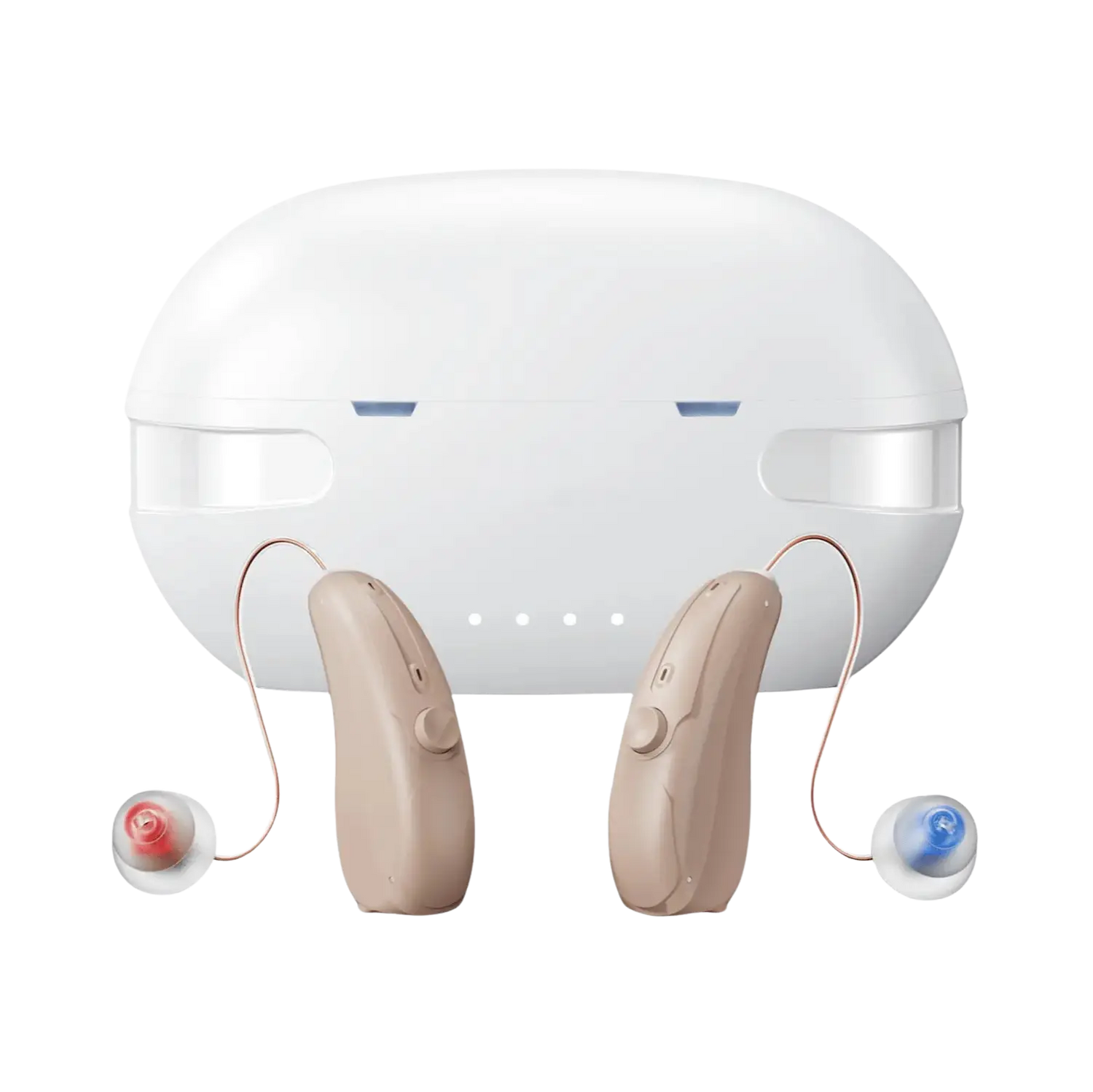
Panda Quantum is built around that problem. It is a receiver-in-canal device with 16-channel processing and active noise reduction aimed at clearer speech in noisy environments, and it includes the same app-based in-ear hearing test found on the Panda Air: you pair it with the app after delivery, it runs a frequency-specific test through the aid itself, and it programs gain and frequency response to your own results rather than to a generic curve. That app-based hearing personalization is what separates a fitted device from a simple amplifier.
Practical details matter for daily wear as well. The Quantum offers up to 80 hours of total battery life with its case and supports Bluetooth for calls, television, and music, so the same device covers the dinner table and the living room. It comes with a 5-year warranty and a 45-day return window. Over-the-counter devices are approved for adults with perceived mild to moderate hearing loss, and severe or profound loss still benefits most from a clinical fitting.

Limitations of This Research
The cross-sectional design is the central constraint. Because hearing, cognition, mood, and social activity were all captured at the same moment, the direction of every relationship in the model is open. The protective associations for hearing aid use and social participation are consistent with a causal story, but the study cannot distinguish that story from reverse causation or from a third factor driving all of them.
Participants came from a single hospital in one Chinese city, so the model's performance elsewhere is unknown. The validation was temporal rather than external, with 157 people, which is a modest number for testing a machine learning model and leaves the estimates imprecise. Cognitive impairment was defined by a Montreal Cognitive Assessment cutoff, a screening threshold rather than a clinical diagnosis, and hearing aid use appears to have been recorded as a yes or no variable without detail on hours of daily wear or how well the devices were fitted. The PubMed record for this article does not list funding sources or competing interests.
What to Do With This
Treat this as a risk stratification tool for clinicians rather than a promise about what hearing aids will do for your brain. The honest summary is that among older adults with hearing loss, the ones wearing hearing aids and still showing up to things scored better, and researchers have not yet untangled which way the arrow points. Addressing hearing loss remains worth doing on its own merits, and the fact that it keeps appearing on the protective side of these models is a reason to take it seriously rather than a reason to expect a specific outcome.
Xu X, Li M, Gao X, Wang Y, Ge J, Zhao R, Ma L, Liu Q. Development and temporal validation of a prediction model for cognitive impairment in older adults with hearing loss based on the population health risk management framework. Frontiers in Public Health. 2026;14:1873714. Retrieved from PubMed. https://doi.org/10.3389/fpubh.2026.1873714