A long-running study of more than 1,500 older Chinese adults with hearing loss found that depressive symptoms do not move in a single direction over time but split into four distinct trajectories, each shaped by different early-warning factors.
Hearing loss and low mood often travel together in later life, but researchers have long wondered whether that link is uniform. Does everyone with age-related hearing loss drift toward depression at the same rate, or do people follow very different emotional paths as the years pass?
A new analysis drawing on seven years of national survey data suggests the second answer is closer to the truth. Among older adults who already had hearing difficulty, depressive symptoms separated into four clearly different long-term patterns, and a handful of everyday factors helped predict which path a person was likely to take.
About This Study
Title: Longitudinal trajectories and predictive factors of depressive symptomatology in Chinese elderly with hearing loss: a growth mixture modeling analysis
Authors: Kuo Wen, Enguang Li, Fangzhu Ai, Ping Tang, Hongjuan Wen, Botang Guo
Affiliations: Changchun University of Chinese Medicine; Jinzhou Medical University; The Affiliated Luohu Hospital of Shenzhen University Medical School
Journal and date: BMC Geriatrics, published June 1, 2026
Study type: Longitudinal cohort analysis using growth mixture modeling
Reference: PubMed DOI: 10.1186/s12877-026-07687-1
Background: Why the Researchers Looked at This
Depression in older adults is common, and untreated hearing loss is one of the most frequently cited contributors. When sound becomes harder to follow, conversations grow tiring, social events lose their appeal, and the resulting isolation can wear on a person's mood. What has been less clear is how that relationship unfolds across years rather than at a single moment.
To study change over time, the researchers used a technique called growth mixture modeling. In plain terms, this is a statistical method that sorts people into hidden subgroups based on how a measurement, in this case depressive symptoms, rises or falls over repeated check-ins. Instead of assuming everyone behaves like the average person, it allows several different patterns to emerge from the data at once.
The goal was twofold: first, to identify those distinct depressive symptom paths among older adults with hearing loss, and second, to find out which characteristics measured at the start of the study predicted who ended up on the more troubled paths.
How the Study Was Done
The team drew on the China Health and Retirement Longitudinal Study, a large national survey known as CHARLS that follows middle-aged and older adults over time. They used four rounds of data collected in 2011, 2013, 2015, and 2018, giving them a window of roughly seven years per participant.
The analysis focused on 1,556 older adults who reported hearing loss. At each round, depressive symptoms were measured, and the modeling grouped participants according to how those symptoms changed. The researchers then examined a wide range of baseline characteristics, including sex, self-rated health, life satisfaction, social activity, sleep duration, and the ability to carry out daily tasks, to see which ones forecast membership in each group.
A regression analysis was used to compare the symptomatic groups against the group that stayed free of depressive symptoms, allowing the team to estimate which factors raised or lowered the odds of following a harder path.
What the Researchers Found
Four separate trajectories emerged. One group started low and climbed over time, an increasing path. A second group stayed high throughout, a severe and stable pattern. A third group remained largely free of depressive symptoms across all four rounds. A fourth group began with symptoms that eased as the years went on, a decreasing path.
Compared with the group that stayed symptom-free, several baseline factors stood out. Being female, rating one's own health as poor, and reporting low life satisfaction were each linked to higher odds of landing in one of the symptomatic groups. In other words, how people felt about their health and their lives at the outset said a great deal about where their mood would head.
Social inactivity carried particular weight. Older adults who were socially inactive at baseline were more likely to fall into the severe and stable group, the path marked by persistent, heavier symptoms. Meanwhile, those who reported at least fair life satisfaction were more likely to be in the group whose symptoms decreased over time.
Two factors appeared protective. Longer sleep duration and a higher ability to perform activities of daily living, the routine self-care and household tasks that support independent living, were both associated with more favorable depressive symptom courses.
What It Means for People with Hearing Loss
The headline message is that depression in older adults with hearing loss is not one story but several. Some people grow more distressed over time, some carry a heavy load throughout, and others hold steady or even improve. That variety matters, because it means a single approach is unlikely to fit everyone.
The predictors the study highlights are also practical. Social inactivity surfaced as a marker of the most persistent symptoms, which reinforces a familiar but important idea: staying engaged with other people appears to protect mood. For someone whose hearing loss is quietly pushing them away from conversations and gatherings, that disengagement is worth taking seriously, both for hearing and for emotional health.
Because factors such as self-rated health, life satisfaction, and social participation can be observed early, the findings point toward earlier, more targeted attention for people who show warning signs, rather than waiting until depression is entrenched.
Social Engagement Was the Strongest Signal, and Hearing Help Should Be Easy to Reach
Since this study tied social inactivity to the most stubborn depressive symptoms, the practical takeaway is to remove whatever quietly keeps older adults out of conversations. For many, that obstacle is untreated hearing loss, and the barriers to addressing it are often cost and the hassle of a clinic visit. Devices designed to lower those barriers can make staying socially connected far more achievable.
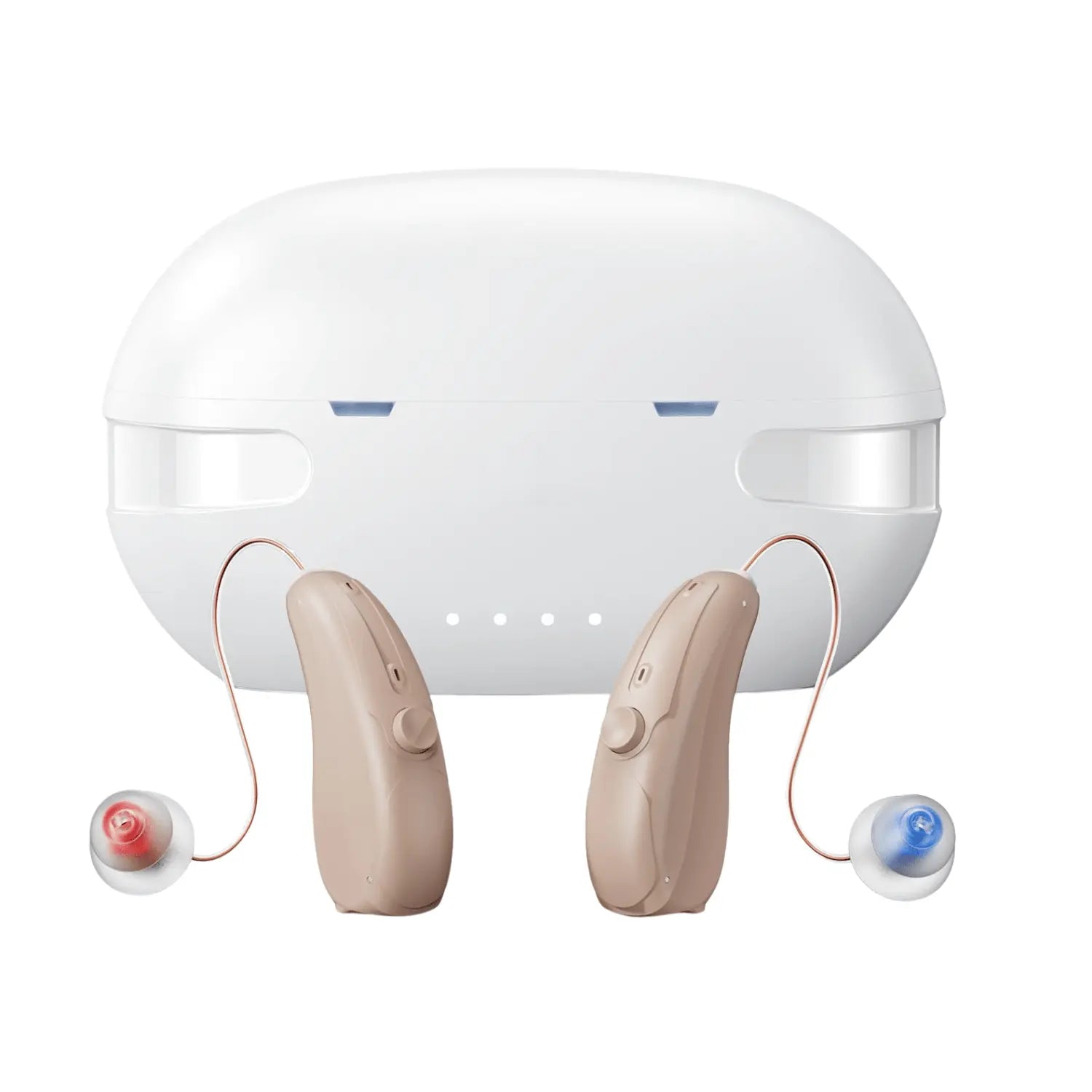
The Panda Air is one example of this newer approach. It is an earbud-style, FDA-regulated over-the-counter device built around self-fitting OTC hearing aids: after it arrives, the wearer pairs it with the Panda app, which runs a frequency-specific hearing test through the device itself and then automatically programs the gain and frequency response to match that person's results, much as an audiologist would at a clinical fitting. These app-tuned hearing aids let someone get a personalized setup at home rather than scheduling and traveling to an appointment.

Practical details support everyday use: the Panda Air uses 16-channel processing with multi-band adaptive noise reduction, comes with a 60-hour fast-charge case, and is backed by a 5-year warranty and a 45-day return window. None of this treats depression, and over-the-counter devices are intended for mild-to-moderate hearing loss, with severe or profound loss still best served by a clinical fitting. But for an older adult whose hearing loss is nudging them away from the dinner table or the card game, rechargeable hearing aids with a charging case that are simple to set up can make rejoining those moments less daunting.
Limitations of This Research
This was an observational study, so it can identify associations but cannot prove that any single factor causes a particular depressive path. Hearing loss was based on participants' own reports rather than formal audiometric testing, and the sample was drawn entirely from older adults in China, which may limit how directly the patterns apply elsewhere. The analysis also relied on survey measures collected at intervals of two to three years, meaning shorter-term shifts in mood could be missed. The authors did not report any commercial funding or conflicts of interest tied to a product.
Where This Leaves Us
For families and clinicians, the most useful lesson may be to watch the early signals, especially social withdrawal, poor self-rated health, and low life satisfaction, in older adults living with hearing loss, and to act before symptoms settle into a lasting pattern. Supporting connection, sleep, and day-to-day independence appears to matter, and addressing hearing loss is one concrete way to keep the door to social life open.
Wen K, Li E, Ai F, Tang P, Wen H, Guo B. Longitudinal trajectories and predictive factors of depressive symptomatology in Chinese elderly with hearing loss: a growth mixture modeling analysis. BMC Geriatrics. 2026. Retrieved from PubMed. https://doi.org/10.1186/s12877-026-07687-1