Hearing Loss Is Common but Stable in Adults With Mucopolysaccharidoses, New Audiology Study Finds
A retrospective study of 122 adults living with mucopolysaccharidoses found that nearly two thirds had measurable hearing loss, most of it sensorineural and, once present, largely stable across roughly 18 years of follow-up.
Mucopolysaccharidoses (MPS) are a group of rare inherited metabolic disorders in which the body cannot break down long sugar chains called glycosaminoglycans. The leftover material accumulates in many tissues, including the middle and inner ear, which is why hearing loss has long been recognized as part of the MPS picture. Most of what doctors knew about MPS-related hearing loss, however, came from children, because for decades few patients lived long enough as adults to be studied carefully.
A new natural-history analysis published in Molecular Genetics and Metabolism looks at the adult end of that timeline. The researchers pulled long-term audiology records from a tertiary metabolic center and asked a basic but unanswered question: once you reach adulthood with MPS, what does your hearing actually do over time, and does it depend on which subtype you have or which treatments you have received?
About This Study
Title: Natural history of hearing loss in adults with mucopolysaccharidoses across phenotype and genotype.
Authors: McCarron EP, Stepien KM, Summerfield N, Sharma R, Jovanovic A, Gossan N, Burkitt-Wright E, Gadepalli C.
Affiliations: Adult Inherited Metabolic Diseases, Salford Care Organisation (Northern Care Alliance NHS Foundation Trust); Adult Inherited Metabolic Disorders, Northern General Hospital, Sheffield Teaching Hospitals NHS Foundation Trust; Faculty of Health, University of Sheffield; Division of Cardiovascular Sciences, University of Manchester; Manchester Centre for Genomic Medicine, Manchester University NHS Foundation Trust; ENT Department, Salford Care Organisation. United Kingdom.
Journal & publication date: Molecular Genetics and Metabolism, 2026, Volume 148, Issue 3, article 110140. Publication date 5 May 2026.
Study type: Single-center retrospective cohort study, with cross-sectional and longitudinal audiological analyses.
PubMed / DOI: 10.1016/j.ymgme.2026.110140 | PubMed PMID 42107344
Background: Why the Researchers Looked at This
Mucopolysaccharidoses include several distinct subtypes, each caused by a different enzyme deficiency. Some, like MPS I (Hurler / Hurler-Scheie) and MPS II (Hunter syndrome), are well-known names in pediatric clinics. Others, such as MPS IVA (Morquio A), are best known for short stature and skeletal disease. All of them can affect hearing, and the pattern is usually mixed: some conductive loss from middle-ear effusion or ossicular changes, layered on top of sensorineural loss from damage to the cochlea or auditory nerve.
Treatments such as enzyme replacement therapy (ERT) and haematopoietic stem cell transplantation (HSCT) have changed the natural course of MPS in many organs. They have allowed many patients with severe subtypes to live into adulthood for the first time. What is not well understood is whether those same treatments meaningfully change the auditory trajectory once a patient is in their twenties, thirties, or older, or whether hearing loss in adulthood simply continues to worsen on its own.
That gap is what the Salford and Manchester team set out to fill. They had access to one of the larger adult MPS clinical populations in Europe, which made it possible to look not just at how common hearing loss is, but at how it changes year over year.
How the Study Was Done
The investigators looked back through the clinical and audiology records of adults with confirmed MPS attending an adult inherited metabolic disease service. They classified hearing loss using standard audiometric thresholds and grouped patients by MPS subtype (for example MPS I, MPS II, MPS IVA) and where possible by their underlying genetic variant.
For the cross-sectional picture, they used each patient's most recent audiogram. For the longitudinal picture, they took the earliest and most recent audiograms for each patient who had both, and compared them. That paired-audiogram subgroup was followed for a median of about 18 years, which is unusually long in any audiology study.
The team also recorded whether each patient had received enzyme replacement therapy, haematopoietic stem cell transplantation, both, or neither, and looked for differences in hearing trajectory between those groups. Because the sample sizes per subtype were small, they used non-parametric statistical tests rather than methods that assume a tidy bell curve.
What the Researchers Found
Out of 122 adults with confirmed MPS, 111 (about 91 percent) had a recent audiogram in their record. Hearing loss was present in 65.7 percent of those patients. That is a striking number for a clinic where the average age skews young by adult-medicine standards, and it confirms that hearing loss is a routine, not an occasional, feature of MPS in adulthood.
The character of the loss was overwhelmingly sensorineural. Pure sensorineural hearing loss was the largest single category at 51.4 percent of patients, with the remainder split across conductive and mixed patterns. In practical terms, that means most adult MPS hearing loss is not the kind that can be reversed with ventilation tubes or middle-ear surgery alone; it sits in the inner ear and behaves like age-related or noise-related sensorineural loss in the general population.
Severity was not evenly spread across subtypes. The differences between subtypes were statistically significant (p < 0.001), with adults who had MPS II and short-stature MPS IVA carrying the heaviest burden. Patients with other subtypes still had measurable loss but tended toward milder categories.
The longitudinal piece was perhaps the most surprising. Out of 56 patients with paired audiograms over roughly 18 years of follow-up, only 14.3 percent shifted into a worse severity category. Across the cohort as a whole, there was no signal of steady progression. In other words, MPS hearing loss tends to declare itself, settle in, and then stay roughly where it is in adulthood, rather than steadily eroding year after year the way some forms of age-related loss can.
Crucially, hearing trajectories did not look meaningfully different in patients who had received enzyme replacement therapy or haematopoietic stem cell transplantation compared with those who had not. The therapies that have reshaped survival in MPS do not appear, on this dataset, to reshape adult auditory outcomes.
What It Means for People with Hearing Loss
The first practical message is for adults with MPS and the clinicians who follow them: hearing loss is not an outlier complication, it is the norm, and audiology should be a standing item on every adult MPS care plan rather than a referral made only after the patient complains. Two thirds of patients in this cohort had measurable loss, and the largest share was sensorineural.
The second message is more reassuring. Because the loss tends to be stable once it appears in adulthood, the planning horizon for hearing devices and rehabilitation is longer than it would be in a steadily progressing disease. A pair of well-fit hearing aids in an adult MPS patient is unlikely to be outgrown by the audiogram in a year or two, which means there is real value in optimizing the fitting and the daily listening experience rather than treating amplification as a temporary measure.
The third message is broader. Sensorineural loss that is stable but functionally significant is the same shape of problem that millions of adults face from age-related causes, noise exposure, or other inner-ear conditions. The technology choices that work for them are the same choices that can work in MPS: receiver-in-canal devices with good speech-in-noise processing, comfortable long-wear ergonomics, and connectivity to phones and televisions for the listening environments where sensorineural loss is hardest.
When Sensorineural Loss Is Stable, the Priority Shifts to Daily Listening Performance
The Salford findings reframe what a good hearing-aid choice looks like for someone whose loss is sensorineural and not aggressively progressive. The question stops being "how soon will I need a stronger device?" and starts being "how well does this device handle the listening situations I am actually in every day?" That tilts the priority list toward clinical-grade processing, comfortable all-day wear, and reliable streaming for phone calls and television, where sensorineural loss is hardest to compensate for.
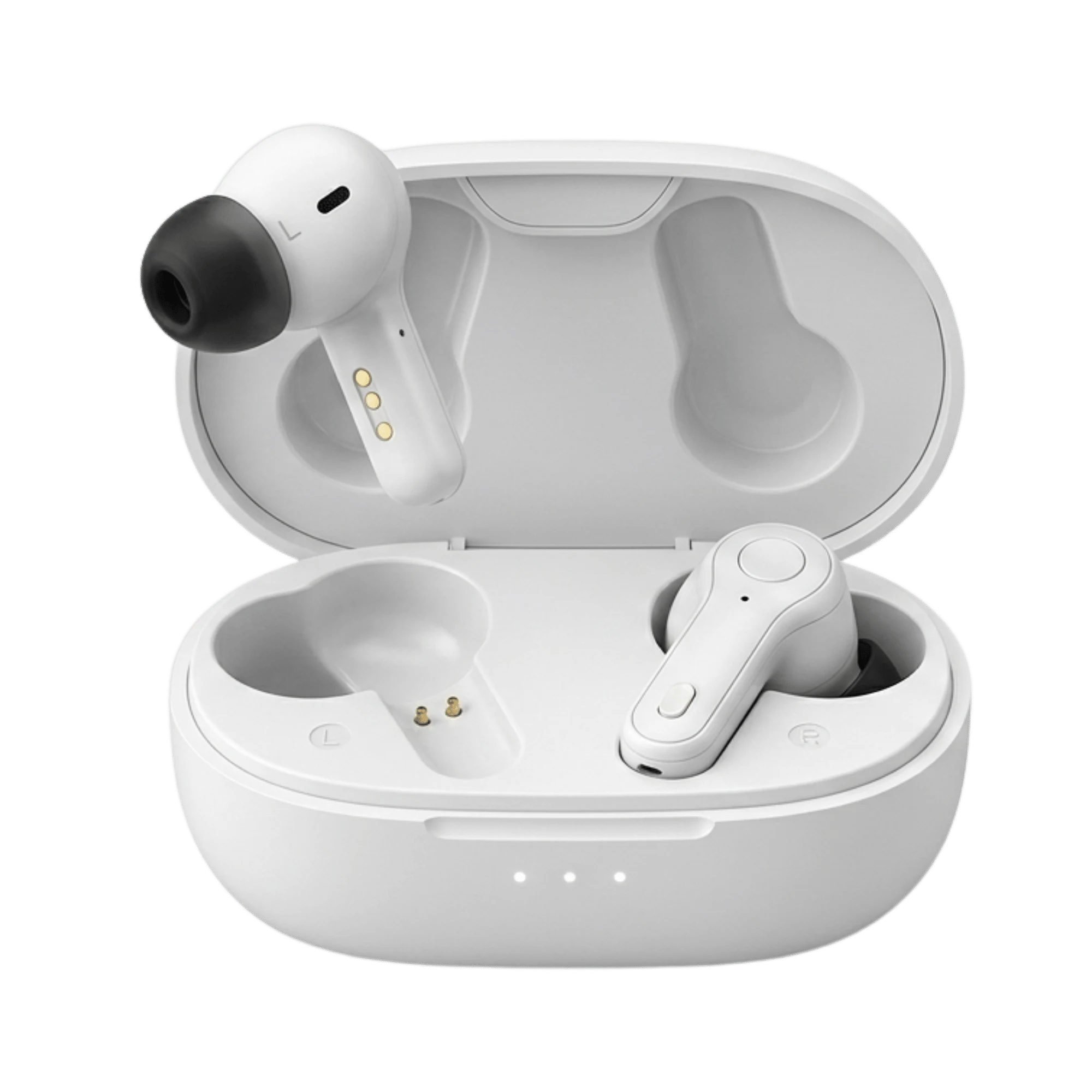
Panda Quantum is built around exactly that profile. It is a 16-channel receiver-in-canal hearing aid with active noise reduction, Bluetooth streaming for calls, music, and TV audio, and a charging case that delivers up to 80 hours of total battery between wall outlets. It includes the Panda app-based in-ear hearing test, so after the device arrives you pair it with the Panda app, the app runs a frequency-specific hearing test through the hearing aid itself, and the gain and frequency response are programmed automatically to match your audiogram in a process similar to what an audiologist does at a clinical fitting. See the Panda Quantum product page for the full specifications.

One important caveat: over-the-counter hearing aids in the United States are intended for adults with perceived mild-to-moderate hearing loss. Adults with MPS who have severe or profound sensorineural loss, or who have complicating skeletal or airway issues, will still benefit most from a clinical audiology pathway alongside any consumer device, both for the fitting itself and for monitoring over time.
Limitations of This Research
The study is retrospective and single-center, which is the practical reality of doing any large analysis in a disease this rare. The paired-audiogram subgroup was 56 patients, and within that group the sample sizes for individual subtypes are inevitably small, which limits how confidently the absence of progression can be generalized to every MPS subtype, age, or genotype. Audiometric methods can also vary slightly across the long time span the paired analysis covers.
The authors note these constraints and frame their results as an adult natural-history baseline rather than a definitive treatment effect study. They do not extrapolate to pediatric MPS hearing trajectories, which behave differently. Funding and conflicts of interest were not detailed in the abstract record.
Where This Leaves Us
For adults living with MPS, this is one of the first large datasets to put numbers on something many patients and families already suspected: hearing loss is common, mostly sensorineural, subtype-specific in severity, and, encouragingly, not relentlessly progressive once adulthood is reached. The takeaway for clinicians is to build audiology into routine care from the start; the takeaway for patients is that investing in a hearing solution that fits well today is likely to pay off over years, not months.
McCarron EP, Stepien KM, Summerfield N, Sharma R, Jovanovic A, Gossan N, Burkitt-Wright E, Gadepalli C. Natural history of hearing loss in adults with mucopolysaccharidoses across phenotype and genotype. Molecular Genetics and Metabolism. 2026;148(3):110140. Retrieved from PubMed. https://doi.org/10.1016/j.ymgme.2026.110140