Hearing Loss Among 12 Dementia Risk Factors Across 14 Countries
A harmonised analysis of more than 214,000 adults aged 50 and older found that dementia risk factors, hearing loss among them, rarely appear alone and vary sharply from one country to the next.
Most of what the world knows about preventing dementia comes from a handful of wealthy countries. That is a problem, because the majority of people living with dementia do not live in those countries. If prevention advice is built on data from the United States and Western Europe, it may not describe the lives of older adults in India, Brazil, Malaysia, or China at all.
A team led by researchers at the University of Southern California set out to fix that gap. They pooled data from 11 large studies of ageing and compared how 12 well established dementia risk factors, including hearing loss, are distributed across 14 countries and regions. The picture that came back was less uniform than prevention campaigns often assume, and it carried one consistent message: risk factors travel in groups.
About This Study
Title: Differences in the prevalence and patterns of dementia risk factors across 14 countries and regions: a harmonised cross-national analysis
Authors: Emma Nichols, Zachary J Kunicki, Michael Markot, Drystan Phillips, Jenny Wilkens, Alden L Gross, Jinkook Lee
Affiliations: Center for Economic and Social Research and Leonard Davis School of Gerontology, University of Southern California; Department of Psychiatry and Human Behavior, Warren Alpert Medical School of Brown University; Johns Hopkins Center on Aging and Health and Department of Epidemiology, Johns Hopkins Bloomberg School of Public Health; Department of Economics, University of Southern California
Journal and publication date: The Lancet Healthy Longevity, 12 July 2026
Study type: Comparative cross-sectional study using harmonised data from 11 nationally representative ageing cohorts
PubMed DOI: 10.1016/j.lanhl.2026.100867
Background: Why the Researchers Looked at This
Over the past decade, researchers have assembled a list of conditions and circumstances that raise a person's chance of developing dementia later in life and that can, at least in principle, be changed. These are called modifiable risk factors. Hearing loss is on that list, alongside low education, high LDL cholesterol, depression, physical inactivity, diabetes, smoking, high blood pressure, obesity, heavy drinking, social isolation, and vision loss.
The word "modifiable" is doing a lot of work in that sentence. It means these factors are potential targets for prevention, not that changing one is guaranteed to prevent dementia. The distinction matters for how you read any study of this kind.
The problem the authors identified is that nearly all of the underlying evidence comes from high-income countries. Without knowing which risk factors are actually common where, a country cannot sensibly decide where to spend limited prevention money. A campaign built around cholesterol may be beside the point in a population whose dominant risk factor is something else entirely.
How the Study Was Done
The researchers drew on 11 nationally representative studies of ageing covering 14 countries and regions: Ireland, the United States, England, Northern Ireland, Eastern Europe, Western Europe, Northern Europe, Southern Europe, South Korea, Mexico, China, Malaysia, Brazil, and India. The group spans both high-income countries and low-income and middle-income countries. Everyone included was aged 50 or older, and the data came from the most recent available study waves, collected between 2009 and 2023.
The key word in the study's title is "harmonised." Different national surveys ask different questions in different ways, so raw comparison between them is misleading. Harmonising means reworking each dataset so that a given risk factor is defined the same way everywhere, which is what makes a genuine country-to-country comparison possible.
In total, 214,251 respondents were included. The team estimated how common each of the 12 risk factors was in each setting, then examined how those patterns broke down by age group, gender, and education using statistical models. They also compared how the risk factors ranked against each other in each country, and looked at whether risk factors tended to occur together rather than in isolation.
What the Researchers Found
The headline result is variation. How common a given dementia risk factor is depends heavily on where you live, and the gaps are not subtle. Low education was far more prevalent in many lower-income settings, reported by 85.6% of respondents in China (95% CI 84.8 to 86.5) against 12.0% in the United States (95% CI 11.3 to 12.7). Obesity ran the other way, at 44.9% in the United States (95% CI 43.3 to 46.5) compared with 13.3% in India (95% CI 12.9 to 13.7).
Those two examples make the authors' broader point. A single global prevention playbook would be aimed at the wrong target in roughly half the countries studied, because the risk factors are not stacked in the same order everywhere.
Patterns also shifted within countries. The distribution of risk factors differed by age group, by gender, and by education level, though the researchers noted these internal patterns were not consistent across every setting. In other words, even the sub-patterns resist a single tidy summary.
Against that variation, two findings held nearly everywhere. First, risk factors rarely came alone: in every country and region studied, more than half of individuals had at least two of the 12 risk factors at once. Second, the factors clustered in broadly similar ways across settings, grouping into a cardiovascular cluster, a risky behaviours cluster, and a social or sensory cluster. Hearing loss belongs to that third group, sitting alongside vision loss and social isolation rather than standing on its own.
That clustering is arguably the most useful thing in the paper. It suggests that the conditions which push dementia risk upward tend to arrive as bundles, and that the sensory and social side of ageing forms a recognisable bundle of its own.
What It Means for People with Hearing Loss
The practical reading here is not that hearing loss causes dementia. This study did not test that, and nothing in it should be taken as evidence that treating hearing loss prevents dementia. What it does show is that hearing loss keeps company. It sits in a cluster with vision loss and social isolation, and more than half of older adults everywhere in the study carried at least two risk factors at once.
For an individual, that reframes the question. If you are noticing your hearing, the odds are reasonable that something else in the same cluster is also drifting, whether that is vision or how much contact you have with other people. The clustering finding is a nudge to look at the group rather than the single item.
It also matters that the authors framed their conclusion around tailoring. Prevention strategies, they argue, should fit the context they are deployed in. Applied to hearing, that means the barrier worth attacking is whichever one is actually in your way, and for a great many people that barrier has long been the cost and inconvenience of getting help at all.
When Risk Factors Cluster, the Reachable Ones Matter Most
Look at the sensory and social cluster the researchers identified and one thing stands out. Some items in it are hard to move. Others are comparatively tractable. Hearing is one of the tractable ones, and historically the thing standing in the way has been price and access rather than the technology itself.
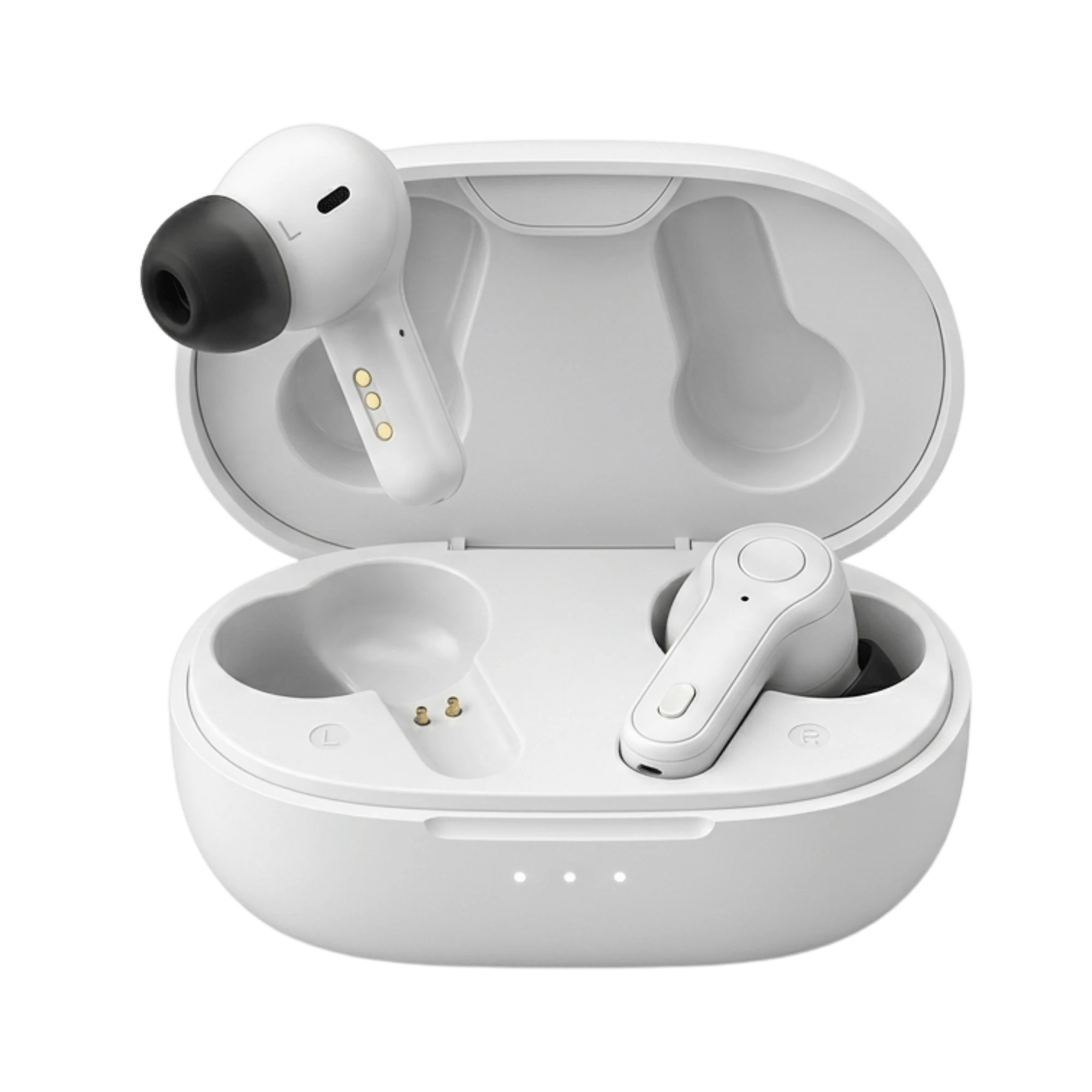
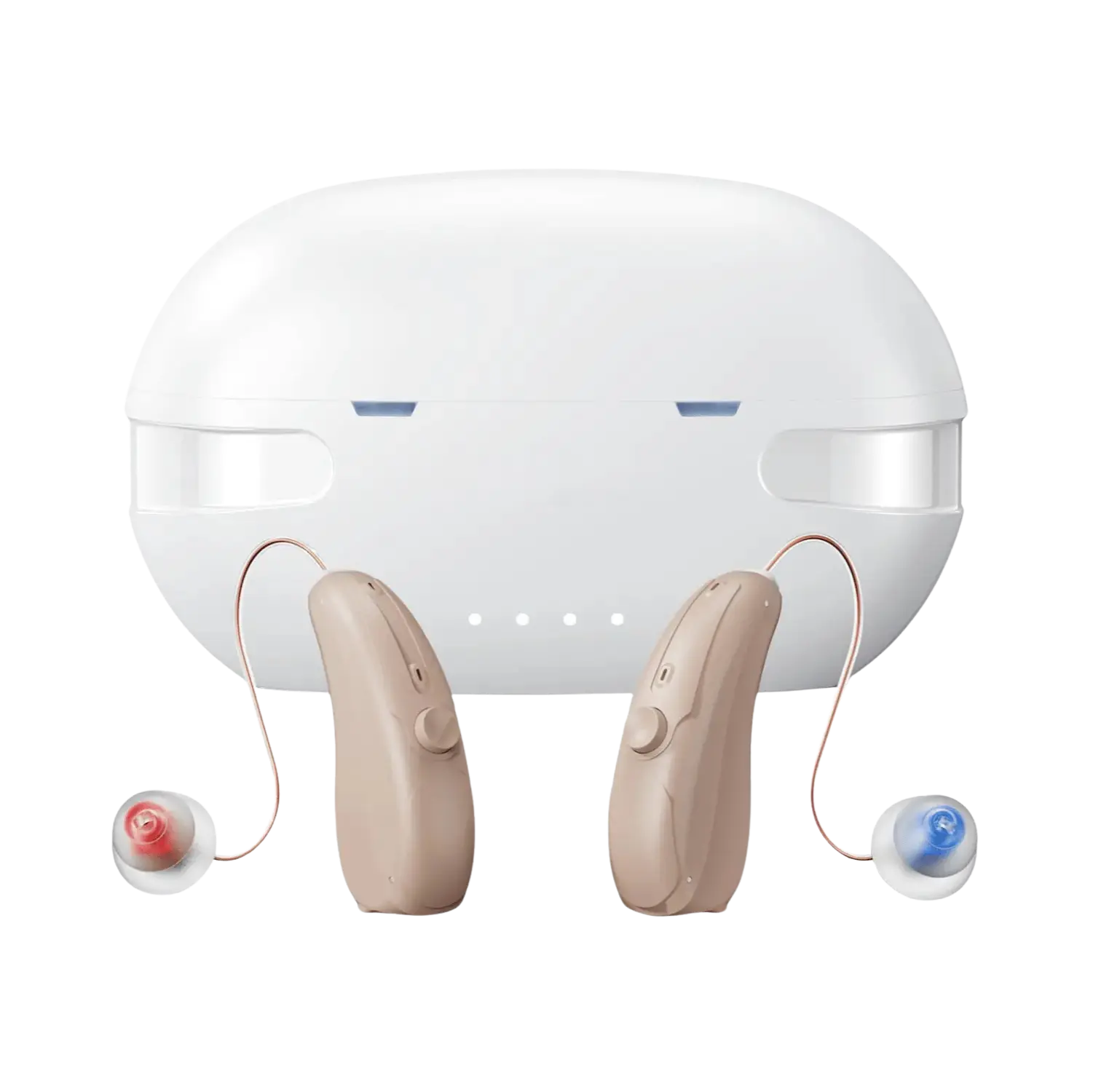
Because this study points at access and context as the things that differ between populations, FDA-cleared over-the-counter devices are worth knowing about, since they were created specifically to lower that barrier. Panda Air is one such device. It is an earbud-style aid with 16-channel WDRC processing and multi-band adaptive noise reduction, and it belongs to the category of self-fitting OTC hearing aids: after delivery you pair it with the Panda app, which runs a frequency-specific test through the aid itself and programs gain and frequency response to your own audiogram, much as a clinical fitting would. That makes it one of the app-tuned hearing aids that skip the clinic visit entirely.
On the practical side it is one of the rechargeable hearing aids with charging case, with a 60-hour fast-charge case, and it carries a 5-year warranty and 45-day returns. Worth noting: OTC hearing aids are approved for mild-to-moderate hearing loss. Severe or profound loss still benefits most from a clinical fitting, and this study offers no reason to think otherwise.
You can read more at pandahearing.com/products/panda-air.
Limitations of This Research
This is a cross-sectional study, which means it photographs a population at one moment rather than following it forward. It can report how common hearing loss and the other risk factors are, and how they cluster, but it cannot establish that any of them causes dementia, nor that addressing one changes anyone's outcome. Readers should resist turning a prevalence finding into a causal claim.
Other caveats apply. The data were gathered across a long span, between 2009 and 2023, so some national estimates are considerably fresher than others. Respondents missing data on a given risk factor were excluded from that specific analysis. And harmonisation, while necessary for comparison, involves judgement calls about how to make differently worded surveys line up. The work was funded by the National Institutes of Health.
Where This Leaves Us
The most durable thing this study offers is not any single percentage but a shape: dementia risk factors cluster, and they cluster in broadly similar ways whether you are in Ireland or Malaysia, even as their prevalence swings wildly between the two. Hearing loss sits inside the social and sensory bundle. That does not tell you that acting on your hearing will protect your memory, and this study cannot support that claim. What it does suggest is that the sensory and social parts of ageing are worth considering together rather than one at a time, and that the right prevention approach depends on where you actually live.
Nichols E, Kunicki ZJ, Markot M, Phillips D, Wilkens J, Gross AL, Lee J. Differences in the prevalence and patterns of dementia risk factors across 14 countries and regions: a harmonised cross-national analysis. The Lancet Healthy Longevity. 2026. Retrieved from PubMed. https://doi.org/10.1016/j.lanhl.2026.100867