In a study of 524 older adults with hearing loss, researchers built a five-variable risk model for cognitive impairment, and two of the five variables were things a person can change.
The link between hearing loss and cognitive decline is now one of the better-established findings in the field. What is far less settled is what to do with that knowledge in practice. Knowing that a group faces elevated risk does not tell a clinician which individuals in that group need attention first.
A team based in Anhui, China set out to build a screening tool for exactly that purpose: a short, low-cost way to flag which older adults with hearing loss are most likely to already have cognitive impairment. The variables their model selected are as interesting as the model's accuracy.
About This Study
Title: Development and temporal validation of a prediction model for cognitive impairment in older adults with hearing loss based on the population health risk management framework
Authors: Xianyan Xu, Mengting Li, Xuling Gao, Yan Wang, Jun Ge, Rong Zhao, Li Ma, Qiankun Liu
Affiliations: Department of Nursing, Bengbu First People's Hospital, Bengbu, Anhui, China; School of Nursing, Bengbu Medical University, Bengbu, Anhui, China
Journal and date: Frontiers in Public Health, volume 14, published July 16, 2026
Study type: Cross-sectional study with machine learning model development and temporal validation, 524 participants
PubMed DOI: 10.3389/fpubh.2026.1873714
Background: Why the Researchers Looked at This
Older adults with hearing loss carry a higher risk of cognitive impairment than their normal-hearing peers. Several mechanisms have been proposed, including the extra mental effort required to decode degraded speech, reduced stimulation of the brain's auditory pathways, and the social withdrawal that often follows when conversation becomes tiring.
Cognitive impairment here refers to measurable decline in memory, attention, or executive function that falls short of dementia. It is typically screened with a short test such as the Montreal Cognitive Assessment, or MoCA, which scores out of 30, with results below a threshold indicating possible impairment and adjustment made for how many years of education a person has had.
The authors note that despite the well-documented association, tools that stratify risk within this specific population remain limited. A general dementia risk calculator is not designed for people who already have hearing loss. Their aim was a model built for that group, using variables that a community clinic or nursing team could collect without specialist equipment.
How the Study Was Done
The researchers enrolled 524 adults aged 60 and older with hearing loss between June 2023 and September 2024. Rather than splitting the group at random, they divided it by enrollment period: 367 participants recruited from June 2023 to May 2024 formed the development cohort, and 157 recruited from June to September 2024 formed a temporally independent validation cohort. Testing a model on a later group is a stricter check than a random split, because it approximates using the tool on future patients.
Cognitive function was measured with the Montreal Cognitive Assessment, with a score below 26 taken to indicate cognitive impairment after correction for education. Candidate predictors were chosen using the Integrated Framework for Population Health Risk Management, then narrowed with LASSO regression, a technique that shrinks the influence of weak variables toward zero so only the informative ones survive.
Six machine learning models were trained and compared on the surviving variables, evaluated on discrimination, calibration, and clinical usefulness. The best performer was then tuned with grid search and five-fold cross-validation, and SHAP analysis was applied to show how much each variable contributed to individual predictions rather than leaving the model as a black box.
What the Researchers Found
Cognitive impairment was present in 40.8 percent of the sample. That is a high figure, and it reflects a population selected for hearing loss rather than the general older population, but it underlines how common the overlap is in this group.
LASSO narrowed the candidate variables to five: age, pure-tone average, depression, hearing aid use, and participation in social activities. Pure-tone average is the standard summary measure of hearing sensitivity from an audiogram, expressed in decibels, where a higher number means worse hearing.
In multivariable analysis, depression, older age, and a higher pure-tone average were each associated with greater likelihood of cognitive impairment. Hearing aid use and participation in social activities went the other way and were identified as protective factors. Two of the five predictors, in other words, describe behaviors rather than fixed characteristics.
Random Forest performed best among the six models. After tuning it reached an area under the curve of 0.952 in the training cohort and 0.871 in the validation cohort. In validation it produced an F1 score of 0.737, sensitivity of 0.779, a Youden index of 0.583, and a negative predictive value of 0.863, meaning it was reasonably good at correctly clearing people who did not have impairment.
The SHAP analysis ranked pure-tone average, age, and social activities as the most influential variables in the tuned model. Degree of hearing loss carrying that much weight is notable given that the entire sample already had hearing loss; the model is picking up gradations within the condition, not just its presence.
What It Means for People with Hearing Loss
The important limit to state plainly first: this was a cross-sectional study, meaning hearing, cognition, and hearing aid use were all measured at the same moment. It cannot establish that wearing hearing aids prevents cognitive decline. People who wear hearing aids may differ from those who do not in ways the model did not capture, including general health engagement and financial resources.
What the study does show is that hearing aid use and social participation both mark out the lower-risk end of this population, and that they tend to travel together. Hearing that conversation is easier makes gatherings less draining, and gatherings that are less draining are ones people keep attending. That is a plausible reading of why both variables survived the same selection process.
Depression appearing alongside them is worth noting too. It is often treated as a downstream consequence of hearing loss rather than something to address in its own right, and this model suggests it belongs in the same conversation as the audiogram.
Why Staying in the Conversation Depends on Hearing It Clearly
If social participation is one of the strongest variables in this model, then the practical question is what makes social settings manageable. Restaurants, family dinners, and group conversations are precisely the situations where untreated hearing loss becomes most tiring, and where a device that only makes everything louder does not help much.

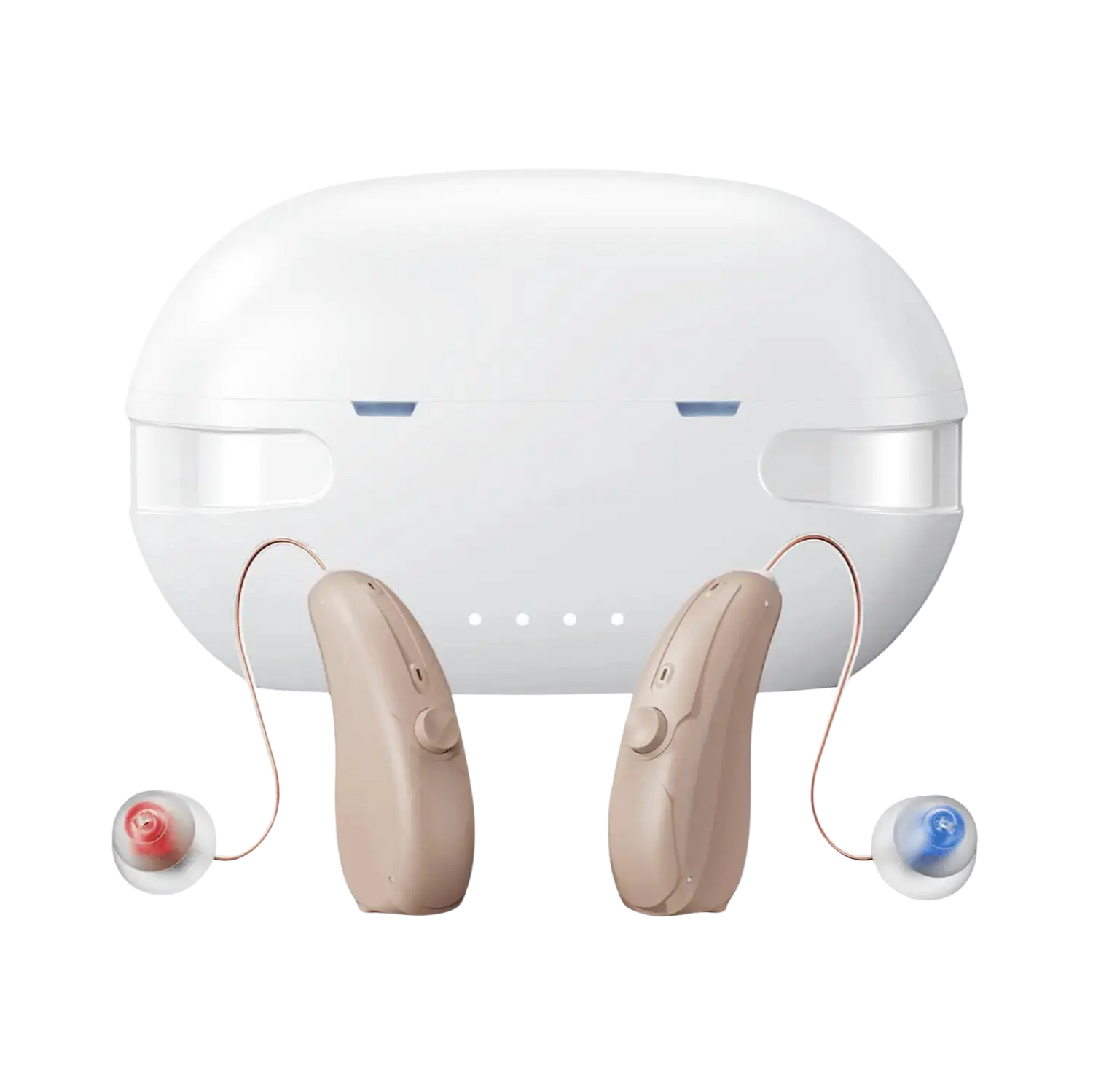
Panda Quantum is designed around that specific problem. It is a 16-channel receiver-in-canal aid with active noise reduction, built to separate speech from background sound so that group settings stay workable rather than exhausting. Its 16-channel WDRC processing shapes amplification differently across the frequency range instead of raising everything at once, which is what makes speech-in-noise hearing aids feel different from simple amplifiers in a busy room.
It also includes the app-based in-ear hearing test: after delivery, the Panda app runs a frequency-specific test through the aid itself and programs gain and frequency response to the result, which is the same app-based hearing personalization step a clinical fitting performs. Bluetooth handles calls, TV, and music directly, and the battery runs up to 80 hours in total with the case. Panda covers the Quantum with a 5-year warranty and 45-day returns. OTC devices are approved for mild to moderate hearing loss; severe or profound loss still benefits most from a clinical fitting.
Limitations of This Research
Beyond the cross-sectional design, the sample is a constraint. All 524 participants were recruited through a single hospital system in one region of China, so the model's calibration may not transfer to populations with different demographics, different rates of hearing aid ownership, or different patterns of social life. The validation cohort of 157 is also modest, and performance dropping from 0.952 in training to 0.871 in validation is the expected signature of a model that fits its development data somewhat optimistically.
Hearing aid use appears to have been recorded as a yes or no variable, which does not capture how many hours a day a device is actually worn, a distinction known to matter. The Montreal Cognitive Assessment is a screening instrument rather than a diagnosis, so the 40.8 percent figure describes screen-positive results, not confirmed cases. No funding source or competing interest disclosure was included in the abstract record retrieved from PubMed.
What to Do With This
Treat this as a risk stratification tool rather than proof of cause and effect, because that is what it is. Its practical value is that of the five things it looks at, two are within a person's control. Nobody can change their age, and pure-tone average moves in only one direction over time, but whether hearing loss is treated and whether someone stays socially engaged are both live decisions. On the evidence here they are the two that mark the lower-risk end of the population, and they reinforce each other.
Xu X, Li M, Gao X, Wang Y, Ge J, Zhao R, Ma L, Liu Q. Development and temporal validation of a prediction model for cognitive impairment in older adults with hearing loss based on the population health risk management framework. Frontiers in Public Health. 2026. Retrieved from PubMed. https://doi.org/10.3389/fpubh.2026.1873714