Hearing Aid Fitting Accuracy Predicts Who Stops Wearing Their Devices
A study of 455 older adults in Chile found that the further a hearing aid's real output drifted from the amplification it had been prescribed to deliver, the more likely its owner was to stop wearing it altogether.
Being fitted with a hearing aid and actually wearing one are two different things. Across health systems worldwide, a meaningful share of people who receive hearing aids quietly stop using them, and the devices end up in a drawer. The explanations usually offered are broad ones: discomfort, appearance, cost, or the general hassle of upkeep.
A new analysis out of Chile points at something narrower, more technical, and considerably easier to fix. It asked whether the precision of the fitting itself, measured in decibels, predicts who keeps their hearing aids in their ears and who gives up on them.
About This Study
Title: Discrepancies between insertion and target gain are associated with hearing aid abandonment in Chilean older adults
Authors: Eduardo Fuentes-López, Javier Galaz-Mella, Dominique Terán-Tapia, Ximena Hormazábal-Reed, Carrie L. Nieman, Anthony Marcotti
Affiliations: Departamento de Fonoaudiología, Escuela de Ciencias de la Salud, Facultad de Medicina, Pontificia Universidad Católica de Chile, Santiago; Faculty of Rehabilitation Sciences, Universidad Andres Bello, Santiago; Escuela de Salud Pública, Pontificia Universidad Católica de Chile, Santiago; Escuela de Fonoaudiología, Universidad San Sebastián, Santiago; Department of Otolaryngology, Head and Neck Surgery, Johns Hopkins School of Medicine, and the Cochlear Center for Hearing and Public Health, Johns Hopkins Bloomberg School of Public Health, Baltimore
Journal and publication date: Scientific Reports, July 14, 2026
Study type: Retrospective cohort study of 455 adults receiving publicly funded hearing aids
PubMed DOI: https://doi.org/10.1038/s41598-026-59511-w
Background: Why the Researchers Looked at This
When a hearing aid is programmed, the process starts from a prescription. A person's audiogram, which is a chart of the quietest sounds they can detect at each pitch, is fed into a formula that calculates how much amplification the device ought to deliver at each frequency. That calculated goal is called the target gain. It is specific to one person's ears and one person's pattern of hearing loss.
What the device actually delivers once it is sitting in a particular ear canal is a separate quantity, called the insertion gain. The two are not automatically the same. Ear canals vary in length, width and shape, and an identical device can behave differently from one ear to the next. Verification equipment exists precisely to measure what is really happening near the eardrum so the two numbers can be compared and the programming corrected.
The researchers noted that abandonment rates run high in parts of South America, and that leaving age-related hearing loss untreated carries real consequences while consuming public resources. If a measurable and correctable gap between insertion and target gain turned out to drive abandonment, that would be a lever worth pulling.
How the Study Was Done
The team assembled a retrospective cohort of 455 people who had received hearing aids through public funding in two regions of Chile. Because the devices came through a public program, the group represents ordinary recipients rather than volunteers who sought out a research study, which is a useful feature when the question is about real-world adherence.
For each participant, the gap between insertion gain and target gain was measured using a hearing aid analyzer, the equipment that reads what a device is actually producing rather than what its software claims. Whether someone had abandoned their hearing aids was established by self-report.
The analysis used Poisson regression models to estimate how the size of that gap related to the risk of abandonment, while controlling for other factors that might independently explain who stops wearing their devices.
What the Researchers Found
Roughly 18 percent of the participants had stopped using their hearing aids. That figure alone is worth sitting with: close to one in five devices, paid for out of public funds and fitted by professionals, was no longer being worn.
The fitting measurements separated the two groups. At a 65 decibel input level, roughly the level of ordinary conversation, the average discrepancy between what the device delivered and what it had been prescribed to deliver was 7.8 decibels among the people who abandoned their hearing aids. Among those who kept wearing them, the average gap was 5.8 decibels. The difference between the two groups came to about 2 decibels on average.
Once the other predictors were accounted for, the relationship held and behaved like a dose response. Each additional decibel of discrepancy was associated with roughly a 10 percent higher risk of abandonment (relative risk 1.10, with a 95 percent confidence interval running from 1.06 to 1.15). Because that interval sits entirely above 1.0, the association was statistically reliable rather than a fluke of the sample, and the steady climb with each decibel is the kind of pattern that tends to indicate a real underlying effect rather than noise.
The researchers also reported a practical detail about aftercare. Attending follow-up appointments, up to about four of them, was associated with better alignment between the device's output and its target. In other words, the mismatch was not a fixed property of the device or the ear. It was something that repeated visits tended to reduce.
What It Means for People with Hearing Loss
The most useful idea in this paper is that a hearing aid which sounds wrong may be measurably wrong. When amplification lands several decibels off the prescription, the device is not delivering the correction the wearer's audiogram called for, and the common advice to simply give it time and get used to it can end up papering over a fixable technical problem.
It also reframes what a fitting is. A fitting is not a single appointment where a device is handed over. It is a target to be hit, verified, and then re-hit as needed. The finding about follow-up visits suggests the first attempt frequently misses, and that the people who came back were the ones whose devices ended up closer to the mark.
For anyone struggling with hearing aids they already own, the actionable question is whether the fitting was ever verified against a prescribed target for their own audiogram, and if so, how large the gap was.
Why Matching Amplification to Your Own Audiogram Is the Part That Keeps Devices in Ears
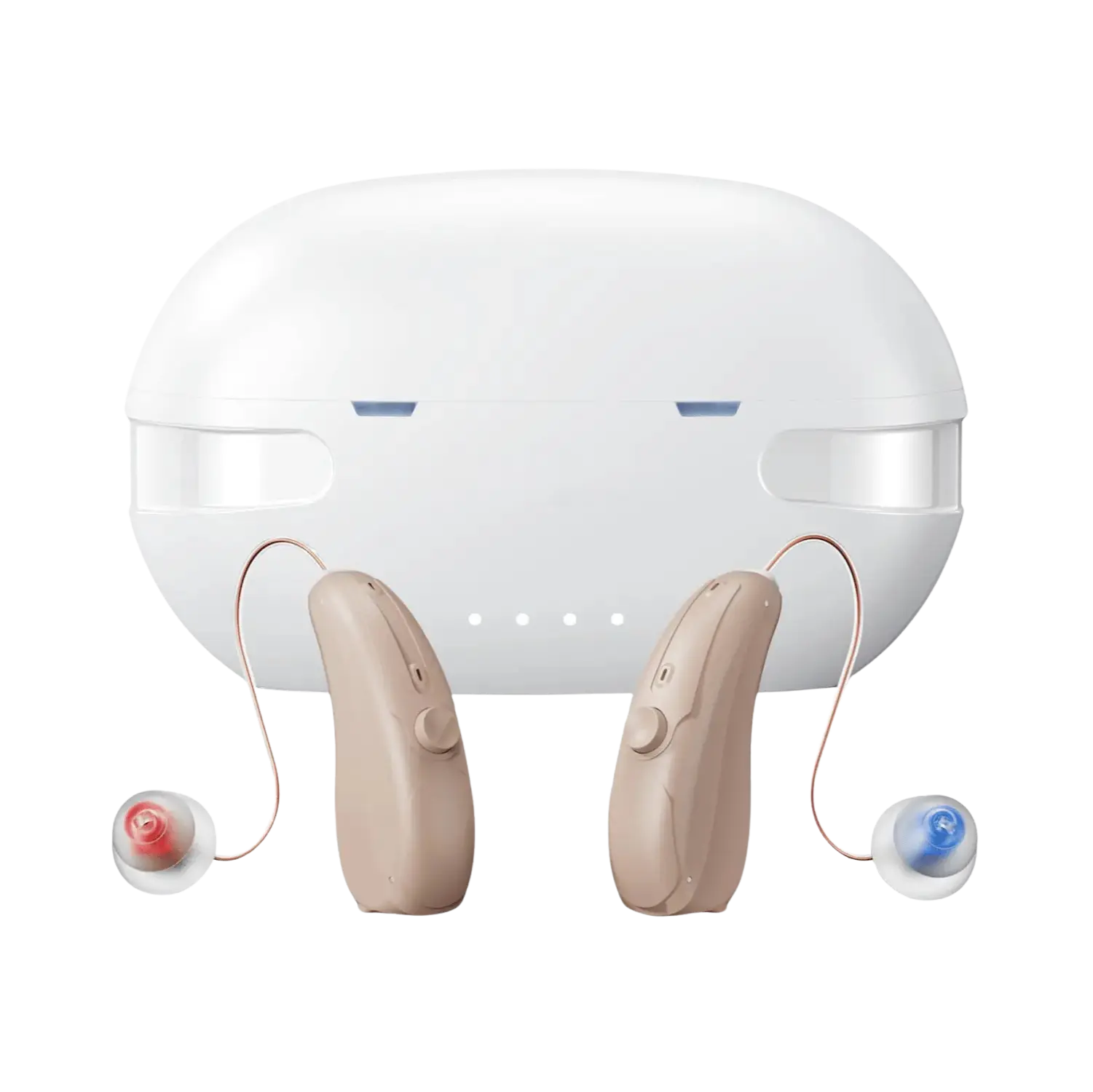
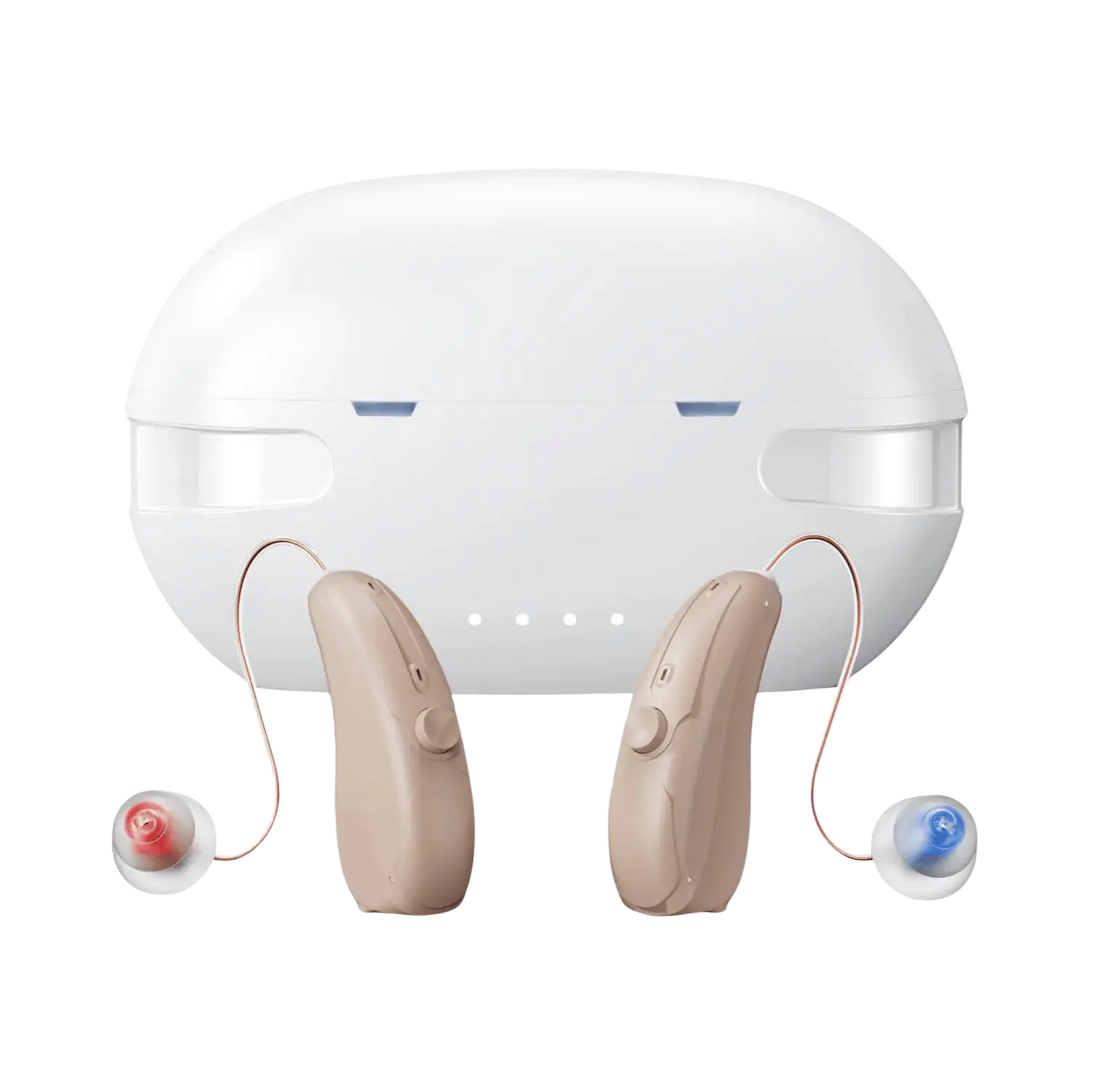
Because this study locates the problem in the gap between prescribed and delivered amplification, the question that matters for any wearer is how their device gets matched to their own audiogram in the first place. Panda Quantum, a 16-channel receiver-in-canal device, includes a self-hearing test that runs through the hearing aid itself. After the device arrives, the wearer pairs it with the Panda app, the app runs a frequency-specific hearing test through the device, and the resulting audiogram is applied automatically to set the gain and frequency response, similar to what an audiologist does at a clinical fitting.

The distinction worth drawing out is that app-based hearing personalization of this kind performs a frequency-specific hearing adjustment rather than moving a single volume control. That is exactly the axis the Chilean data speaks to, since the researchers measured mismatch at a given input level across frequencies, not overall loudness. Because the test can be repeated through the app, re-checking the fit does not depend on booking another appointment, which is the same lever the study found improved alignment. Quantum also carries adaptive noise reduction, Bluetooth for calls, TV and music, up to 80 hours of total battery with the case, a 5-year warranty and a 45-day return window. Details are on the Panda Quantum product page.
One caveat belongs here. Over-the-counter devices are approved for mild-to-moderate hearing loss. People with severe or profound loss still benefit most from a clinical fitting, which is also where the verification equipment used in this study lives.
Limitations of This Research
This was a retrospective cohort study, which means the researchers looked backward at data already collected rather than assigning anyone to a precise or an imprecise fitting. It can establish that larger gain discrepancies travel with higher abandonment, but it cannot prove the discrepancy caused the abandonment. It is plausible that some third factor, such as the quality or attentiveness of the clinic a person attended, drives both the sloppier fitting and the lower persistence. The finding on follow-up appointments carries the same caution, since people who attend more appointments may differ from those who do not in ways that also affect whether they keep wearing their devices.
Abandonment was captured by self-report rather than by data logging inside the devices, so it depends on accurate recall and candid answers. The cohort came from a publicly funded program in two Chilean regions, and fitting practices, follow-up availability and device models differ across countries, so the exact numbers should not be assumed to transfer elsewhere. The PubMed record for this article does not list funding sources or competing interests, so readers wanting that detail should consult the full text.
Where This Leaves Us
The quiet argument in this paper is that a good deal of hearing aid abandonment may be a measurement problem wearing the costume of a motivation problem. When a device misses its prescribed target by a few decibels, the person wearing it does not experience that as a number, they experience it as sound that is not worth the trouble, and eventually the hearing aid comes out. That reframing is useful because decibels of mismatch are checkable and adjustable, whereas willpower is not. Whether a fitting is verified in a clinic or matched through a hearing test run by an app, the underlying task is the same: get the amplification to the target the audiogram asked for, then check that it stayed there.
Fuentes-López E, Galaz-Mella J, Terán-Tapia D, Hormazábal-Reed X, Nieman CL, Marcotti A. Discrepancies between insertion and target gain are associated with hearing aid abandonment in Chilean older adults. Scientific Reports. 2026. Retrieved from PubMed. https://doi.org/10.1038/s41598-026-59511-w