Auracast Could Change How Hearing Aids Handle Airports, Theaters, and Classrooms, But the Evidence Is Still Early
A new scoping review in CoDAS maps what is actually known about Auracast, the next-generation Bluetooth broadcast standard being built into hearing aids for public listening.
Anyone who has ever tried to follow a gate announcement in an airport, a sermon in a large church, or a train station PA while wearing hearing aids knows the problem. The room is too big and too echoey for the microphones on the hearing aid to salvage the message. For decades the workaround was the telecoil, or T-coil, a small copper wire in the hearing aid that could pick up magnetic signals from special loops installed in venues. It worked, but installation was inconsistent and telecoil support has been aging out of newer devices.
Auracast is meant to be the replacement. It is a Bluetooth-based broadcast standard launched in 2022 that lets a public space stream audio directly to any compatible receiver in range, whether that receiver is a phone, an earbud, or a hearing aid. A new scoping review from a group at the University of Sao Paulo asked a simple question: what is actually published about Auracast so far, and does the evidence support the promise?
Title: Auracast and hearing devices: a scoping review on connectivity and accessibility for individuals with hearing loss in public environments.
Authors: Lucas Marini Goncalves, Anderson Vinicius de Moraes Ortega, Thais Corina Said de Angelo, Adriane Lima Mortari Moret, Natalia Barreto Frederigue Lopes, Regina Tangerino de Souza Jacob.
Affiliations: Departamento de Fonoaudiologia, Faculdade de Odontologia de Bauru (FOB), Universidade de Sao Paulo (USP), Bauru, Brazil.
Journal: CoDAS, Volume 38, Issue 4, July 6, 2026.
Study type: Scoping review following Joanna Briggs Institute and PRISMA-ScR guidelines, of records from June 2022 through April 2025.
PubMed / DOI: 10.1590/2317-1782/e20250241pt
Background: Why the Researchers Looked at This
Public listening environments are one of the last hard problems in hearing aid design. A hearing aid can be excellent one-on-one and still struggle in a lecture hall, a bus station, or a museum. That is because the sound has to travel through the air to the hearing aid's microphone, gathering reverberation and background noise on the way. If instead the venue could stream the same audio directly into the wearer's ear, most of that problem would go away.
Telecoils have offered a version of this for decades, but their installed base is patchy and newer, smaller hearing aids increasingly leave the telecoil out. Auracast is being positioned as the modern successor. It is a Bluetooth Low Energy Audio feature, formally launched by the Bluetooth Special Interest Group in June 2022, that supports one-to-many audio broadcasts. A venue installs an Auracast transmitter, a wearer's device scans for available broadcasts the same way a phone scans for Wi-Fi, and the audio streams in. The authors wanted to see what the peer-reviewed literature says about this system now that it has been in the field for a few years.
How the Study Was Done
The authors followed scoping-review methodology from the Joanna Briggs Institute and reported using the PRISMA-ScR checklist. Scoping reviews are used when a field is new or heterogeneous enough that a full systematic review would be premature; the goal is to map what has been studied, not to pool numerical outcomes. Their search used a single keyword, Auracast, applied from the launch date of June 2022 through April 2025.
They queried the scientific databases PubMed, Scopus, IEEE Xplore, and Dimensions Analytics, and grey literature including Google Scholar, hearing aid manufacturer websites, professional association pages, and repositories such as OSF and OpenGrey. Two reviewers independently and blindly screened records, with disagreements resolved by consensus. The framework for including studies was PCC: Population (people with hearing loss using hearing aids), Concept (Auracast), and Context (public environments).
What the Researchers Found
The screen returned 348 records. After duplicates were removed and eligibility applied, 17 studies made it into the final synthesis. That is a small evidence base for a technology being widely discussed as the future of accessible public listening.
Most of what has been published is technical or descriptive, in the sense that it explains how Auracast works and describes deployments, rather than measuring outcomes with actual hearing aid users in public environments. There is broad agreement across the included studies that Auracast could improve accessibility and autonomy in public settings once it is integrated into hearing aids. Wearers would be able to walk into a room, discover an available audio stream, and listen without a special T-coil loop or an extra receiver. In theory that closes a real gap in daily life.
What the review specifically cannot answer, given the current literature, is how well Auracast performs clinically for hearing aid users. There are very few studies that put wearers in a controlled airport, theater, or classroom and measured comprehension, listening effort, or preference against a comparison condition. The evidence is at the demonstration stage, not the clinical outcomes stage.
The authors also raise adoption issues. Large-scale rollout depends not only on the technology maturing but on financial factors (who pays to install transmitters in every venue that needs one) and social factors (training staff, alerting patrons, and reaching people who do not know Auracast exists). In low-infrastructure contexts these barriers are especially high, and the review flags that the current publications do not adequately address them.
What It Means for People with Hearing Loss
The practical takeaway is a nuanced one. Auracast is real, it is coming, and the underlying idea is sound. If you buy a hearing device today that supports Bluetooth Low Energy Audio and Auracast, you will benefit as more venues install transmitters, and airports, houses of worship, transit systems, and lecture halls have started to. But do not buy a device today on the assumption that Auracast is already ubiquitous. Coverage in most cities is still spotty, and the strongest immediate wins from Bluetooth in hearing aids are not from Auracast public broadcasts. They are from phone calls, video calls, TV streaming, and podcasts routed directly to the ear.
In other words: Bluetooth streaming is the feature you will use every day. Auracast is the feature that will quietly get more useful over the next few years as venues catch up, and having it built in future-proofs a device you might wear for the better part of a decade.
Bluetooth Streaming for Phone Calls, TV, and Music the Review's Everyday Version of This Problem
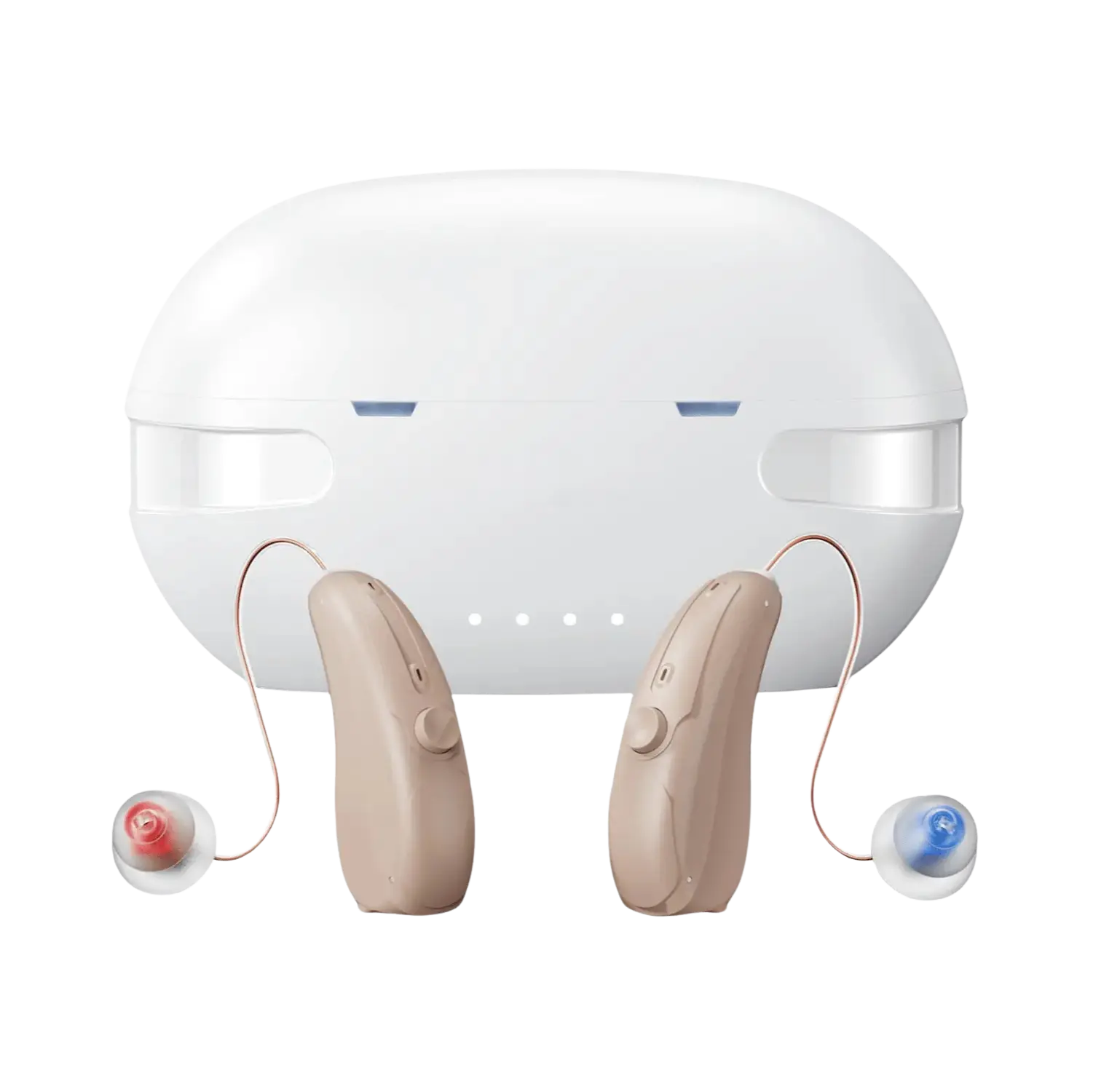
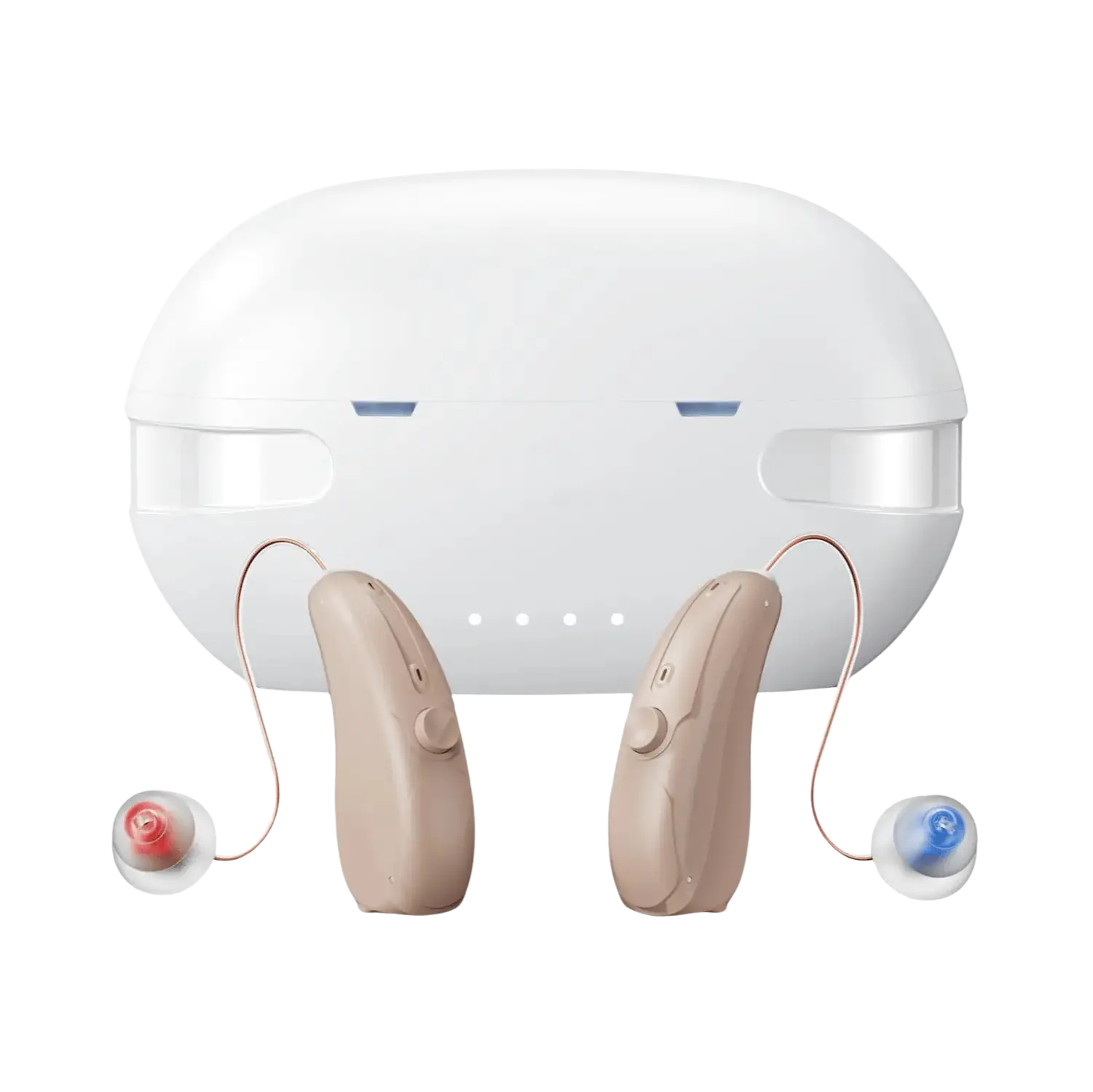
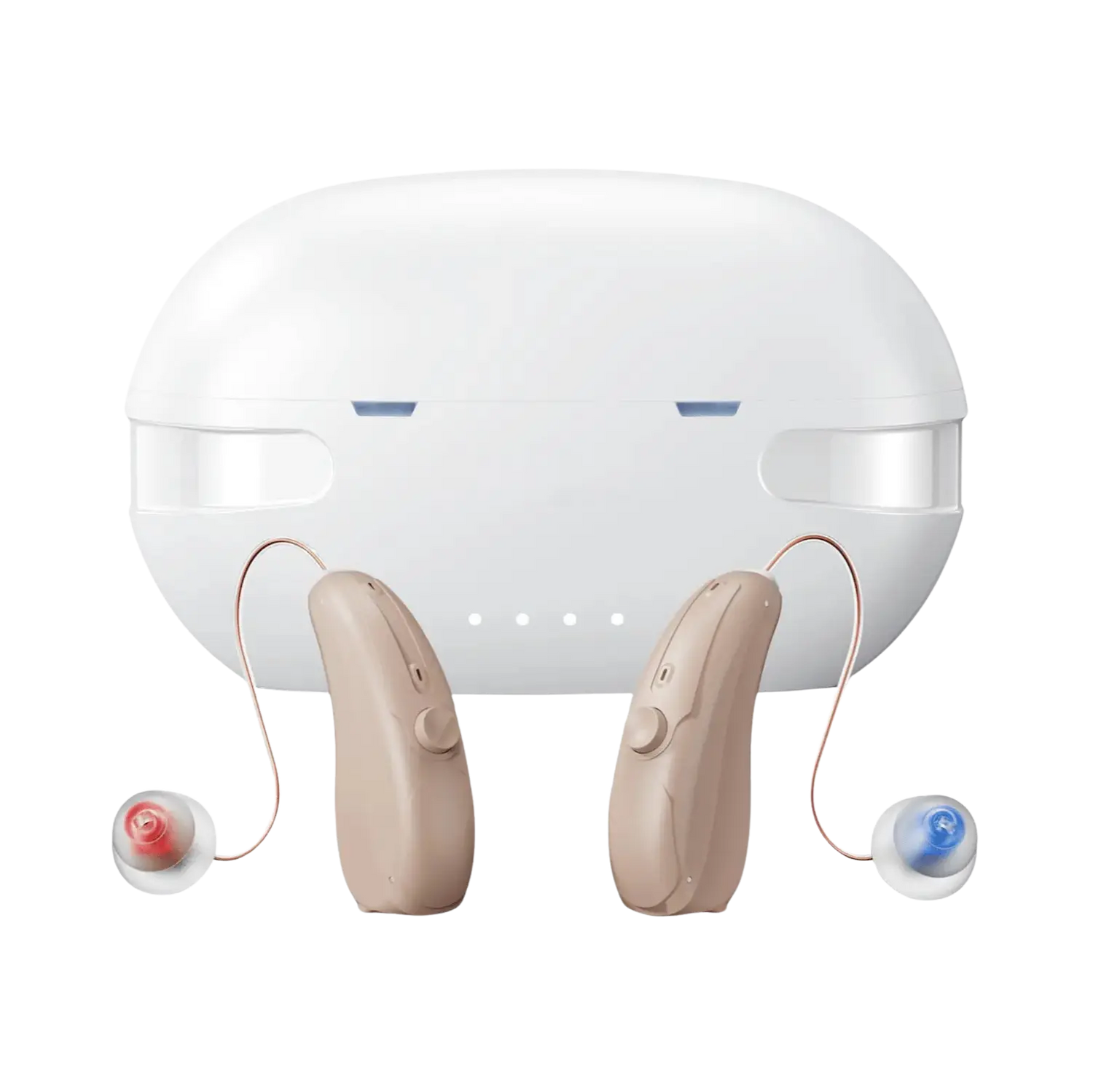
If the review's takeaway is that direct-to-ear streaming solves the toughest listening environments better than air-based microphones do, then Panda Quantum is the model built around that idea. Quantum is a 16-channel receiver-in-canal hearing aid with active noise reduction and Bluetooth for calls, TV, and music. That means phone calls come straight into the hearing aids at both ears, TV audio can be streamed without pushing the volume up for everyone else in the room, and music or podcasts play into the ears while the hearing aids continue to amplify the speech going on around you.
Quantum's 16 channels of processing and adaptive noise reduction are also aimed at the acoustic side of the same problem the review describes: hearing clearly in noisy environments where microphones alone struggle. Like Panda Air, Quantum includes the Panda app-based in-ear hearing test, so after the device arrives it can be paired with the app, tested through the hearing aid itself, and automatically programmed to match the wearer's audiogram in a workflow similar to a clinical fitting. Battery life reaches up to 80 hours with the charging case, and the device carries a 5-year warranty and a 45-day return window.
A note that reflects the review's honesty about scope: OTC hearing aids are FDA-cleared for mild-to-moderate loss. If your loss is severe or profound, a clinical fitting is still the right first stop, and something like a cochlear implant may be a better long-term answer.

Limitations of This Research
The review itself is a scoping map, not a clinical evaluation. Its own finding is that most of the underlying literature is technical rather than clinical, meaning almost no included studies measured hearing outcomes for real wearers in real venues. Using only Auracast as a search keyword also risks missing adjacent work published under Bluetooth Low Energy Audio or LE Audio labels, though the authors were transparent about that choice. Finally, the field is moving quickly; the search window closed in April 2025 and both device support and venue installations have been rolling out since.
What to Do With This
If you are shopping for a hearing device now, Bluetooth streaming for phone calls, TV, and music will give you the biggest daily quality-of-life change, and it is well proven. Auracast is a bet on the next few years, and it is a reasonable one, but it is not yet the reason to pick or reject a specific device. Ask what the manufacturer supports, watch for Auracast installations in the venues you actually go to, and expect the picture to look different in 2028 than it does today.
Goncalves LM, Ortega AVM, Angelo TCS, Moret ALM, Lopes NBF, Jacob RTS. Auracast and hearing devices: a scoping review on connectivity and accessibility for individuals with hearing loss in public environments. CoDAS. 2026;38(4):e20250241. Retrieved from PubMed. https://doi.org/10.1590/2317-1782/e20250241pt