Hearing Aid Dome Choice Affects Own-Voice Quality and Sound Distance
A new Boston University study reports that hearing aids fitted with closed domes made outside sounds feel closer to the listener and made wearers' own voices sound less natural, yet objective occlusion measurements failed to predict which individuals were affected most.
Anyone who has put on a hearing aid for the first time knows that the early days can feel strange in ways that have very little to do with whether sounds are louder. A voice from across the room can seem oddly close, as though the speaker were somehow inside your head rather than standing by the window. Your own voice can sound boomy, hollow, or just not quite like you.
Audiologists have long suspected that the small silicone tip sitting in the ear canal, usually called a dome, contributes to both sensations. A study published in Ear and Hearing set out to test whether these two familiar complaints, an unnatural own voice and sounds that refuse to feel external, are really the same underlying problem showing up in two different ways.
About This Study
Title: Relating Sound Externalization, Own-Voice Perception, and Occlusion in Adults With Hearing Aids
Authors: Pinar Ertürk, Virginia Best
Affiliations: Department of Speech, Language and Hearing Sciences, Boston University, Boston, Massachusetts, USA
Journal and date: Ear and Hearing, published July 21, 2026
Study type: Experimental laboratory study in adults with and without hearing loss
PubMed DOI: 10.1097/AUD.0000000000001870
Background: Why the Researchers Looked at This
Two terms sit at the centre of this research. The first is externalization. When hearing works normally, a sound coming from a speaker across the room feels like it originates over there, out in space. That sense of distance and direction is what researchers call externalization. When it breaks down, the same sound feels compressed toward the listener or seems to play inside the head, which listeners typically describe as unnatural and fatiguing even when the sound itself is perfectly audible.
The second term is the occlusion effect. When something blocks the ear canal, the low-frequency energy that your skull generates while you speak becomes trapped instead of escaping. The result is the familiar boomy, hollow own-voice quality that people notice when they plug their ears with a finger and hum. Hearing aids can create the same trapped-energy situation, and the degree to which they do depends heavily on how tightly the dome seals the canal.
Domes come in broadly two styles. Open domes are vented, letting air and low-frequency sound pass around the device. Closed domes seal the canal much more completely, which helps deliver amplification efficiently and reduces feedback whistling, but which also traps more of the wearer's own voice. An earlier study had found that heavily occluding domes disturbed the perceived location of external speech. The Boston University team wanted to know whether that externalization problem and the classic occlusion effect were, in fact, the same phenomenon.
How the Study Was Done
The researchers recruited two groups of young adults: 10 with normal hearing and 10 with sensorineural hearing loss, the permanent inner-ear type that hearing aids are most commonly prescribed for. Every participant was fitted with hearing aids in both configurations, once with open domes and once with closed domes, so that each person effectively served as their own comparison. Participants who already wore hearing aids were additionally tested with their own everyday devices.
Externalization was captured with a simple numerical scale running from 0 to 10, where 0 meant the sound seemed to be inside the head and 10 meant it seemed to be out at the loudspeaker. Own-voice quality was rated on a separate scale from 1 to 10, where 1 was the most unnatural and 10 the most natural, with participants speaking aloud and judging how they sounded to themselves.
Crucially, the team did not rely on subjective impressions alone. They also measured occlusion objectively using real ear measurements, a standard clinical procedure in which a thin probe microphone sits in the ear canal alongside the hearing aid and records the actual sound pressure present. That gave the researchers a physical number for how much each fitting was trapping sound, which they could then compare against what people said they experienced.
What the Researchers Found
The broad pattern came out roughly as expected. Externalization ratings were significantly higher when people listened without hearing aids than when they listened with them, and significantly higher with open domes than with closed domes. In other words, putting a hearing aid in the ear pulled sounds inward to some degree, and sealing the canal more tightly pulled them inward further.
Own-voice ratings followed a similar shape. People tended to rate their own voice as more natural unaided than aided, and more natural with open domes than with closed domes. On the surface, that consistency looks like strong evidence that one mechanism, occlusion, drives both effects.
Then the analysis got interesting. When the researchers checked whether the objective occlusion measurements could explain the variation in either set of ratings, they could not. The physical measure of how much sound a given fitting trapped did not account for a significant amount of the variance in externalization ratings, nor in own-voice ratings. Two people with very similar measured occlusion could report quite different experiences.
The two subjective measures also failed to track each other at the individual level. A participant's own-voice rating did not significantly predict that same participant's externalization rating. So while both complaints get worse on average as fittings become more closed, knowing that a particular person dislikes the sound of their own voice tells you surprisingly little about whether that person also experiences sounds as trapped inside the head.
One further observation stood out. Among participants tested with their own regularly worn hearing aids, the devices appeared to have a positive effect on own-voice perception while still disrupting externalization. That combination hints at acclimatization. People may adapt to the sound of their own voice through daily wear, while the spatial compression of external sound persists.
What It Means for People with Hearing Loss
The practical message is that dome selection is a genuine comfort decision, not a trivial accessory choice. A tighter seal buys amplification efficiency and feedback control, and for people with more significant hearing loss that trade is often worth making. But it comes with a cost to how natural the world sounds, and this study suggests that cost shows up in two partly independent ways.
The finding that objective measurements did not predict individual experience is arguably the most useful takeaway for wearers. It means that no measurement taken in a fitting appointment can reliably tell you in advance how a given configuration will feel to you specifically. Your own report of what sounds right remains the most informative signal available, and it deserves to be taken seriously rather than dismissed as something you will simply get used to.
The own-device result also offers some reassurance to new wearers who are struggling. If acclimatization really does improve own-voice comfort over weeks of daily use, then an early negative reaction to the sound of your own speech is not necessarily a permanent verdict on the device. It does, however, argue for having enough time with a device to find out.
Why an Unpredictable Fit Response Makes a Real Trial Period Matter
If the central finding here is that laboratory measurements cannot predict how a particular fitting will feel to a particular person, then the only way to answer the question is to wear the device in ordinary life for long enough to judge. That makes return windows and adjustment flexibility genuinely important rather than fine print.

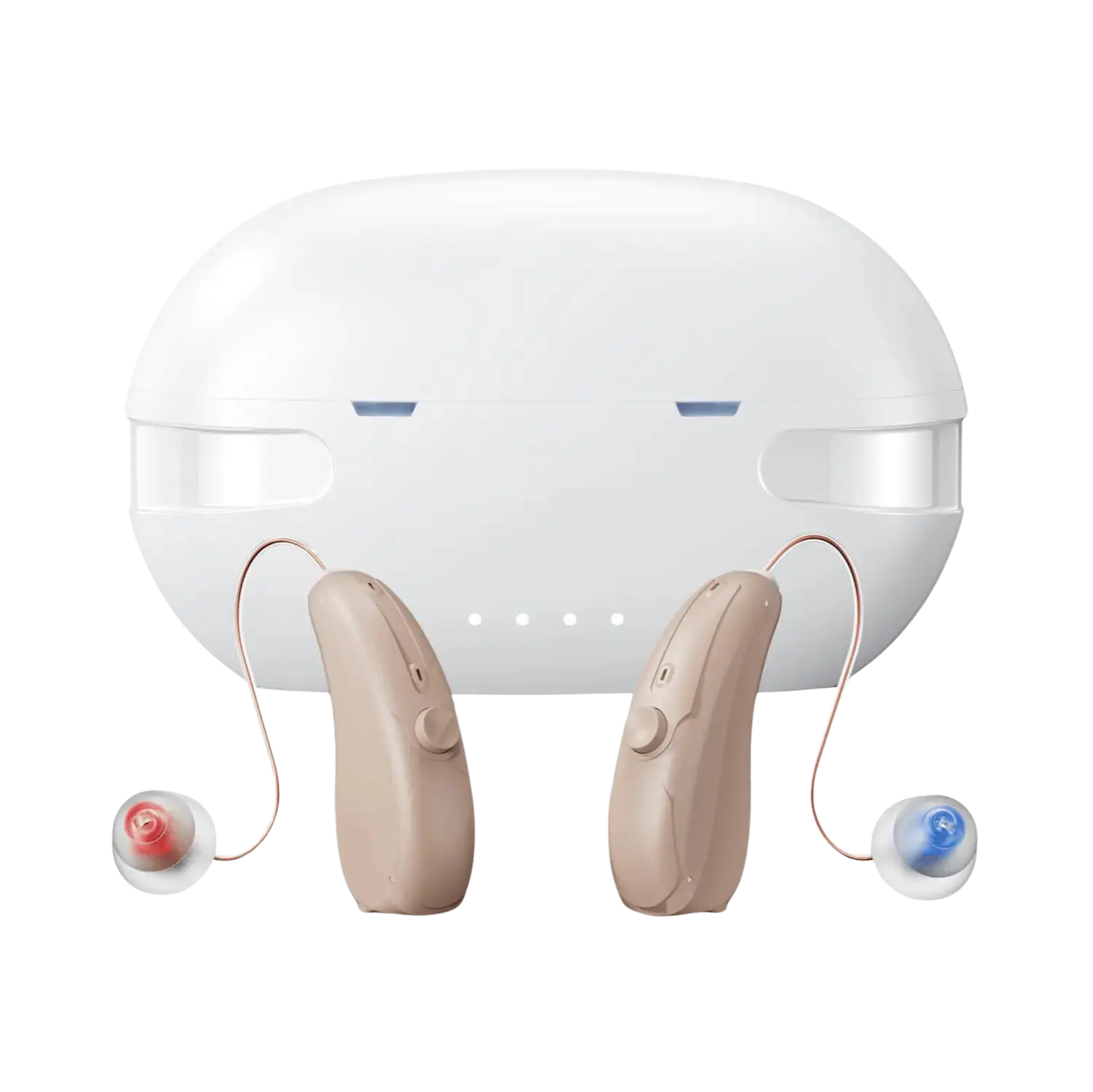
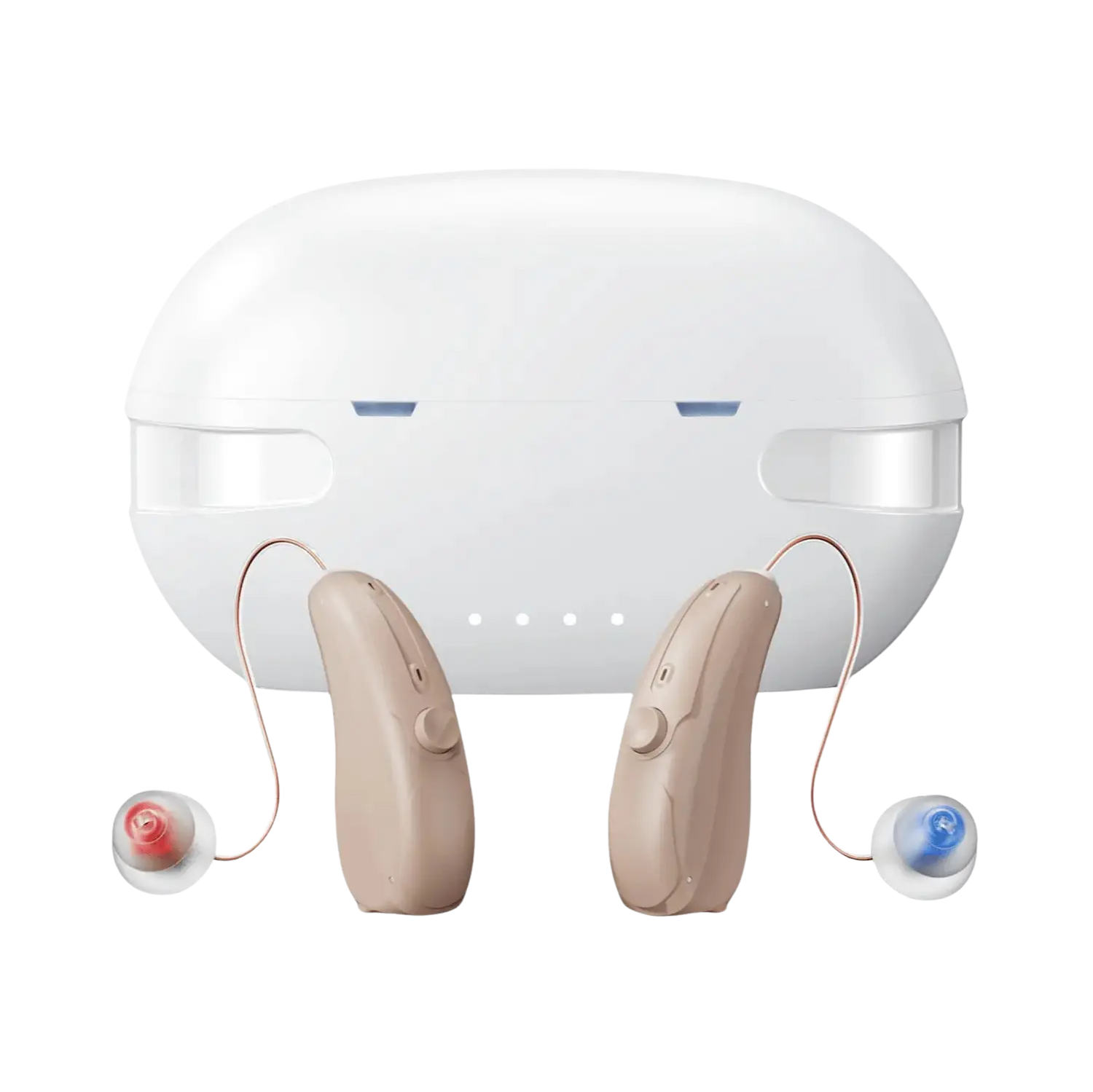
Because this study shows that the physical fit in the canal shapes both own-voice quality and how external the world sounds, devices in this category are built around the receiver-in-canal design the researchers were testing. Panda Quantum is one such device, a receiver-in-canal hearing aid with 16-channel processing and adaptive noise reduction, and it pairs with an app that runs a frequency-specific hearing test through the aid itself and then programs gain and frequency response to the result. That app-based hearing personalization means the amplification side can be tuned to your ears rather than left at a generic setting, which matters when you are separately trying to judge how a fit feels.
Quantum runs up to 80 hours of total battery with its case and supports Bluetooth for calls, TV, and music, and it comes with a 5-year warranty and a 45-day return window. Given that this study found acclimatization effects in people wearing their own devices day to day, a multi-week window at home is closer to the timeframe the research suggests you actually need. It is worth noting that over-the-counter devices are approved for mild-to-moderate hearing loss, and people with severe or profound loss still benefit most from a clinical fitting.
Limitations of This Research
This was a small study. Twenty participants in total, split into two groups of ten, is enough to detect broad group-level patterns but leaves limited power for detecting relationships between individual measures. The null findings, meaning the failure of occlusion measurements to predict ratings and the failure of own-voice ratings to predict externalization, should therefore be read as an absence of clear evidence for a link rather than proof that no link exists.
The participants were also young adults, including the group with sensorineural hearing loss. Most hearing aid wearers are considerably older, and age-related hearing loss brings changes in auditory processing that can affect spatial perception independently of any device. Whether these results transfer cleanly to a typical older population is an open question. The published abstract does not disclose funding sources or competing interests, so those cannot be assessed here.
Where This Leaves Us
Two of the most common complaints from new hearing aid wearers, an unnatural own voice and sounds that feel too close, both worsen as the ear canal is sealed more tightly, but they do not appear to be the same problem and neither can be predicted from a physical measurement. That argues for treating fitting configuration as something to be tested in real life rather than settled in a booth, and for giving any new device enough weeks of ordinary use to let acclimatization do its work before reaching a verdict.
Ertürk P, Best V. Relating Sound Externalization, Own-Voice Perception, and Occlusion in Adults With Hearing Aids. Ear and Hearing. 2026. Retrieved from PubMed. https://doi.org/10.1097/AUD.0000000000001870