Hearing Aid Directional Microphones Help Speech but Hinder Locating Who Is Talking
A Danish and American research team tracked head and eye movements inside a virtual reality room full of competing talkers and found that the directional processing designed to sharpen speech also made it harder for listeners to work out where that speech was coming from.
Anyone who has stood in a busy restaurant knows that hearing is not only about volume. Before you can follow a conversation, you have to find it. Your brain compares tiny differences in the sound arriving at each ear, decides which direction the voice is coming from, and turns your head to meet it. That whole sequence happens in a fraction of a second and usually without conscious effort.
Hearing aids have long tried to help with the second half of that problem, the part where a target voice competes with everything else. Directional microphones amplify sound arriving from in front of the wearer and suppress sound from behind and to the sides. The approach works, but a group of researchers in Denmark and the United States wanted to know what it costs. Their answer, published in the journal Ear and Hearing, is that the same processing that cleans up speech can quietly interfere with the search that comes first.
Title: Effects of Hearing Loss and Hearing Aid Directionality on Performance and Orienting Behavior in a Multi-Talker Audiovisual Search Task
Authors: Sreeram Kaithali Narayanan, Axel Ahrens, Filip Rønne, Torsten Dau, Virginia Best, Tobias Neher
Affiliations: Hearing Systems Section, Department of Health Technology, Technical University of Denmark, Kongens Lyngby; Department of Clinical Research, University of Southern Denmark, Odense; Technical Audiology Section, Odense University Hospital and University of Southern Denmark; ORCA Labs, Lynge, Denmark; Department of Speech, Language and Hearing Sciences, Boston University, Boston, Massachusetts
Journal and publication date: Ear and Hearing, 2026
Study type: Controlled laboratory experiment with 42 adults, 20 with normal hearing and 22 with hearing loss, tested unaided and aided
PubMed DOI: 10.1097/AUD.0000000000001872
Background: Why the Researchers Looked at This
Most hearing research measures a listener sitting still, facing a single loudspeaker, repeating back sentences. That setup is clean and repeatable, but it removes the thing that makes real rooms hard. In real life you move. You turn toward the person who just started speaking, you glance at someone else, and the target keeps changing position relative to your ears.
Directional microphone processing complicates this. A directional hearing aid deliberately treats sound from the front differently from sound arriving elsewhere, which alters the spatial cues the brain relies on. Reverberation, the pattern of reflections bouncing off walls and ceilings, blurs those cues further. The researchers wanted to see whether directionality helps or hurts when a listener has to actively search a room rather than simply listen straight ahead.
They also wanted to look at behavior, not only scores. Two people can get the same number of answers right while going about the task in completely different ways, and how someone moves their head and eyes to find a voice says a great deal about how much work the listening is taking.
How the Study Was Done
Twenty adults with normal hearing and 22 adults with hearing loss took part. Each was placed inside a moderately reverberant audiovisual environment produced by a 64-channel loudspeaker array combined with virtual reality glasses. Several narratives played at once from different positions, and the participant had to locate and identify one specific target narrative among them. The target could appear at any of 15 possible horizontal positions around the listener.
The virtual reality glasses did double duty. As well as rendering the visual scene, their built-in sensors tracked where the participant's head was pointing and where their eyes were looking, moment by moment. Every participant completed the task unaided and then aided, once with the hearing aids set to omnidirectional mode, which picks up sound from all around roughly equally, and once with directional mode engaged.
Performance was scored three ways: whether the answer was correct, how far off the reported location was, and how long the response took. Behavior was measured separately using the rate at which people first turned the wrong way, the balance between head movement and eye movement, how efficient the search path was, and how far head and gaze ended up from the true target position.
What the Researchers Found
The participants with hearing loss did worse than the normal-hearing group on every measure and in every condition. Their responses were less accurate, their location estimates were further off, and they took longer to answer. The gap held whether they were wearing hearing aids or not.
The behavioral data told a more detailed story. Listeners with hearing loss searched less directly. They were more likely to turn their head away from the target on the first move, then correct, and they leaned more heavily on eye movements than on head movements to scan the scene. In other words, they were doing more searching to reach a worse answer.
The result that stands out concerns the normal-hearing group. When those participants wore hearing aids, their accuracy went down and their localization errors went up compared with their own unaided performance, and the effect was strongest with the directional microphone setting. They also relied slightly more on head movement when aided. Since these were people whose hearing needed no help at all, the finding isolates the effect of the processing itself rather than the effect of hearing loss.
Both groups showed more complex eye-movement patterns once aided, with the hearing-impaired listeners showing the most complex gaze behavior of all. And the two groups solved the problem differently at the moment of answering. Where normal-hearing participants tended to line up both head and gaze with the target, the hearing-impaired participants frequently aimed their eyes at the correct location while leaving their head pointed elsewhere.
What It Means for People with Hearing Loss
The practical takeaway is not that directional microphones are a bad idea. They exist because they solve a genuine problem, and decades of research support their value for understanding speech in noise. What this study adds is that the benefit is not free. Sharpening the front of the sound field costs some of the spatial information that tells you where a voice is in the first place.
That trade matters most in exactly the settings people complain about. At a dinner table where the conversation jumps from one end to the other, or in a meeting where someone behind you speaks up, finding the talker is half the job. A wearer who notices they keep turning the wrong way in group settings is not imagining it, and the fix may be as simple as switching programs rather than accepting the difficulty.
It also suggests a reasonable expectation to bring to a fitting. Asking whether a device offers more than one microphone mode, and when each one is worth using, is a fair question. A setting that is excellent for a one-on-one conversation across a noisy table is not automatically the right setting for walking through a crowded space.
Why Noisy Rooms Ask Two Different Things of a Hearing Aid
This study is a reminder that a crowded room places two separate demands on a hearing aid. One is pulling a target voice out of competing sound. The other is leaving enough of the surrounding scene intact that the wearer can still orient within it. Devices handle that balance through how finely they divide and shape incoming sound rather than through blunt amplification.

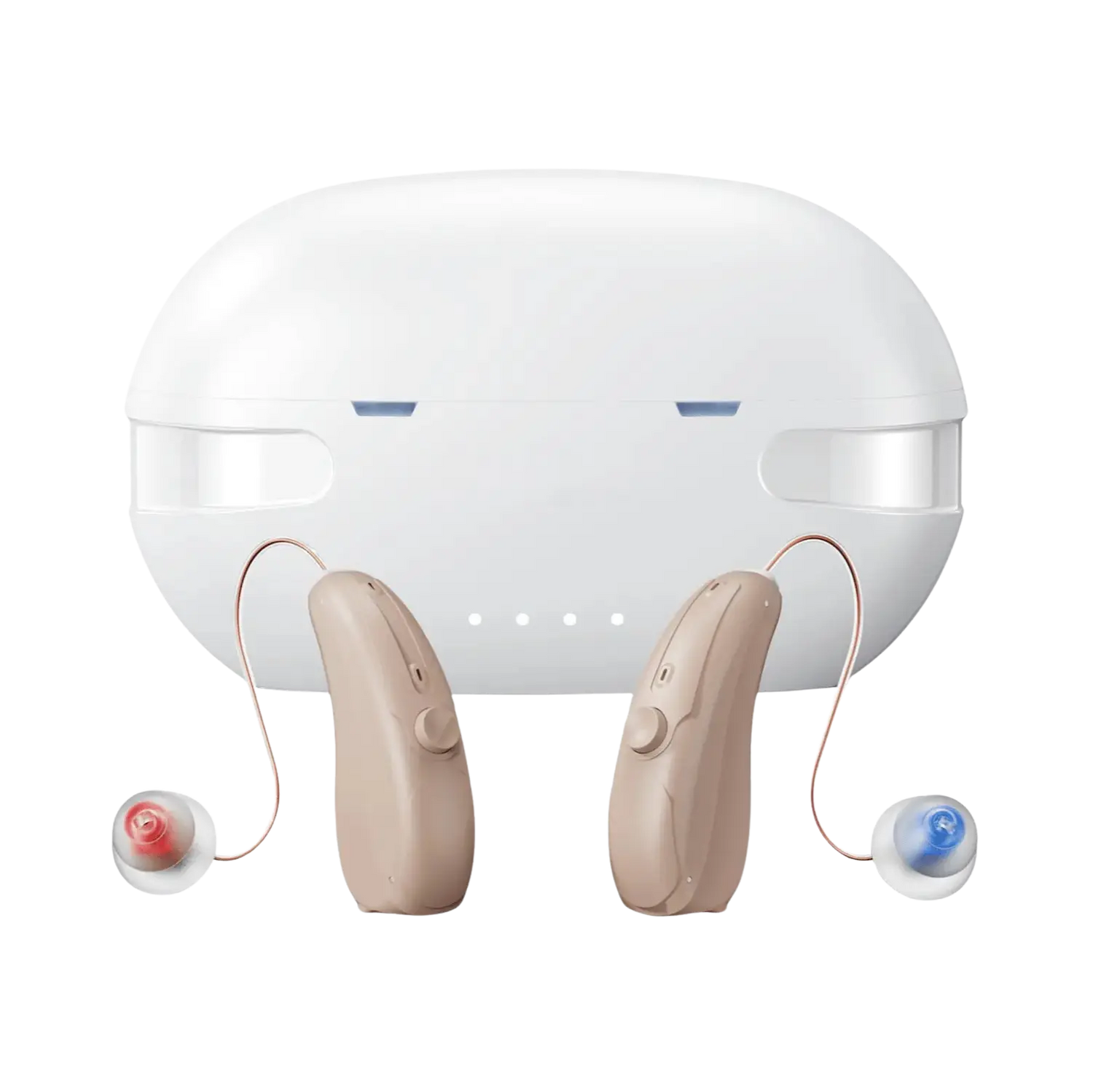
Panda Quantum sits in that category. It is a receiver-in-canal device built around 16-channel processing with active noise reduction, which is the design language behind speech-in-noise hearing aids: instead of raising everything at once, the device works across bands so that speech can stay legible while steady background sound is pulled back. It also pairs with the Panda app to run an in-ear hearing test through the aid itself, then sets gain and frequency response to the result, so the tuning reflects the wearer's own audiogram rather than a generic curve.
Beyond the processing, Quantum offers Bluetooth for calls, television, and music, and up to 80 hours of total battery life with its case, along with a 5-year warranty and 45-day returns. Worth noting alongside research like this: over-the-counter devices are approved for mild-to-moderate hearing loss, and severe or profound loss still benefits most from a clinical fitting. You can read the full specifications at pandahearing.com.
Limitations of This Research
This was a laboratory study, and its realism has limits. A 64-channel loudspeaker array with virtual reality glasses reproduces a reverberant room convincingly, but participants were completing a defined search task rather than holding a real conversation, and only one acoustic environment was tested. With 42 participants in total, the sample is reasonable for this kind of detailed motion tracking but small enough that individual differences carry weight. Testing normal-hearing participants with hearing aids is also an experimental device rather than a real-world scenario, useful for isolating the processing effect but not a description of how anyone actually listens.
On disclosure, the PubMed record for this article does not include funding or competing-interest statements, so those were not available for review here. It is worth noting that one co-author is affiliated with ORCA Labs in Lynge, Denmark, a hearing research laboratory tied to the hearing device industry. Readers who want the full disclosure statement will find it in the published article.
Where This Leaves Us
Hearing well in a crowded room turns out to be two jobs rather than one, and a feature that solves the second can make the first slightly harder. That is a solvable engineering problem rather than a dead end, and it argues for devices and fittings that can shift behavior depending on the situation instead of applying one strategy everywhere. For anyone wearing hearing aids now, the useful move is to pay attention to which situations feel hardest and say so, because the difficulty of finding a voice is a different complaint from the difficulty of understanding it, and it deserves a different answer.
Narayanan SK, Ahrens A, Rønne F, Dau T, Best V, Neher T. Effects of Hearing Loss and Hearing Aid Directionality on Performance and Orienting Behavior in a Multi-Talker Audiovisual Search Task. Ear and Hearing. 2026. Retrieved from PubMed. https://doi.org/10.1097/AUD.0000000000001872