Earbud Hearing Aid Modes Fall Short of Prescription Gain Targets
A Japanese team put a popular consumer earbud's hearing aid feature on a real-ear measurement rig and found it amplifies less, and shapes sound less precisely, than standard fitting formulas prescribe.
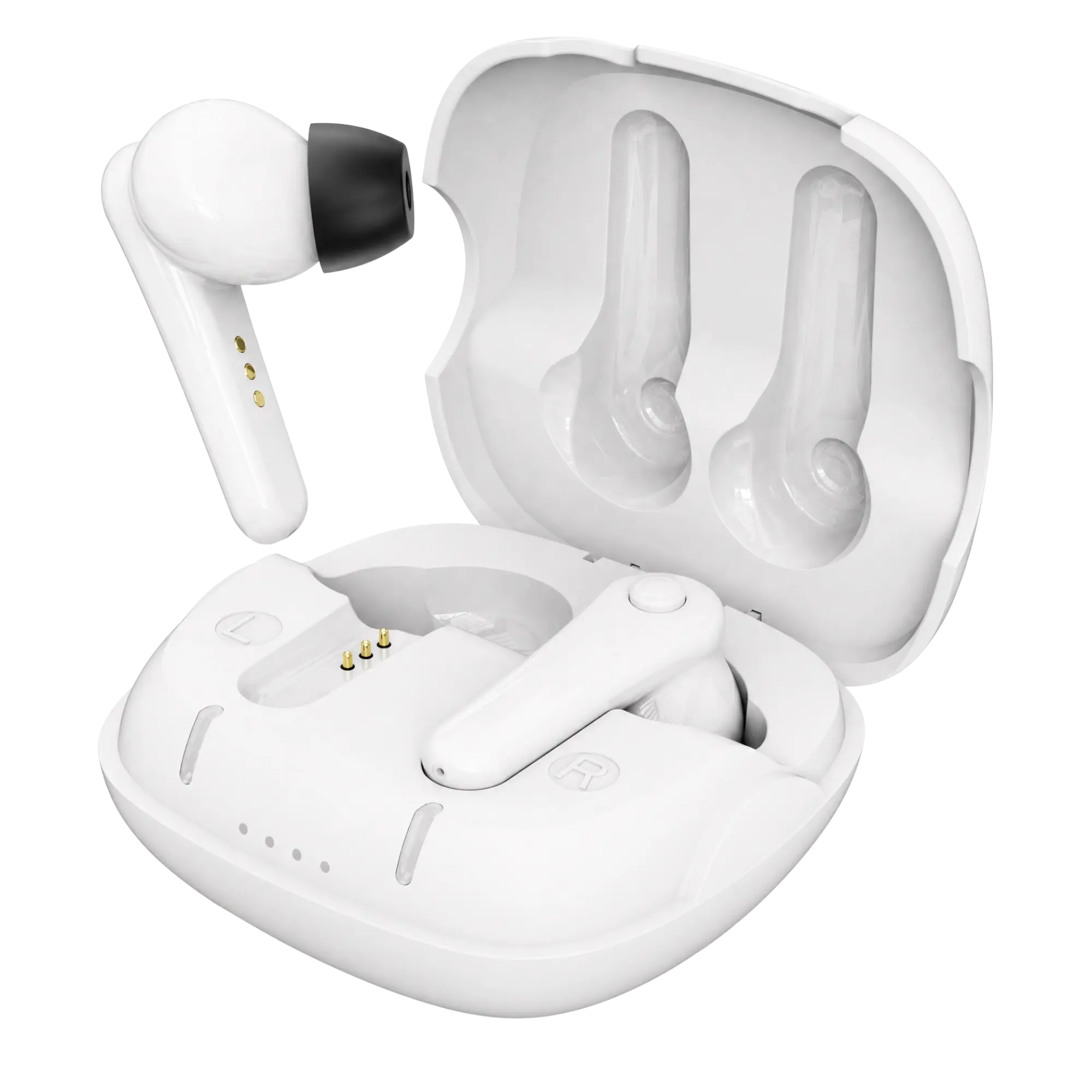
For most of the last century, getting help with hearing loss meant a clinic visit, an audiogram, and a device programmed to a prescription formula by a trained fitter. In the last few years that model has been joined by something very different: mainstream consumer earbuds that run a self-administered hearing check and then switch on an amplification mode based on the result.
These products have moved quickly through regulatory review in several countries. What has moved more slowly is independent measurement of what they actually do to sound inside a real ear. A new study in Auris Nasus Larynx takes one of the best known examples into a sound-treated booth and compares its output against the targets clinicians have used for decades.
About This Study
Title: Amplification characteristics of the Hearing Aid Program in AirPods Pro 2
Authors: Ko Hentona, Daisuke Suzuki, Ayaka Sasaki, Takashi Okada, Keigo Oguchi, Motoki Izawa, Hyugo Doi, Wataru Fujita, Mika Yokoyama, Eri Suzuki, Hiroyuki Ozawa, Akifumi Tomizawa, Naoki Oishi, Seiichi Shinden
Affiliations: Department of Otolaryngology, Saiseikai Utsunomiya Hospital, Utsunomiya, Japan; Department of Otolaryngology - Head and Neck Surgery, Keio University School of Medicine, Tokyo, Japan; School of Medicine, Sapporo Medical University, Sapporo, Japan; Faculty of Health Sciences at Narita, International University of Health and Welfare, Narita, Japan
Journal and publication date: Auris, Nasus, Larynx, published online 3 August 2026
Study type: Laboratory real-ear measurement study in adult volunteers
PubMed DOI: 10.1016/j.anl.2026.05.007
Background: Why the Researchers Looked at This
A hearing aid does not simply make everything louder. It applies different amounts of gain at different pitches, matched to where a person's hearing has weakened, and it applies less gain as incoming sound gets louder so that shouting and clattering dishes do not become painful. How much gain to apply, and where, is decided by a prescription formula. Two of the most widely used are NAL-NL2, developed by the National Acoustic Laboratories in Australia, and DSL v5, developed in Canada. Both take an audiogram and output a target gain curve.
The way clinicians verify that a device is actually hitting those targets is real-ear measurement. A thin probe microphone is placed in the ear canal next to the device, a calibrated speech-like signal is played, and the difference between the sound in the open ear and the sound with the device running is recorded. That difference is the real-ear insertion gain, or REIG. It is the closest thing audiology has to a direct readout of what a device is doing to sound before it reaches the eardrum.
The device examined here recently gained approval in Japan as a Class II medical device, incorporating both a self-administered hearing check and a hearing assistance program. Unlike a conventional prescription fitting, its amplification is set automatically by proprietary algorithms working from thresholds the device measured itself, and the internal processing parameters are not published. That opacity is precisely what motivated the researchers: nobody outside the manufacturer knew how the output compared with established targets.
How the Study Was Done
The team started by choosing five audiometric profiles meant to represent the range of hearing patterns a device like this would encounter. Two were flat losses, one at roughly 30 decibels and one at roughly 50 decibels. One was a low-frequency loss. The remaining two were high-frequency losses, one sloping gradually and one sloping steeply. All five came from an independent dataset of results collected with the device's own hearing check feature, rather than being invented for the experiment.
Each profile was then programmed into the device in turn, and real-ear measurements were taken in ten adult volunteers, using the right ear in each case. The test signal was the International Speech Test Signal, a standardized speech-like sound used for exactly this purpose, presented at three input levels: 50, 65, and 80 decibels sound pressure level. Those levels stand in roughly for quiet conversation, ordinary conversation, and a loud environment. All measurements took place in a calibrated sound-treated booth.
Finally, the measured insertion gain was compared descriptively against the NAL-NL2 and DSL v5 targets calculated from the same device-derived thresholds. This is an important design detail. The comparison was not against some idealized audiogram but against what the formulas would have prescribed given exactly the hearing data the device itself had collected.
What the Researchers Found
The device did behave like a hearing aid in the broad sense. Gain varied according to which audiometric profile was loaded, and it varied according to how loud the incoming sound was. Both are hallmarks of nonlinear, level-dependent amplification rather than a simple volume boost.
Gain generally rose toward the mid and high frequencies relative to the low frequencies, which is the correct general direction for the most common pattern of age-related and noise-related hearing loss. Consonant sounds that carry most of the intelligibility in speech live in that mid-to-high region, so tilting amplification upward there is the right instinct.
Insertion gain fell progressively as the input level rose, with marked attenuation at the 80 decibel input. In plain terms, the louder the room, the less the device added. That is standard compression behavior and it protects against uncomfortable output, but the degree of reduction at the loudest input was described as pronounced.
The headline comparison is where the two approaches diverged. Measured insertion gain was generally lower than what NAL-NL2 and DSL v5 prescribed for the same thresholds. The frequency-specific variation in gain was also less pronounced than the formulas called for. Put another way, the consumer device's gain curve was both flatter and lower than a prescription fitting would have been for the same ear.
The authors read this as a design philosophy rather than a defect. Their conclusion is that the program emphasizes general listening support and output control rather than strict matching of prescriptive targets, and they call for further work to clarify what clinical role consumer-oriented hearing devices should occupy.
What It Means for People with Hearing Loss
The practical reading is neither dismissal nor endorsement. A device that amplifies less than prescribed and shapes frequencies less sharply may be perfectly adequate for someone with a mild loss who mainly wants help in quiet rooms and one-on-one conversation. Under-amplification is also more comfortable for a first-time user, and comfort is a real determinant of whether a device gets worn at all.
The concern arises further along the curve. Someone with a steeply sloping high-frequency loss needs a lot of targeted gain in a narrow band, and a flatter, more conservative gain curve is unlikely to deliver it. If that person concludes from a disappointing trial that amplification does not help them, a useful intervention has been written off for the wrong reason.
The other lesson is about verification. A self-administered hearing check produces thresholds, and thresholds are only useful if the device then does something specific with them. This study is a reminder that the gap between measuring your hearing and matching your hearing is where a lot of the engineering actually lives.
When Gain Has to Follow the Audiogram, Not Just Approximate It
Because this study shows that a device can measure your hearing accurately and still amplify well below the frequency-specific targets that measurement implies, the interesting question for buyers is how many independently adjustable bands a device actually has, and whether its own test result is used to set them.

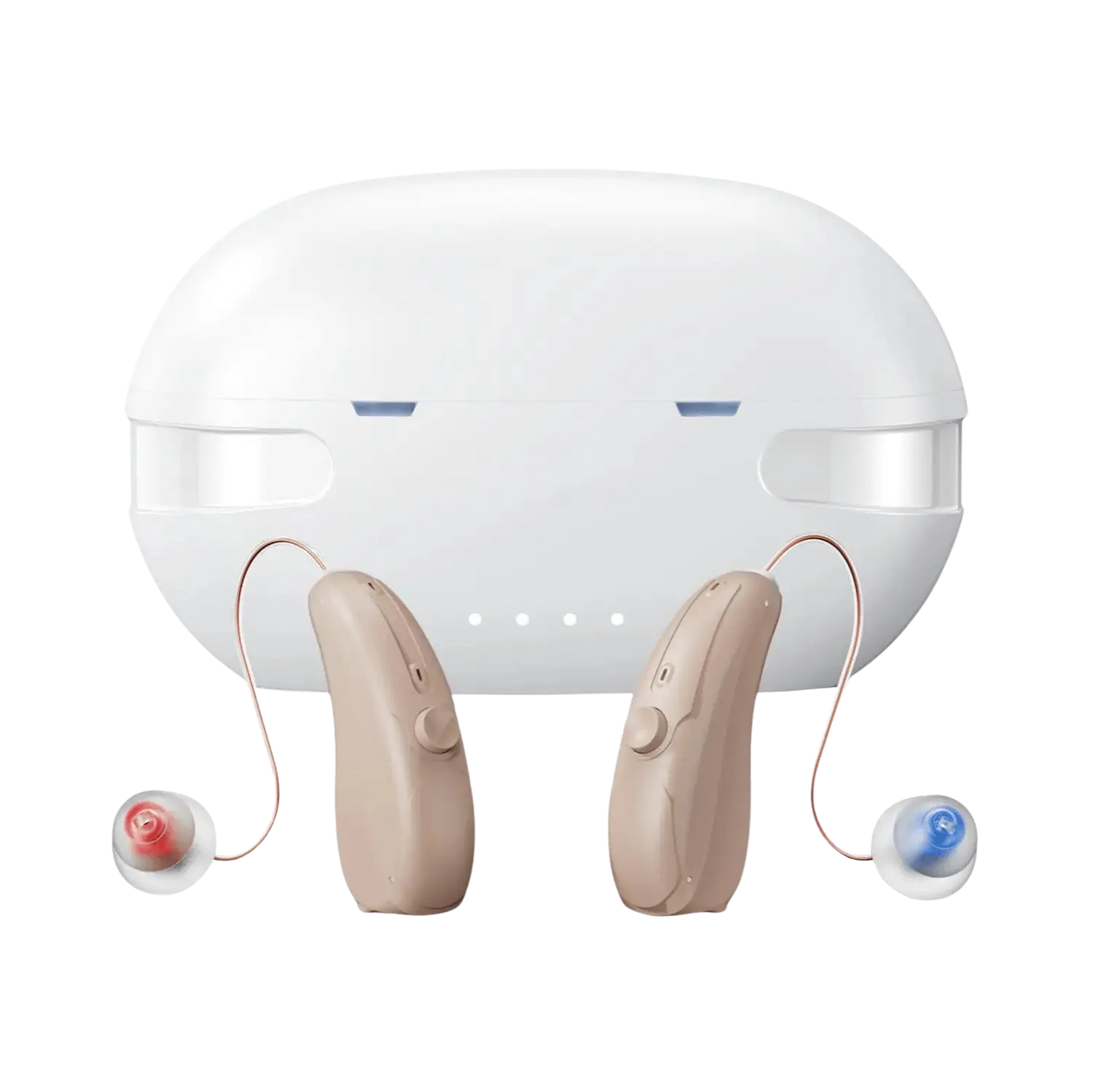
Panda Quantum is built around that step. It is a receiver-in-canal device with 16-channel WDRC hearing aid processing and adaptive noise reduction, and it includes an app-based in-ear hearing test: after delivery, you pair the aid with the Panda app, it runs a frequency-specific test through the aid itself, and it then auto-programs gain and frequency response to your audiogram, in the manner of a clinical fitting. That combination of self-hearing test hearing aids and app-based hearing personalization is aimed at the exact gap this paper measures, and the 16 channels exist so that a steeply sloping loss can be treated differently at 4 kHz than at 500 Hz. Quantum also carries Bluetooth for calls, TV, and music, up to 80 hours of total battery with the case, a 5-year warranty, and 45-day returns.
One honest caveat applies to every device in this category. Over-the-counter hearing aids are approved for mild-to-moderate hearing loss. If your loss is severe or profound, a clinical fitting with a professional remains the better path, and a hearing test with an audiologist is worth the appointment.
Limitations of This Research
This is a small laboratory study. Ten volunteers, right ears only, one device model, and five representative profiles rather than a large sample of real patient audiograms. The comparison against NAL-NL2 and DSL v5 was descriptive rather than statistical, so the paper reports that measured gain was generally lower without quantifying by how much across conditions. Measurements were taken in a sound-treated booth with a standardized speech signal, which is the right way to characterize a device but says nothing directly about how it performs in a restaurant.
Most importantly, no speech understanding or patient outcome data were collected. Matching a prescriptive target is a proxy for benefit, not benefit itself, and the paper does not claim otherwise. The abstract does not report funding sources or competing interests, so readers should consult the full text for those disclosures. The firmware of a consumer device can also change with a software update, which means any measurement of this kind is a snapshot of one version at one point in time.
Where This Leaves Us
Consumer devices with hearing assistance modes have made the first step toward help enormously easier, and this study confirms they are doing real signal processing rather than marketing. It also shows that easier is not the same as equivalent: the gain these devices deliver sits below what fitting formulas prescribe, and the frequency shaping is gentler. For a mild loss that may be exactly right. For a sloping loss it is worth asking, before you buy anything, how precisely a device can follow the shape of your own audiogram, and whether anyone has verified that it does.
Hentona K, Suzuki D, Sasaki A, Okada T, Oguchi K, Izawa M, Doi H, Fujita W, Yokoyama M, Suzuki E, Ozawa H, Tomizawa A, Oishi N, Shinden S. Amplification characteristics of the Hearing Aid Program in AirPods Pro 2. Auris Nasus Larynx. 2026. Retrieved from PubMed. https://doi.org/10.1016/j.anl.2026.05.007