Can Better Hearing Aid Fitting Protect the Aging Brain? A New Trial Sets Out to Find Out
A Finnish research team has published the protocol for a randomised trial testing whether a data-driven approach to fitting and following up hearing aids improves speech understanding in noise and, over two years, cognitive outcomes in older adults.
Most people who get hearing aids are handed a device and sent home. What happens next varies enormously. Some are fitted precisely and followed up carefully. Others receive a rough prescription, struggle for a few weeks, and quietly put the devices in a drawer. Researchers have long suspected that this gap between what hearing aids can do and what they actually do in daily life explains why the technology often underdelivers.
A team based at Kuopio University Hospital and the University of Eastern Finland has now formally registered a trial designed to test that suspicion. Their protocol, published in BMJ Open on 21 July 2026, describes a study that will compare a structured, data-driven fitting and follow-up programme against ordinary standard care, and will track not only hearing outcomes but also memory, mood and quality of life.
About This Study
Title: Proof-of-concept randomised controlled trial of data-driven hearing rehabilitation versus standard care in older adults with hearing loss: the healthy hearing for healthy ageing protocol
Authors: Laura Ihalainen, Mariagnese Barbera, Timo Tormakangas, Petteri Hyvarinen, Tytti Willberg, Pia Linder, Alina Solomon, Aarno Dietz
Affiliations: Department of Otorhinolaryngology, Kuopio University Hospital, Kuopio, Finland; Institute of Clinical Medicine, University of Eastern Finland; Ageing Epidemiology Research Unit, School of Public Health, Imperial College London; Gerontology Research Center, University of Jyvaskyla; Department of Otorhinolaryngology, Turku University Central Hospital; Division of Clinical Geriatrics, Center for Alzheimer Research, Karolinska Institutet, Stockholm
Journal and publication date: BMJ Open, 21 July 2026, volume 16, issue 7, article e122681
Study type: Protocol for a proof-of-concept, single-site, two-arm parallel-group randomised controlled trial. Trial registration NCT06495268
PubMed DOI: 10.1136/bmjopen-2026-122681
Background: Why the Researchers Looked at This
The authors open with a blunt observation. Hearing aids can relieve hearing loss, but the process of getting someone successfully into them, which audiologists call hearing aid rehabilitation, is repeatedly undermined by three things: diagnosis that arrives years late, fitting that is not optimised to the individual, and follow-up that is inconsistent or absent altogether.
Layered on top of that is a second question that has drawn intense attention over the past decade. Population studies have repeatedly linked hearing loss with faster cognitive decline and higher dementia risk. What has been much thinner on the ground is randomised evidence, meaning studies where participants are assigned by chance to different approaches so that the comparison is fair. Without randomised trials it remains difficult to say whether treating hearing loss well actually changes the cognitive trajectory, or whether the association simply reflects other shared causes of aging.
The Finnish team argues that these two gaps are connected. If hearing aid rehabilitation is often mediocre in practice, then trials that test hearing aids as ordinarily delivered may be testing a weak version of the intervention. Fix the delivery, they reason, and you get a cleaner test of what better hearing can do for the brain.
How the Study Was Done
The trial will enrol up to two hundred adults who have hearing loss, who have been referred for their first hearing aid rehabilitation, and who do not have cognitive decline at the outset. Participants are randomly assigned in equal numbers to one of two arms: data-driven hearing rehabilitation, or standard care as normally provided.
The active phase runs for twelve months, followed by a further twelve months of extended follow-up, giving a two-year window in which to observe both hearing and cognitive change. The primary outcome is not a beep-detection audiogram but a pair of speech-in-noise measures validated for Finnish: the Finnish matrix sentence test, in which listeners repeat sentences presented against background noise, and the digits-in-noise test, which does the same with spoken numbers. Both are designed to capture the thing hearing aid users actually complain about, which is following speech when the room is not quiet.
Secondary outcomes are broad. They include patient-reported questionnaires such as Hearing in Real-Life Environment and the Speech, Spatial and Qualities of Hearing scale, quality of life measured with the 15D instrument, cognitive testing using the Consortium to Establish a Registry for Alzheimer's Disease battery, and psychosocial measures. Exploratory work adds brain-based measures: event-related responses, cortical auditory evoked potentials, structural brain imaging and vision-related assessments. Ethical approval was granted by the Regional Medical Research Ethics Committee of the Wellbeing Services County of North Savo under approval number 697/2023.
What the Researchers Found
It is important to be clear about what this publication is and is not. It is a protocol, meaning it sets out in advance exactly what the researchers will do, which outcomes they will count as primary, and how they will analyse the data. There are no results yet. Publishing the plan before the data arrive is a deliberate safeguard against the temptation to reshape a study around whatever turns out to look impressive.
What the paper does establish is a diagnosis of the problem. The authors identify delayed diagnosis, suboptimal fitting and the absence of systematic follow-up as the three specific failure points in hearing aid rehabilitation, and they frame the trial around correcting all three at once rather than any single one. That framing is itself a finding of sorts, because it locates the weakness not in the hardware but in the process wrapped around it.
The choice of primary outcome carries a similar message. By putting two speech-in-noise tests at the centre of the study rather than a standard hearing threshold test, the team is asserting that the meaningful measure of a successful fitting is functional. It is whether the person can follow a conversation in a restaurant, not whether a tone at four kilohertz became audible at a slightly lower volume.
The two-year structure also signals what the researchers expect. Speech understanding can shift within months of a good fitting. Cognitive differences, if they emerge at all, take longer, which is why the twelve-month intervention is paired with a further twelve months of observation. The design is explicitly proof of concept, which in trial language means it is sized to show whether the approach is workable and worth testing at scale, not to deliver a final verdict.
What It Means for People with Hearing Loss
The practical message available today does not depend on the trial's eventual results. It is that fitting quality and follow-up are not administrative details. A serious research team has judged them important enough to build a two-year randomised trial around, and has designed that trial on the premise that ordinary standard care leaves real benefit unclaimed.
For anyone currently wearing hearing aids, that suggests a useful question to ask: was this device actually matched to my hearing, and has anyone checked since? Devices that are never adjusted after the first week are common, and they are precisely the scenario the Finnish team classifies as suboptimal.
It is also worth noting what the trial does not claim. Nobody in this study is asserting that hearing aids prevent dementia. The authors state plainly that randomised evidence on hearing and cognition remains limited, and their trial exists because the question is open rather than settled.
Why Speech in Noise Became the Number That Counts
The single most transferable idea in this protocol is its choice of yardstick. When a research team designing a two-year trial picks speech in noise over a quiet-room threshold, it is telling manufacturers and buyers alike where the real difficulty lives.

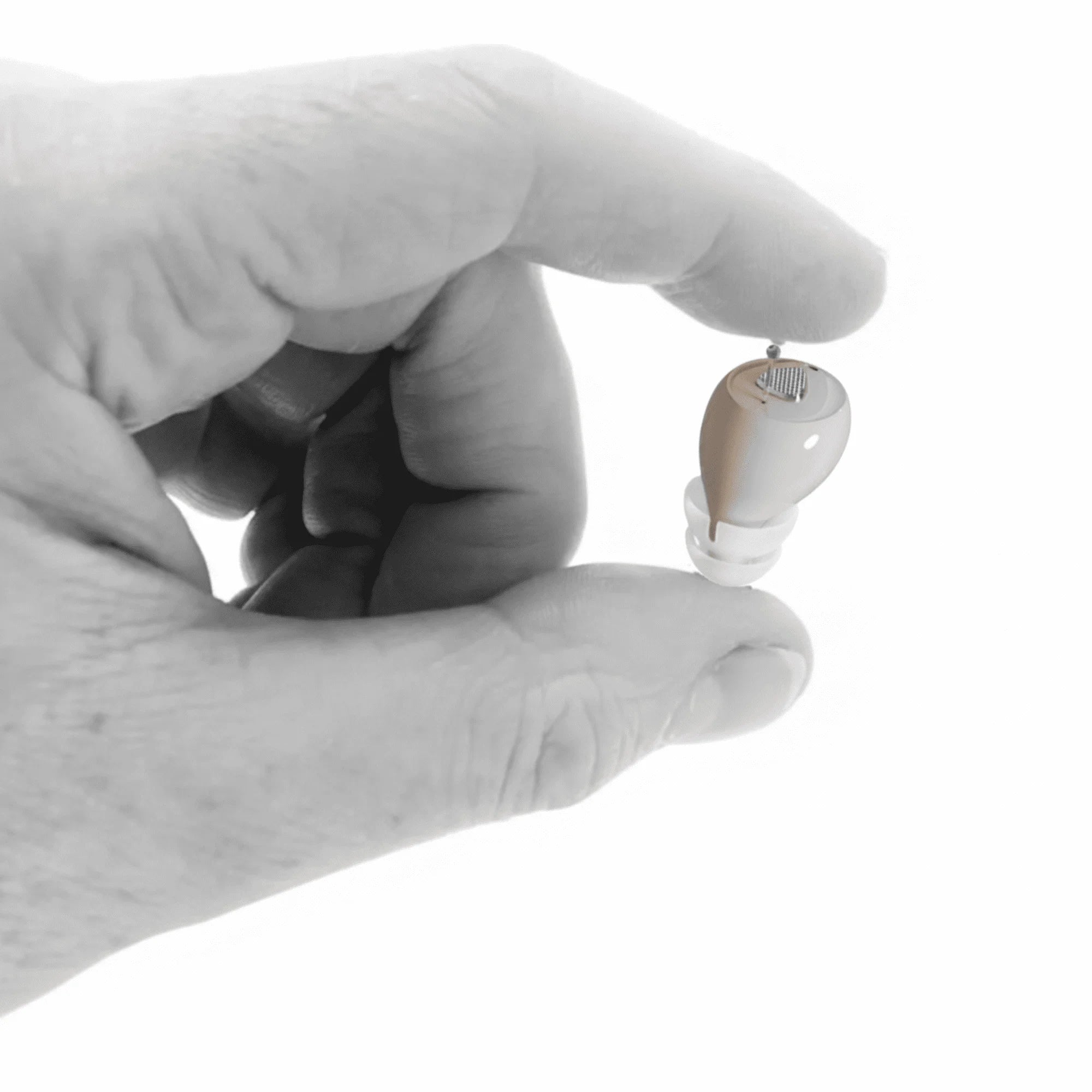
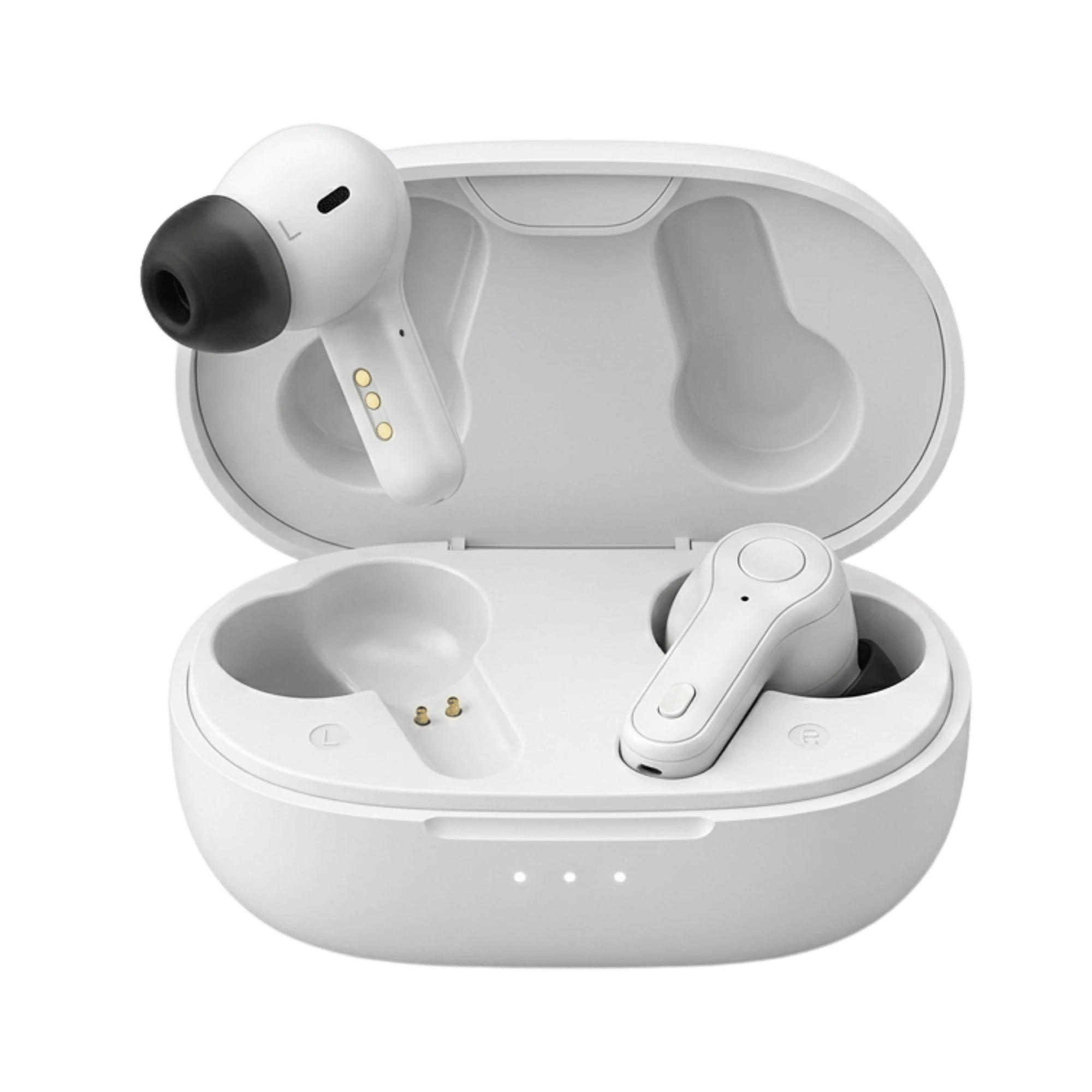
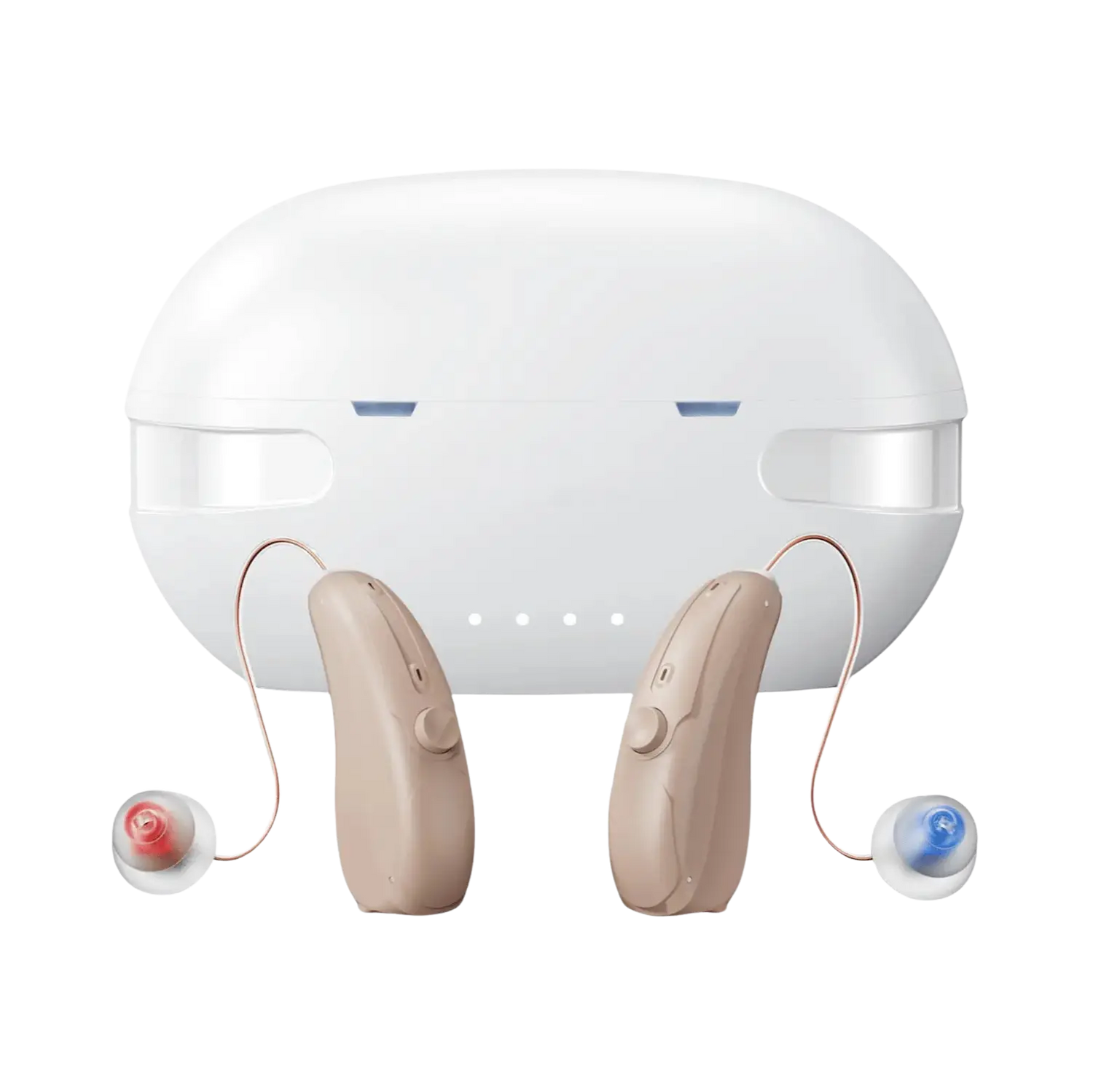
Because the trial treats fitting precision and noisy-room performance as the two things that decide whether rehabilitation succeeds, it is worth knowing that FDA-cleared over-the-counter devices are now built around both. Panda Quantum is one such device. It is a 16-channel receiver-in-canal hearing aid with adaptive noise reduction, designed for clear speech in noisy environments, and it includes an app-based in-ear hearing test that runs through the aid itself after delivery, using the result to set gain and frequency response to the wearer's own audiogram rather than a generic curve.
That app-based hearing personalization addresses the follow-up gap in a small way, since the test can be repeated rather than performed once and forgotten. Quantum also carries Bluetooth for calls, television and music, up to eighty hours of total battery with its case, a five-year warranty and forty-five-day returns. One caveat belongs here: over-the-counter devices are approved for mild-to-moderate hearing loss, and people with severe or profound loss still get the most from a clinical fitting.
Limitations of This Research
The largest limitation is simply that no results exist. A protocol describes intentions, and trials sometimes fail to recruit their target, lose participants to follow-up, or produce differences too small to interpret. The study is also single-site, which strengthens consistency of delivery but limits how confidently the findings will generalise beyond one Finnish hospital system and one healthcare culture.
Sample size is another constraint the authors acknowledge through the proof-of-concept label. Up to two hundred participants split across two arms is modest for detecting cognitive change, which typically requires larger numbers over longer periods. The exclusion of people who already have cognitive decline keeps the question clean but also means the results will not speak to those who may need the answer most. One author is affiliated with Sonova AG, a hearing device manufacturer, which readers may wish to weigh; the protocol's ethical approval and trial registration are both disclosed in the paper.
Where This Leaves Us
For the next two years this trial will be quietly running while the debate about hearing and cognition continues without it. When the results arrive they will not close that debate, but they will do something more immediately useful. They will tell us whether the ordinary experience of getting hearing aids, the rushed fitting and the follow-up that never happens, is costing people measurable understanding of speech. That is a question worth answering regardless of what it turns out to mean for memory.
Ihalainen L, Barbera M, Tormakangas T, Hyvarinen P, Willberg T, Linder P, Solomon A, Dietz A. Proof-of-concept randomised controlled trial of data-driven hearing rehabilitation versus standard care in older adults with hearing loss: the healthy hearing for healthy ageing protocol. BMJ Open. 2026;16(7):e122681. Retrieved from PubMed. https://doi.org/10.1136/bmjopen-2026-122681