Age-Related Hearing Loss Ranks Among the Top Drivers of Years Lived in Poor Health, Global Study Finds
A sweeping analysis of health data from 204 countries finds that age-related hearing loss sits among a small handful of chronic conditions responsible for most of the time people now spend in poor health.
People are living longer than ever, but a growing share of those extra years is being spent in less than full health. A new global study set out to measure that gap between how long people live and how long they stay well, and to name the conditions that widen it most.
Among the leading contributors, the researchers point to something many families treat as an inevitable part of getting older: age-related hearing loss. Unlike many of the other drivers on the list, it is common, often treatable, and increasingly addressable without a hospital visit.
About This Study
Title: Global, regional, and national trends in the morbidity gap and contributing diseases, injuries, and risk factors, 1990 to 2023: a systematic analysis for the Global Burden of Disease Study 2023
Authors: Simon I. Hay, Paul Nam, Haaris Saqib, Susan A. McLaughlin, Christopher J. L. Murray, and the GBD 2023 collaborators
Affiliations: Institute for Health Metrics and Evaluation and Department of Health Metrics Sciences, University of Washington, Seattle, USA, with international collaborators
Journal: The Lancet Public Health, August 2026
Study type: Systematic analysis of global health-metrics modeling data
Reference: PubMed, DOI 10.1016/S2468-2667(26)00098-8
Background: Why the Researchers Looked at This
For decades, public health progress was measured mostly by how long people lived. But length of life and quality of life are not the same thing. A person can gain years while spending more of them managing pain, low mood, or difficulty getting around.
To capture this, researchers use two measures. Life expectancy estimates how long a person is expected to live. Healthy life expectancy, often shortened to HALE, estimates how many of those years are lived in good health. The difference between the two is what the study calls the morbidity gap, or the stretch of life spent in poor health.
A long-standing idea in public health, the compression of morbidity hypothesis, holds that good prevention and care should push disability toward the very end of life, shrinking that gap. The authors wanted to test whether the world is actually moving in that direction.
How the Study Was Done
The team drew on the Global Burden of Disease Study 2023, a large international effort that pulls together health data from around the world. For 204 countries and territories, they compared life expectancy at birth against healthy life expectancy for each year from 1990 to 2023.
They then calculated the morbidity gap as life expectancy minus healthy life expectancy, and looked at how it changed over time, by wealth level and by sex. To find out which conditions drove the gap, they broke it down into contributions from specific diseases, injuries, and underlying risk factors, adjusting for people who live with more than one condition at once so that overlapping disability would not be counted twice.
Because these are estimates rather than direct counts, the researchers reported ranges of uncertainty around each figure, built from hundreds of statistical draws.
What the Researchers Found
The gap between living and living well is widening. Globally, the morbidity gap grew from about 8.8 years in 1990 to roughly 10.7 years in 2023, an increase of about 1.9 years, or nearly 22 percent.
This was not confined to a few places. The point estimates suggested the gap widened in 203 of the 204 countries and territories studied. By 2023, an average of about 14.5 percent of life was spent in poor health, up from 13.6 percent in 1990. The added years of poor health were spread across adulthood rather than packed into the final months of life.
Strikingly, a small set of chronic, largely non-fatal conditions accounted for most of the burden. Musculoskeletal disorders (especially low back pain), mental disorders (particularly depression and anxiety), sense organ diseases (led by age-related hearing loss), unintentional injuries (such as falls), and other non-communicable diseases together made up about 57.4 percent of unhealthy years globally in 2023.
The gaps were largest, not smallest, in wealthier countries with the longest life expectancies. High blood sugar, high body weight, and childhood and maternal undernutrition ranked as the leading risk factors feeding the global gap.
The placement of age-related hearing loss on that short list is notable. It is one of the few top contributors that rarely shortens life yet quietly erodes daily function for years, and one of the few with widely available, non-surgical options for management.
What It Means for People with Hearing Loss
Age-related hearing loss is easy to dismiss because it comes on slowly and does not hurt. Yet this analysis places it alongside back pain and depression as a leading reason people spend years of later life below their full health. That reframing matters, because hearing is one of the more modifiable items on the list.
When hearing fades, conversations become tiring, phone calls get avoided, and social gatherings shrink. Researchers have long linked untreated hearing loss to isolation, low mood, and added strain on thinking and memory. If a common, treatable condition is helping drive the growing stretch of unhealthy years, then finding and addressing it earlier is a practical lever, not a luxury.
The catch has historically been access. Traditional hearing care can be costly and time-consuming, which is one reason many people wait years before acting. That is exactly the barrier that newer options are designed to lower.
Lowering the Cost of Acting on a Treatable Contributor
Because this study frames age-related hearing loss as a leading yet treatable driver of years spent in poor health, the barriers between a person and their first hearing device carry real weight. When cost and clinic access are the sticking points, over-the-counter tools built to be simple and affordable can help more people act sooner.
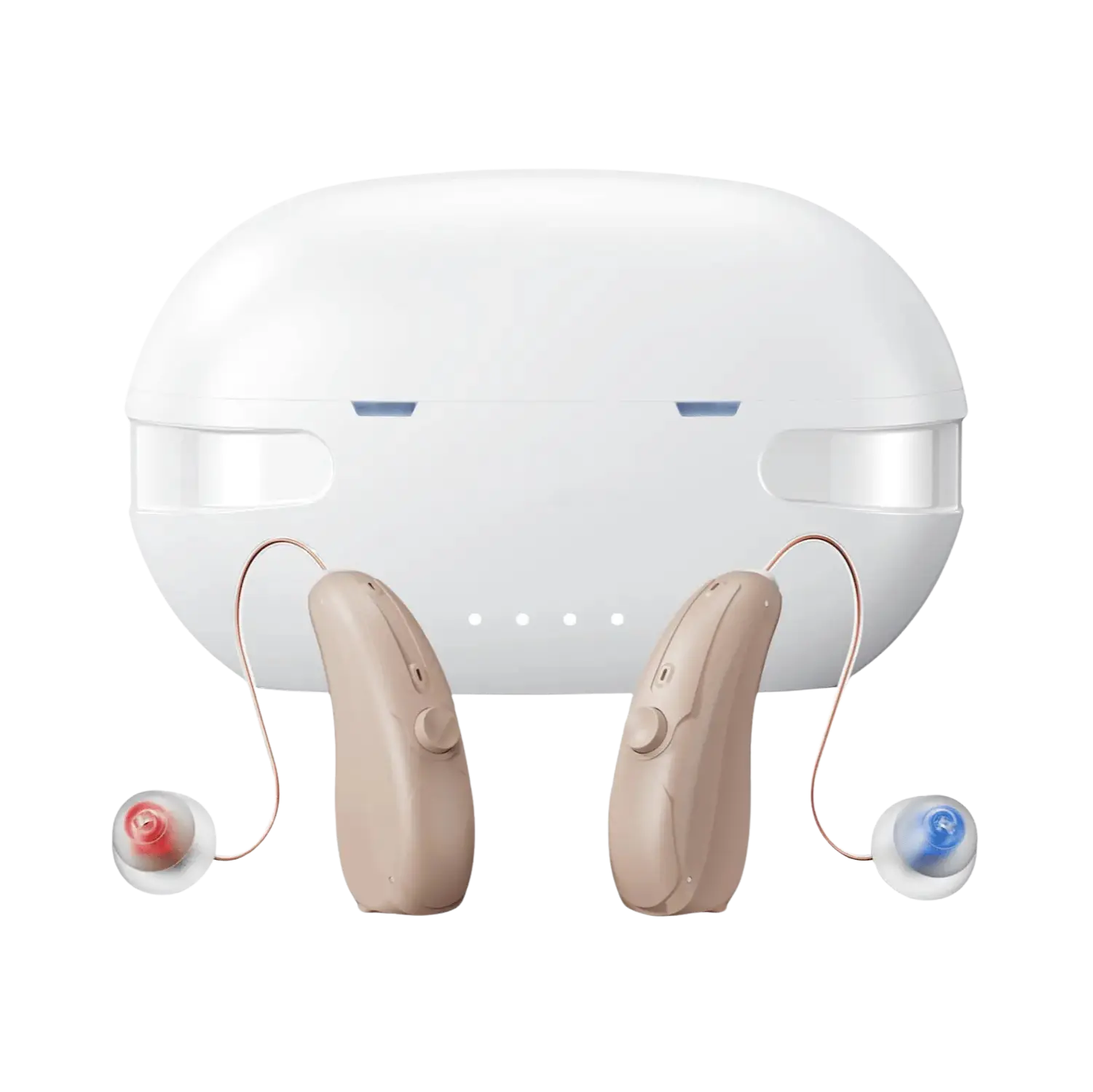
Panda Air is one example. It is an earbud-style, AirPod-like hearing aid designed for people who want a modern, low-friction way in. After it arrives, you pair it with the Panda app and run an app-based in-ear hearing test that checks your hearing frequency by frequency through the aid itself, then tunes gain and frequency response to match your results, much like a clinical fitting. As app-tuned hearing aids go, that self-fitting approach is meant to remove the guesswork without a series of office visits.
It uses 16-channel processing with multi-band adaptive noise reduction, recharges in a 60-hour fast-charge case, and comes with a 5-year warranty and 45-day returns. One honest caveat worth keeping in mind: over-the-counter devices are cleared for mild to moderate hearing loss, and people with severe or profound loss still benefit most from a clinical fitting.

Limitations of This Research
This is a modeling study, so its figures are careful estimates rather than exact head counts, and each carries a range of uncertainty. Age-related hearing loss appears here as one aggregated category within a much larger global picture, so the analysis describes population-level patterns rather than any individual person's risk or outcome.
The authors also had to make assumptions when separating out overlapping conditions, and data quality varies from country to country. The study was funded by the Gates Foundation, which supports the Global Burden of Disease program.
Where This Leaves Us
The headline is that longer lives are not automatically healthier ones, and that a few common conditions shape much of the difference. Age-related hearing loss earns its place on that list, but it is also one of the more fixable entries, which makes catching it early and acting on it a meaningful step toward more good years, not just more years.
Hay SI, Nam P, Saqib H, McLaughlin SA, Murray CJL, and the GBD 2023 collaborators. Global, regional, and national trends in the morbidity gap and contributing diseases, injuries, and risk factors, 1990 to 2023: a systematic analysis for the Global Burden of Disease Study 2023. The Lancet Public Health. 2026. Retrieved from PubMed. DOI 10.1016/S2468-2667(26)00098-8