Tinnitus Linked to Poorer Speech Understanding in Noise, Study Finds
Adults with tinnitus understood speech in background noise significantly worse than matched peers, even though their hearing thresholds and cognitive test scores were essentially the same.
People who live with tinnitus, the persistent ringing, buzzing or hissing that has no outside source, often report something their hearing tests cannot explain: conversations in restaurants, family gatherings and other noisy places feel harder than they should. If the audiogram says hearing is normal, where does that difficulty come from?
A new study from audiology researchers in Türkiye and Australia, published in the journal Ear and Hearing, set out to measure that gap directly, and to test whether it comes from the brain's attention and memory systems or from the ear itself.
About This Study
Title: Speech Perception in Noise in Individuals With Tinnitus: Top-Down and Bottom-Up Processes
Authors: Sevmez HS, Gürses E, Yücel HM, Türkyilmaz MD, Dillon H
Affiliations: Hacettepe University, Ankara, Türkiye; Macquarie University, Sydney, Australia
Journal: Ear and Hearing, published online October 15, 2026
Study type: Case-control observational study
PubMed DOI: 10.1097/AUD.0000000000001896
Background: Why the Researchers Looked at This
Understanding speech in a noisy room is one of the hardest things the auditory system does. Scientists describe it as a mix of two kinds of processing. Bottom-up processes are the raw signal work: the ear and auditory pathways picking apart sounds by pitch, timing and location. Top-down processes are the brain's contributions: attention, working memory and the ability to fill in missing pieces from context.
Tinnitus could plausibly interfere with either side. The phantom sound might occupy attention and memory resources, a top-down cost. Or the same underlying changes in the auditory system that produce tinnitus might also degrade the processing of real sounds, a bottom-up cost, even when standard hearing thresholds look normal.
The researchers designed this study to separate those explanations by measuring speech-in-noise ability, spatial listening (the ability to use the location of sounds to separate them), and cognitive performance in the same people.
How the Study Was Done
The team recruited 31 adults with tinnitus and 31 age-matched adults without tinnitus, all between 18 and 60 years old and all with normal hearing on standard audiological evaluation. Matching the groups on age and hearing was the crucial design choice: it means any difference in listening performance cannot simply be blamed on a worse audiogram.
Everyone completed the Listening in Spatialized Noise-Universal Test, a standardized task that measures how well a person follows target speech against background talkers. The test varies whether the speech and the noise come from the same direction (colocated) or from different directions (spatially separated). The benefit a listener gains when the sounds are separated is called the spatial advantage.
Participants also took two cognitive tests: Serial Digit Learning, which taxes memory, and the Stroop test, which taxes attention and the ability to suppress distraction. Together these probe the top-down side of listening.
What the Researchers Found
First, the groups really were matched: hearing thresholds did not differ significantly between people with and without tinnitus. On paper, their ears looked the same.
Their listening did not. Participants with tinnitus performed significantly worse at understanding speech in noise, and the gap appeared in both listening conditions, whether the noise came from the same direction as the speech or from a different one. The statistical effect was robust, with a p value of 0.001.
The spatial advantage, however, was comparable between groups. People with tinnitus gained just as much benefit as controls when speech and noise were separated in space, suggesting their ability to use spatial cues was intact.
Cognitive performance also showed no significant group differences on either the memory or the attention task. The brains of the tinnitus group, at least as measured here, were doing their top-down job normally.
Putting the pieces together, the authors conclude that the speech-in-noise difficulty in tinnitus was present across both listening conditions rather than limited to the use of spatial cues, a pattern more consistent with subtle changes in auditory processing than with a failure of attention or memory.
What It Means for People with Hearing Loss
For the millions of people with tinnitus, this study offers a measure of validation. Struggling to follow conversation in a noisy cafe while being told your hearing test is normal can feel dismissive. These results show the difficulty is real and measurable, and that a standard audiogram does not capture everything that matters for everyday listening.
It also suggests that anyone with tinnitus who notices trouble in noisy settings should mention it specifically when seeking hearing care. Speech-in-noise testing exists, and this research argues it deserves a larger role whenever tinnitus is part of the picture.
For people who have both tinnitus and hearing loss, the findings underline that noisy environments are where support is needed most, since tinnitus appears to add its own penalty on top of whatever the hearing loss contributes.
Why Speech-in-Noise Support Matters When You Have Tinnitus
Because this study pinpoints noisy environments as the hardest setting for people with tinnitus, it is worth knowing what modern FDA-OTC hearing aids can and cannot do here. To be clear, hearing aids are not a treatment or cure for tinnitus. What they can do, for adults who also have mild to moderate hearing loss, is make everyday sound clearer, and many people find that when the world around them comes through more clearly, their tinnitus feels less noticeable.
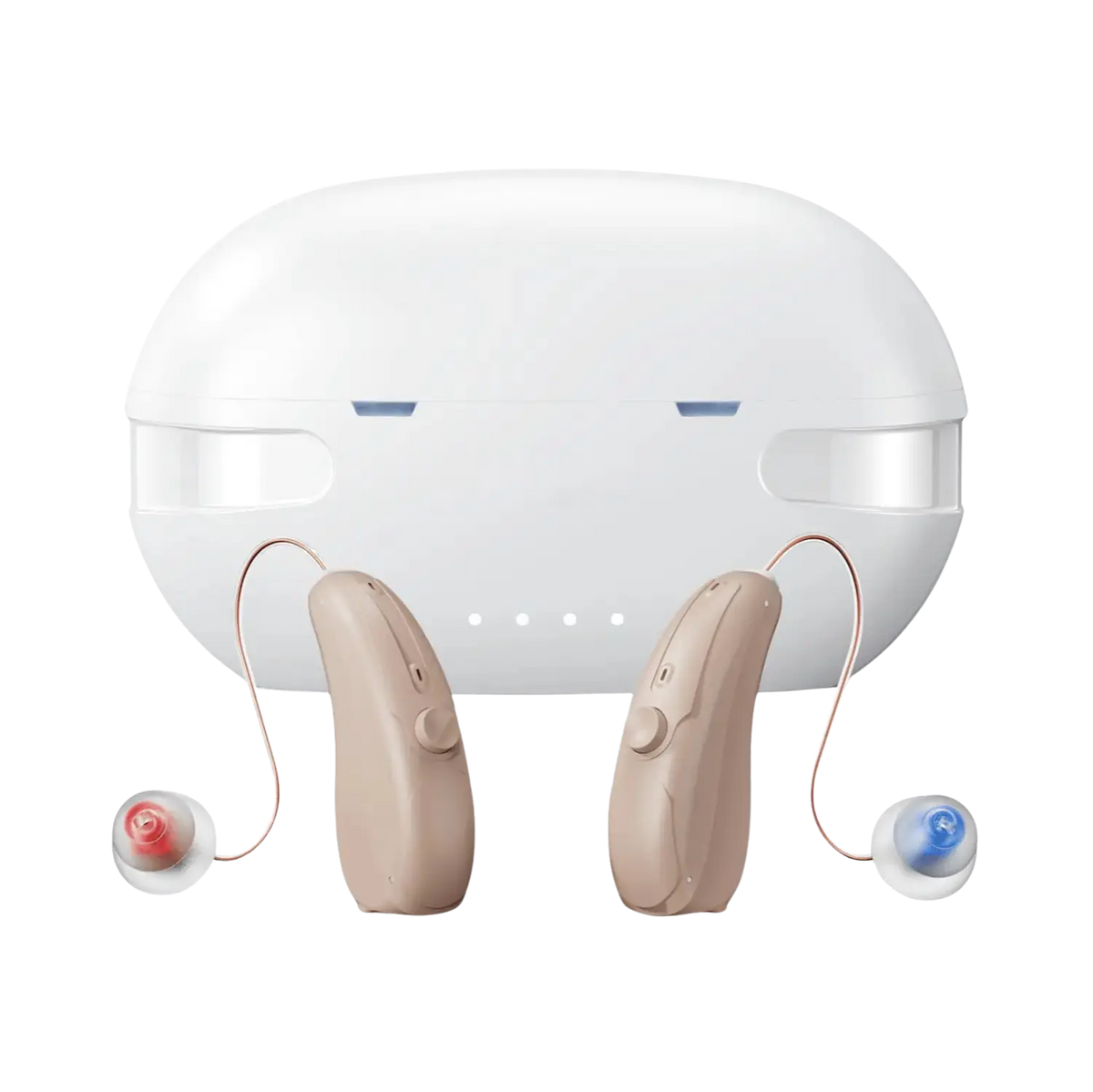
Panda Quantum is built around exactly the challenge this study measured: clear speech in noisy environments. It is a 16-channel receiver-in-canal device with adaptive noise reduction designed to favor speech over background sound, plus Bluetooth for calls, TV and music. A single charge lasts 20 hours, and the case carries three additional full charges for 80 hours of total use.
An optional companion app can run an in-ear hearing check and personalize the sound to your profile, though Quantum works without the app or the test. It comes with a 5-year warranty and a 45-day trial that begins when the device arrives. Details are at pandahearing.com/products/panda-hearing-aids-quantum.

Limitations of This Research
This was a modest study, with 31 people in each group, and all participants had normal hearing and were under 60, so the results may not describe older adults or people with hearing loss alongside their tinnitus. As a cross-sectional comparison it also cannot prove that tinnitus causes the listening difficulty; it can only show the two travel together.
The cognitive tests covered attention and memory but not every top-down ability involved in listening, so a subtler cognitive contribution cannot be fully ruled out.
What to Do With This
If you have tinnitus and noisy rooms wear you out, this research says you are not imagining it, even if your hearing test comes back clean. Ask for speech-in-noise testing when you seek care, be deliberate about choosing quieter seats and settings when conversation matters, and if you also have hearing loss, know that helping the ears deliver a clearer signal is where technology can realistically contribute. The ringing itself remains a separate problem science is still working on, but the listening difficulty around it is now firmly on the map.
Sevmez HS, Gürses E, Yücel HM, Türkyilmaz MD, Dillon H. Speech Perception in Noise in Individuals With Tinnitus: Top-Down and Bottom-Up Processes. Ear and Hearing. 2026. Retrieved from PubMed. https://doi.org/10.1097/AUD.0000000000001896

