Studie: Ein normaler Hörtest übersieht womöglich frühe Veränderungen im Innenohr
Neue Forschungsergebnisse der University of Texas at Austin deuten darauf hin, dass sich der Verstärker des Innenohrs verändern kann, lange bevor ein Standard-Hörtest Auffälligkeiten zeigt.
Die meisten Menschen betrachten einen Hörtest als klare Bestanden-oder-nicht-Prüfung: Ist das Audiogramm normal, sind die Ohren in Ordnung. Dennoch berichten viele Erwachsene mit normalem Audiogramm von echten Schwierigkeiten, Gesprächen zu folgen, besonders in lauter Umgebung – und Forschende vermuten schon lange, dass Standardtests nicht alles erfassen, was in der Cochlea vor sich geht.
Eine neue, in The Journal of Neuroscience veröffentlichte Studie untermauert diesen Verdacht mit konkreten Zahlen. Durch die Messung, wie die Cochlea Schall komprimiert – ein Kennzeichen ihres eingebauten Verstärkers –, zeigen die Autoren, dass sich Menschen mit völlig normalen Hörschwellen erheblich darin unterscheiden können, wie gut dieser Verstärker arbeitet.
Titel: Normal Audiogram Does Not Confirm Intact Cochlear Amplification: Compressive Nonlinearity Reveals Incipient Cochlear Changes
Autoren: Sajana Aryal, Srikanta K. Mishra
Institution: Department of Speech, Language, and Hearing Sciences, University of Texas at Austin, USA
Fachzeitschrift: The Journal of Neuroscience, August 2026
Studientyp: Physiologische Querschnittsstudie (144 Ohren)
Referenz: DOI: 10.1523/JNEUROSCI.0476-26.2026 (PubMed)
Hintergrund: Warum die Forschenden das untersucht haben
Die Cochlea, das schneckenförmige Hörorgan des Innenohrs, leitet Schall nicht einfach weiter. Ihre äußeren Haarzellen verstärken leise Töne aktiv und dämpfen laute – eine Eigenschaft, die Wissenschaftler als kompressive Nichtlinearität bezeichnen. Dieser cochleäre Verstärker verleiht dem menschlichen Gehör seine bemerkenswerte Empfindlichkeit und Bandbreite, und es ist bekannt, dass er sich verschlechtert, wenn sich ein Hörverlust entwickelt.
Bei Menschen, deren Audiogramm im Normalbereich liegt, ging man jedoch bislang meist davon aus, dass diese Kompression einheitlich und intakt ist. Diese Annahme war nie systematisch überprüft worden. Wenn frühe Veränderungen in der Cochlea beginnen, bevor sich die Hörschwellen verschieben, könnten Unterschiede in der Kompression als Frühwarnzeichen einer beginnenden Funktionsstörung dienen – und vielleicht erklären, warum manche Menschen mit normalen Testergebnissen Schwierigkeiten bei der Verarbeitung von Schall haben.
So wurde die Studie durchgeführt
Die Forschenden untersuchten 144 Ohren junger Erwachsener mit normalem Audiogramm (46 von Männern, 98 von Frauen). Statt die Teilnehmenden auf Töne reagieren zu lassen, maßen sie otoakustische Distorsionsprodukt-Emissionen – leise Töne, die die Cochlea selbst erzeugt und die mit einem empfindlichen Mikrofon im Gehörgang aufgezeichnet werden. Wie diese Emissionen mit steigendem Eingangspegel zunehmen, bildet die Kompression der Cochlea direkt ab.
Das Team legte strenge Kriterien für das Signal-Rausch-Verhältnis an und nutzte statistische Modelle mit Kontrolle von Kovariaten, die die Kompression als kontinuierliches Maß behandelten. So ließen sich strukturierte Unterschiede zwischen einzelnen Personen herausarbeiten, statt alle in eine einzige Kategorie „normal“ einzuordnen. Zudem maßen die Forschenden das Hörvermögen im erweiterten Hochtonbereich – ein Indikator für die Gesundheit der basalen Region der Cochlea, den Standard-Audiogramme nicht abdecken.
Was die Forschenden herausgefunden haben
Das zentrale Ergebnis: Die cochleäre Kompression unterschied sich von Person zu Person erheblich, obwohl alle Teilnehmenden normale Hörschwellen hatten. Der cochleäre Verstärker ist also nicht bei jedem, der einen Hörtest besteht, gleich gesund.
Diese Unterschiede waren kein zufälliges Rauschen. Feine Abweichungen bei den Hörschwellen im Standardfrequenzbereich – noch innerhalb des Normalbereichs – gingen mit Unterschieden in der cochleären Verstärkung einher. Die Empfindlichkeit im erweiterten Hochtonbereich zeigte zusätzliche Zusammenhänge mit den Kompressionsmessungen, was darauf hindeutet, dass das empfindliche basale Ende der Cochlea an diesen Unterschieden beteiligt ist.
Besonders bemerkenswert ist vielleicht, dass altersbedingte Effekte selbst in dieser eng begrenzten Gruppe junger Erwachsener nachweisbar waren. Das legt nahe, dass sich die Funktionsweise der Cochlea schon früh im Erwachsenenalter auseinanderentwickeln kann – Jahrzehnte bevor ein Hörverlust üblicherweise diagnostiziert wird.
Die Autoren folgern, dass die Funktion der Cochlea ein Kontinuum biologischer Zustände widerspiegelt, von denen manche eine beginnende Funktionsstörung darstellen können, die einem messbaren Hörverlust vorausgeht.
Was das für Menschen mit Hörverlust bedeutet
Für alle, denen gesagt wurde, ihr Gehör sei normal, die aber dennoch Mühe haben, Gesprächen zu folgen, bietet diese Studie eine gewisse Bestätigung. Ein normales Audiogramm zeigt, dass leise Töne wahrgenommen werden können, belegt aber nicht, dass der Verstärkungsmechanismus des Innenohrs vollständig intakt ist.
Die Ergebnisse stützen zudem die Sichtweise, Hörgesundheit als Kontinuum zu verstehen, das im Laufe der Zeit beobachtet werden sollte, statt als Entweder-oder-Zustand. Veränderungen scheinen sich allmählich anzusammeln. Deshalb ist es sinnvoller, auf frühe Schwierigkeiten im Alltag zu achten und darauf zu reagieren, als zu warten, bis ein Test auffällig wird.
Hören ist ein Kontinuum – deshalb zählt Personalisierung
Wenn sich die Funktion der Cochlea von Person zu Person deutlich unterscheidet, wie diese Studie zeigt, ist eine Einheitsverstärkung für alle ein grobes Werkzeug. Dieser Gedanke steht unter anderem hinter modernen OTC-Hörgeräten gemäß den FDA-Vorgaben, die für Erwachsene mit wahrgenommenem leichtem bis mittelgradigem Hörverlust entwickelt wurden und die Personalisierung zunehmend direkt ins Gerät integrieren.

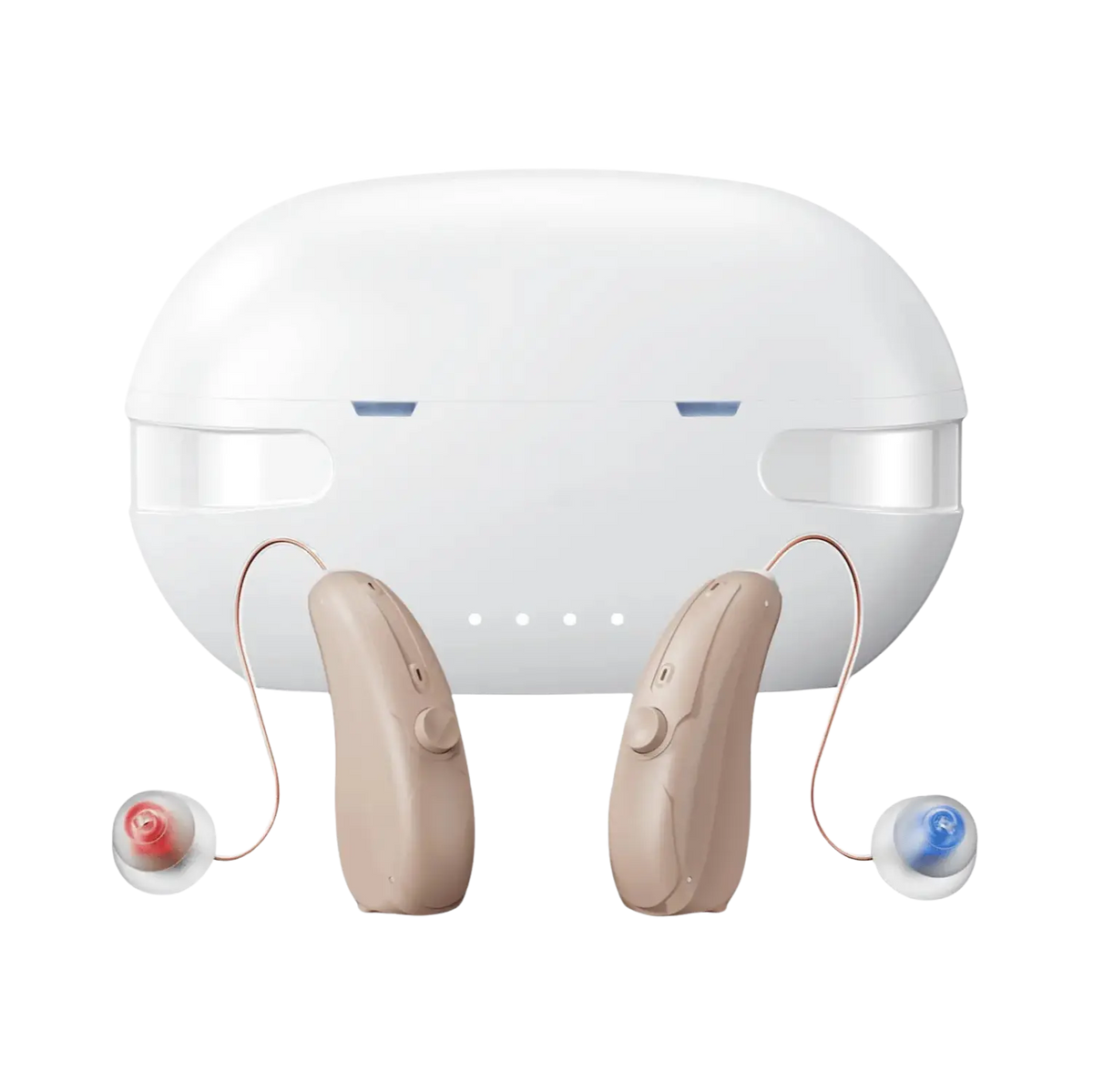
Panda Quantum spiegelt diesen Ansatz wider. Es ist ein 16-Kanal-RIC-Gerät (Hörer im Gehörgang) mit adaptiver Geräuschunterdrückung, entwickelt für klarere Sprache in lauter Umgebung – mit Bluetooth für Telefonate, Fernsehen und Musik, 20 Stunden pro Ladung plus einem Etui mit drei zusätzlichen vollen Ladungen für insgesamt 80 Stunden, einer 5-jährigen Garantie und einer 45-tägigen Testphase, die mit der Lieferung beginnt. Eine optionale Begleit-App kann über das Hörgerät einen Hörcheck im Ohr durchführen und eine App-basierte Hörpersonalisierung anwenden, die Verstärkung und Frequenzgang an das persönliche Hörprofil des Trägers anpasst. App und Test sind optional – Quantum funktioniert auch ohne sie voll und ganz.
Um es klar zu sagen: Kein Verbrauchergerät misst die cochleäre Kompression so, wie es diese Laborstudie getan hat. Der Zusammenhang ist einfacher: Das Hören unterscheidet sich zwischen einzelnen Menschen, lange bevor es tatsächlich nachlässt, und für alle, die leichte bis mittelgradige Schwierigkeiten bemerken, sind Geräte, die sich an den Einzelnen anpassen, ein sinnvoller Ausgangspunkt. Ein hochgradiger oder an Taubheit grenzender Hörverlust erfordert weiterhin eine klinische Anpassung.
Grenzen dieser Studie
Es handelte sich um eine Querschnittsstudie mit jungen Erwachsenen. Sie bildet also eine Momentaufnahme der Unterschiede ab und verfolgt nicht, ob eine geringe Kompression tatsächlich einen künftigen Hörverlust vorhersagt – das kann nur eine Langzeitbeobachtung bestätigen. Otoakustische Emissionen bieten zudem nur einen indirekten Einblick in die Funktion der äußeren Haarzellen. Das Abstract nennt weder Finanzierungsquellen noch Interessenkonflikte.
Was Sie daraus mitnehmen können
Die praktische Schlussfolgerung: Behandeln Sie Ihr Gehör wie andere Aspekte Ihrer Gesundheit, die sich allmählich verändern. Achten Sie auf frühe Schwierigkeiten, besonders in lauter Umgebung, lassen Sie einen Ausgangstest machen und geben Sie sich nicht mit einem einzigen normalen Ergebnis zufrieden, wenn Ihnen das Zuhören dennoch schwerer fällt, als es sollte. Die Wissenschaft zeigt immer deutlicher: Das Ohr führt sein eigenes, früheres Protokoll.
Aryal S, Mishra SK. Normal Audiogram Does Not Confirm Intact Cochlear Amplification: Compressive Nonlinearity Reveals Incipient Cochlear Changes. The Journal of Neuroscience. 2026. Abgerufen über PubMed. https://doi.org/10.1523/JNEUROSCI.0476-26.2026