Why Are Hearing Aids So Expensive? The Real Reasons (and Cheaper Alternatives)
When you first shop for hearing aids, the sticker shock hits hard. Prescription devices at clinics often cost $3,500 to $5,000 per pair. You might feel like you're paying for cutting-edge alien technology, or that the hearing aid industry has simply decided to price devices out of reach.
But here's what most people don't realize: the actual hardware inside that $5,000 hearing aid costs between $200 and $300 to manufacture. The shocking price gap isn't about the device itself. It's about how hearing aids are sold, who's marking them up, and the layers of professional services bundled into the price. Understanding these five cost layers is the key to knowing whether you're paying for what you actually need.
The Five Cost Layers Inside a $5,000 Hearing Aid
Layer 1: Hardware. The actual microphones, speakers, processing chip, battery, and plastic casing run about $200 to $300 per pair in materials and assembly. This hasn't changed much in a decade. The technology is well-understood; manufacturing is efficient. But once the device leaves the factory, the markup begins.
Layer 2: R&D and proprietary algorithms. Hearing aid manufacturers spend hundreds of millions annually on research. Phonak, ReSound, Oticon, Widex, and Starkey (the Big Five) have invested decades into noise reduction, feedback cancellation, directional processing, and wireless technology. The R&D is real and substantial. Manufacturers recoup that investment by marking up each device $1,000 to $2,000 above the cost of goods. That layer covers engineering salaries, clinical studies, and the next generation of technology.
Layer 3: Audiologist services. When you buy hearing aids at a clinic, you're paying for a full-service bundle: a licensed hearing test, device fitting, programming to your specific frequencies, trial adjustments, and follow-up visits (often for a year). These services are valuable if you have complex hearing loss, custom earmold needs, or ongoing professional guidance. For a typical adult with mild-to-moderate sensorineural loss, though, this bundle adds cost without proportional benefit.
Layer 4: Retail and clinic markup. Hearing aid manufacturers set a suggested retail price, but clinics and retailers mark it up on top. Consumer Reports exposed this: hearing clinics add an average markup of 117 percent on the final consumer price. Local audiology clinics average $1,800 per device ($3,600 per pair); national chains like Miracle Ear average $1,700 per device. That markup covers rent, staff, equipment, and profit. Costco, by contrast, operates on a tighter margin and charges around $837 per device ($1,674 per pair).
Layer 5: Brand marketing and sales. The Big Five manufacturers spend heavily on television advertising, doctor relationships, and sales rep networks. You see Phonak and ReSound ads because millions are spent to keep those names top-of-mind. These costs are built into the device price and passed to the consumer.
What the FDA's 2022 OTC Rule Changed
On October 17, 2022, the FDA created a formal category for over-the-counter hearing aids. For the first time in decades, adults 18 and older with mild-to-moderate hearing loss could legally buy hearing aids directly from retailers, online vendors, and pharmacies without a prescription or an audiologist's sign-off.
This rule reversed a 1977 FDA directive that had kept hearing aids prescription-only. Federal officials estimated the savings would be about $2,800 per pair. One year later, reality confirmed the projection: average OTC hearing aid prices landed around $1,600 per pair, while prescription devices averaged $4,600. The OTC category opened the door for companies like Panda, Bose, MDHearing, and others to compete directly with the established brands by selling to consumers, not just to clinics.
What changed isn't the technology. It's the business model. OTC manufacturers skip the clinic markup, the audiologist appointment, and the heavy brand advertising spending. Those savings flow directly to you.
What Direct-Buy OTC Skips (and Doesn't)
OTC hearing aids keep: the microphones, the processing chip, the R&D-backed noise reduction algorithms, FDA certification, and the warranty. The technology inside an OTC device is not inferior; it's the same class of digital signal processing as prescription devices. OTC manufacturers still invest in acoustic engineering and firmware improvements.
OTC hearing aids skip: the clinic markup (50-100%), the in-person hearing test fee (often $50-$100), the professional fitting appointment (often $200-$500), the follow-up tuning visits, and the brand-marketing premium. You do not get an audiologist visit. You do not get a year of follow-up care included. You do get a self-fitting process, usually through an app, that measures your frequencies at home in 10 minutes.
For most adults with mild-to-moderate hearing loss shopping for the first time, this trade-off is favorable. You spend a fraction of the price for the same underlying technology. For users with severe-profound loss, complex audiograms, or a strong preference for ongoing professional care, the prescription route remains the better choice.
When the Premium Is Worth It
The premium price for prescription hearing aids makes sense if you meet one or more of these conditions:
- Severe-to-profound hearing loss (OTC is designed for mild-to-moderate only).
- Complex audiogram with asymmetrical loss across different frequencies.
- Need for custom earmolds (OTC uses standard dome sizes).
- Existing relationship with an audiologist, or strong preference for in-person care.
- Tinnitus or balance disorders requiring professional assessment.
In these cases, the audiologist's expertise and ongoing adjustments justify the cost. Prescription fitting isn't a sales tactic; it's appropriate care for users who need it.
When the Premium Isn't Worth It
For approximately 85 percent of hearing aid buyers, the audiologist premium adds little tangible benefit. Research shows that adults with typical sensorineural hearing loss across mild-to-moderate ranges get nearly the same hearing improvement from OTC devices as they do from prescription devices costing $4,000 more. The frequency correction is similar. The noise reduction algorithms work comparably. The battery life is often better in OTC models.
If you are a typical adult buyer, new to hearing aids, with symmetrical hearing loss in both ears, and comfortable with app-based self-fitting, the OTC route saves you $2,500 to $4,000 with no meaningful sacrifice in hearing clarity.
Cheaper Alternative Checklist
A lower-cost hearing aid is not automatically the right choice, but it is worth comparing when the buyer has gradual, perceived mild to moderate hearing difficulty and does not need complex medical care.
| Check | Why it matters |
|---|---|
| Is the product a hearing aid, not just an amplifier? | Amplifiers and hearing aids are not the same buying decision |
| Does it explain who should not use OTC? | Good guidance should name medical warning signs |
| Is there a return path? | Comfort and fit can only be judged after use |
| Does the model match your daily listening need? | Discretion, earbud style, and RIC clarity solve different problems |
Compare lower-cost options: See affordable Panda vs retail options
How Panda Prices Compare
Panda Stealth - $279 (was $379, save $100). Built for users who want hearing correction without anyone knowing. Stealth is an invisible ITC (in-the-canal) device with 16-channel digital processing and 12-band smart noise reduction. No Bluetooth, no app, no connectivity. Three listening modes (Quiet, Noisy, Outdoor) controlled via the charging case, which doubles as a wireless remote. Stealth is for discretion-first buyers who prioritize invisibility and simplicity. Weight is just 2.3 grams - less than a dime.

Panda Air - $299 (was $399, save $100). Designed to look like modern wireless earbuds. Air is an earbud-style ITC device with 16-channel processing and multi-band adaptive noise reduction. Full Bluetooth support for calls, TV, and music. Clinically tuned self-fitting via app. 60-hour total battery with a fast-charge case. Air is for users who want support without the medical look, or who value Bluetooth connectivity for streaming.
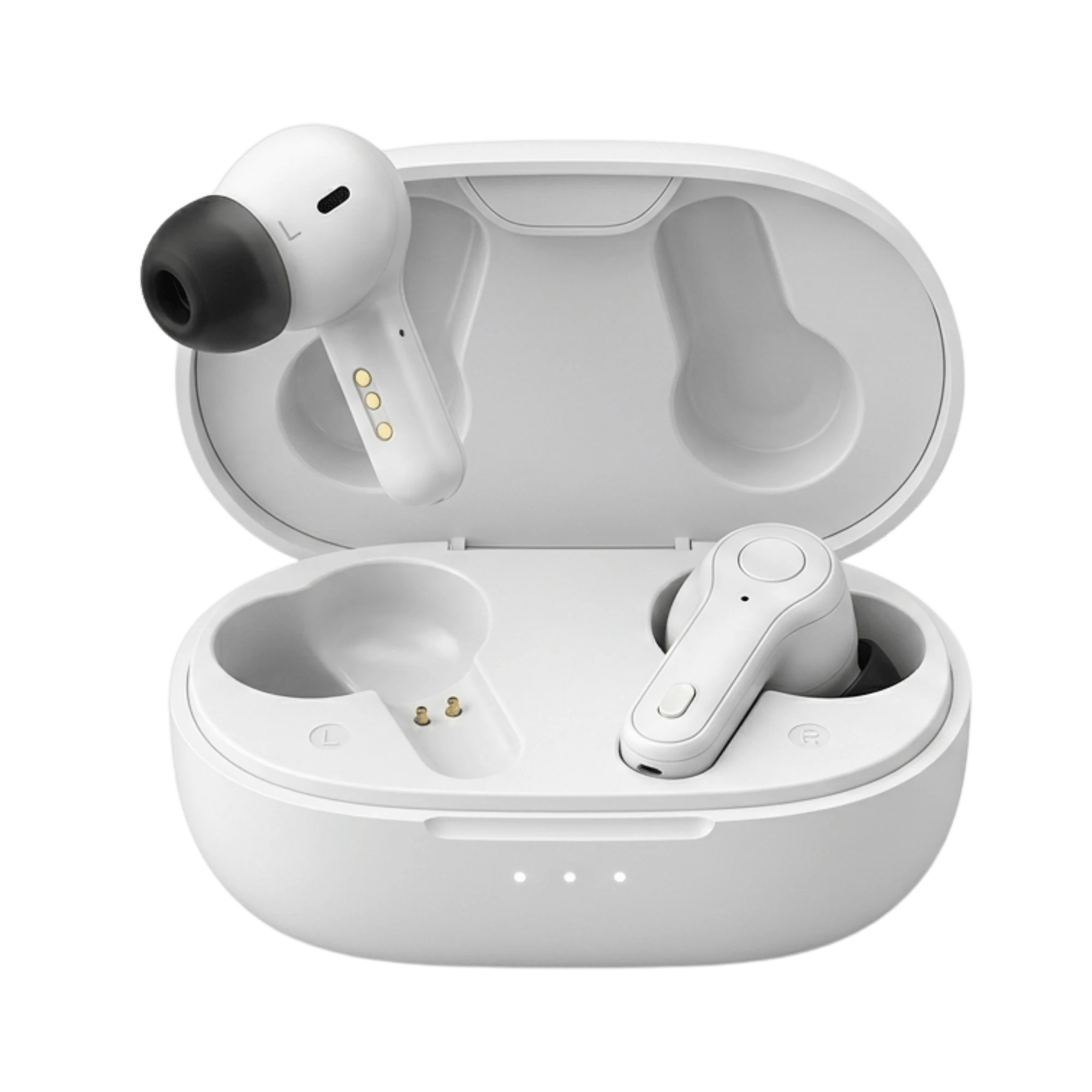
Panda Quantum - $349 (was $499, save $150). Clinical-grade RIC (receiver-in-canal) device for users who want serious hearing performance. Quantum includes frequency-matching technology that corrects the specific gaps in your hearing profile, the same principle audiologists use in $3,000+ prescription fitting. Adaptive tinnitus masking. 16-channel WDRC. Up to 80 hours total battery (20 hours per charge, case recharges 3 times). Full Bluetooth for calls, TV, and music. Clinically tuned self-fitting. Quantum is for users with more complex hearing needs or those who want the most advanced OTC technology available.

Clinically Tuned Self-Fitting at Home
Panda Air and Panda Quantum both include a clinically tuned self-fitting process. You complete a 10-minute hearing test on your phone or computer, at home, in a quiet room. The test measures the frequencies you struggle with, the same way an audiologist's test does. The device adjusts automatically to correct those gaps. This is the same frequency-targeted correction approach that audiologists use in professional fitting, except you do it yourself and keep the $500 fitting fee in your pocket.
For Panda Quantum, the frequency-matching system goes further. It uses what Panda calls "the same frequency-matching principle used in $3,000+ prescription devices," adapting 16 channels of processing to your specific loss pattern. You are not getting a generic preset. You are getting a personalized correction, performed at home, in 10 minutes, at a fraction of the professional fitting cost.
Adaptive Tinnitus Masking - Quantum Only
Panda Quantum includes adaptive tinnitus masking. For users who experience ringing, buzzing, or hissing in the ears, this feature generates soothing, adaptive sounds that mask the tinnitus pattern and help reduce its perception. Most OTC hearing aids in the $300 range do not include tinnitus management. Most prescription aids do, but they cost 10 times more. Quantum brings this clinical feature to the OTC price point.
Bottom Line on Hearing Aid Prices
The technology gap between a $349 OTC hearing aid and a $5,000 prescription device is much smaller than the price gap. Both use similar microphones, amplification, and noise reduction algorithms. The price difference is not about better hardware or better hearing correction. It is about service overhead, clinic markup, brand marketing, and the cost of maintaining an appointment-based business model. For most adults, you are paying for service, not better hearing. If you do not need ongoing professional care, direct-buy OTC hearing aids deliver FDA-registered, clinically tuned technology at less than 10 percent of the prescription price. All three Panda models include 5-year warranties and 45-day trials, so you can try them risk-free and return them if they do not meet your needs.
FAQ: Hearing Aid Cost Questions
How much do hearing aids actually cost to make?
Materials and assembly run about $200-$300 per pair. The microphones, speakers, processing chip, battery, and case are manufactured at standard industrial efficiency. The markup from the manufacturer (R&D cost recapture) is typically $1,000-$2,000 per device before it reaches a clinic. After the clinic's markup, the consumer price can reach $3,600-$5,000 per pair. OTC manufacturers sell directly, eliminating the clinic markup layer.
Why won't insurance cover hearing aids?
Insurance traditionally views hearing aids as cosmetic or elective, not medically necessary. Some plans cover them for severe-profound loss, and a few states have begun requiring coverage. Medicare does not cover hearing aids for adults over 65 (though the landscape is changing). Private insurance coverage is rare. This is why most people pay out-of-pocket. OTC and direct-buy models bypass the insurance complexity entirely, making hearing aids more accessible at lower cost.
Are cheap hearing aids actually any good?
It depends on which cheap hearing aids you're considering. Unregulated online amplifiers under $100 are often just generic sound boosters with no frequency matching or noise reduction. FDA-regulated OTC hearing aids like Panda, Bose, and others must meet safety and performance standards. A $349 Panda Quantum is not cheap in that sense; it is clinically tuned, FDA-certified, and backed by a warranty and trial period. Price and quality are not the same thing. OTC hearing aids at $279-$349 offer genuine clinical technology, not a gamble.
Will hearing aid prices keep dropping?
The FDA's 2022 OTC rule opened the market to new manufacturers and direct-to-consumer sales. Competition typically drives prices down over time. As more companies enter the OTC space and manufacturing scales up, pricing pressure will likely intensify. However, premium features like tinnitus masking, advanced frequency matching, and extended battery life may command higher prices. The biggest savings have already occurred: OTC ($1,600 average) versus prescription ($4,600 average) is a $3,000 swing. Further drops are possible, but the $2,000+ savings gap is unlikely to widen dramatically.
The Clearer Choice for Cost-Conscious Hearing Aid Shoppers
Hearing aid pricing is confusing because it bundles hardware, R&D, professional services, and retail markup into a single sticker price. Once you understand those five layers, the strategy becomes clear. If you have mild-to-moderate hearing loss, no complex audiological needs, and comfort with self-fitting, OTC direct-buy hearing aids deliver the same level of hearing correction as prescription devices costing $3,000-$5,000 more. You are not sacrificing hearing quality. You are skipping service overhead. For the typical adult buyer, Panda's direct OTC models save you thousands while preserving clinical performance, FDA certification, and a full warranty. The technology inside a Panda Quantum hearing aid uses frequency-matching technology comparable to prescription devices. The price difference reflects the business model, not the engineering. That is why Panda Stealth, Air, and Quantum represent the best hearing aid value available in 2026 for adults who want to reclaim clarity without the clinic price tag.