If you have ever taken a hearing aid out because it made your own voice sound like you were talking inside a barrel, you have already met the case for open ear hearing aids. An open ear fit is the audiology answer to that plugged-up feeling, and for many people with high-frequency hearing loss, it is the most comfortable, most natural-sounding option on the shelf in 2026.
This guide explains what open ear hearing aids actually are, who they fit best, the trade-offs nobody tells you about, and how Panda Quantum delivers a clinically tuned open-fit experience at a price that does not require a clinic visit.

What Open Ear Hearing Aids Actually Are
An open ear hearing aid (also called open-fit) uses a soft, vented dome instead of a sealed earmold. The dome sits inside your ear canal but does not block it. Natural, unprocessed low-frequency sound still passes through to your eardrum, while the device adds amplification where your hearing needs help, usually in the higher frequencies. Most open ear hearing aids on the market today are receiver-in-canal (RIC) models, with the speaker delivering sound through a thin wire to a small dome in the ear canal.
The closed alternative seals the canal with a full earmold or a closed dome. That delivers more amplification across the whole frequency range but at the cost of occlusion: that plugged, hollow feeling that makes chewing sound loud and your own voice sound off. The two fits exist for two different kinds of hearing loss, and most modern hearing aids, including Panda Quantum, ship with both dome styles so you can choose.
Who Open Ear Hearing Aids Work Best For
Open ear is the right fit for most people with mild to moderate high-frequency hearing loss. That is the most common adult hearing loss pattern: you hear the low rumble of a man's voice just fine but the consonants at the end of words go missing. A 2016 literature review in Trends in Hearing found that open fittings consistently scored better than closed fittings for own-voice quality, localization, and overall comfort in this group.
Open ear is the wrong fit if your hearing loss is severe, profound, or flat across all frequencies. In that case the open vent lets too much amplified sound escape before it reaches your eardrum, and feedback whistling becomes a real risk. People in that situation typically do better with a closed dome, a custom earmold, or a more powerful BTE.
Want a clinically tuned open-fit hearing aid you can set up at home?
Shop Panda Quantum — $349The Honest Pros and Cons of an Open Fit
Where open ear shines. Your own voice sounds like your voice, not like an audio recording played through a tin can. Chewing, swallowing, and breathing do not get artificially louder. The dome ventilates, so the canal stays drier and earwax has somewhere to go. The hardware itself, sitting behind the ear with only a thin wire and a tiny dome inside, is genuinely hard to spot at conversational distance.
Where open ear has limits. Because the canal is not sealed, there is less amplification headroom. If you need a lot of volume, an open fit will not get you there. Directional microphones also work harder against the unblocked outside sound, which can affect performance in very noisy restaurants. And feedback is a real concern if the dome size, prescription, or device tuning is wrong, which is why the fitting matters as much as the device.
What to Look for in 2026
A good open ear hearing aid in 2026 is more than a small RIC with a vented tip. The processing matters, the fitting matters, and the return policy matters. Here is what to weigh before you buy:
| Feature to look for | Why it matters |
|---|---|
| Multi-channel WDRC processing | More channels means the device can target your high-frequency loss precisely without overamplifying the lows you already hear well. 16 channels is the modern standard. |
| Adaptive noise reduction | An open fit lets in more outside sound by design. The device needs smart noise reduction to keep speech in focus in a busy room. |
| Feedback control | The vented dome makes feedback whistling more likely. Good feedback management is the difference between an open fit you love and one you put back in the drawer. |
| A proper hearing test | Open-fit only works when the amplification is matched to your actual frequency loss. A self-fitting hearing test or audiologist fitting is essential. A device with one-size-fits-all presets is not really fitted at all. |
| Dome size options | Open and closed domes in multiple sizes let you switch fits as your hearing changes or as your ears adjust to wear. |
| Long return window | Open fits can take a week or two of brain-adjustment to feel right. A 30-day return is barely long enough; 45 days is more humane. |
| FDA-OTC compliance | Since the 2022 FDA-OTC rule, a regulated hearing aid no longer requires an audiologist gatekeeper for mild-to-moderate loss. Make sure the device you are buying is FDA-OTC certified, not a re-labeled amplifier. |
Why Panda Quantum Is a Strong Open Ear Choice in 2026
Panda Quantum is a receiver-in-canal hearing aid built for exactly the high-frequency hearing loss that open-fit was invented for. It ships with both open and closed domes in multiple sizes, so you choose the fit that matches your hearing test rather than getting locked into one. The receiver sits in your ear canal under a soft dome, with a thin wire running to the body of the device tucked behind your ear. At a conversational distance, most people will not notice you are wearing them.
Inside the shell, Panda Quantum runs 16-channel wide dynamic range compression with adaptive noise reduction across a 250 to 5,500 Hz wideband range. That is the same broad processing approach you find in clinic-fit prescription RICs, applied through a self-fitting hearing test you take at home in ten minutes. The test identifies the specific frequencies where you struggle and adjusts the device to correct only those gaps. You stay independent. You stay connected. Just better hearing, every day.
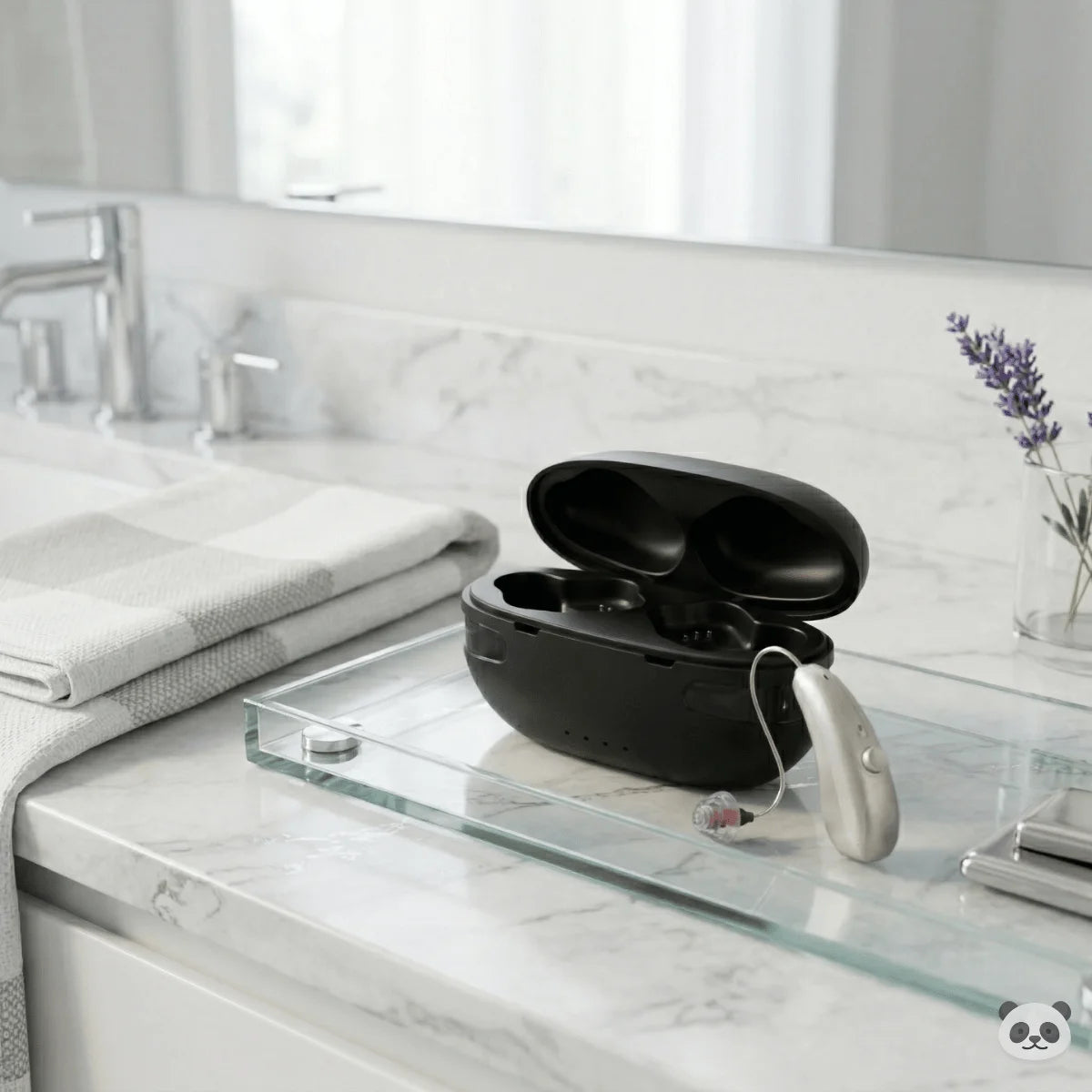
The other open-fit fundamentals are in place too. Soft-start adaptation keeps the device from whistling when you insert it. Bluetooth carries phone calls, TV audio, and music directly into the hearing aids. The rechargeable magnetic case gives you about 20 hours per charge and stores three more full recharges, for roughly 80 hours of total wear between outlet visits. And the 5-year warranty plus 45-day risk-free trial means you have real time to adjust to an open fit, not just a token return window.
Panda Quantum — $349
5-year warranty, 45-day risk-free trial, free shipping. FDA-OTC certified. Includes both open and closed domes in multiple sizes.
See Panda Quantum →Open Ear vs Closed Ear: How to Decide
Most first-time wearers benefit from starting with an open dome and only stepping up to a closed one if they need more amplification. The reason is simple: occlusion is the number-one reason people abandon hearing aids after the first week. Eliminating that hurdle gives your brain time to learn the new sound landscape before you add a closed fit's extra volume.
If your hearing test reveals heavier amplification needs, especially below 1,000 Hz, talk to a professional or use the clinically tuned self-fitting hearing test inside the Panda Quantum setup to dial the device in to a closed dome instead. Same hardware, different dome, very different sound experience.
Not sure which fit is right for you?
Try Panda Quantum risk-free for 45 days — $349Open Ear Hearing Aid FAQs
Are open ear hearing aids better than closed ear hearing aids? Better is the wrong word, the right one is matched. Open ear is generally better for mild to moderate high-frequency hearing loss because it sounds more natural and avoids occlusion. Closed fittings amplify more across all frequencies, which suits moderate-to-severe and flat losses better.
Will an open ear hearing aid fix my hearing loss? No hearing aid fixes hearing loss, open ear or otherwise. What a well-fitted open ear hearing aid does is restore the frequencies you have lost, so conversations are easier to follow and TV sounds balanced again. With a frequency-matched device like Panda Quantum, most people notice the difference inside the first week.
Do I have to see an audiologist to get an open ear hearing aid? Not since the FDA's 2022 OTC rule. If your loss is mild to moderate and you are over 18, you can buy a regulated OTC open-fit hearing aid like Panda Quantum directly and fit it yourself with a 10-minute online hearing test. Audiologist visits remain a good option for severe loss or for people who simply prefer in-person care.
The Bottom Line on Open Ear Hearing Aids
If you have mild to moderate high-frequency hearing loss, an open ear hearing aid is usually the most natural-sounding place to start. The trick is matching the device to your actual hearing test rather than guessing with preset volume levels.
Panda Quantum delivers a clinically tuned open-fit experience at $349, with both open and closed domes in the box, 16-channel processing, adaptive noise reduction, Bluetooth, a 5-year warranty, and a 45-day risk-free trial. It is FDA-OTC certified, no clinic visit required, and the self-fitting hearing test takes ten minutes from your couch.
If you are ready to stop missing the high frequencies of your grandkids' voices, try Panda Quantum today at $349. Forty-five days risk-free. If the open fit is not the upgrade you need, send it back for a full refund, no questions asked.
For more on how Panda handles speech in noisy environments, see the 16-channel hearing aid approach Panda Quantum uses to keep dinner conversations from disappearing into the room.